
Common Sweetleaf (Symplocos tinctoria)
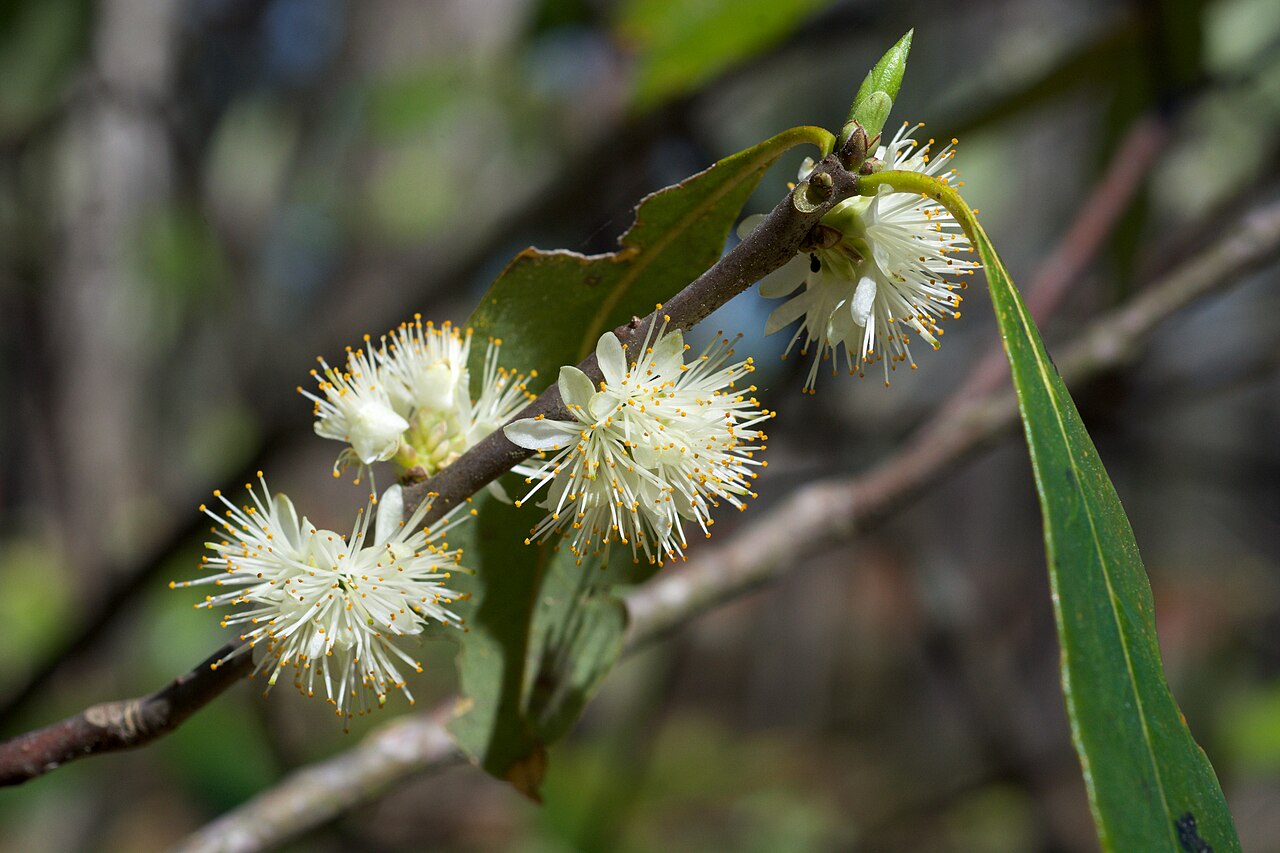
Symplocos tinctoria, known as Common Sweetleaf or Horse-Sugar, is a semi-evergreen understory shrub or small tree of the southeastern Coastal Plain and Piedmont. The common names come directly from its leaves, which taste distinctly sweet and are eagerly browsed by deer, livestock and other wildlife, a trait unusual enough among woody plants that it has shaped both the plant’s folk names and its ecological role.
Common Sweetleaf typically holds at least some of its leathery, yellow-green leaves through winter, especially in the warmer parts of its range, making it a useful semi-evergreen layer in a native woodland garden. It is an unassuming plant most of the year, but in late winter to early spring it produces dense clusters of small, fragrant, fuzzy yellow-cream flowers directly along the bare or nearly bare stems, well before most other understory shrubs bloom.
For gardeners developing the understory layer of a Southeastern woodland or wildlife garden, Common Sweetleaf is a genuinely useful, low-maintenance native: tolerant of shade, valuable to browsing wildlife and early pollinators, and interesting enough in flower and form to merit a spot even though it rarely appears in the mainstream nursery trade.
Identification
Common Sweetleaf is usually a multi-stemmed shrub or small understory tree, most often seen in the 10 to 20 foot range in cultivation and in typical wild stands, though it can reach significantly larger size, to roughly 55 feet tall with a trunk to 14 inches in diameter under the best conditions deep in its range. It is deciduous to semi-evergreen depending on climate, holding more of its foliage through winter in the Deep South and dropping more of it farther north.
Leaves
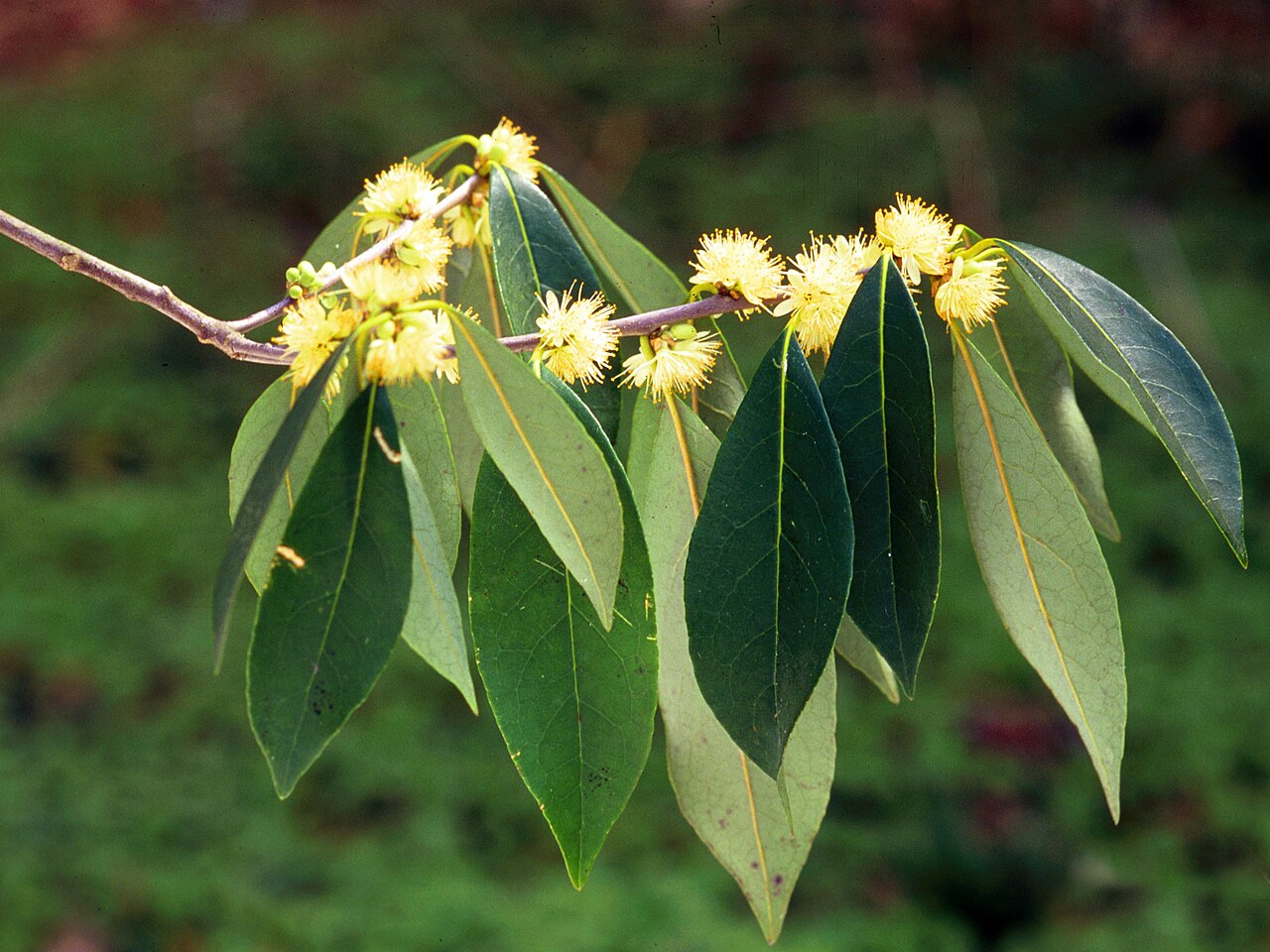
Leaves are alternate, simple, leathery, and elliptic to oblanceolate, with finely toothed to nearly smooth margins. They are dark yellow-green above and noticeably paler, yellowish beneath, with fine hairs on the lower surface; the midrib and petiole often show a distinctive yellow-green tone. The twig pith is chambered, a technical but reliable identification trait, and the foliage is not aromatic when crushed, unlike many superficially similar shrubs. True to the common name, the leaves have a mild, genuinely sweet taste, which is why browsing animals seek them out.
Flowers & Fruit
Flowers emerge in late winter to early spring, in dense axillary clusters along the previous year’s growth, often before or alongside new leaves. Each small flower has a fuzzy, brush-like look from its many slender stamens tipped in yellow to orange anthers, surrounding a short corolla of cream to pale yellow petals; the display is more textural than showy from a distance but striking up close, and is fragrant enough to draw early-season pollinators from some distance. Flowers are followed by small, dry, orange-brown to brown fruits that mature by late summer or fall.
Quick Facts
| Scientific Name | Symplocos tinctoria |
| Family | Symplocaceae (Sweetleaf) |
| Plant Type | Semi-evergreen to deciduous shrub or small tree |
| Mature Height | 10–20 ft typical; to 55 ft in ideal wild conditions |
| Mature Spread | 8–15 ft, often thicket-forming |
| Growth Rate | Slow to moderate |
| Sun Exposure | Part Shade to Shade; tolerates some sun with adequate moisture |
| Water Needs | Moderate; adaptable from moist bottomlands to drier sandhills |
| Soil Type | Sandy to loamy acidic soils; moist woods, sandhills, dune edges |
| Soil pH | Acidic |
| Bloom Time | Late winter to early spring |
| Flower Color | Cream to pale yellow, fragrant |
| Fall Color | Minimal; semi-evergreen to deciduous yellow-green |
| Fruit | Small dry orange-brown drupe |
| Deer Resistant | No — actively browsed; a deer and livestock favorite |
| USDA Hardiness Zones | 7–9 |
Native Range
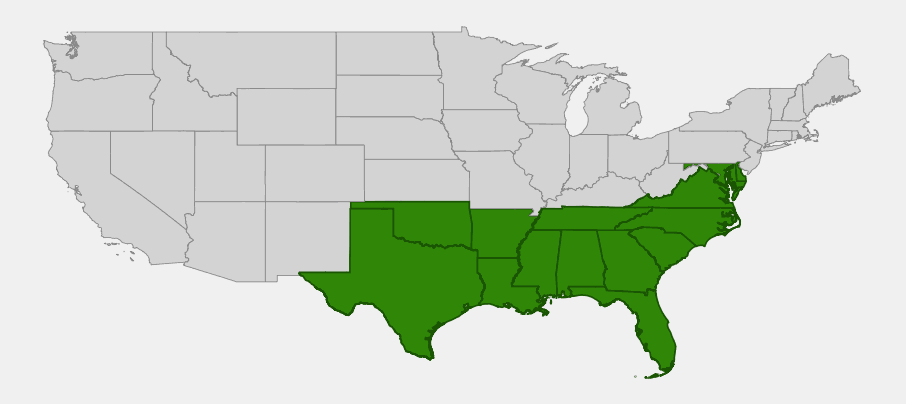
Common Sweetleaf is native to the southern and eastern United States, from eastern Oklahoma and Texas east across the Gulf states to Florida and north along the Atlantic Coastal Plain and Piedmont to Delaware, Maryland and Virginia, with scattered populations reaching into Tennessee. It is the only species of its genus native to North America, with the rest of Symplocos concentrated in East Asia and the tropics.
Within this range it grows in a wide variety of acidic-soil habitats: thin to dense upland woods on slopes and bluffs, broad-leaf woods on sandy soils, stream borders, mesic forests, pocosin edges, pine flatwoods, longleaf pine sandhills, and even stabilized coastal dunes. It is usually scattered rather than dominant, occurring as an occasional understory individual rather than in dense stands, though it can be locally common in favorable sites. The species is considered globally secure, though it has conservation tracking status in a few states at the edges of its range.
📋 Regional plant lists featuring Common Sweetleaf: Delaware, Southern New Jersey & Long Island, Maryland, Virginia & West Virginia, North Carolina & South Carolina, Georgia, Alabama & Mississippi, Kentucky & Tennessee, Arkansas, Louisiana, Eastern Oklahoma & Eastern Texas. This site does not currently publish a dedicated Florida regional list; see the Florida nursery directory below.
Growing & Care Guide
Common Sweetleaf is an easygoing, low-maintenance shrub once sited correctly, asking mainly for acidic soil and some shade rather than special care.
Light
Give Common Sweetleaf part shade to shade for best form and foliage; it is a true understory species in the wild. It will tolerate more sun where soil moisture is reliable, but performs best with at least some overhead canopy protection, especially in the hotter parts of its range.
Soil & Water
This shrub is adaptable across moist bottomland forest edges, mesic woods, drier sandhills and even stabilized dune soils, but it consistently needs acidic soil to thrive. Keep soil evenly moist during establishment; mature plants handle a reasonable range of moisture conditions, from the drier sandhills at one extreme to seasonally moist forest edges at the other, though it is not a true wetland plant.
Planting Tips
Because deer and livestock browse the foliage readily, young plants in areas with deer pressure may need temporary protection until they are established and tall enough to outgrow easy browsing height. Give the plant room to form its natural multi-stemmed, somewhat thicket-like shape, or prune selectively if a more tree-like single-trunk form is preferred. It is slow to moderate in growth, so patience pays off with this species.
Pruning & Maintenance
Minimal pruning is needed; remove dead or damaged wood as it appears and thin congested stems if a more open form is desired. Common Sweetleaf has no major pest or disease issues of note, though its branches can occasionally host leaf galls caused by a fungus in the genus Exobasidium, which are cosmetic and not seriously harmful to the plant.
Propagation
Propagation is typically from seed, which benefits from cold stratification to improve germination, consistent with many woody Southeastern natives that flower in late winter. Because it is uncommon in general commerce, sourcing plants or seed from a native plant specialty nursery is usually necessary.
Landscape Uses
- Woodland understory and native wildlife gardens, where its shade tolerance and browse value are assets rather than drawbacks
- Naturalized thickets and screening in partly shaded areas, given its multi-stemmed, somewhat colonial habit
- Early-season pollinator support, planted alongside other Southeastern understory natives such as Yaupon Holly and Tree Huckleberry
- Restoration plantings on acidic sandy or sandhill sites within its native range
Wildlife & Ecological Value
Common Sweetleaf’s sweet-tasting foliage makes it one of the more actively used browse plants in the Southeastern understory, a trait that shapes its wildlife value more than any other single feature.
For Pollinators
Blooming in late winter and early spring, often before most other understory shrubs, Common Sweetleaf offers an early nectar and pollen source for bees and other early-flying pollinators at a time when little else is in bloom, making it disproportionately valuable in the seasonal pollinator calendar despite its modest individual flowers.
For Mammals
The foliage is relished by white-tailed deer and was historically valued as livestock browse, which is directly reflected in both of its common names. This makes it an excellent choice for a deliberately wildlife-friendly planting, though gardeners in high deer-pressure areas should expect and plan for heavy browsing, especially on young plants.
For Birds
The dry fall fruits provide incidental food for some birds, and the dense, often semi-evergreen branching structure offers year-round cover and nesting habitat in the understory layer, a structural niche that is valuable in mature Southeastern woodlands.
Ecosystem Role
As a widespread but typically scattered understory species across a broad range of Coastal Plain and Piedmont habitats, Common Sweetleaf contributes browse, early-season floral resources and structural diversity to Southeastern forest communities, filling an ecological niche that few other native shrubs occupy in quite the same way.
Cultural & Historical Uses
The common names Sweetleaf and Horse-Sugar directly reference the plant’s sweet-tasting foliage, historically recognized and used as fodder for horses and other livestock by early American settlers. The name Yellowwood and the Latin species epithet tinctoria refer to a yellow dye once extracted from the bark and leaves, a historical use documented in early American botanical references. The bark was also used as a tonic by early settlers, according to historical accounts, though this reflects period practice rather than a current recommendation.
Today Common Sweetleaf is grown almost exclusively by native plant enthusiasts and in restoration plantings rather than general horticulture; despite being a common enough plant across a wide swath of the Southeast, it has historically ranked among the least-cultivated native shrubs of the region, likely because its late-winter flowers and modest stature don’t compete visually with showier garden shrubs, even though its ecological value is considerable.
Frequently Asked Questions
Why is Common Sweetleaf called “Horse-Sugar”?
Its leaves have a genuinely sweet taste, and livestock, especially horses, as well as deer, readily browse them. This distinctive palatability is the source of both the “Sweetleaf” and “Horse-Sugar” common names.
Is Common Sweetleaf evergreen?
It is semi-evergreen to deciduous depending on climate and winter severity. In the warmer, southern parts of its range it typically holds much of its foliage through winter; farther north it behaves more like a deciduous shrub.
Will deer destroy a newly planted Common Sweetleaf?
They can, especially while the plant is young and within easy browsing height. In areas with significant deer pressure, protect new plantings with fencing or cages until the shrub is well established and taller.
When does Common Sweetleaf bloom?
It flowers in late winter to early spring, often before most other understory shrubs, which makes it a valuable early nectar source for bees and other early pollinators.
Does Common Sweetleaf need acidic soil?
Yes, it is consistently found on acidic soils throughout its native range, from sandy Coastal Plain sites to upland Piedmont woods, and performs best when that soil chemistry is maintained in cultivation.

Looking for a nursery that carries Common Sweetleaf?
Browse our regional nursery directories: Alabama to Arkansas, Colorado to Hawaii (includes Georgia & Florida), Kentucky to Montana (includes Louisiana & Mississippi), Nebraska to Oklahoma (includes North Carolina & Oklahoma), and Pennsylvania to Virginia (includes Tennessee, Texas & Virginia). For more ideas, see our guides to woodland garden design with natives and caring for native shrubs.

