
Death Valley Jointfir (Ephedra funerea)
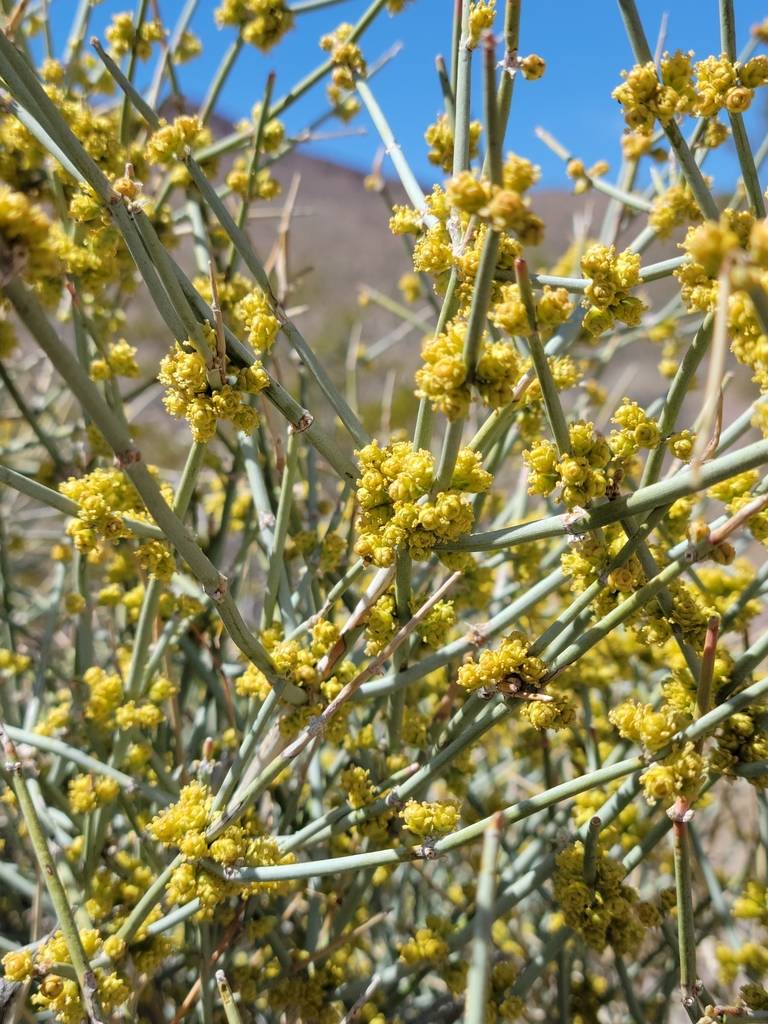
Ephedra funerea, the Death Valley Jointfir (also called Death Valley ephedra or Death Valley Mormon tea), is a stiff, broom-like desert shrub of the northern Mojave Desert. It has almost no visible leaves; instead, its gray-green, jointed stems do the work of photosynthesis. It grows in and around Death Valley in eastern California and southern Nevada, with records in northwestern Arizona, and its species name comes from the Funeral Mountains on the east side of Death Valley.
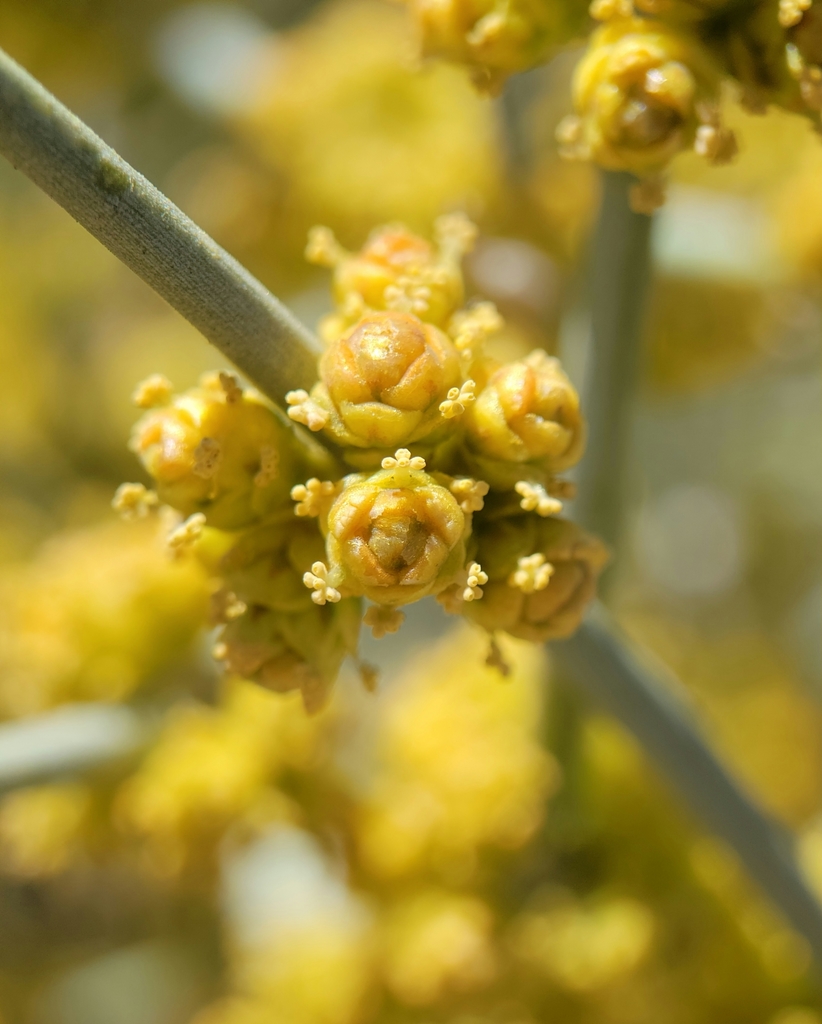
Ephedras are not flowering plants. They are gymnosperms, distant relatives of conifers, and they reproduce with small cones. Plants are male or female: in early spring, male shrubs are covered in yellow pollen cones, and female shrubs bear small seed cones with papery, pale-margined bracts. Death Valley jointfir is one of the toughest shrubs in North America, growing on hot, rocky slopes and gravelly fans where few other plants survive.
This guide covers how to tell it from the more common Nevada and California jointfirs, where it grows, how to use it in a xeriscape or desert garden, and its value to wildlife. It is a specialist plant of a small area and is rarely sold, so treat it as a plant to recognize and admire in the desert first, and grow it only from nursery-raised or legally collected seed.
Identification
Death Valley jointfir is an upright, many-stemmed shrub with rigid, gray-green twigs and tiny scale leaves at each joint. Like other ephedras, it looks like a clump of bare green sticks most of the year.
Stems & Leaves
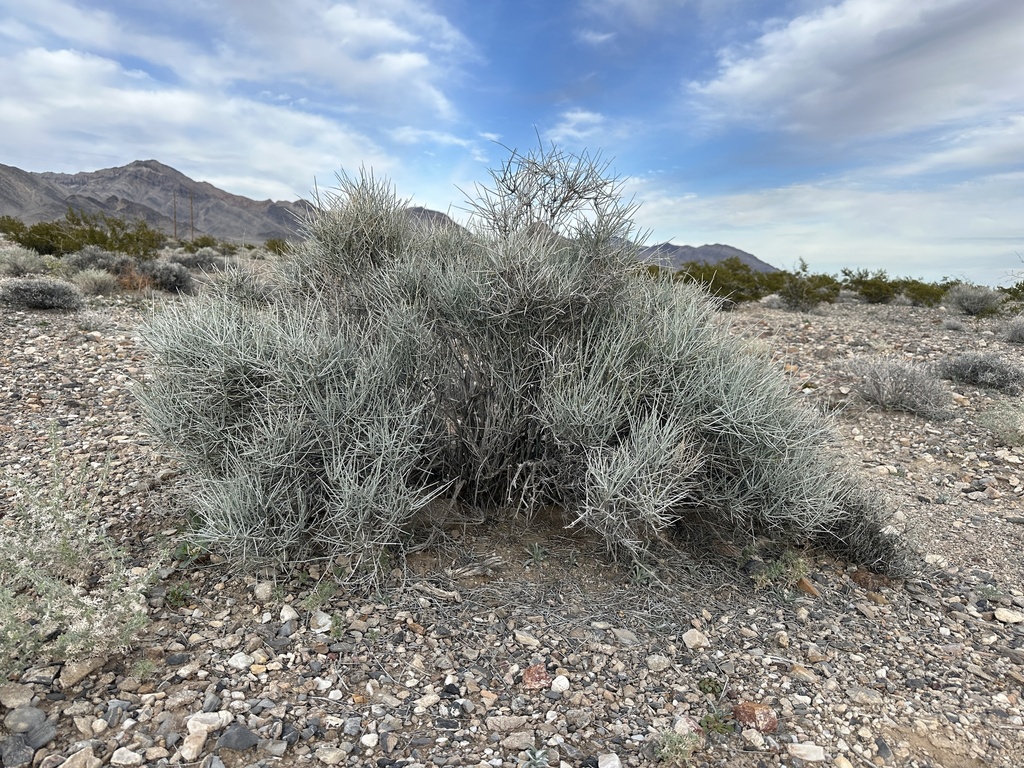
It forms an erect, rounded shrub, usually 2 to 4 feet tall and occasionally to about 5 feet. The twigs are stiff, grooved and jointed, gray-green when young and aging to gray with cracked bark on the older stems. The twigs are rigid and often end in sharp tips. The leaves are reduced to tiny scales, usually in whorls of three at each node, that soon dry and turn gray.
Cones
In March and April, male plants bear clusters of small yellow pollen cones, up to about ⅓ inch long, at the nodes. Female plants bear slightly larger seed cones, either sessile or on short stalks. The seed cone bracts are arranged in threes and have thin, papery, pale margins, which give the cones a frilly look.
Seeds
Each seed cone holds two or three hard seeds, pale green ripening to light brown, which drop in late spring. They are eaten and cached by rodents.
Look-alikes
The two other common jointfirs in its range are Nevada Jointfir, which has leaves and cone bracts in pairs (two per node) rather than threes, and California Jointfir, which also has leaves in threes but has less rigid twigs and usually a single seed per cone. Green Mormon Tea has bright green, erect, broom-like twigs and leaves in pairs. Ephedra identification often requires looking closely at the node leaves and the seed cones.
Quick Facts
| Scientific Name | Ephedra funerea Coville & C.V. Morton |
| Family | Ephedraceae (ephedra family) |
| Plant Type | Evergreen-stemmed gymnosperm shrub |
| Mature Height | 2–4 ft (occasionally to 5 ft) |
| Mature Spread | 2–4 ft |
| Growth Rate | Slow |
| Sun Exposure | Full sun |
| Water Needs | Very low; extremely drought tolerant |
| Soil Type | Rocky, gravelly or sandy, very well drained |
| Soil pH | Neutral to alkaline (about 7.0–8.5) |
| Bloom Time | Cones March–April (no true flowers) |
| Flower Color | Yellow pollen cones; pale green to brownish seed cones |
| Fall Color | None; stems stay gray-green all year |
| Fruit | Small seed cone with 2–3 hard seeds |
| Deer Resistant | Moderate; browsed lightly by bighorn sheep and burros |
| USDA Hardiness Zones | 7–10 |
Native Range
Death Valley jointfir has one of the smallest ranges of any North American ephedra. USDA PLANTS lists it in California, Nevada and Arizona. Most populations are in the northern Mojave Desert in and around Death Valley: the Funeral, Black, Panamint and Grapevine Mountains of Inyo County, California, and the nearby Amargosa Desert, Pahrump Valley and Nye and Clark Counties of southern Nevada. There are also records in northwestern Arizona.
It grows on hot, dry, rocky slopes, alluvial fans, gravelly flats and the edges of washes, often on limestone or other alkaline rock, in creosote bush scrub and mixed desert scrub. These are some of the hottest and driest places in North America, with summer temperatures above 110 °F and only a few inches of rain a year.
Much of its range is protected within Death Valley National Park and surrounding public lands. It is not listed as threatened, but because it occurs in such a small area, it is a good example of the specialized plants of the Death Valley region. Botanists have noted that it shares traits with both Nevada and California jointfir.
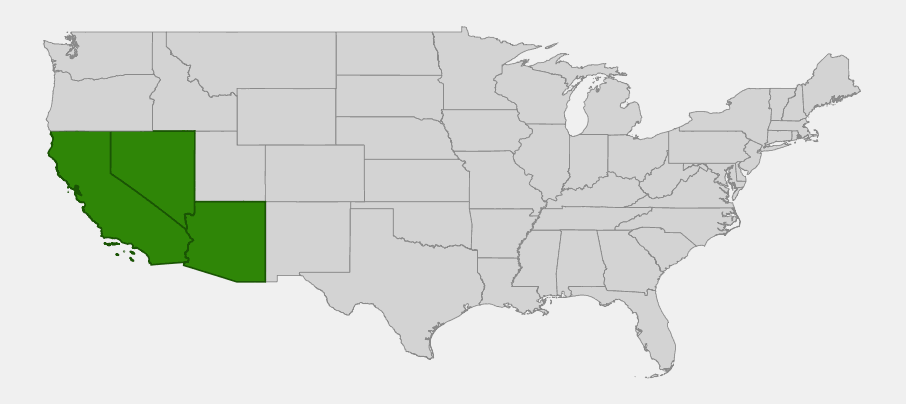
📋 Regional plant lists featuring Death Valley Jointfir: Arizona & New Mexico · California & Nevada
Growing & Care Guide
Death Valley jointfir is rarely offered in the nursery trade, but it can be grown from seed by desert-plant enthusiasts in the Mojave and similar hot, dry climates. Buy nursery-raised plants or seed when you find them, and never dig shrubs from the wild; ephedras have deep roots and do not survive transplanting, and most wild plants are on protected public land.
Light
Full, all-day sun. It tolerates intense reflected heat and is a good choice for the hottest corner of a desert garden.
Soil & Water
Plant in rocky, gravelly or sandy soil with perfect drainage; it tolerates alkaline soil. Water deeply every couple of weeks during the first summer, then rarely or not at all once established. Too much water and heavy soil cause root rot.
Planting Tips
Plant young plants in fall or winter so roots can grow before summer heat. Plant both male and female plants if you want seeds. Space shrubs 3 to 4 feet apart, and use a gravel mulch rather than bark.
Pruning & Maintenance
Very little care is needed. Remove dead stems at the base when needed. Avoid shearing, which ruins the natural broom-like shape. Do not fertilize.
Propagation
Sow fresh seed in fall or early spring in a gritty mix; ephedra seed usually germinates without special treatment, though a short cold stratification can help. Keep seedlings on the dry side to prevent damping off. Plants can also be grown from cuttings with rooting hormone, but success is low.
Landscape Uses
- Xeriscape and desert gardens: a sculptural, nearly maintenance-free shrub
- Rock gardens: gray-green texture among boulders and gravel
- Habitat restoration: revegetation of disturbed northern Mojave sites
- Wildlife gardens: cover and seed for desert birds and rodents
Wildlife & Ecological Value
In the sparse desert scrub around Death Valley, the dense stems of Death Valley jointfir offer shelter and food to many animals.
For Pollinators
Ephedras are mostly wind-pollinated, releasing clouds of pollen in spring. Ants, flies and small bees visit the cones, and female cones produce sugary droplets that insects take, which may help with pollination.
For Birds
Quail, sparrows and other seed-eating birds eat the fallen seeds, and the dense, twiggy shrubs give small birds and lizards cover from predators and heat.
For Mammals
Kangaroo rats, pocket mice and other rodents collect and cache the seeds, which helps plant new shrubs. Desert bighorn sheep, burros and jackrabbits browse the green stems, especially in drought.
Ecosystem Role
As a long-lived, deep-rooted shrub, it stabilizes rocky slopes and desert soils, catches windblown soil and seeds, and creates shaded “islands” under which other desert plants can sprout.
Cultural & Historical Uses
Frederick Vernon Coville, who explored Death Valley with the Death Valley Expedition of 1891, and Conrad Vernon Morton described Ephedra funerea in 1935. The name funerea refers to the Funeral Mountains on the east side of Death Valley, where the species was found. The genus name Ephedra is an ancient Greek name used for a horsetail-like plant.
Native peoples of the desert Southwest, including the Timbisha Shoshone of Death Valley, used ephedra stems to make a tea, and Mormon pioneers and other settlers later adopted it, which is why the shrubs are called Mormon tea, Indian tea or Brigham tea. Safety note: unlike Asian Ephedra sinica, North American ephedras contain little or no ephedrine, but do not use any ephedra as medicine, and anyone with heart conditions, high blood pressure or who is pregnant should avoid it.
Ephedras are an ancient lineage. The family has a fossil record going back more than 100 million years, and with their jointed, nearly leafless green stems they are often mistaken for horsetails. They are among the plants best adapted to the heat and drought of North American deserts.
Frequently Asked Questions
Why is it called Death Valley jointfir?
It grows mainly in and around Death Valley, and its scientific name refers to the Funeral Mountains, where it was first collected. “Jointfir” refers to its jointed stems and its distant relationship to conifers.
Is Death Valley jointfir a flowering plant?
No. Ephedras are gymnosperms, related to conifers. They produce pollen cones and seed cones instead of flowers, and individual shrubs are either male or female.
How can I tell it from Nevada jointfir?
Look at the joints. Death Valley jointfir has its tiny leaves and seed cone bracts in threes, while Nevada jointfir has them in pairs. Death Valley jointfir also has stiffer, often sharp-tipped twigs and two or three seeds per cone.
Can I make Mormon tea from it?
Native peoples and settlers brewed tea from ephedra stems. North American species contain little or no ephedrine, but they are not food-tested, and nobody should use them medicinally. Never harvest plants in Death Valley National Park.
Can I grow Death Valley jointfir?
Yes, in hot, dry climates with very well-drained soil and full sun, if you can find nursery-raised plants or legally obtained seed. It needs almost no water once established. Never dig plants from the wild.

Looking for a nursery that carries Death Valley Jointfir?
Browse our native plant nursery directory: Arizona · California · Nevada

