
California Jointfir (Ephedra californica)
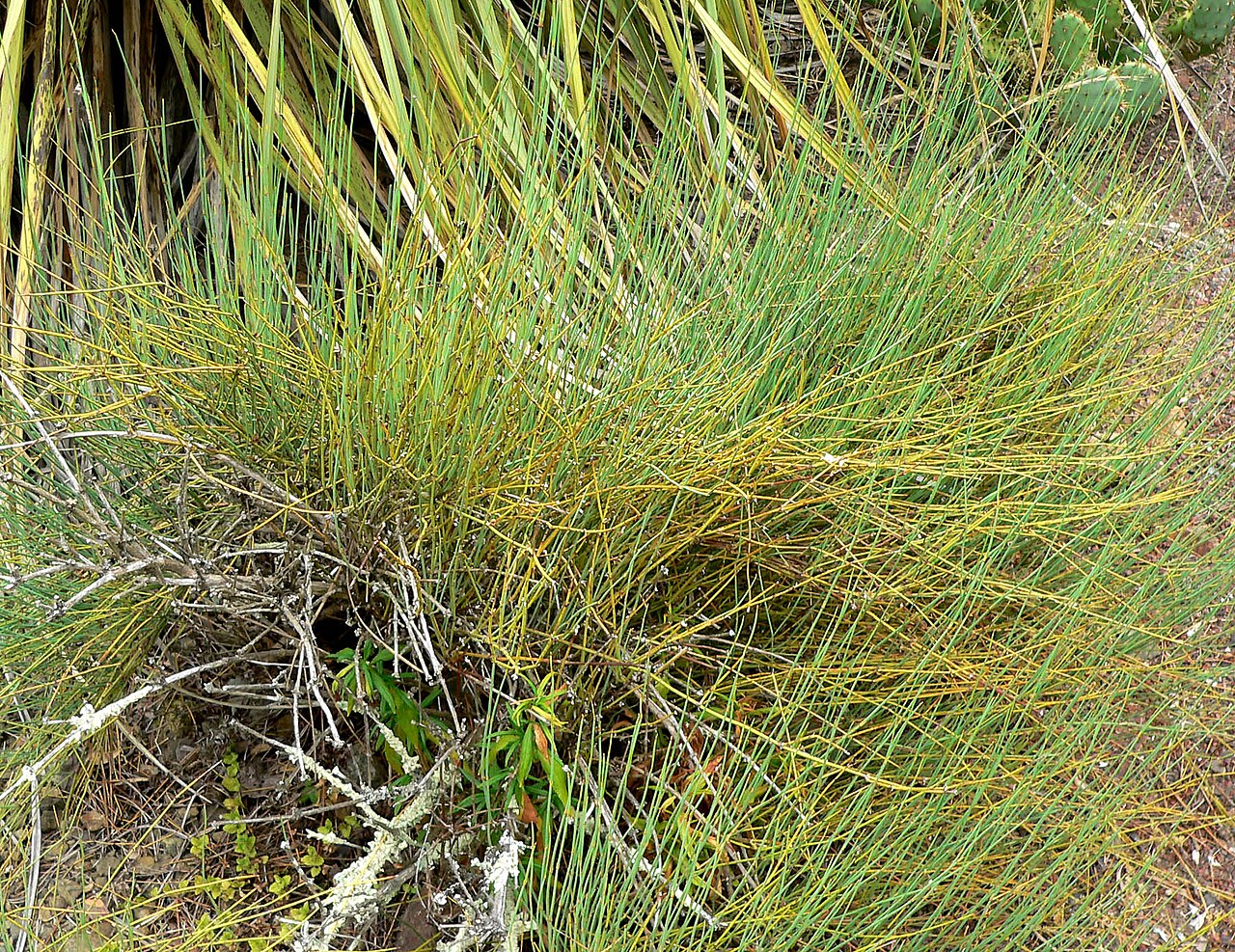
Ephedra californica, known as California Jointfir, California ephedra or desert tea, is a low, broom-like desert shrub made almost entirely of slender green jointed stems. It looks a little like a clump of horsetail or a pile of green knitting needles. The leaves are reduced to tiny scales at the joints, so the stems do the photosynthesis. It is not a flowering plant at all but a gymnosperm, a distant relative of conifers, and it reproduces with small cones instead of flowers.
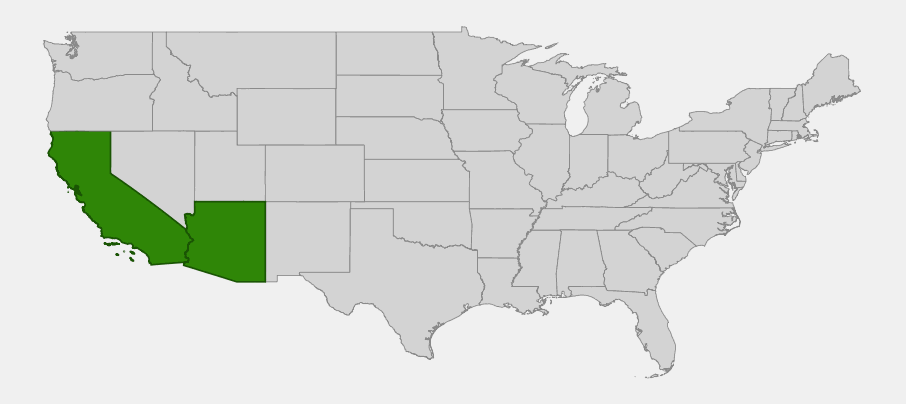
California jointfir is native to California and western Arizona and continues south into Baja California. It grows on dry slopes, gravelly and sandy washes, desert flats, grassland and scrub, from the San Joaquin Valley and the inner Coast Ranges through southern California to the Mojave and Sonoran deserts. It is the only Ephedra that reaches the San Joaquin Valley and the coastal side of southern California.
This guide explains how to identify California jointfir and tell it from the other jointfirs (Mormon teas), where it grows, how to grow it in a dry native garden, what it offers wildlife, and the history of “desert tea.” Like other ephedras, it is related to the Asian plants that are the source of the drug ephedrine, but North American species are reported to contain little or none of it.
Identification
California jointfir is easy to recognize as an Ephedra: a shrub of green, grooved, jointed stems with no obvious leaves. Telling it from other jointfirs takes a closer look at the leaves at the joints and the seed cones.
Stems & Growth Habit
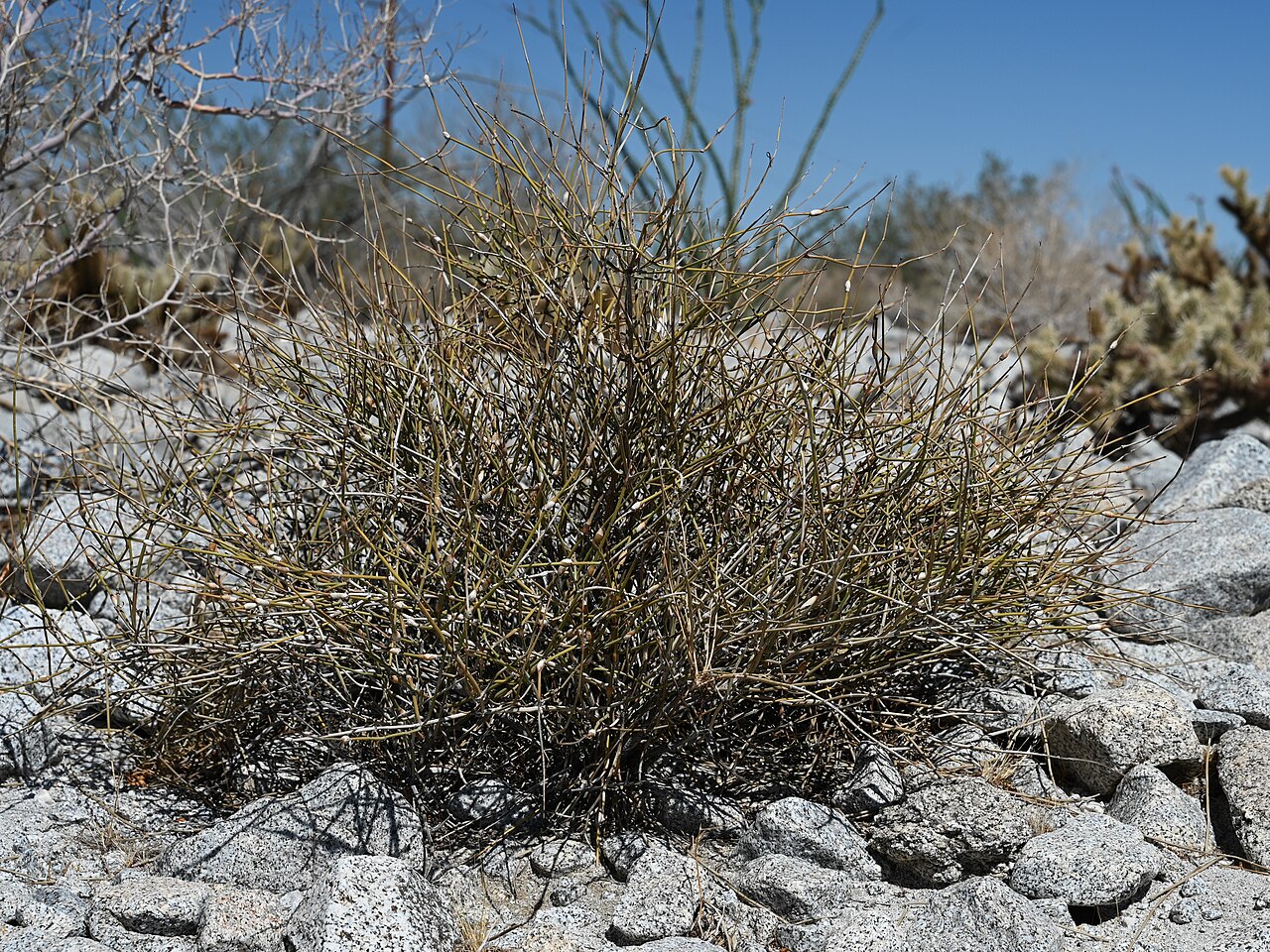
It is a rounded, open to dense shrub usually 1 to 3 feet tall and somewhat wider, sometimes sprawling. The stems are yellow-green to gray-green, finely grooved, and jointed every inch or two. Young stems are bright green and stiff; older stems turn gray and woody near the base. Unlike some jointfirs, the twigs do not end in sharp spines.
Leaves
The leaves are tiny, papery scales, usually in whorls of three at each joint (sometimes in pairs), joined at the base into a short sheath. They soon dry and turn brown, so the plant looks leafless most of the year. Whorls of three leaves help separate it from Nevada jointfir and green Mormon tea, whose leaves are in pairs.
Cones
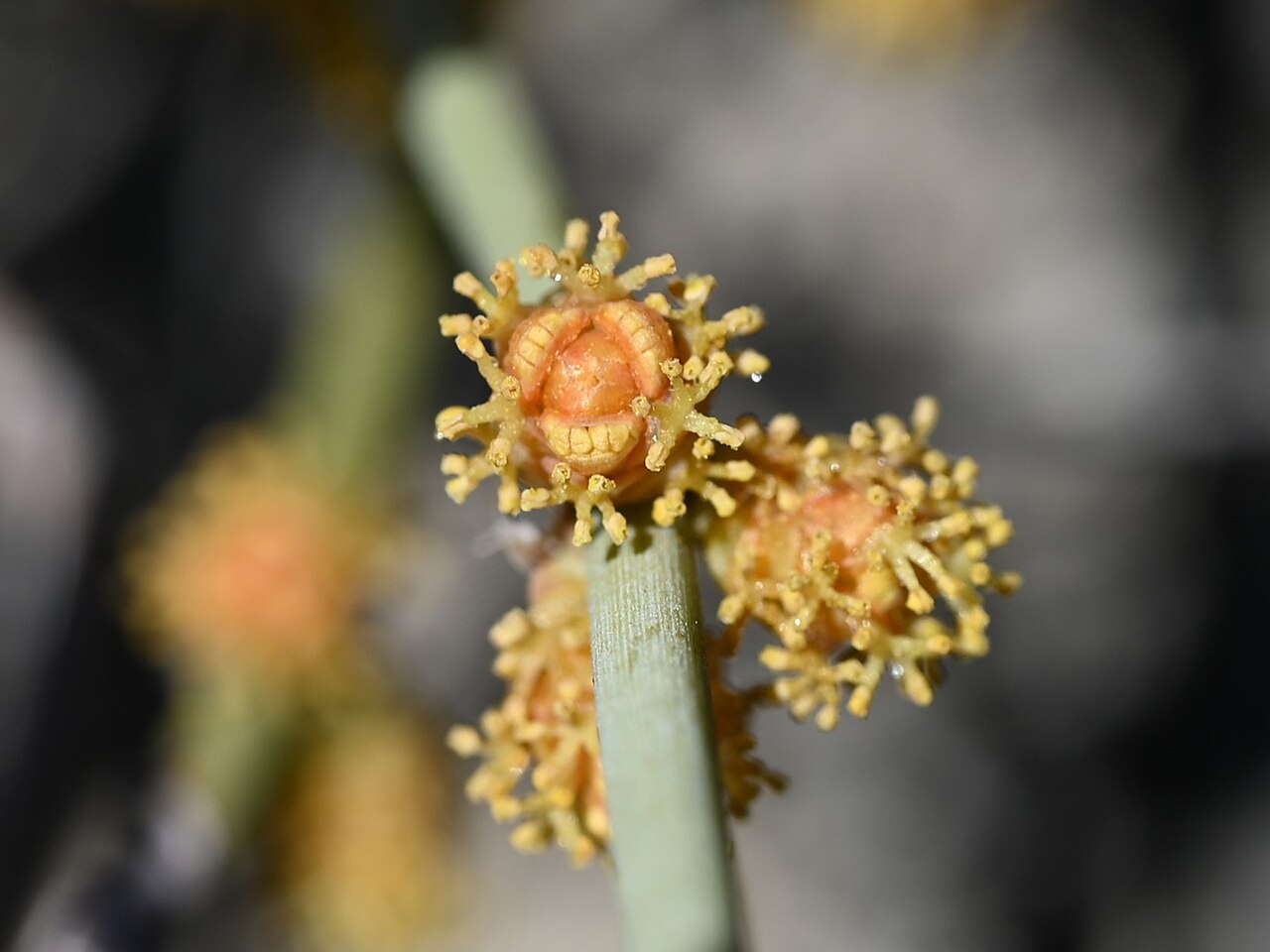
Jointfirs are dioecious: male and female cones grow on separate plants. Male (pollen) cones appear at the joints in late winter and spring, small and oval, with yellow anthers sticking out between the bracts. Female (seed) cones are small and greenish to pale, and their bracts in whorls of three have thin, papery, translucent wings, a feature of the section of Ephedra it belongs to.
Seeds
Each seed cone usually holds a single smooth, brown seed (occasionally two). The seeds ripen in late spring and early summer and are an important food for desert rodents and birds.
Similar Species
Several other jointfirs grow in the Southwest. Nevada Jointfir and Green Mormon Tea have leaves in pairs. Longleaf Jointfir (Ephedra trifurca) also has leaves in threes but has sharp, spine-tipped twigs and larger plants, while Texas and Oklahoma Clapweed (Ephedra antisyphilitica) has leaves in pairs and fleshy red seed cones. In the field, the single seed per cone, the papery-winged cone bracts and the location help confirm California jointfir.
Quick Facts
| Scientific Name | Ephedra californica S. Watson |
| Family | Ephedraceae (jointfir family, a gymnosperm) |
| Plant Type | Low evergreen-stemmed desert shrub |
| Mature Height | 1–3 ft |
| Mature Spread | 2–4 ft |
| Growth Rate | Slow |
| Sun Exposure | Full sun |
| Water Needs | Very low; drought tolerant once established |
| Soil Type | Sandy, gravelly or rocky, well-drained soil |
| Soil pH | About 6.5–8.5 |
| Bloom Time | Cones March–May (no flowers) |
| Flower Color | None; pollen cones yellow, seed cones pale green |
| Fall Color | None; green stems all year |
| Fruit | Small seed cones with papery bracts, usually one seed |
| Deer Resistant | Moderate; browsed by deer and livestock at times |
| USDA Hardiness Zones | 8–11 |
Native Range
USDA PLANTS lists California jointfir as native in two states, California and Arizona. In California it ranges from the southern San Joaquin Valley, the Carrizo Plain and the inner South Coast Ranges through the Transverse and Peninsular ranges, the coastal sage scrub of southern California, and the Mojave and Colorado (Sonoran) deserts. In Arizona it is found in the western and southwestern deserts.
It grows on dry, open ground: gravelly and sandy washes, alluvial fans, rocky desert slopes, valley grassland, saltbush scrub, creosote bush scrub and coastal sage scrub. Most populations are below about 3,500 feet (roughly 1,100 m), lower than many other jointfirs.
Beyond the United States, its range extends south into Baja California, Mexico. It does not reach Canada.
📋 Regional plant lists featuring California Jointfir: Arizona & New Mexico · California & Nevada
Growing & Care Guide
California jointfir is an unusual, sculptural shrub for desert and dry Mediterranean gardens. It is grown mostly by native plant enthusiasts and is sold occasionally by California native nurseries and native plant society sales. Once established it needs almost no care, and its green stems give year-round color where most desert shrubs turn gray in summer.
Light
Plant it in full sun. In shade it becomes thin and floppy.
Soil & Water
Give it sandy, gravelly or rocky soil with excellent drainage. It tolerates alkaline soils. Water deeply every couple of weeks during its first summer, then little or not at all in desert and inland gardens; occasional deep water in a very dry summer is enough. Overwatering and heavy clay are the main causes of failure.
Planting Tips
Plant in fall or winter so the roots establish with the rains. Space plants 3 to 4 feet apart. It looks best in groups among boulders, on dry slopes, or in a gravel garden with cacti, yuccas and desert wildflowers. To get seeds, you need both male and female plants.
Pruning & Maintenance
No regular pruning is needed. Remove old gray, dead stems from the base if the clump looks untidy. Avoid fertilizer and summer irrigation, which make it leggy and short-lived.
Propagation
Grow it from fresh seed sown in fall or winter in a gritty, well-drained mix; germination is usually best in cool weather. Seedlings are slow. Plants can also be started from layered stems or from rooted basal shoots, but cuttings root poorly.
Safety Note
North American jointfirs have traditionally been brewed into “desert tea” or “Mormon tea.” Unlike Asian Ephedra species, they are reported to contain little or no ephedrine, but the tea can still be astringent and its safety has not been well studied. Don’t drink it if you are pregnant, have heart or blood pressure problems, or take stimulant medications, and never use ephedra products as a diet or energy supplement.
Landscape Uses
- Desert and xeriscape gardens: a year-round green accent among boulders, cacti, yuccas and desert wildflowers
- Dry slopes and erosion control: its spreading clumps and deep roots help hold sandy and gravelly soil
- Habitat gardens: cover and seeds for lizards, quail, sparrows and desert rodents
- Restoration: desert, grassland and coastal sage scrub restoration in southern and central California
- Containers and sculptural plantings: its bundle of jointed stems is an unusual texture in large pots and modern gravel gardens
Wildlife & Ecological Value
California jointfir is modest-looking, but in desert and scrub communities it provides food and cover through the year.
For Pollinators
Ephedras are mostly wind-pollinated, but their cones produce pollination droplets and attract insects. Flies, small bees and other insects have been seen visiting Ephedra cones and feeding on the sugary droplets.
For Birds
Quail, sparrows and other ground-feeding birds eat the seeds, and the dense, stiff stems give small birds and lizards shelter from hawks and the sun.
For Mammals
Kangaroo rats, pocket mice and other rodents gather and cache the seeds. Deer, bighorn sheep and livestock browse the green stems, especially in winter when little else is green.
Ecosystem Role
Its clumps trap windblown sand and leaf litter, creating small “islands” of richer soil and shade under which annual wildflowers and seedlings can establish. The plant is also part of the habitat of rare San Joaquin Valley animals such as the blunt-nosed leopard lizard and kangaroo rats.
Cultural & Historical Uses
Indigenous peoples of California and the Southwest brewed the stems of local jointfirs into a tea used as a beverage and as a remedy for colds, kidney complaints and other ailments. Seeds of some species were roasted and ground into flour.
Early settlers learned the custom, and names such as Mormon tea, Brigham tea, miner’s tea and desert tea all come from this use. The genus also includes Asian ma huang (Ephedra sinica), the plant from which the drug ephedrine was first isolated; North American species are reported to contain little or none of it.
Jointfirs belong to the Gnetales, an ancient group of gymnosperms with only three living genera. Ephedra fossils go back more than 100 million years, making California jointfir a living link to a very old plant lineage.
Frequently Asked Questions
Is California jointfir the same as Mormon tea?
It is one of several Ephedra species called Mormon tea or desert tea. California jointfir is the species of the San Joaquin Valley, southern California and the low deserts of California and Arizona. Green Mormon tea (E. viridis) and Nevada jointfir (E. nevadensis) are different species with leaves in pairs.
Does California jointfir contain ephedrine?
North American jointfirs are reported to contain little or no ephedrine, unlike the Asian species used to make the drug. Its tea is still not a safe weight-loss or energy product, and people with heart conditions or who are pregnant should avoid it.
Does California jointfir have flowers?
No. It is a gymnosperm, related to conifers. Male plants produce small yellow pollen cones and female plants produce small seed cones in spring.
How do I grow California jointfir?
Plant it in full sun in sandy or gravelly, fast-draining soil, water it through its first summer, then let it live on rainfall. It is very drought tolerant and fails mostly from overwatering or poor drainage.
What eats California jointfir?
Desert rodents and ground birds such as quail eat the seeds, and deer, bighorn sheep and livestock browse the green stems.

Looking for a nursery that carries California Jointfir?
Browse our native plant nursery directory: Arizona · California

