Desert Marigold (Baileya multiradiata)
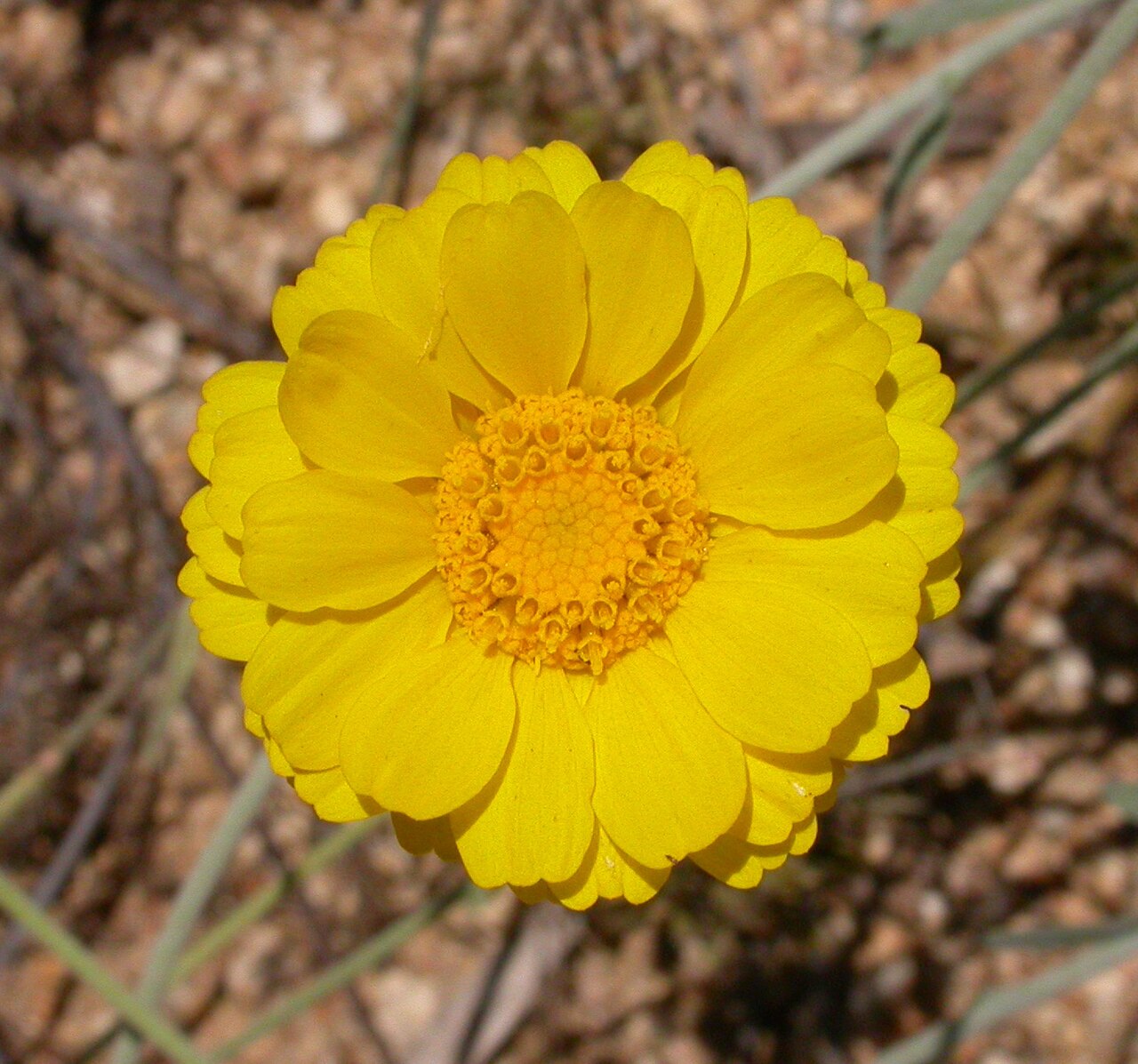
Desert marigold brings bright yellow flower heads above a low mound of pale, woolly foliage. Its airy stalks let a gravel garden remain visually open, rather than turning it into a dense bed of leaves. This is a plant of southwestern deserts and dry adjoining country, where rainfall and temperature determine when flowers appear and how long an individual survives.
The common name does not make this a Tagetes bedding marigold. Baileya multiradiata is a native member of the sunflower family with a different growth pattern and site requirement. It may behave as an annual, biennial or short-lived perennial. A lasting planting is often a succession of seedlings and established plants, not one original clump living indefinitely.
For Utah gardeners, desert marigold belongs principally in the warm, dry part of the state and appropriate similar sites. Its appearance in the Utah and western Colorado regional list does not establish Colorado nativity: Colorado is outside the native-state distribution used here. Select this species for a sunny, freely drained site rather than assuming that every plant in a combined regional list fits every location.
Identification
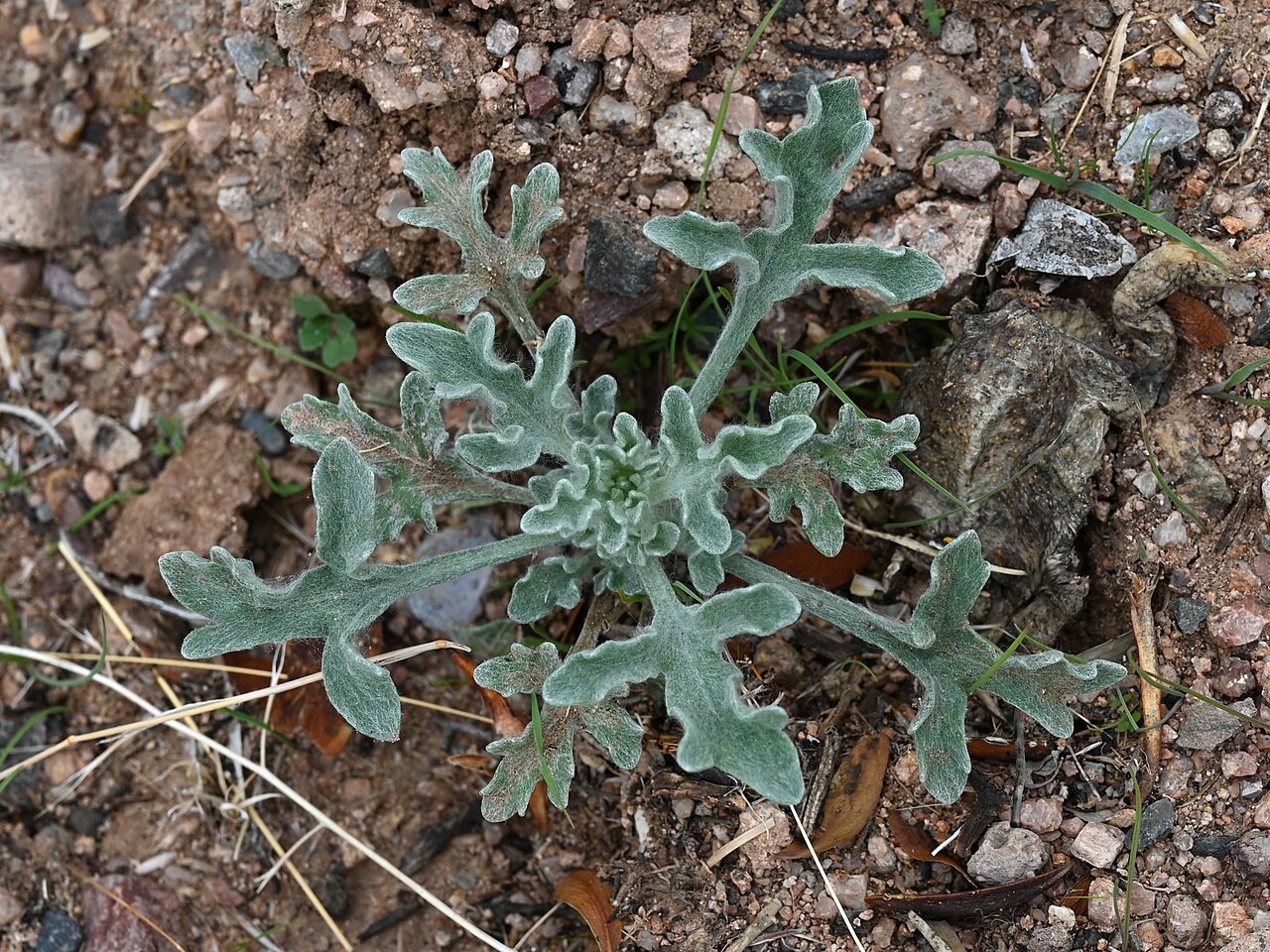
Woolly gray foliage
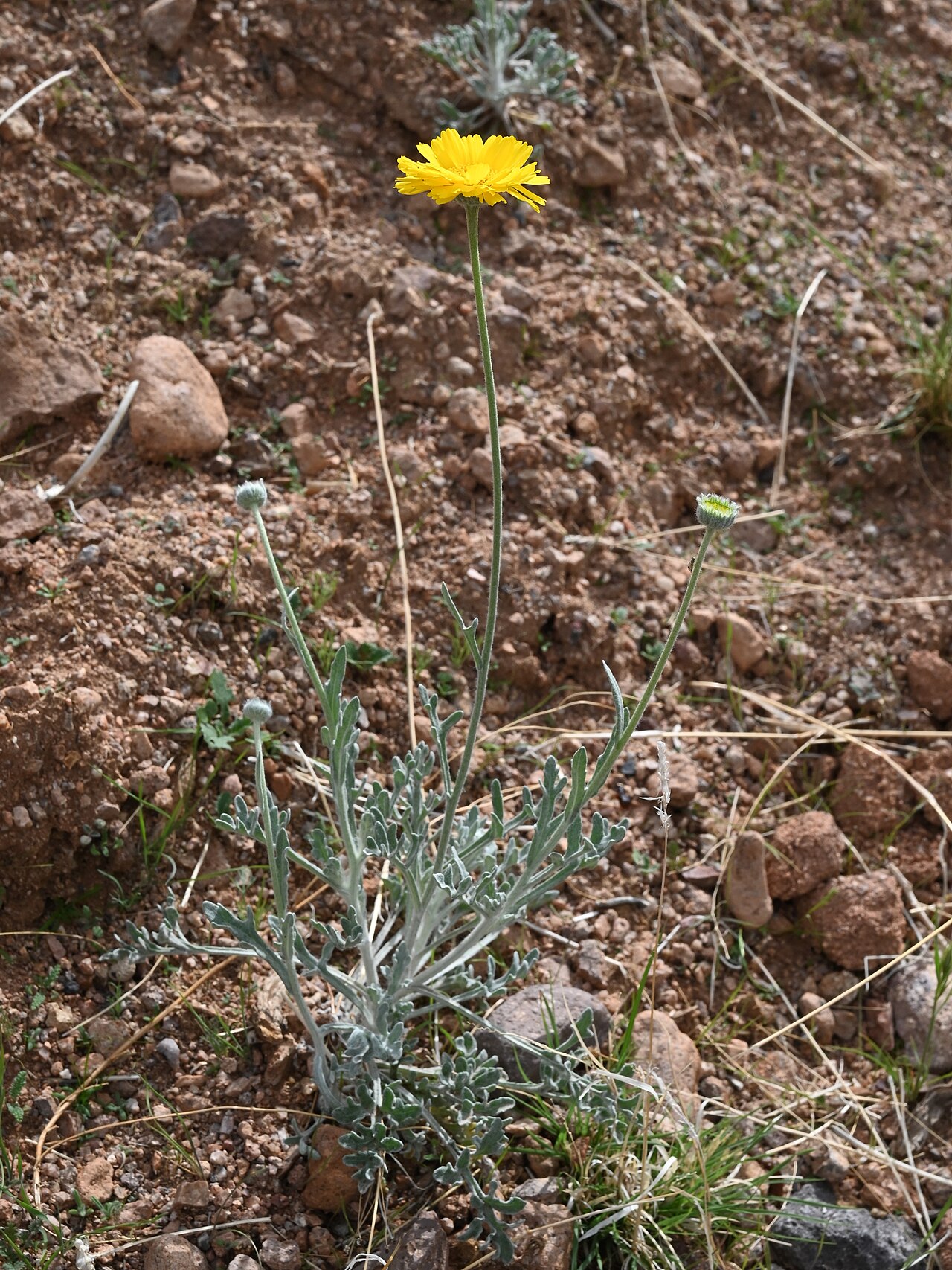
The whitish hairs on the leaves and stems are a useful identification feature. Most leaves form a basal rosette or occur on the lower portions of the stems. They are often lobed or divided, with the smaller stem leaves arranged alternately. The foliage looks gray to silvery in strong light, contrasting with the clear yellow flower heads.
Yellow composite flower heads
Each apparent flower is a head made of many small flowers. Broad yellow ray florets surround a central disk of tiny yellow florets; the rays may overlap in several ranks and have toothed tips. Heads can approach two inches across in favorable plants. Count neither size nor ray number as a single decisive character, because growing conditions affect both.
Long, relatively bare flower stalks
Flower heads rise on elongated stalks well above much of the foliage. This gives the plant its open appearance and helps distinguish it from a densely leafy bedding marigold. Several stalks can branch from a plant, so a single individual can carry fresh flowers, older heads and developing seed at once.
Fruit and seasonal appearance
After flowering, the heads produce small ribbed achenes. University of Arizona descriptions note the absence of a pappus, the feathery or bristly attachment familiar on many other sunflower-family seeds. Spent heads and a sparse rosette are normal stages, not automatic evidence that a plant needs fertilizer or daily water.
Separating similar desert marigolds
Baileya pleniradiata is a real lookalike, not another name for this species. University of Arizona keys contrast its more leafy upper stems and shorter flower stalks with the longer, relatively bare stalks of B. multiradiata. Examine a whole plant with leaves and stems, not only a close-up of a yellow head. Nursery labels should give the full scientific name.
Quick Facts
| Scientific Name | Baileya multiradiata |
| Family | Asteraceae |
| Plant Type | Annual, biennial or short-lived perennial wildflower |
| Mature Height | Usually about 8–24 inches; smaller plants occur on harsh sites |
| Mature Spread | A small basal clump with branching flower stalks; allow roughly a foot or more |
| Growth Rate | Relatively quick flowering; individual plants may be short-lived |
| Sun Exposure | Full sun |
| Water Needs | Low after establishment; seasonal rain strongly influences flowering |
| Soil Type | Well-drained sandy or gravelly soils; avoid persistently wet roots |
| Soil pH | Adapted to desert soils; drainage matters more than a narrow pH target |
| Bloom Time | Spring through fall in favorable conditions, often in rain-driven flushes |
| Flower Color | Bright yellow flower heads |
| Fall Color | No dependable autumn foliage display; flowering may continue in mild weather |
| Fruit | Small ribbed achenes without a feathery pappus |
| Deer Resistant | Do not assume reliable deer resistance; protect new plants where browsing occurs |
| USDA Hardiness Zones | Choose stock suited to the local desert climate; no universal zone range is assigned here |
Native Range
The native U.S. range used for this map comprises Arizona, California, Nevada, New Mexico, Texas and Utah. Kew also records native Mexican distribution. These are state-level outlines: a green state is not a claim that the species occurs in every county, habitat or elevation within that state.
Open sandy and gravelly ground, washes and desert plains are characteristic habitats. Arizona descriptions commonly place it between roughly 2,000 and 5,000 feet, while records elsewhere reflect their own local climates. A warm southern Utah garden and a cold mountain garden in the same state are very different horticultural settings.
Desert wildflower displays respond strongly to rain. A population can be inconspicuous in a poor year and conspicuous after favorable moisture. The native-range map should therefore be read together with the habitat description, not as a prescription to irrigate until a plant flowers continuously. Colorado is deliberately unshaded in this treatment.
Native Range at a Glance
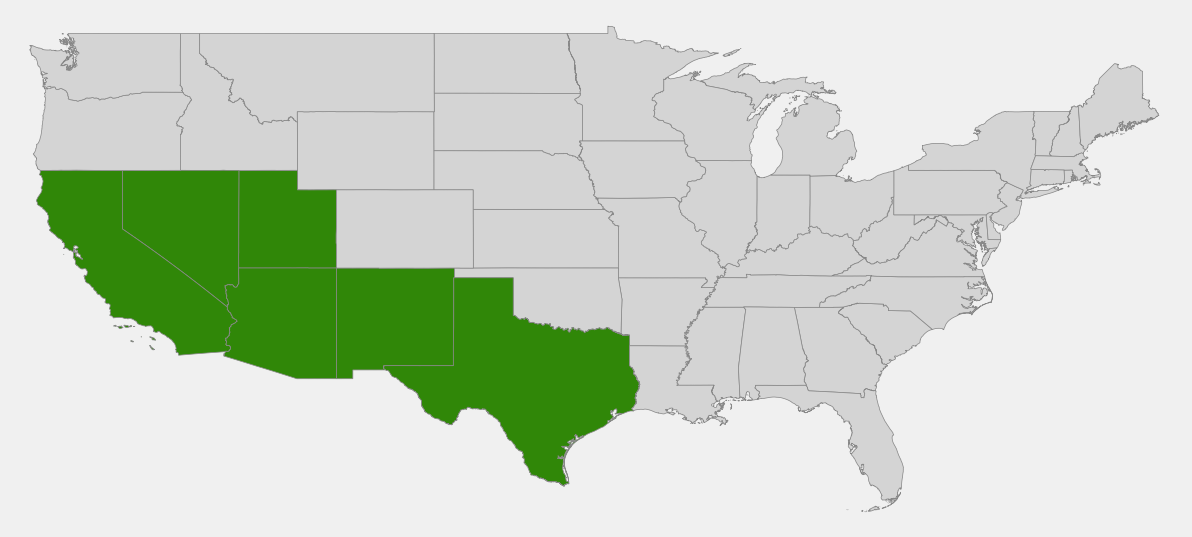
| U.S. States | Arizona, California, Nevada, New Mexico, Texas, Utah |
| Mexico / Canada / Other Range | Native in parts of northern and western Mexico |
| Ecoregion | Southwestern desert and adjoining dry grassland landscapes |
| Elevation Range | Arizona accounts commonly report about 2,000–5,000 feet; not a universal range limit |
| Habitat | Sandy or gravelly plains, washes, arroyo outwash and open disturbed ground |
| Common Associates | Locally appropriate desert shrubs, grasses and other open-ground wildflowers |
Explore our regional native-plant lists: UT regional list. These lists cover several states; each species has its own native range.
Growing & Care Guide
Choose sun and drainage first
Use a sunny position with a root zone that drains freely. A mineral surface and open spacing suit its natural form. Avoid placing it at the low point of a heavily irrigated lawn or in a basin that stays wet after irrigation. In compacted ground, correcting the site is more useful than adding rich material only inside a small planting hole.
Plant without burying the crown
Set nursery-grown stock at the depth at which it was growing, keeping the crown above any accumulating mulch. Water the root ball and surrounding soil at planting, then monitor moisture while roots establish. A tiny plug and a mature wild plant have different reserves; drought adaptation does not mean a newly planted root ball can be left completely dry.
Water for establishment, not perpetual lushness
Once established, reduce supplemental water according to soil, season and rainfall. Let the root zone lose excess moisture between waterings. Continuous wetness is a poor match for a desert taprooted plant. If flowering pauses during adverse weather, first consider its normal seasonal rhythm instead of immediately increasing irrigation.
Manage a short-lived population
Keep some mature heads if you want natural recruitment, and learn to recognize the woolly seedlings before weeding. Other heads may be removed for tidiness. Leave small patches of open soil where seedlings can emerge; thick organic mulch can prevent successful recruitment. A mix of ages is usually a more realistic goal than preserving every old individual.
Grow from responsibly sourced seed
Buy correctly labeled, regionally appropriate seed rather than collecting from protected land. Germination can vary substantially among seed lots. University of Arizona trials found a response to stratification in one tested lot, but that result is not a universal percentage or a complete recipe for every seed source. Follow the supplier’s tested treatment and keep records of your own conditions.
Watch plant condition before treating problems
Sparse foliage and old dry stalks may reflect age or weather rather than a pest. Check drainage, recent irrigation and the crown before applying products. Do not assume an unknown yellow-flowered seedling is desert marigold merely because it appeared nearby. When replacing a failed plant, correct the cause and verify the identity rather than repeating the same planting conditions.
Landscape Uses
- Sunny, low-water wildflower areas within its regional climate.
- Open gravel gardens with space for the silvery basal foliage.
- Small pollinator plantings combined with other locally native bloom seasons.
- Naturalistic plantings that allow seedlings to replace short-lived individuals.
Wildlife & Ecological Value
For Pollinators
The flower heads offer many small florets in a compact landing area. The National Park Service includes desert marigold in southwestern pollinator planting guidance. Its value is best supported by allowing flowers to remain accessible and avoiding broad insecticide use, rather than promising a particular specialist bee or butterfly that has not been documented here.
For Birds
A planting that retains seed heads provides more structural and seasonal variety than one stripped of every spent bloom. This page does not identify an obligate bird association or guarantee seed consumption by a named species. Pairing small wildflowers with native shrubs and grasses adds cover and nesting structure that desert marigold alone cannot supply.
For Mammals
Desert gardens can experience browsing and digging, especially around newly watered plants. No blanket deer-proof claim is made here. Protect establishment where necessary, but retain wildlife access to the wider planting when practical. This ornamental guide is not a forage or livestock-feeding recommendation.
Ecosystem Role
Its ecological role includes occupying open, well-drained ground and responding to favorable moisture with flowers and seed. A garden can preserve part of that dynamic by allowing a little exposed mineral soil and seedling turnover. Dense shade, continual irrigation and deep mulch change the habitat rather than simply improving it.
Cultural & Historical Uses
The name desert marigold links the plant visually to familiar yellow garden flowers, but its botanical identity is distinct. Reading a scientific label prevents accidental substitution with a bedding marigold or another Baileya species. This is especially useful when exchanging seed, because a common name alone is not enough to preserve identity.
University and national-park accounts emphasize its place in southwestern wildflower landscapes. Those descriptions are more useful for gardening than an unsupported claim that it flowers without interruption or never needs replacement. The practical lesson is to work with seasonal rainfall, short life spans and seed recruitment.
No edible or medicinal use is recommended by this page. Traditional-use claims require their own careful documentation and should not be inferred from the word marigold. Obtain nursery-grown plants or responsibly produced seed, and leave wild populations and protected-site seed heads undisturbed.
Frequently Asked Questions
Is desert marigold a perennial?
It may be annual, biennial or short-lived perennial depending on conditions. Plan for renewal from seedlings rather than assuming a permanent clump.
Is it native to Colorado?
Colorado is not included in the current Kew native distribution used here. It appears in a combined Utah and western Colorado list, but that regional grouping is not a state-by-state nativity statement.
Will it bloom all summer?
It can bloom across a long season in favorable conditions, but rainfall, temperature and plant age cause pauses. “Spring through fall, often in flushes” is more accurate than a guarantee of continuous bloom.
Why are the leaves gray?
The leaves and stems are covered in pale woolly hairs. Gray foliage is a normal identification feature, not necessarily mildew or nutrient deficiency.
Should I mulch it deeply?
Keep the crown free of piled material and allow some open ground if you want seedlings. Deep organic mulch and a constantly wet crown are poor matches for this desert plant.
Sources & Further Reading
- Kew Plants of the World Online: identity, synonyms and native distribution
- USDA PLANTS profile
- University of Arizona: Baileya multiradiata identification
- University of Arizona: lookalike Baileya pleniradiata
- University of Arizona: restoration seed germination research
- National Park Service: Death Valley wildflowers
- National Park Service: Tonto wildflowers
- Utah State University: Washington County perennials
- National Park Service: southwestern pollinator plants
Find Native Plants Near You
Ask a native-plant nursery for correctly identified, nursery-propagated stock and information about regional provenance. Match the plant to your site rather than collecting it from a wild population.