
Eastern Prairie Fringed Orchid (Platanthera leucophaea)
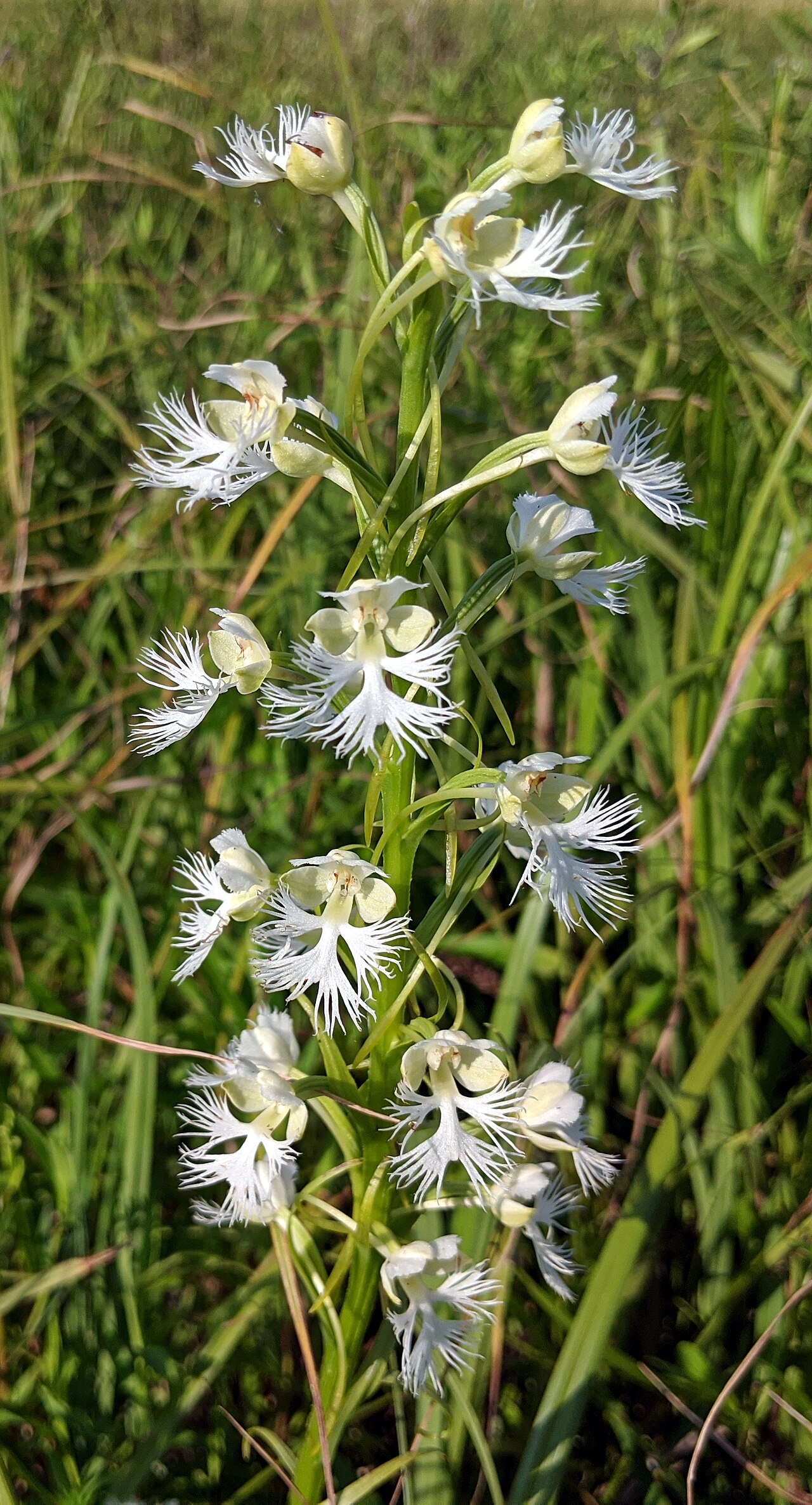
Platanthera leucophaea, the Eastern Prairie Fringed Orchid (USDA: prairie white fringed orchid; formerly Habenaria leucophaea), is one of the most striking and rarest orchids of the Midwest. In early summer it sends up a spike of up to 40 creamy white, fragrant flowers, each with a lip so deeply fringed that it looks like lace. Its flowers open at night and are pollinated by hawkmoths.
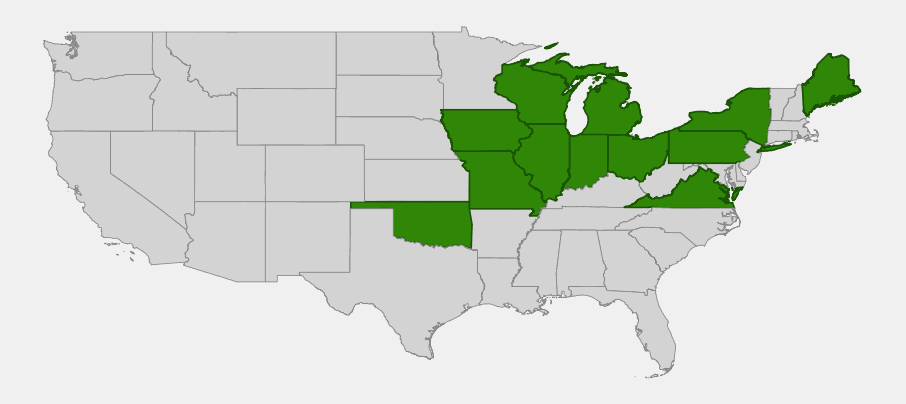
This orchid once grew in wet prairies, sedge meadows and fens across the Great Lakes region and beyond, but most of that habitat was plowed, drained or overgrown. It is listed as threatened under the U.S. Endangered Species Act (since 1989) and as endangered in Canada. According to the U.S. Fish and Wildlife Service, it now occurs in Illinois, Indiana, Iowa, Maine, Michigan, Missouri, Ohio and Wisconsin, and possibly Virginia; USDA PLANTS also lists New York, Pennsylvania and Oklahoma, where it is known only from historical records.
This page is an identification and appreciation guide. It is protected by law, and it cannot be grown from nursery stock in home gardens. Never dig, pick or collect this orchid or its seeds; transplanted plants die, and every wild plant matters to its recovery. The best way to help it is to support prairie and wetland conservation.
Identification
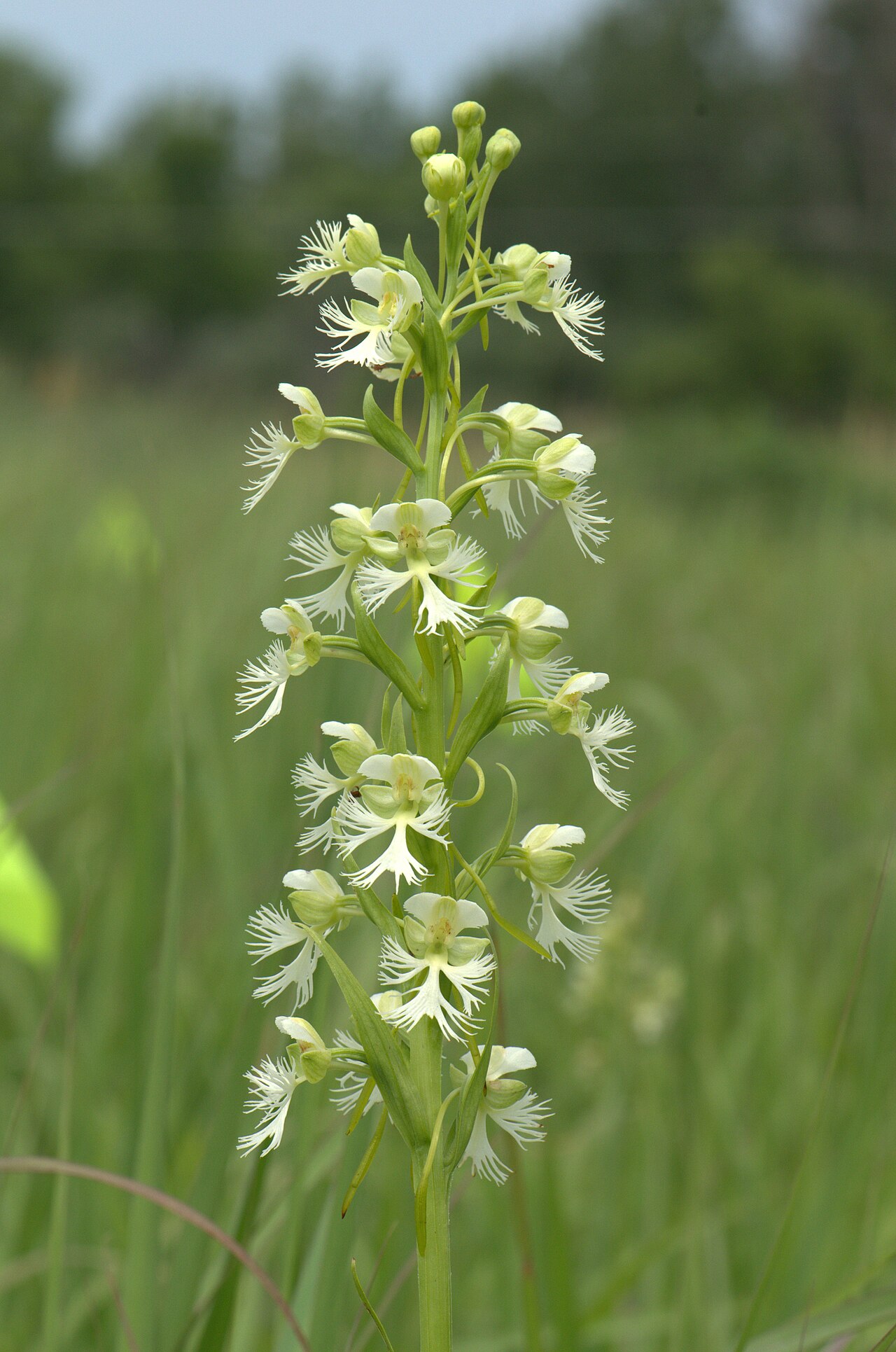
Eastern prairie fringed orchid is a tall, single-stemmed orchid with a few long, keeled leaves and a cylindrical spike of white flowers with deeply fringed lips. It blooms from late June to mid-July.
Stems & Leaves
A smooth, stout stem 8 to 40 inches tall (usually 1 to 3 feet) grows from a fleshy, tuberous root. The stem carries 3 to 6 lance-shaped, keeled leaves that clasp the stem and become smaller toward the top. The leaves are smooth, green and up to about 8 inches long.
Flowers
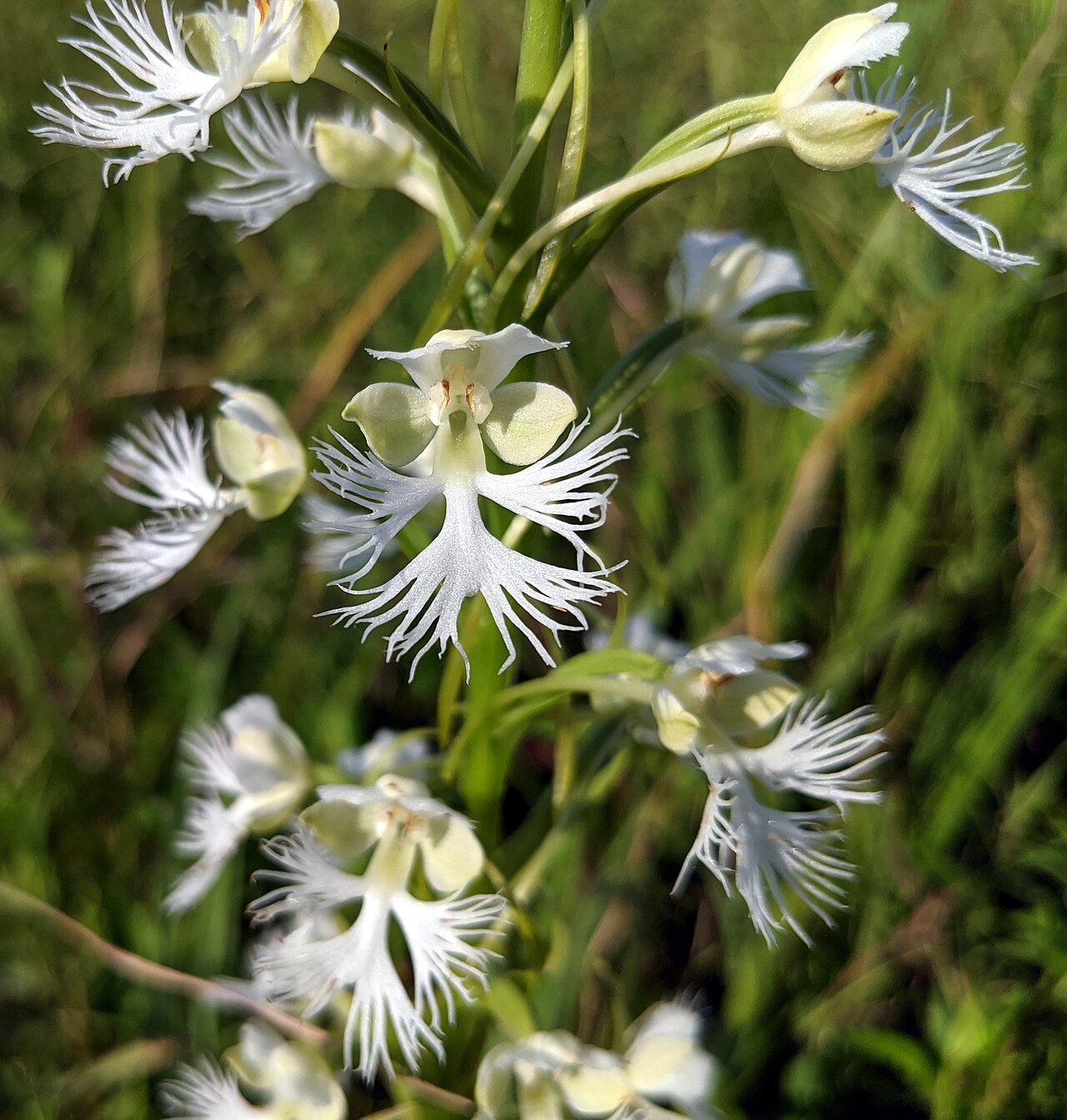
The flower spike is 2 to 8 inches long, with 5 to 40 creamy white to slightly greenish flowers. Each flower is about 1 inch long. The lip hangs down and is divided into three fan-shaped lobes, each deeply cut into a fringe. A slender nectar spur about 1 to 2 inches long curves behind the flower. The flowers are strongly fragrant at night.
Fruit
The fruit is an upright capsule holding thousands of dust-like seeds, which are carried by the wind in fall. Like all orchids, seedlings need a partner fungus to grow and may take several years to flower. Plants do not bloom every year, and they may stay dormant underground in some years.
Look-alikes
Western Prairie Fringed Orchid (P. praeclara), also federally threatened, grows mainly west of the Mississippi River. It has larger flowers (about 1 inch wide or more), fewer flowers per spike, and a longer spur. The two were treated as one species until 1986. Ragged Fringed Orchid has smaller, greenish flowers with a ragged, thread-like fringe. Lesser Purple Fringed Orchid has pink to purple flowers, and the white fringed orchid (P. blephariglottis) of bogs has an undivided lip.
Quick Facts
| Scientific Name | Platanthera leucophaea (Nutt.) Lindl. |
| Family | Orchidaceae (orchid family) |
| Plant Type | Herbaceous perennial terrestrial orchid |
| Mature Height | 8–40 in |
| Mature Spread | 4–8 in |
| Growth Rate | Slow; may take years to flower |
| Sun Exposure | Full sun |
| Water Needs | Moist to wet |
| Soil Type | Moist prairie loam, sedge meadow and fen peat |
| Soil pH | Neutral to slightly alkaline (about 6.5–8.0) |
| Bloom Time | Late June–mid-July |
| Flower Color | Creamy white |
| Fall Color | Leaves wither in late summer |
| Fruit | Capsule with tiny dust-like seeds |
| Deer Resistant | Low; deer browse the flower spikes |
| USDA Hardiness Zones | 4–7 (protected; not cultivated) |
Native Range
Eastern prairie fringed orchid is native to the Great Lakes region and the northeastern Midwest, with outlying populations farther east and south. USDA PLANTS lists it in Iowa, Illinois, Indiana, Maine, Michigan, Missouri, New York, Ohio, Oklahoma, Pennsylvania, Virginia and Wisconsin, and in Ontario. The U.S. Fish and Wildlife Service reports current populations in eight states (Illinois, Indiana, Iowa, Maine, Michigan, Missouri, Ohio and Wisconsin) and possibly Virginia, where it has not been surveyed for many years. The New York, Pennsylvania and Oklahoma records are historical; the single Oklahoma record, from Choctaw County, has not been seen in about 150 years.
The species is most common in northeastern Illinois, southeastern Wisconsin, Michigan and Ohio, with outlying populations in a Maine bog and in Iowa, Missouri and Virginia. It grows in open, moist to wet, sunny habitats: mesic to wet tallgrass prairie, sedge meadows, fens, marsh edges, bogs and, sometimes, old fields and roadside ditches that keep native prairie plants.
Most of its decline came from the plowing and draining of prairies and wetlands. Today the main threats are habitat loss, changes in water levels, invasion by woody plants, reed canary grass and buckthorn, deer browsing, and illegal collection. Many remaining sites are small, and recovery depends on prescribed fire, brush control, hand-pollination of plants in small populations, and seed banking.
📋 Regional plant lists featuring Eastern Prairie Fringed Orchid: Ohio & Indiana · Michigan, Wisconsin & Eastern Minnesota · Illinois, Iowa & Missouri · New Hampshire, Maine & Vermont · Maryland, Virginia & West Virginia
Can You Grow It?
Realistically, no. Eastern prairie fringed orchid is a federally threatened species that depends on specific soil fungi, wet prairie conditions and night-flying hawkmoths. It is not available as nursery-propagated stock for home gardens, and plants dug from the wild do not survive. Never dig, buy or collect wild plants or seed. Under the Endangered Species Act it is illegal to remove listed plants from federal land or to sell them across state lines, and many states protect it on all land.
Light
In the wild it needs full sun and open prairie. Shrubs and trees moving into its habitat shade it out, so conservation sites are kept open with fire and brush cutting.
Soil & Water
It grows in moist to wet, mineral-rich soils with a stable water table. Drainage ditches, roads and development that lower or raise water levels can wipe out populations.
Planting Tips
Conservation programs, not gardeners, carry out reintroductions. Botanical gardens and agencies have grown seedlings in labs with their partner fungi and planted them into protected, restored prairies.
Pruning & Maintenance
Land managers protect populations with prescribed burns, removal of invasive plants such as reed canary grass and buckthorn, and cages to keep deer from eating flower spikes.
Propagation
Seed germinates only with a specific mycorrhizal fungus. Because hawkmoth visits are rare in small populations, volunteers and biologists sometimes hand-pollinate flowers to increase seed production, under permits from state and federal agencies.
Where to See It
- Protected prairie preserves: state natural areas and nature preserves in Illinois, Wisconsin, Michigan and Ohio
- Guided field trips: in early July, offered by some state natural heritage programs and conservation groups
- Volunteer stewardship: prairie workdays and orchid monitoring programs in the Chicago region and elsewhere
- Respectful viewing: stay on trails, never pick flowers, and do not share exact locations publicly
Wildlife & Ecological Value
Eastern prairie fringed orchid has a close relationship with night-flying moths and soil fungi, which makes it an indicator of healthy wet prairie.
For Pollinators
Its flowers are pollinated at night by large hawkmoths (sphinx moths) with tongues long enough to reach nectar at the bottom of the 1- to 2-inch spur. As a moth feeds, pollen packets (pollinia) stick to its eyes or tongue and are carried to the next flower. Shorter-tongued insects cannot reach the nectar.
For Birds
It is not a significant food plant for birds, but its wet prairie habitat supports sedge wrens, bobolinks, sandhill cranes and other grassland and wetland birds.
For Mammals
White-tailed deer and rabbits eat the flower spikes and can prevent plants from setting seed, so some sites are fenced or caged.
Ecosystem Role
Like all orchids, it depends on soil fungi for germination and early growth. Healthy populations indicate high-quality wet prairie with intact water levels, native plants, fire and pollinators.
Cultural & Historical Uses
Thomas Nuttall described the orchid in 1834 as Orchis leucophaea, and John Lindley moved it to Platanthera in 1835. For much of the 20th century it was called Habenaria leucophaea. The name leucophaea means “dusky white.” In 1986, botanists Charles Sheviak and Marlin Bowles separated the western populations as a new species, Platanthera praeclara.
It was federally listed as threatened in 1989 along with the western prairie fringed orchid. Recovery efforts have brought together federal and state agencies, forest preserves, botanical gardens, universities and thousands of volunteers, especially around Chicago, where some of the largest remaining populations grow in restored prairies.
The orchid is a symbol of the tallgrass prairie, an ecosystem that once covered much of the Midwest and has been reduced to tiny fragments. Seeing one in bloom on a summer evening, with its fringed flowers glowing white and its scent drifting over the prairie, is a highlight for many Midwestern naturalists.
Frequently Asked Questions
Is the eastern prairie fringed orchid endangered?
It is listed as threatened under the U.S. Endangered Species Act (since 1989) and as endangered in Canada. Many states also list it as endangered or threatened.
Where does the eastern prairie fringed orchid grow?
In wet prairies, sedge meadows and fens of Illinois, Indiana, Iowa, Maine, Michigan, Missouri, Ohio and Wisconsin, possibly Virginia, and Ontario. It is known only from historical records in New York, Pennsylvania and Oklahoma.
How is it different from the western prairie fringed orchid?
The western prairie fringed orchid grows mainly west of the Mississippi River and has larger flowers, fewer per spike, with a longer spur. The two were considered one species until 1986.
Can I grow eastern prairie fringed orchid in my garden?
No. It is federally threatened, it is not available from nurseries, and it depends on specific soil fungi and hawkmoths. Never dig or collect it. Support prairie conservation and volunteer stewardship instead.
What pollinates the eastern prairie fringed orchid?
Night-flying hawkmoths (sphinx moths), whose long tongues reach nectar at the bottom of the long spur. Pollen packets stick to the moths and are carried between flowers.

Looking for a nursery that carries Eastern Prairie Fringed Orchid?
Browse our native plant nursery directory: Illinois, Indiana & Iowa · Maine, Michigan & Missouri · New York, Ohio & Oklahoma · Pennsylvania & Virginia · Wisconsin

