
Lesser Purple Fringed Orchid (Platanthera psycodes)
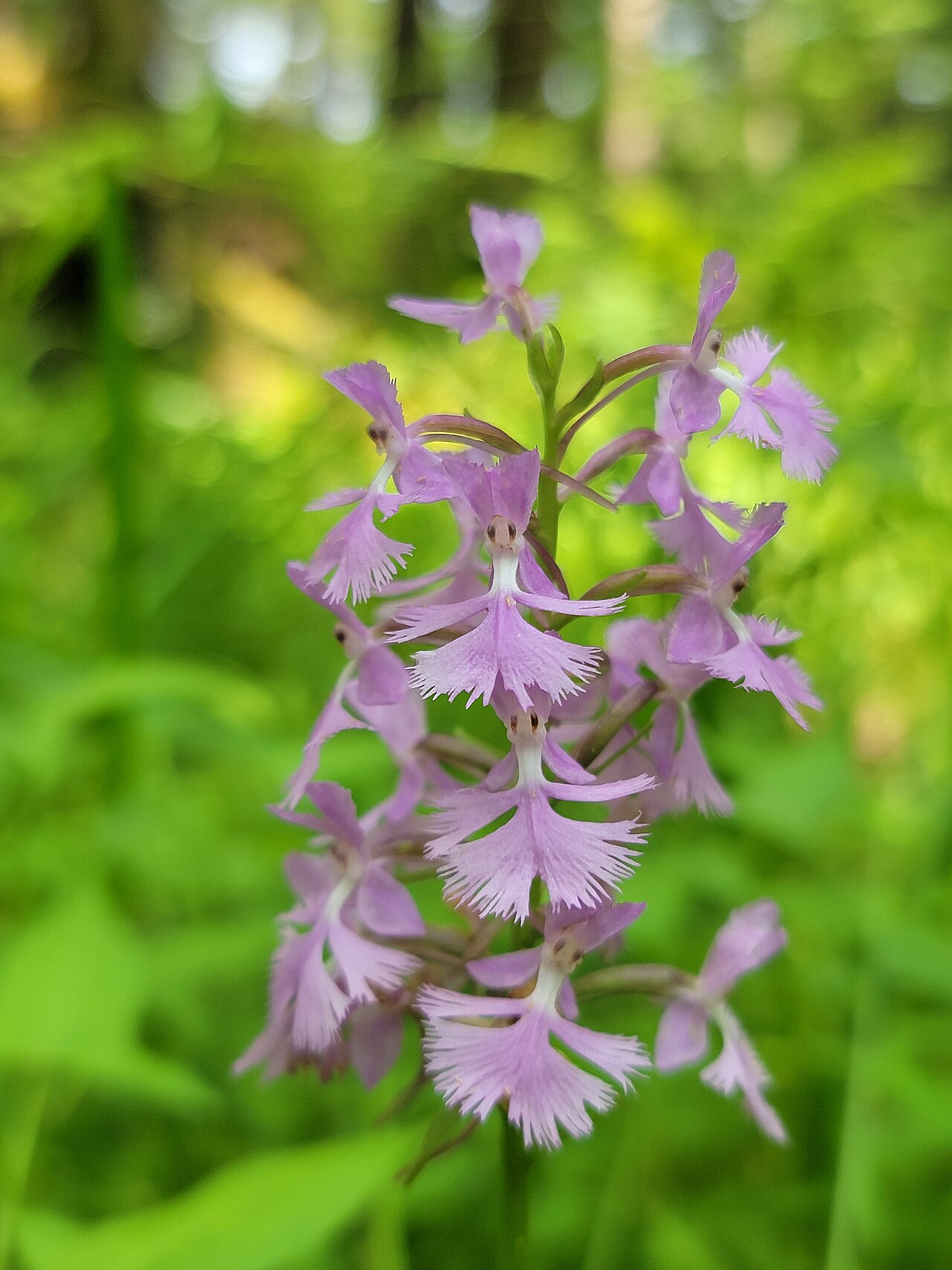
Platanthera psycodes, the Lesser Purple Fringed Orchid (also called small purple fringed orchid or butterfly orchid), is a wild orchid of wet meadows, swamps and stream banks across northeastern North America. In early to midsummer it raises a stem 1 to 3 feet tall topped by a dense, cylindrical spike of fragrant, lavender to rose-purple flowers, each with a lip divided into three fan-shaped, deeply fringed lobes.
It is one of the showiest native orchids of the North Woods and the Appalachians, and one of the more widespread. Its range runs from Newfoundland and Manitoba south through New England, the Great Lakes states and the Appalachian Mountains to northern Georgia. Despite that wide range, it is uncommon in many places and is considered rare at the southern and western edges of its range.
Like all native orchids, it depends on specific soil fungi to germinate and grow, and it cannot be dug from the wild and successfully moved to a garden. This page is a guide to identifying it, understanding where it grows and what pollinates it, and protecting the wet habitats it needs. Older books list it as Habenaria psycodes.
Identification
The lesser purple fringed orchid is easy to recognize as a purple fringed orchid when in bloom. The challenge is telling it from its close relative, the greater purple fringed orchid.
Growth Habit
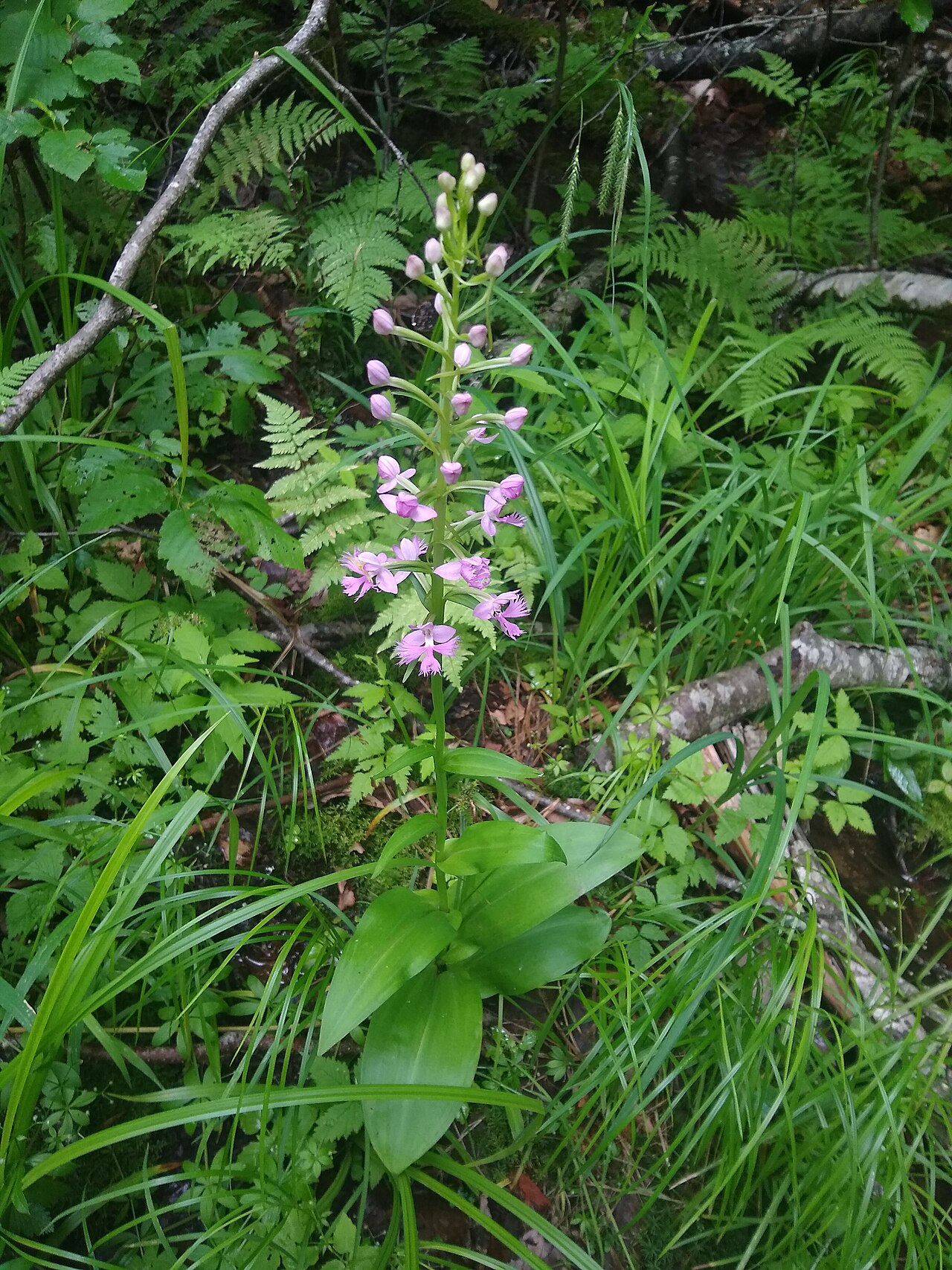
Each plant grows from a cluster of fleshy, tuberous roots and produces a single upright, leafy stem, usually 1 to 3 feet tall. Plants that are not ready to flower produce just one or two leaves at ground level. Flowering plants often grow singly or in small, scattered groups.
Leaves
The stem carries two to five smooth, glossy, elliptic to lance-shaped leaves, largest near the base (up to about 8 inches long) and becoming smaller and bract-like toward the flower spike. The leaves are bright green and clasp the stem.
Flowers
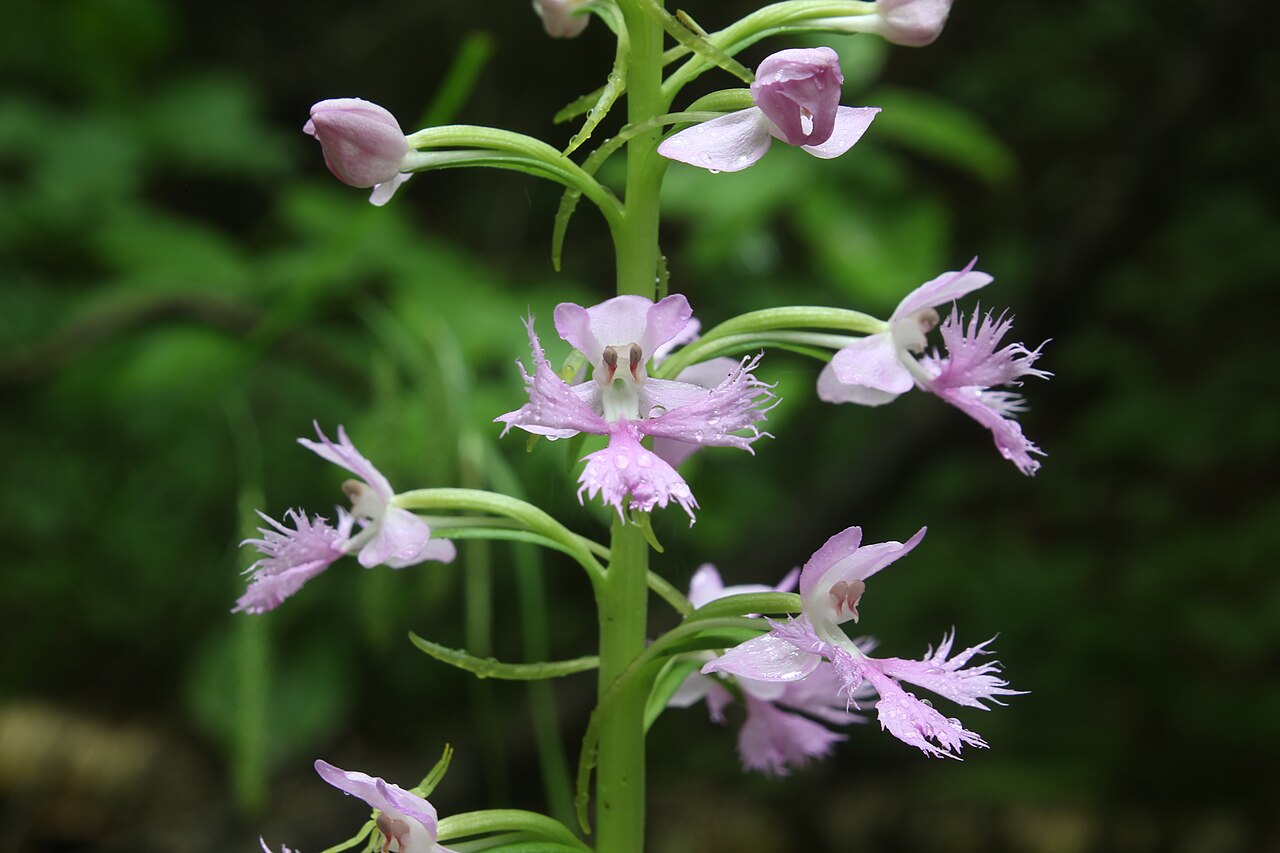
The flowers are packed into a dense, cylindrical raceme 2 to 6 inches long, sometimes with 50 or more flowers. They range from lavender and rose-purple to, rarely, white, and many people find them fragrant, especially in the evening. Each flower has a hood formed by the upper sepal and petals, two spreading side sepals, and a lip roughly 1/2 inch wide divided into three fan-shaped lobes, each finely fringed. A slender nectar spur, about 1/2 to 3/4 inch long, curves down behind the flower.
Fruit & Seeds
After pollination, each flower forms an upright, ribbed capsule that ripens in late summer and splits to release thousands of dust-like seeds. The seeds have almost no stored food and can only germinate with the help of a compatible soil fungus.
Look-alikes
The greater purple fringed orchid (Platanthera grandiflora) is very similar. It usually has larger flowers, with a lip more than about 3/4 inch wide, a looser flower spike, and it tends to bloom a week or two earlier where the two grow together. A reliable detail is the opening of the nectar spur at the center of the flower: round in the greater, but narrow and dumbbell-shaped in the lesser. The purple fringeless orchid (P. peramoena) of the Ohio Valley and southern Appalachians has toothed, not fringed, lip lobes. Other local fringed orchids, such as the ragged fringed orchid and the orange fringed orchid, have greenish-white or orange flowers.
Quick Facts
| Scientific Name | Platanthera psycodes (L.) Lindl. |
| Family | Orchidaceae (orchid family) |
| Plant Type | Terrestrial perennial orchid from tuberous roots |
| Mature Height | 1–3 ft in flower |
| Mature Spread | 6–10 in |
| Growth Rate | Slow; depends on soil fungi |
| Sun Exposure | Full sun to part shade |
| Water Needs | High; constantly moist to wet soil |
| Soil Type | Moist to wet, humus-rich soils of meadows, swamps, stream banks and seeps |
| Soil pH | Acidic to near neutral (about 5.0–7.0) |
| Bloom Time | June–August |
| Flower Color | Lavender to rose-purple, rarely white |
| Fall Color | None; dies back in fall |
| Fruit | Upright ribbed capsule with dust-like seeds |
| Deer Resistant | No; deer often eat flower spikes |
| USDA Hardiness Zones | 3–7 |
Native Range
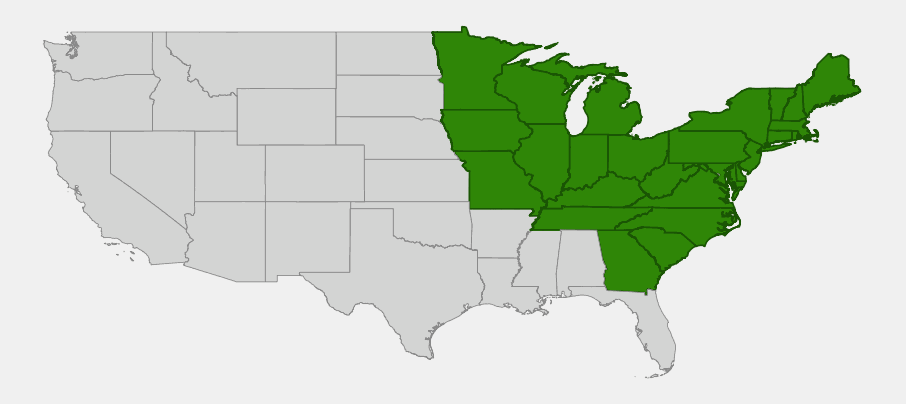
The lesser purple fringed orchid is native to northeastern North America. In Canada it grows from Newfoundland, Nova Scotia, Prince Edward Island and New Brunswick west through Quebec and Ontario to Manitoba, as well as on the French islands of Saint Pierre and Miquelon. In the United States, USDA PLANTS lists it from Maine to Minnesota and south to Iowa, Missouri, Illinois, Ohio and the Mid-Atlantic states.
It is most frequent in northern New England, New York, Pennsylvania and the upper Great Lakes states. South of there it follows the Appalachian Mountains through Virginia, West Virginia, Kentucky, Tennessee and North Carolina to northern Georgia and the mountains of South Carolina. In Missouri, Delaware and other states at the edges of its range, it is known from only a few sites and is considered rare.
It grows in wet, open or lightly shaded places: wet meadows, sedge meadows, swamps and wooded swamp edges, stream banks, seeps, fens, ditches and wet roadsides. In the southern Appalachians it is a plant of higher elevations, in seepy meadows and along mountain streams.
📋 Regional plant lists featuring Lesser Purple Fringed Orchid: New York, Pennsylvania & Northern New Jersey · Ohio & Indiana · Michigan, Wisconsin & Eastern Minnesota · Kentucky & Tennessee · Connecticut, Massachusetts & Rhode Island · New Hampshire, Maine & Vermont · Maryland, Virginia & West Virginia · Delaware, Southern New Jersey & Long Island · Illinois, Iowa & Missouri · Alabama, Georgia & Mississippi · North & South Carolina
Can You Grow It?
Honestly, the lesser purple fringed orchid is not a practical garden plant. Like other native orchids, it depends on specific mycorrhizal fungi in the soil, and wild plants rarely survive being dug up. The best way to enjoy it is to see it in the wild and to protect the wet meadows and swamps where it grows.
Never Dig Wild Plants
Do not dig or collect wild plants. Transplanted orchids almost always decline and die within a few years, and digging also harms the remaining population. The species is listed as rare, threatened or endangered in several states at the edges of its range, where collecting can be illegal as well as harmful. Photograph it instead.
Nursery-Propagated Plants
Only buy plants that are clearly labeled as laboratory or nursery propagated from seed, never “nursery grown” plants of uncertain origin. Propagated plants are rarely available. A few specialists raise Platanthera species from seed in sterile culture, and some orchid growers keep them in carefully managed bog or seep beds.
Growing Conditions
If you do obtain a propagated plant, it needs constantly moist, cool, humus-rich and acidic to near-neutral soil, with sun or light shade, as in a wet meadow or streamside. It does not tolerate drying out, hot summers, or competition from aggressive plants. Even in ideal conditions, garden plants are often short-lived.
Protecting Wild Populations
The best way to help this orchid is to protect its habitat. Keep wet meadows and swamp edges from being drained, filled or mowed during the summer bloom and seed season, control invasive plants such as reed canary grass and purple loosestrife, and reduce deer browsing where it is heavy.
Propagation
Propagation is a job for specialists. The dust-like seeds lack stored food and can only germinate in sterile culture or with their partner fungi, and seedlings take several years to reach flowering size. Home gardeners should not attempt to divide or move plants.
Where to See It
- Wet meadows and swamp edges in the Northeast and Great Lakes: look for purple spikes from late June through August
- Northern and mountain trails: often seen along wet trailsides and ditches in New England, the Adirondacks and the North Woods
- Southern Appalachian seeps: higher-elevation seepy meadows and stream banks in the Blue Ridge
- Nature preserves and state natural areas: many protect fens and wet meadows where this orchid grows
- Orchid and wildflower walks: local native plant societies often lead summer walks to see it
Wildlife & Ecological Value
The lesser purple fringed orchid is part of a group of fringed orchids that are adapted for pollination by butterflies and moths.
For Pollinators
Its nectar is held deep in the long, slender spur, where only long-tongued insects can reach it. Butterflies, skippers and moths, including hawk moths, are the main pollinators. When an insect probes for nectar, the orchid’s sticky pollen packets (pollinia) attach to its proboscis and are carried to the next flower. The evening fragrance is thought to help attract night-flying moths.
For Birds
The orchid itself has little direct value for birds, but the wet meadows and swamp edges where it grows are important habitat for many nesting birds, from sedge wrens to warblers.
For Mammals
White-tailed deer readily eat the flowering stems, and heavy browsing can prevent plants from flowering or setting seed. Rodents and slugs may also damage plants.
Ecosystem Role
Like all orchids, Platanthera psycodes forms partnerships with soil fungi, which are essential for its seeds to germinate and young plants to grow. Its presence is a sign of a healthy, intact wet meadow, swamp or seep, habitats that have been widely drained and lost.
Cultural & Historical Uses
The species name psycodes comes from the Greek psyche, meaning butterfly, and refers to the butterfly-like shape of the flowers. Linnaeus first described it in 1753 as Orchis psycodes. It was later placed in Habenaria, the name used in many older field guides, and is now in Platanthera, from the Greek for “broad anther.”
Purple fringed orchids have long been favorites of naturalists in the Northeast. Henry David Thoreau wrote about finding purple fringed orchids near Concord, Massachusetts, and they are often featured in regional wildflower and orchid guides as a highlight of the summer wetlands.
Like many native orchids, it was once collected for gardens and the cut-flower trade, and digging, drainage and deer browsing have reduced some populations. Today it is protected by law in several states, and it serves as a reminder that the best way to enjoy wild orchids is to leave them where they grow.
Frequently Asked Questions
How do I tell the lesser and greater purple fringed orchids apart?
The lesser has smaller flowers (lip about 1/2 inch wide) in a denser spike, and the opening of its nectar spur is narrow and dumbbell-shaped. The greater purple fringed orchid (Platanthera grandiflora) has larger flowers with a round spur opening and usually blooms a little earlier.
Can I grow lesser purple fringed orchid in my garden?
It is very difficult. It needs specific soil fungi, constantly moist soil and cool conditions. Never dig wild plants. Only buy plants that are clearly propagated from seed, which are rarely available.
When does it bloom?
It blooms from late June to August, depending on latitude and elevation, usually peaking in July.
What pollinates it?
Long-tongued butterflies, skippers and moths, which reach the nectar at the bottom of its long spur and carry away its pollen packets.
Is lesser purple fringed orchid rare?
It is fairly widespread in the Northeast and Great Lakes region, but uncommon in many areas and listed as rare in several states at the edges of its range.

Looking for a nursery that carries Lesser Purple Fringed Orchid?
Browse our native plant nursery directory: Connecticut, Delaware & Georgia · Illinois, Indiana & Iowa · Kentucky, Maine, Maryland, Massachusetts, Michigan, Minnesota & Missouri · New Hampshire, New Jersey, New York, North Carolina & Ohio · Pennsylvania, Rhode Island, South Carolina, Tennessee, Vermont & Virginia · West Virginia & Wisconsin

