Firecracker Penstemon (Penstemon eatonii)
Penstemon eatonii, commonly known as Firecracker Penstemon or Eaton’s Penstemon, is arguably the most brilliantly colored wildflower of the Colorado Plateau and Great Basin desert regions. When this plant blooms in late winter and early spring — often in February and March at lower elevations — its tall, upright stalks lined with dozens of vivid scarlet-red tubular flowers create some of the most spectacular wildflower displays in the American Southwest. The intense color and tubular flower shape are an evolutionary adaptation specifically for hummingbird pollination, and where Firecracker Penstemon grows, Anna’s and Broad-tailed Hummingbirds are rarely far behind.
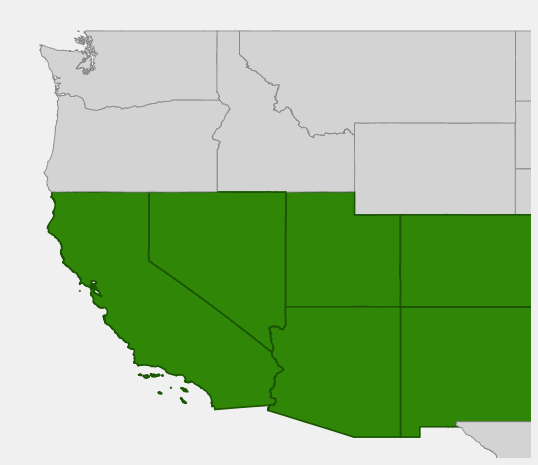
Named for Daniel Coit Eaton (1834–1895), the Yale botanist who first formally described it, this penstemon grows as a semi-evergreen perennial forming basal rosettes of large, gray-green leaves from which emerge one to several flowering stalks reaching 1–3 feet tall. It is a plant of desert foothills and canyon country, flourishing on rocky, gravelly slopes and desert scrub from about 2,000 to 7,000 feet elevation across its range in Utah, Arizona, Nevada, California, and Colorado. Its extreme drought tolerance — established plants can survive months without any rainfall — and preference for fast-draining, rocky soils make it particularly at home in xeriscape gardens and desert landscapes.
Beyond its extraordinary ornamental appeal, Firecracker Penstemon is an ecological keystone for early-season hummingbirds. Its February-March bloom in the low desert coincides precisely with the arrival of migrating hummingbirds, and its abundant nectar production provides critical fuel for these birds at a time when few other flowers are available. In native plant gardens, it is essentially essential for hummingbird enthusiasts in the Southwest and Great Basin.
Identification
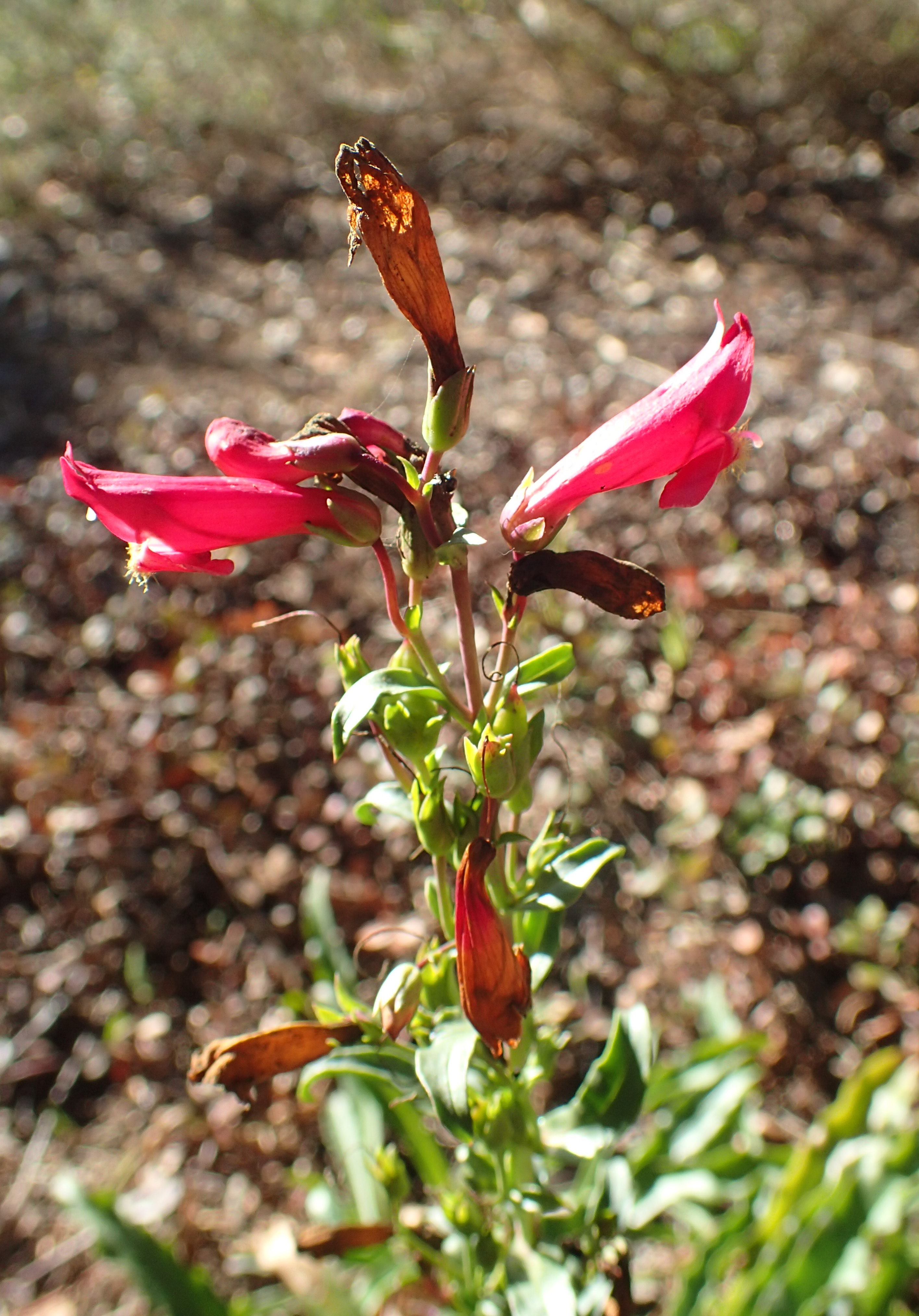
Firecracker Penstemon is a perennial herbaceous plant growing from a woody taproot. It forms basal rosettes of leaves that persist through winter (semi-evergreen), from which arise one to several upright flowering stalks reaching 1–3 feet (30–90 cm) tall. The plant spreads slowly by rhizomes to form small clumps but is not aggressively spreading. Its most distinctive feature — the lined rows of vivid scarlet tubular flowers — makes it unmistakable when in bloom.
Leaves
The basal leaves are 2–5 inches long, oval to lance-shaped, with a distinctive grayish-green color and smooth, slightly waxy texture that reflects the plant’s adaptation to dry, sunny conditions. The leaf margins are smooth or very finely toothed. Stem leaves alternate up the flowering stalk and become progressively smaller and more clasping (somewhat wrapped around the stem) toward the top. All leaves are glabrous (hairless) and slightly succulent-feeling.
Flowers
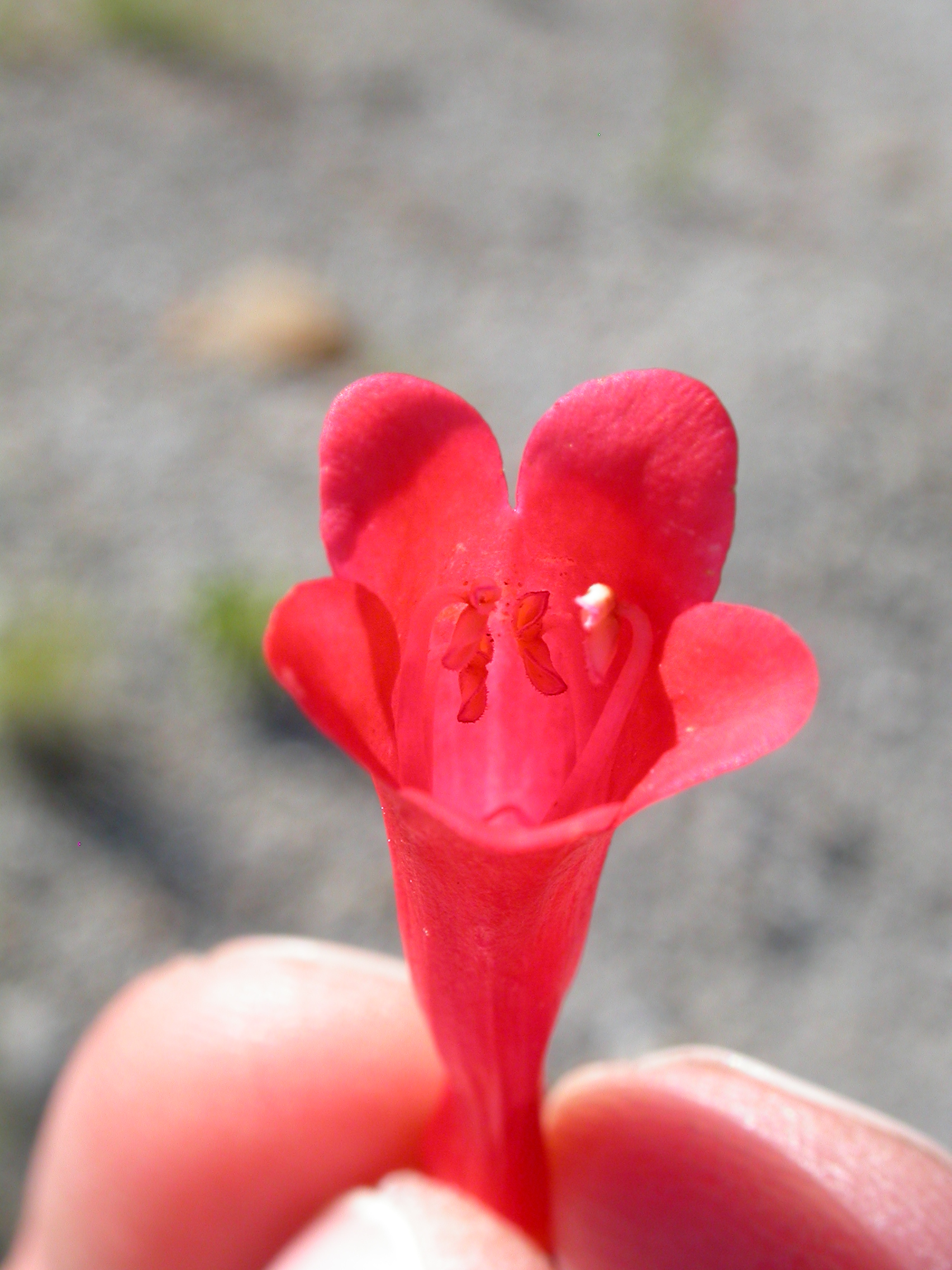
The flowers are the showpiece of this species. Each is a narrow tubular structure, 1–1.5 inches (2.5–4 cm) long, bright scarlet-red externally, with a paler interior. The tube is narrow — specifically sized to match the bill and tongue length of hummingbirds rather than bees. Two lips form the flower opening: the upper lip has 2 lobes and the lower has 3, but the lobes barely flare open, maintaining the tube shape that excludes most bees while allowing hummingbird access. The staminode (sterile stamen from which penstemons take their name) is barely exserted and smooth or nearly beardless — distinguishing this species from bearded penstemons. Flowers are arranged in verticillasters (whorled clusters) along the upper portion of the stem, creating the “stalk lined with flowers” appearance that gives the plant its common name.
Quick Facts
| Scientific Name | Penstemon eatonii |
| Family | Plantaginaceae (Plantain) |
| Plant Type | Perennial herbaceous wildflower |
| Mature Height | 3 ft |
| Sun Exposure | Full Sun |
| Water Needs | Moderate |
| Bloom Time | February – May (elevation-dependent) |
| Flower Color | Vivid scarlet-red |
| Pollinator Value | Hummingbirds (primary); butterflies |
| Deer Resistant | Moderately — rarely browsed |
| USDA Hardiness Zones | 4–9 |
Native Range
Firecracker Penstemon is native to the Colorado Plateau and Great Basin regions of the American Southwest, with a range centered on Utah, Arizona, Nevada, and southern California, extending north into Colorado and south into Baja California. It is most abundant on the Colorado Plateau — the high desert region encompassing much of southern Utah and northern Arizona — where it colonizes rocky canyon walls, sandy desert washes, and gravelly hillsides from the desert floor to montane elevations.
In Utah, Firecracker Penstemon is widespread and common, blooming spectacularly around Zion National Park, Capitol Reef, Bryce Canyon’s lower canyon areas, and the canyon lands around Moab. In Arizona, it occurs across the Colorado Plateau and along the Mogollon Rim, while in Nevada it is found primarily in the southern portions of the state. The species grows from about 2,000 feet elevation in warm desert foothills up to approximately 7,000 feet in montane shrublands.
The species shows a strong affinity for calcareous (limestone) soils and the rocky, fast-draining substrates of canyon country. It is commonly found growing in association with big sagebrush (Artemisia tridentata), pinyon-juniper woodland, desert scrub communities, and the lower fringes of ponderosa pine forests.
📋 Regional plant lists featuring Firecracker Penstemon: Intermountain West
Growing & Care Guide
Firecracker Penstemon is one of the most rewarding native plants for southwestern and Intermountain West gardens — easy to grow, spectacular in bloom, and virtually maintenance-free once established. The key to success is providing excellent drainage and avoiding overwatering.
Light
Full sun is essential. Firecracker Penstemon evolved in open, sun-baked desert environments and declines rapidly in shaded or partially shaded locations. Choose the sunniest spot in the garden — south or west-facing slopes with reflected heat are ideal. In full sun, the plants bloom more profusely and develop more compact, attractive growth forms.
Soil & Water
Perfect drainage is the most important cultural requirement. Firecracker Penstemon will rot quickly in heavy, wet soils. It thrives in gravelly, sandy, or rocky soils with excellent drainage. On heavy clay sites, amend the planting area deeply with gravel and coarse sand, or plant in raised beds or berms. Once established, this plant is highly drought tolerant — in its native range, it survives months without rainfall. In cultivation, established plants need little or no supplemental water except during severe drought. Overwatering is the primary cause of failure.
Planting Tips
Plant in fall or early spring from container stock. Set the crown of the plant at or slightly above the surrounding soil level to ensure water drains away from the base. Space plants 2–3 feet apart. Mulch lightly with gravel rather than organic material, which can hold excessive moisture. Seeds germinate readily after a brief cold stratification period and can be direct-sown in fall for spring germination.
Pruning & Maintenance
After flowering, cut stalks to the basal rosette to maintain a tidy appearance and encourage rebloom the following year. Leave some stalks if you wish to collect seed or provide seed for birds. The basal rosette remains semi-evergreen through winter and should not be cut back. Firecracker Penstemon is short-lived (3–5 years) but self-seeds readily in suitable conditions, ensuring the colony persists and expands. Divide or transplant seedlings in fall to propagate.
Landscape Uses
- Hummingbird garden — indispensable for attracting migrating and resident hummingbirds
- Rock garden and desert xeriscape
- Canyon and slope plantings on rocky, well-drained sites
- Pollinator garden providing early-season nectar
- Wildflower meadow in desert and high desert settings
- Naturalized plantings in pinyon-juniper woodland gardens
Wildlife & Ecological Value
Firecracker Penstemon is one of the most important native plant species for hummingbird habitat in the Intermountain West and Southwest.
For Hummingbirds
The scarlet tubular flowers of Firecracker Penstemon are among the most precisely evolved hummingbird flowers in North America. The narrow tube, bright red color (hummingbirds have exceptional red-color vision), and copious nectar production make this plant a preferred food source for Broad-tailed Hummingbirds, Black-chinned Hummingbirds, and Costa’s Hummingbirds throughout its range. In areas where it blooms in February and March, it often provides the first significant nectar supply of the year — making it critically important for early migrants and wintering birds.
For Butterflies & Insects
Despite its primary adaptation for hummingbird pollination, various butterfly species, particularly swallowtails and skippers, successfully visit the flowers for nectar. Native bumblebees occasionally “rob” nectar by piercing the base of the flower tube. The seeds provide a modest food source for sparrows and finches in late summer.
For Mammals
Deer and rabbits rarely browse Firecracker Penstemon, making it one of the more reliably deer-resistant native wildflowers of the West. The clumping growth form and sparse foliage provide minimal cover but some shelter for small reptiles and insects at the base of the plants.
Ecosystem Role
As an early-blooming species in desert and semidesert ecosystems, Firecracker Penstemon provides critical early-season food resources for hummingbirds at a time when the desert landscape has few flowers. Its role in supporting migrating hummingbirds — which are themselves important pollinators of many other native plant species — gives it an outsized ecological influence relative to its modest physical presence.
Cultural & Historical Uses
Indigenous peoples of the Colorado Plateau and Great Basin used various penstemons medicinally, and Firecracker Penstemon was among those documented in ethnobotanical records. The Navajo prepared root decoctions from related penstemons to treat skin conditions and infections. The Hopi used penstemon preparations in ceremonial contexts and for treating headaches and rheumatism. While specific documented uses of P. eatonii are less extensive than for some other penstemons, the species was certainly known and used within its range.
The plant was formally described to science by Asa Gray in 1874, based on specimens collected by Daniel Coit Eaton during surveys of the Colorado Plateau and canyon country of Utah and Arizona in the early 1870s. The vivid scarlet flowers immediately attracted attention from botanists and horticulturalists, and Firecracker Penstemon has been in cultivation in western gardens since at least the early 20th century.
Today, Firecracker Penstemon is widely grown throughout the Southwest and has gained international popularity as an ornamental plant in Mediterranean-climate gardens. It is a staple of hummingbird gardens, xeriscape demonstrations, and native plant nurseries across the region. Conservation organizations use it in riparian and desert restoration projects, where its drought tolerance and wildlife value make it particularly valuable.
Frequently Asked Questions
When does Firecracker Penstemon bloom?
Bloom time is highly elevation-dependent. At lower desert elevations (2,000–4,000 ft), plants can bloom as early as February. At mid-elevations in Utah and Colorado (5,000–6,500 ft), they typically bloom March through May. At higher elevations near 7,000 ft, blooming may extend into June. A single planting can thus extend the flowering season considerably by including plants from different elevations.
Is Firecracker Penstemon a perennial?
Yes, but it is a short-lived perennial — most plants live 3–5 years. However, it self-seeds readily in suitable conditions, so established colonies tend to perpetuate themselves. Remove spent stalks after seed set to prevent excessive self-seeding if desired, or leave them to naturalize.
Do hummingbirds really prefer it?
Absolutely — Firecracker Penstemon is among the most reliable hummingbird plants for the Southwest and Intermountain West. The scarlet color, tube shape, and abundant nectar are textbook examples of hummingbird flower syndrome. In areas where migrating hummingbirds pass through in February-March, blooming plants are discovered and visited within days.
Will it grow in garden soil?
Yes, if drainage is excellent. The most common mistake is planting in rich, moisture-retentive garden soil. Amend with plenty of gravel, or plant on slopes and berms where water drains away quickly. In suitable conditions, Firecracker Penstemon is easy and rewarding to grow.
How do I get seeds to grow?
Seeds require a period of cold stratification — either sow outdoors in fall (nature provides the cold treatment) or refrigerate seeds in moist sand for 4–6 weeks before spring sowing. Surface sow on fast-draining gritty mix and keep lightly moist until germination. Germination rate is typically good (60–80%) with properly stratified seeds.