
Florida Gamagrass (Tripsacum floridanum)
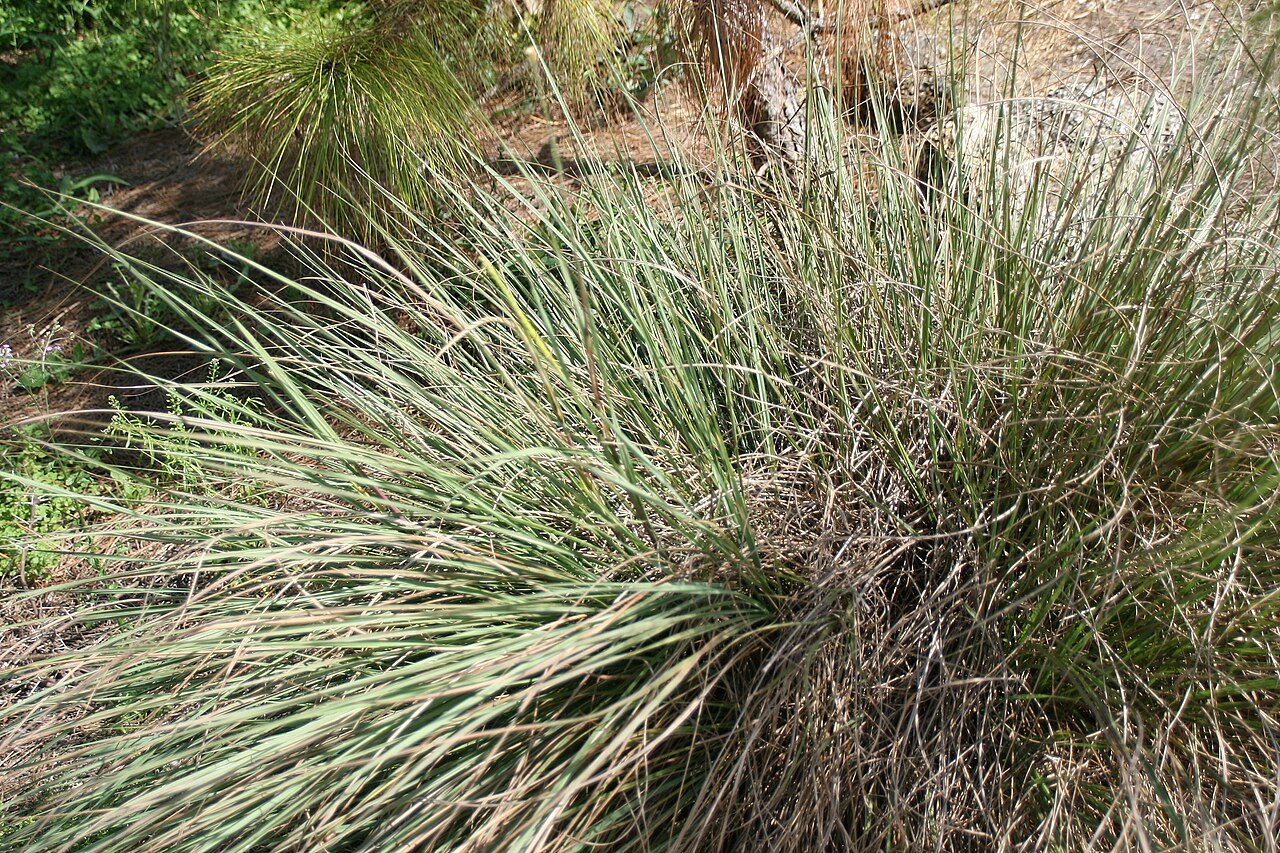
Tripsacum floridanum, the Florida Gamagrass, also called Florida tripsacum or Florida mock gamagrass, is a clumping perennial grass of the pine rocklands and wet prairies of south Florida. It is a smaller, finer-leaved relative of the eastern gamagrass and fakahatchee grass of the Southeast, and like them it belongs to the same tribe of the grass family (Poaceae) as corn.
Florida gamagrass is listed as Threatened by the State of Florida, and the Atlas of Florida Plants records it as a state-threatened species. Much of its habitat in Miami-Dade County has been lost to development, and the remaining pine rocklands depend on regular fire. Gardeners should buy only nursery-propagated plants and never dig or collect plants or seed from the wild.
In gardens it forms a neat, fountain-like clump of narrow, gray-green leaves 2 to 3 feet tall, a scaled-down alternative to the much larger fakahatchee grass. This guide covers how to recognize it, where it grows, how to grow it in south Florida landscapes, and how it differs from its larger relative, Eastern Gamagrass (Tripsacum dactyloides).
Identification
Two gamagrasses grow wild in Florida. Florida gamagrass is the smaller one, with narrow, wiry leaves, and in the wild it is limited to the southern part of the state. Eastern gamagrass (T. dactyloides), which includes the large landscape form sold as fakahatchee grass, has much broader leaves and grows throughout the state and much of the eastern United States.
Growth Habit
Florida gamagrass is a warm-season perennial bunchgrass that grows from short, thick rhizomes into a dense, rounded to arching clump, usually 2 to 3 feet tall and about as wide. Old clumps develop a thatch of dead leaves at the base.
Leaves
The leaves are long, narrow and somewhat stiff, usually less than ⅓ inch wide, often folded or rolled inward, and gray-green to blue-green. They arch outward from the clump in a fountain shape. The leaves of eastern gamagrass are typically ½ to 1 inch wide or more, with a prominent white midrib.
Flowers
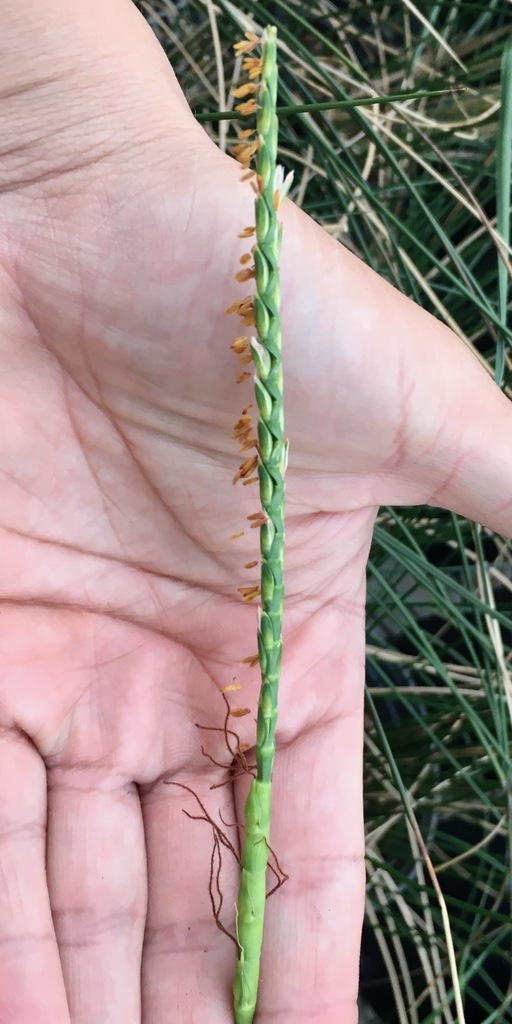
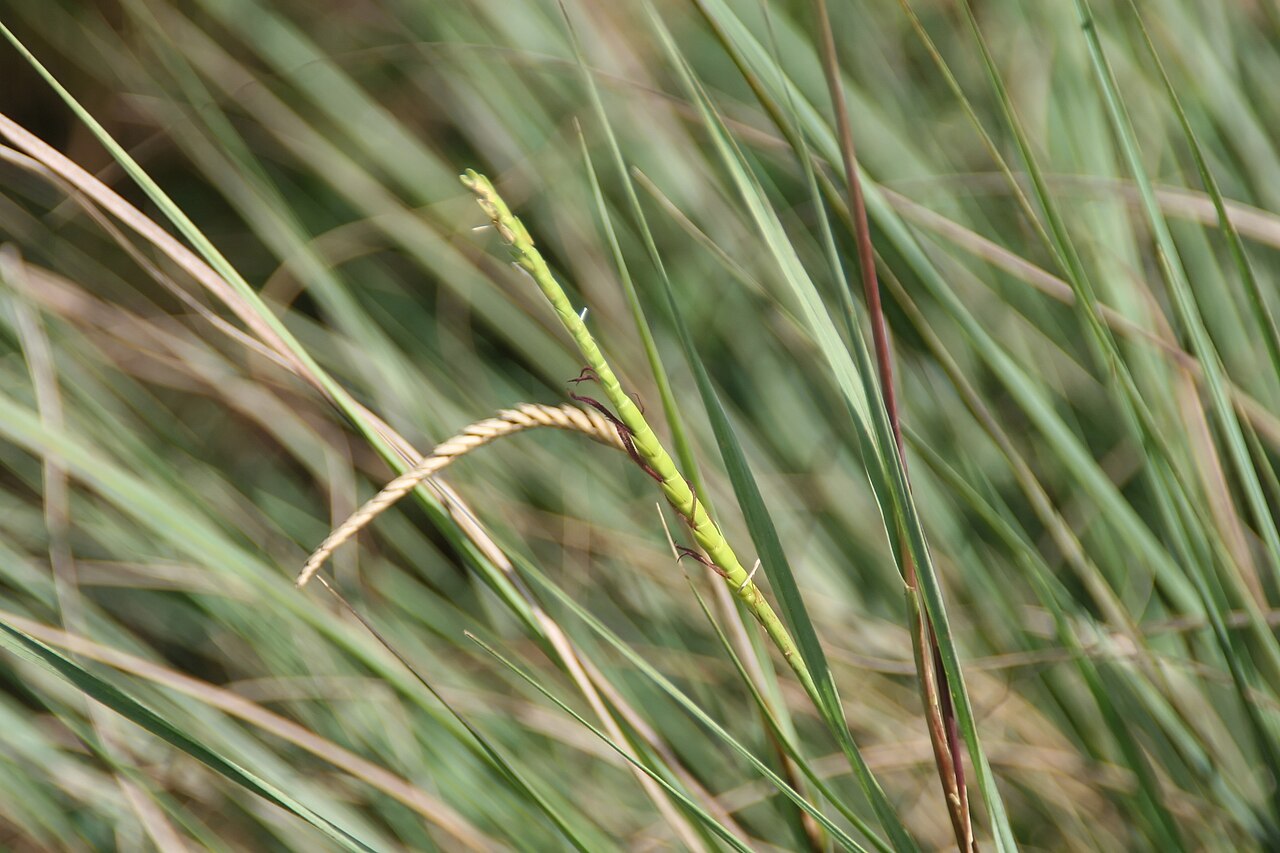
The flowers are borne on slender, upright spikes held among or just above the leaves, usually one spike per stem, sometimes two. Like corn, each spike has separate male and female parts. The lower part holds female spikelets sunk in hard, bead-like segments, from which feathery reddish-purple stigmas emerge. The upper part holds male spikelets that dangle orange to yellow anthers. Plants can flower from late winter through fall.
Seeds
After flowering, the male part drops away. The female part breaks apart into hard, shiny, bead-like segments, each enclosing a single grain. These segments fall to the ground near the parent clump, and some are carried away by water or animals.
Quick Facts
| Scientific Name | Tripsacum floridanum (sometimes treated as T. dactyloides var. floridanum) |
| Family | Poaceae (grass family) |
| Plant Type | Warm-season perennial bunchgrass |
| Mature Height | 2–3 ft |
| Mature Spread | 2–3 ft |
| Growth Rate | Moderate |
| Sun Exposure | Full sun to light shade |
| Water Needs | Low to moderate; tolerates seasonal wetness and drought |
| Soil Type | Sandy or limestone-based soils, including marl and rocky pineland soils |
| Soil pH | About 6.0–8.5 |
| Bloom Time | February–November |
| Flower Color | Orange anthers and reddish-purple stigmas on green spikes |
| Fall Color | Leaves remain gray-green; tips brown in dry winters |
| Fruit | Hard, bead-like seed segments |
| Deer Resistant | Moderate; deer may graze young leaves |
| USDA Hardiness Zones | 10–11 |
Native Range
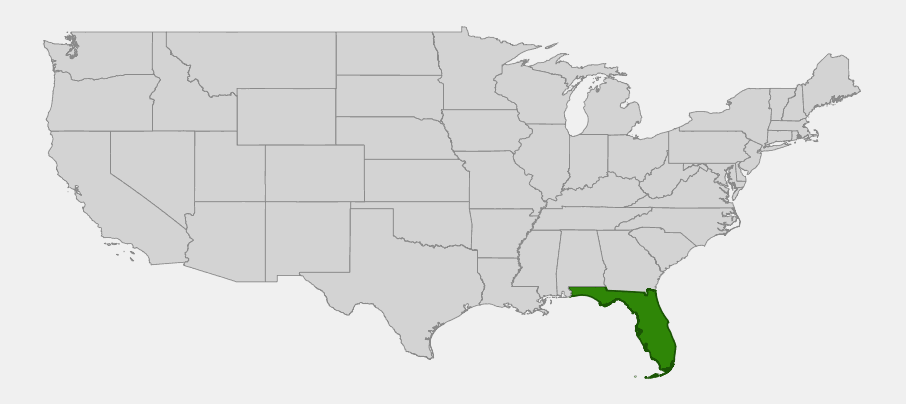
In the United States, Florida gamagrass grows naturally only in Florida. USDA PLANTS lists it as native to Florida, and the Atlas of Florida Plants records it as native and state-listed as Threatened. It was described from Miami, where it was collected in 1877, and it has been reported from Cuba.
Within Florida it is limited to the southern part of the peninsula, mainly the Miami Rock Ridge in Miami-Dade County, with scattered records elsewhere in south Florida. Plants growing farther north are cultivated.
Its main habitats are pine rocklands, the open, fire-maintained slash pine forests on limestone outcrops of the Miami Rock Ridge, as well as marl prairies, wet prairies, open pinelands and roadsides on seasonally wet soils. More than 90 percent of the original pine rockland in Miami-Dade County outside Everglades National Park has been cleared, which is a major reason for the species’ threatened status.
📋 Regional plant lists featuring Florida Gamagrass: North & South Florida
Growing & Care Guide
Florida gamagrass is a tough, attractive ornamental grass for south Florida landscapes. Because it is a state-threatened species, buy it only from native plant nurseries that grow it from cultivated stock. Never dig plants or collect seed from pine rocklands or other wild sites, many of which are also protected preserves.
Light
Plant it in full sun to light shade. In full sun it forms a dense, upright clump. In shade it becomes looser and flowers less.
Soil & Water
It is adaptable, growing in sand, rocky limestone soils, marl and ordinary garden soil, and it tolerates both short periods of flooding and extended dry spells once established. Water regularly for the first few months, then only during long droughts. It needs no fertilizer.
Planting Tips
Space plants about 2 to 3 feet apart for a massed groundcover or border, or use single clumps as accents. It works well in rain gardens, along swales and in pineland-style plantings with wildflowers and palms. North of zone 10, frost will brown the leaves, and a hard freeze may kill plants.
Pruning & Maintenance
Cut clumps back to about 6 inches in late winter every year or two to remove dead leaves and refresh the foliage. In the wild, fire does this. It has few pest problems.
Propagation
Divide established clumps in spring or early summer with a sharp spade, keeping several growing points and roots with each division. It can also be grown from the bead-like seed segments, which germinate better after soaking or a period of moist storage. Use only seed from cultivated plants.
Landscape Uses
- Ornamental grass: a compact, fine-textured alternative to fakahatchee grass in small spaces
- Pine rockland and prairie restoration: planted with propagated stock under the guidance of land managers
- Rain gardens and swales: tolerates both seasonal flooding and dry spells
- Mass plantings and borders: neat clumps for edging walks and beds
- Wildlife gardens: cover for small animals and grass-feeding insects
Wildlife & Ecological Value
Florida gamagrass is part of the grass layer that carries the frequent, low-intensity fires on which south Florida’s pine rocklands depend. Without that grassy fuel, fires burn poorly and hardwoods take over.
For Pollinators
Like most grasses, Florida gamagrass is wind-pollinated and offers no nectar. Bees sometimes collect pollen from the anthers. Grass-feeding caterpillars, including those of some skippers, feed on gamagrass leaves.
For Birds
Ground-feeding birds eat seeds when they can reach them, though the hard seed segments are less used than those of smaller grasses. The dense clumps give cover to ground-dwelling birds.
For Mammals
Gamagrasses are palatable to grazing animals. In the wild, deer and small mammals may graze young leaves, and the thick clumps provide shelter for small animals.
Ecosystem Role
Florida gamagrass helps form the herbaceous layer of pine rocklands and marl prairies, two of the most threatened plant communities in the United States. Its clumps hold soil, slow runoff on seasonally wet ground, and provide fuel for the frequent fires that keep pine rocklands open and diverse.
Cultural & Historical Uses
Florida gamagrass was named by Thomas Porter and George Vasey and published by Vasey in 1892, based on specimens collected in Miami in 1877 by A. P. Garber. Some botanists have treated it as a variety of the widespread eastern gamagrass, Tripsacum dactyloides, but USDA PLANTS and the Atlas of Florida Plants recognize it as a separate species.
The genus Tripsacum is of special interest to plant breeders because it is one of the closest wild relatives of corn (Zea mays). Researchers have studied gamagrasses for genes related to drought and pest resistance and for their ability to reproduce through seed without fertilization (apomixis), which occurs in some Tripsacum populations.
In south Florida landscapes, Florida gamagrass has become popular as a smaller native alternative to fakahatchee grass and is sometimes sold under names such as dwarf fakahatchee grass. Its use in native plantings helps keep the species in cultivation while its wild pine rockland habitat is protected and restored.
Frequently Asked Questions
Is Florida gamagrass endangered?
It is listed as Threatened by the State of Florida, as recorded in the Atlas of Florida Plants. It is not federally listed. Buy only nursery-propagated plants, and never collect plants or seed from the wild.
How is Florida gamagrass different from fakahatchee grass?
Fakahatchee grass is the common nursery name for eastern gamagrass (Tripsacum dactyloides), a larger plant with leaves ½ to 1 inch wide or more that forms clumps 4 to 6 feet tall. Florida gamagrass is a smaller species with narrow, wiry leaves and clumps about 2 to 3 feet tall.
Where does Florida gamagrass grow wild?
Only in south Florida, mainly on the pine rocklands of the Miami Rock Ridge, with scattered populations in other open, seasonally wet habitats in south Florida. It has also been reported from Cuba.
Can I grow Florida gamagrass in north Florida?
It is a tropical species best suited to zones 10 and 11. In colder areas it may be damaged or killed by frost. North of its range, eastern gamagrass is a better choice.
Is it related to corn?
Yes. Tripsacum is one of the closest wild relatives of corn. Like corn, its spikes have separate male and female flowers, with the female flowers producing silky stigmas.

Looking for a nursery that carries Florida Gamagrass?
Browse our native plant nursery directory: Florida