
Fringe Cups (Tellima grandiflora)
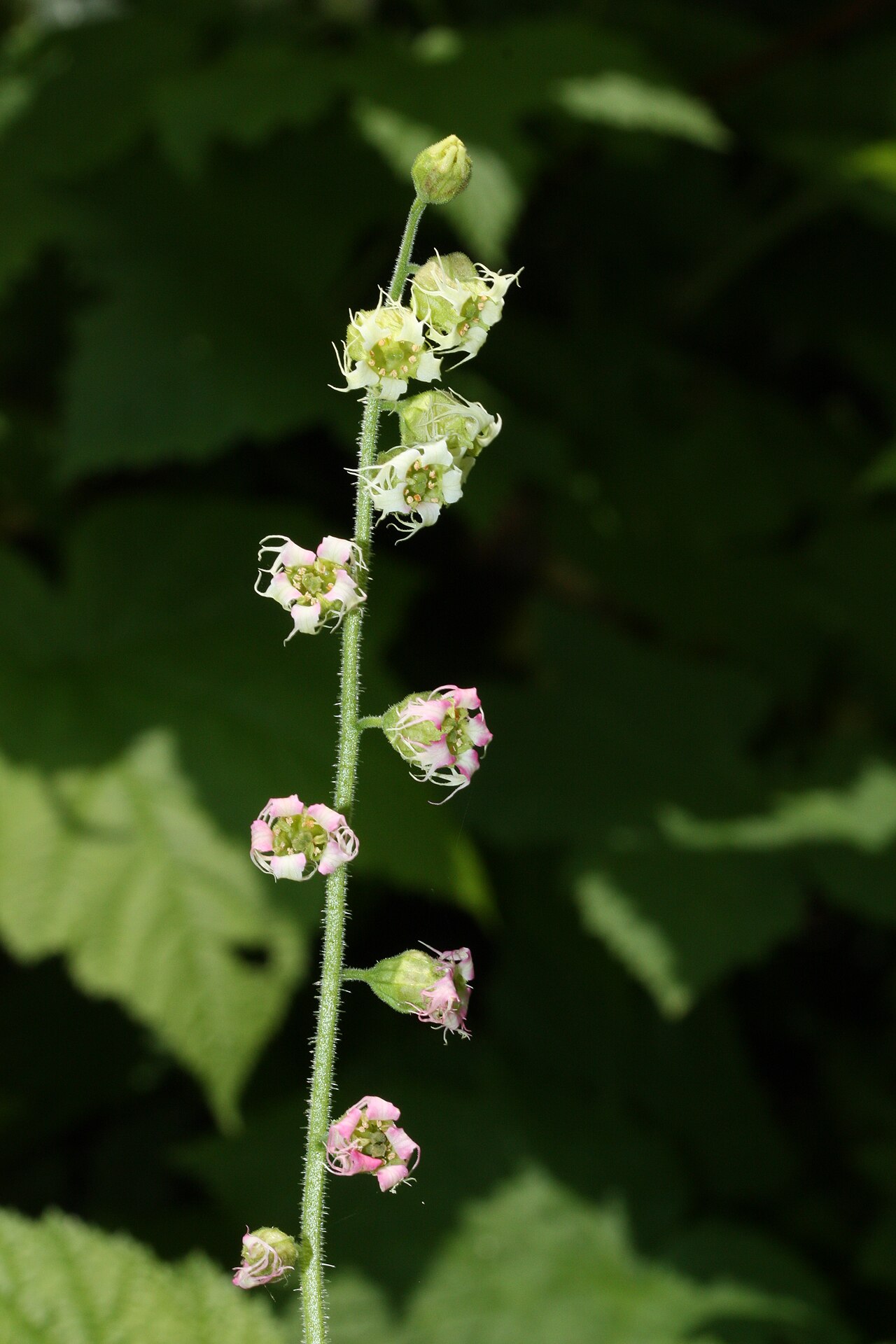
Tellima grandiflora, known as Fringe Cups, fringecup, fragrant fringecup or (in USDA PLANTS) bigflower tellima, is a woodland perennial of the Pacific Northwest and one of the most dependable native plants for shady gardens in the region. It forms low mounds of rounded, hairy, scalloped leaves, and from April to early summer it sends up slender stalks 1 to 3 feet tall, lined with small cup-shaped flowers. Each cup is edged with five finely cut petals that open greenish white and slowly turn pink to deep rose as they age.
Fringe cups belongs to the saxifrage family (Saxifragaceae), alongside alumroots (Heuchera), foamflowers (Tiarella) and piggyback plant (Tolmiea). It is the only species in its genus. Out of flower it is easy to mistake for an alumroot, but once the frilly, faintly sweet-scented flowers open there is nothing else quite like it in western forests.
It grows wild from southern Alaska through British Columbia, Washington and Oregon to the mountains of central California, and inland to northern Idaho and northwestern Montana. This guide covers how to recognize it, where it grows, how to use it in a shade garden, and its surprisingly famous relationship with a small moth.
Identification
Fringe cups is a clump-forming herb with most of its leaves at the base. It is best identified in spring and early summer, when the tall, wand-like flower stalks rise well above the foliage.
Roots & Growth Habit
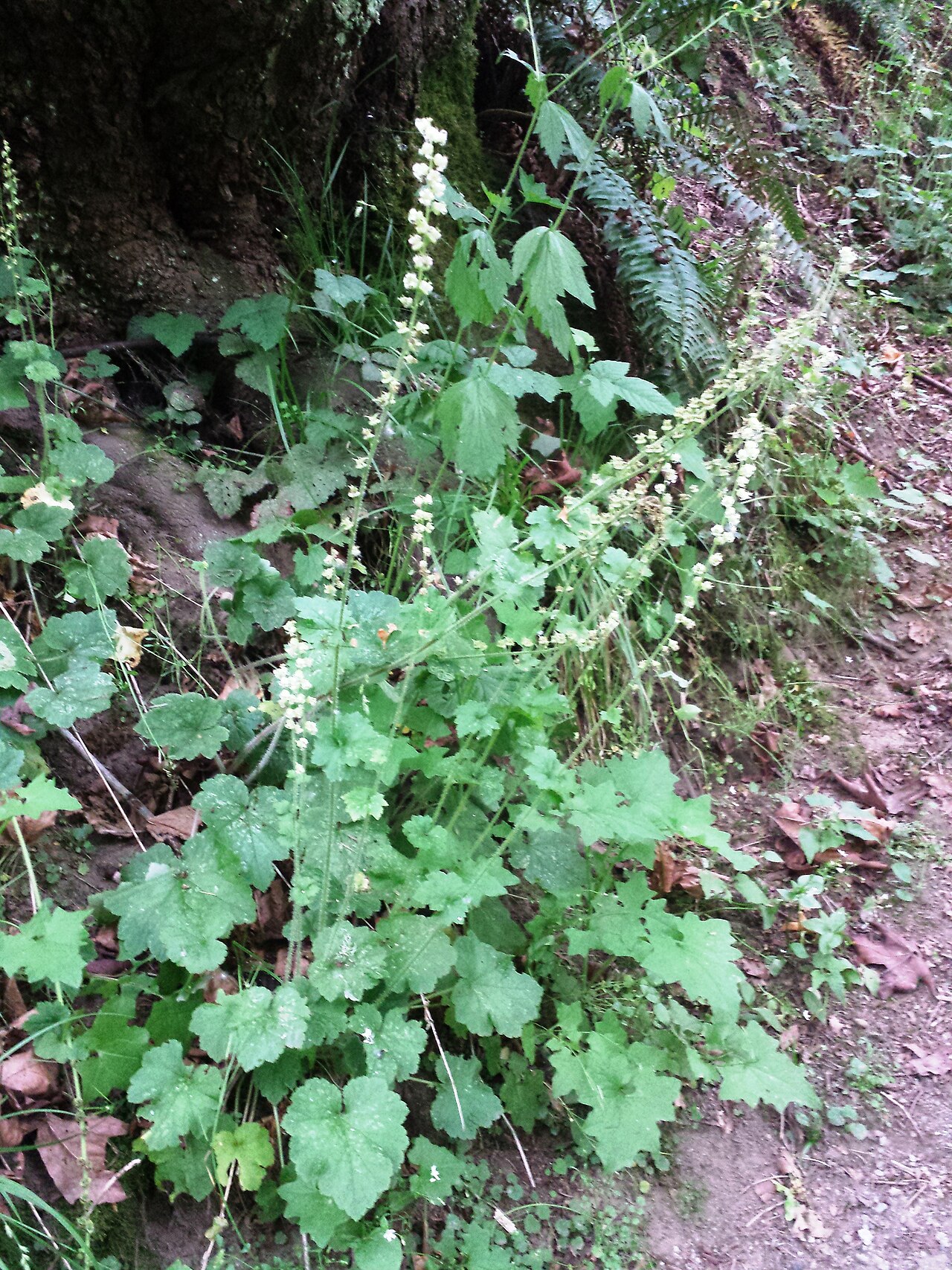
The plant grows from a short, thick rootstock (a caudex) that slowly branches to form a clump. There are no runners, but plants self-sow readily in moist, partly shaded ground, so a single clump can become a loose colony over a few years. In mild climates the leaves stay green through winter.
Leaves
The basal leaves are round to heart-shaped, about 2 to 4 inches across, shallowly divided into five to seven lobes and bluntly toothed along the edges. They sit on long, hairy stalks, and both stalks and leaf surfaces are covered with soft, slightly bristly hairs. The flowering stems carry only a few smaller leaves. In winter or in sun the foliage can take on reddish or bronze tints.
Flowers
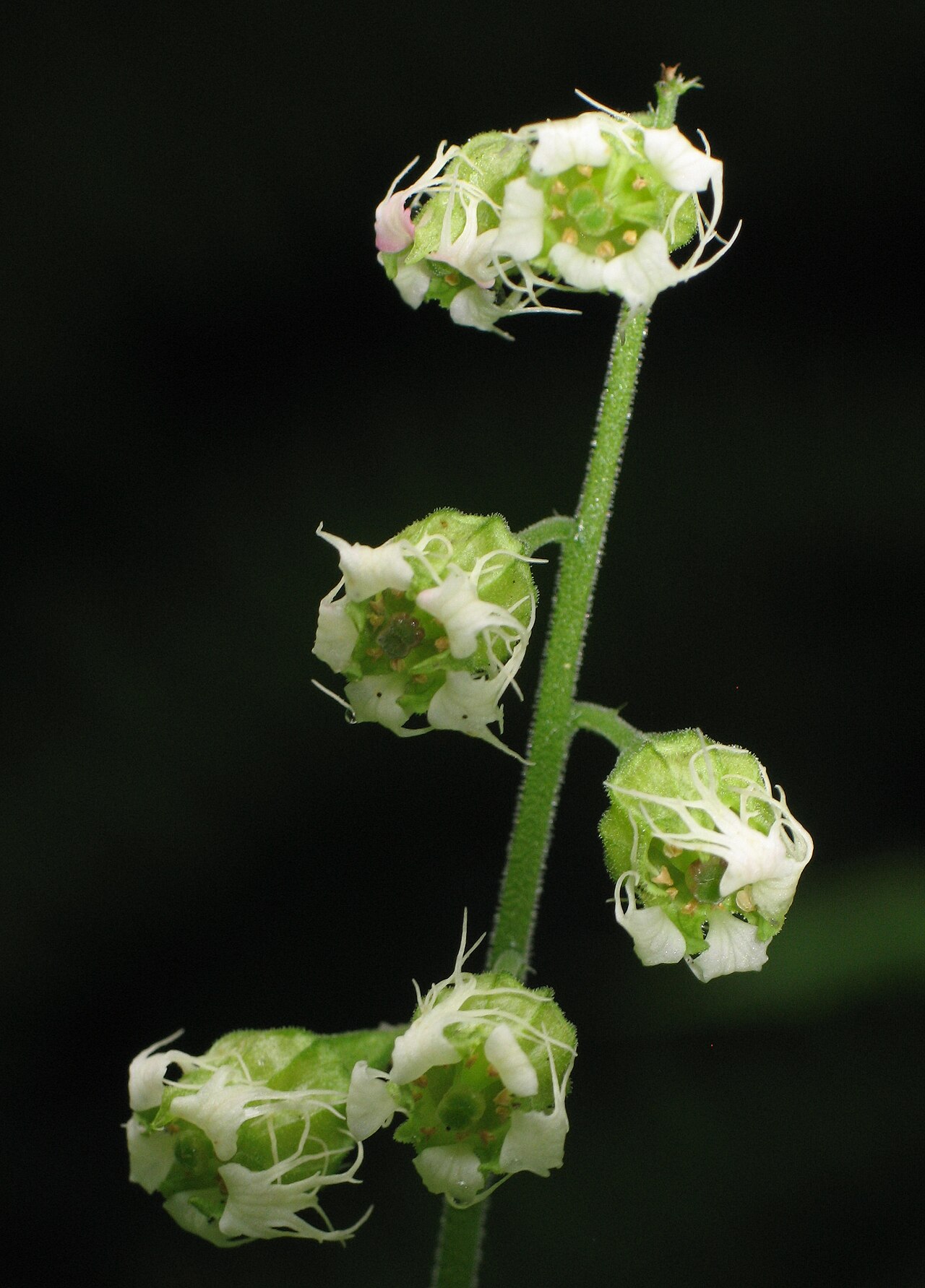
Flowering stems are 1 to 3 feet tall, hairy and often a little sticky near the top. They carry a long, one-sided raceme of 10 to 35 nodding to horizontal flowers. Each flower has a green, bell-shaped calyx about a quarter inch long, which forms the “cup.” Five petals sit on its rim, and each one is deeply cut into narrow, thread-like fringes, so the whole flower looks frilled. The petals open greenish white or cream and age to pink and dark red, so one stalk often shows several colors at once. There are 10 short stamens and 2 styles. The flowers have a light, sweet fragrance, especially in the evening.
Bloom time runs from about April to July, earliest at low elevations near the coast and latest in the mountains and the far north.
Fruit & Seeds
Each flower ripens into a small capsule enclosed in the persistent calyx cup. The capsule opens at the top between its two beaks, and the tiny brown seeds are shaken out when wind or passing animals bend the stalk, much like seeds of alumroot. Seeds need no special treatment and germinate readily on bare, moist soil.
Look-alikes
Alumroots (Heuchera), especially Crevice Alumroot, have very similar leaves, but their flowers are tiny and borne in airy, branched panicles, without fringed cups. Piggyback plant (Tolmiea menziesii) has similar hairy leaves that often grow little plantlets at the leaf base, and its flowers are brownish purple tubes. Foamflower (Tiarella trifoliata) has white, starry flowers in narrow sprays.
Quick Facts
| Scientific Name | Tellima grandiflora (syn. T. odorata); USDA common name bigflower tellima |
| Family | Saxifragaceae (saxifrage family) |
| Plant Type | Herbaceous perennial; semi-evergreen woodland wildflower |
| Mature Height | 1–3 ft in flower; leafy mound 6–12 in |
| Mature Spread | 12–24 in |
| Growth Rate | Moderate |
| Sun Exposure | Part shade to full shade; sun only in cool, moist coastal gardens |
| Water Needs | Moderate; moist soil in spring, tolerates some summer dryness in shade once established |
| Soil Type | Rich, moist, well-drained woodland soil; loam or humusy clay |
| Soil pH | About 5.5–7.0 |
| Bloom Time | April–July |
| Flower Color | Greenish white aging to pink and dark rose |
| Fall Color | Leaves may turn reddish or bronze in cold weather |
| Fruit | Small capsule within the calyx cup, with tiny dark seeds |
| Deer Resistant | Generally; deer seldom browse it heavily |
| USDA Hardiness Zones | 4–9 |
Native Range
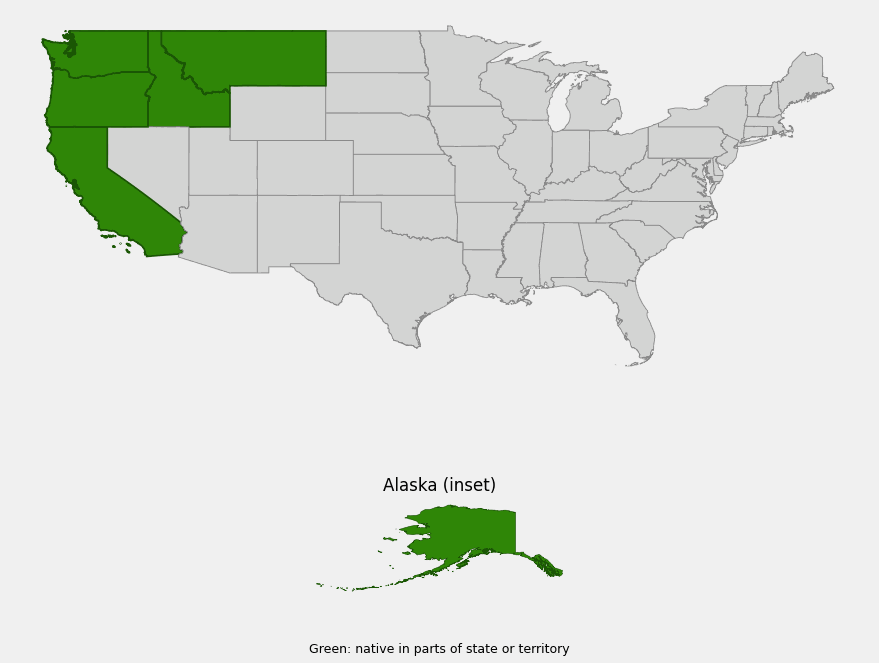
Fringe cups is a plant of the Pacific Northwest and the northern Pacific coast. USDA PLANTS records it as native in Alaska, Washington, Oregon, California, Idaho and Montana, and in British Columbia and Alberta in Canada. In Alaska it reaches north along the coast of the southeastern panhandle, and in California it follows the Coast Ranges and the Sierra Nevada south to roughly San Luis Obispo and Placer counties.
It is most common west of the Cascades, in the moist conifer forests of western Washington, western Oregon and coastal British Columbia, where it grows along streams, in shady ravines, on moist slopes and at forest edges. East of the Cascades it is limited to cooler, wetter forests, and it reaches its inland limit in the northern Rocky Mountains of Idaho and northwestern Montana. NatureServe ranks it as vulnerable in both of those states, and it is considered critically imperiled in Alberta, where only a few populations are known.
Fringe cups is widely grown in gardens in Britain and Ireland and has escaped there to become naturalized in damp woods and on shady banks. Within North America, though, it is native only in the West.
📋 Regional plant lists featuring Fringe Cups: Idaho, Eastern Oregon & Eastern Washington · Montana & Wyoming · Alaska
Growing & Care Guide
Fringe cups is one of the easiest native perennials for shady gardens west of the Cascades, and it does well in similar cool, moist climates elsewhere. It asks for little more than shade, some humus and spring moisture, and it will fill in gaps under trees by seeding itself around.
Light
Part shade to full shade suits it best: under deciduous trees, on the north side of buildings, or at the edge of a woodland. Near the coast, where summers are cool and cloudy, it can take morning sun. In hot, dry inland gardens, full sun scorches the leaves and shortens bloom.
Soil & Water
Give it moist, well-drained soil with plenty of organic matter, like a forest floor. It is not fussy about texture and grows in loam, sandy soil or heavier humus-rich clay. Keep it watered in spring while it flowers. Established plants in shade tolerate the normal dry Pacific Northwest summer, though the leaves may look tired by August. An occasional deep watering keeps them fresh.
Planting Tips
Plant nursery-grown plants in spring or fall, 12 to 18 inches apart. They look best in drifts of five or more, mixed with ferns, wild ginger and other low woodland plants, or along a shady path where the flowers can be seen up close and smelled in the evening. A light mulch of leaves or bark fines keeps the soil cool.
Pruning & Maintenance
Cut the flower stalks back after the seeds ripen if you want to limit self-sowing, or leave them for the moths and seed-eating birds and let the plant spread. Remove tattered leaves in late winter to make room for new growth. Powdery mildew can appear in dry, crowded conditions; better air circulation and spring moisture usually prevent it. Fringe cups has few other problems, though slugs sometimes chew the young leaves.
Propagation
Fringe cups is easy from seed. Sow the fine seed on the surface of moist soil in fall or spring, without covering it deeply; no cold treatment is needed. Mature clumps can also be divided in early spring or fall by cutting the rootstock into sections with leaves and roots attached. Volunteer seedlings move easily while small.
Landscape Uses
- Woodland and shade gardens: a long-blooming spring perennial for dappled shade under trees
- Pacific Northwest native plantings: pairs naturally with sword fern, bleeding heart, wild ginger and Oregon wood sorrel
- Stream banks and rain garden edges: in moist, shady parts of a site that do not flood for long
- Naturalizing: self-sows to fill open ground in shady beds and restoration plantings
- Pollinator and moth gardens: supports native bees and the specialist Greya moths
Wildlife & Ecological Value
Fringe cups looks modest, but it is one of the best-studied wildflowers in western North America because of its partnership with a small moth.
For Pollinators
The fragrant flowers are visited by bumblebees, small native bees, flies and other insects, and the Lady Bird Johnson Wildflower Center notes that they also draw hummingbirds and butterflies. Its most specialized visitor is a small moth, Greya politella (family Prodoxidae, the same family as the yucca moths). The female lays her eggs inside the flower, pushing her ovipositor through the floral cup into the ovary. While she does this, pollen carried on her body is often transferred to the stigma, so she pollinates the flower as she lays her eggs. The caterpillars then eat some of the developing seeds. Ecologist John N. Thompson and his colleagues studied this relationship for many years, showing that whether the moth acts mostly as a partner or mostly as a seed predator depends on which other pollinators are present in a given population.
For Birds
Small seed-eating birds such as juncos and sparrows pick at the seed heads, and the insects the flowers attract help feed warblers and other insectivorous birds during the spring nesting season. The low foliage provides cover on the forest floor.
For Mammals
Fringe cups is not an important food plant for large mammals. Deer usually leave it alone, which makes it useful in gardens where deer are common.
Ecosystem Role
In the understory of Pacific Northwest forests, fringe cups is one of the many herbs that cover and stabilize moist soil along streams, trails and openings. It colonizes disturbed ground such as trail edges and small clearings, where its self-sowing habit lets it fill gaps quickly. Its fine roots and leaf litter add organic matter to the forest floor.
Cultural & Historical Uses
Fringe cups was first described in 1814 by the botanist Frederick Pursh as Mitella grandiflora, and it was later moved to Tellima, a genus named by Robert Brown in 1823. That genus name is an anagram of Mitella, the miterworts, the group in which it was first placed. Grandiflora means large-flowered, which is fair only by comparison with the tiny flowers of miterworts.
Fringe cups had a modest place in Indigenous medicine. According to Pojar and MacKinnon’s Plants of the Pacific Northwest Coast, the Skagit pounded and boiled the plant and drank the tea for many kinds of sickness, especially loss of appetite. It is not a food plant, and like other medicinal herbs it should not be eaten casually.
The plant also has a place in chemistry: the ellagitannins tellimagrandin I and II were named after it, because they were first isolated from Tellima grandiflora. In horticulture it has long been popular in British and European shade gardens, and selections with reddish winter foliage are sold in nurseries. In its home region it is valued as a tough, low-maintenance native that brings soft color and fragrance to shady spring gardens.
Frequently Asked Questions
Does fringe cups grow in full shade?
Yes. It grows well in full to part shade and flowers reliably in the light shade of deciduous trees. Deep, dry shade under dense conifers slows it down, but it still survives there if the soil has some moisture in spring.
Is fringe cups invasive?
Not in its native range, where it simply self-sows into open, moist ground. In gardens it can spread more than expected by seed. Cut the stalks back after flowering if you want to keep it in place. Outside North America, it has become naturalized in parts of Britain and Ireland.
Why do fringe cups flowers change color?
The petals open greenish white or cream and gradually turn pink and then deep rose or red as they age. Many plants change flower color after pollination or with age, which may help insects focus on fresh flowers. Because the stalk opens from the bottom upward, one spike often shows several colors at once.
How is fringe cups different from alumroot?
The leaves are very similar, but the flowers are not. Alumroot (Heuchera) has many tiny flowers in loose, branched sprays, while fringe cups has larger, cup-shaped flowers with deeply fringed petals in a single, unbranched spike.
Is fringe cups deer resistant?
It is generally left alone by deer, which makes it a good choice for shady gardens in the Pacific Northwest where deer browse many other perennials. Slugs are more likely to cause damage, mainly to young leaves in spring.

Looking for a nursery that carries Fringe Cups?
Browse our native plant nursery directory: Alaska · California · Idaho · Montana · Oregon · Washington