
Woodland Pinedrops (Pterospora andromedea)
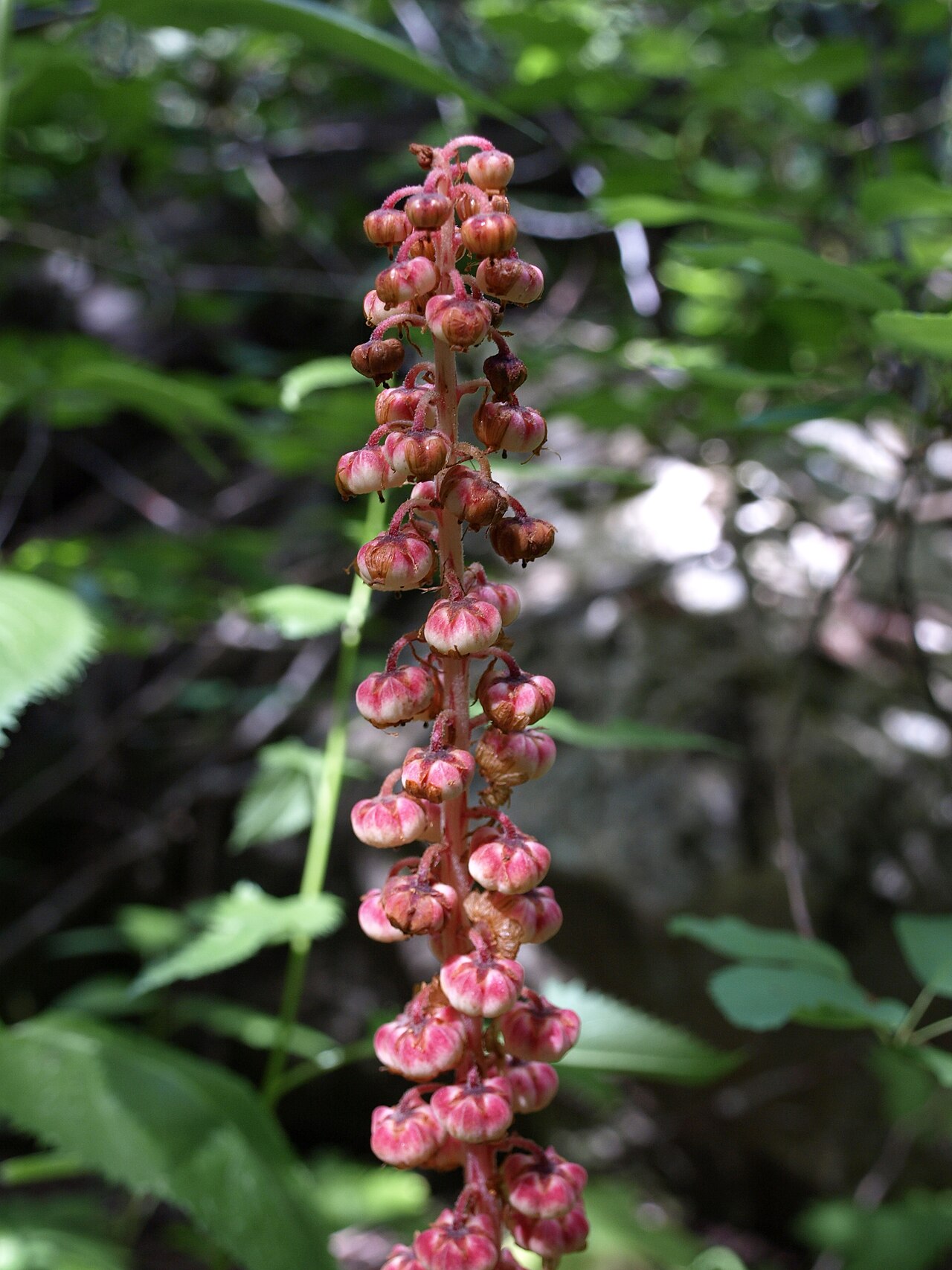
Pterospora andromedea, known as Woodland Pinedrops or simply pinedrops, is one of the strangest and most striking wildflowers of North American conifer forests. In early to midsummer a stiff, sticky, reddish-brown stalk pushes up through the needle litter, sometimes reaching 3 feet or more, and hangs dozens of small cream-colored, urn-shaped flowers along its upper half. There are no green leaves at all. Pinedrops is the only species in its genus and belongs to the heath family (Ericaceae), in the same group as Monotropa (Indian pipe and pinesap); USDA PLANTS places these plants in a separate Indian pipe family, Monotropaceae.
Pinedrops has no chlorophyll and cannot make its own food. It is a mycoheterotroph: its roots are joined to underground fungi, mainly species of Rhizopogon, a group of false truffles, which are in turn linked to the roots of pines and other conifers. Sugars made by the trees pass through the fungus into the pinedrops. In effect the plant lives off the forest’s underground fungal network, which is why it only appears where the right conifers and fungi grow together.
Woodland pinedrops cannot be grown from nursery stock, transplanted, or raised in a garden, and it should never be dug up. A plant removed from its fungal partners simply dies. This page is therefore a guide to identifying, appreciating and protecting pinedrops where it grows wild, from the Pacific Coast and the Rockies to scattered sites around the Great Lakes and in the Northeast, where it is rare.
Identification
Pinedrops is easy to recognize once you have seen it. No other plant in its range combines a tall, unbranched, sticky red-brown stem with a long spike of small, nodding white to yellowish bells. Old stalks are just as distinctive: they dry to a rusty brown and stand through the winter, often into the next summer, still carrying their round seed capsules.
Stems
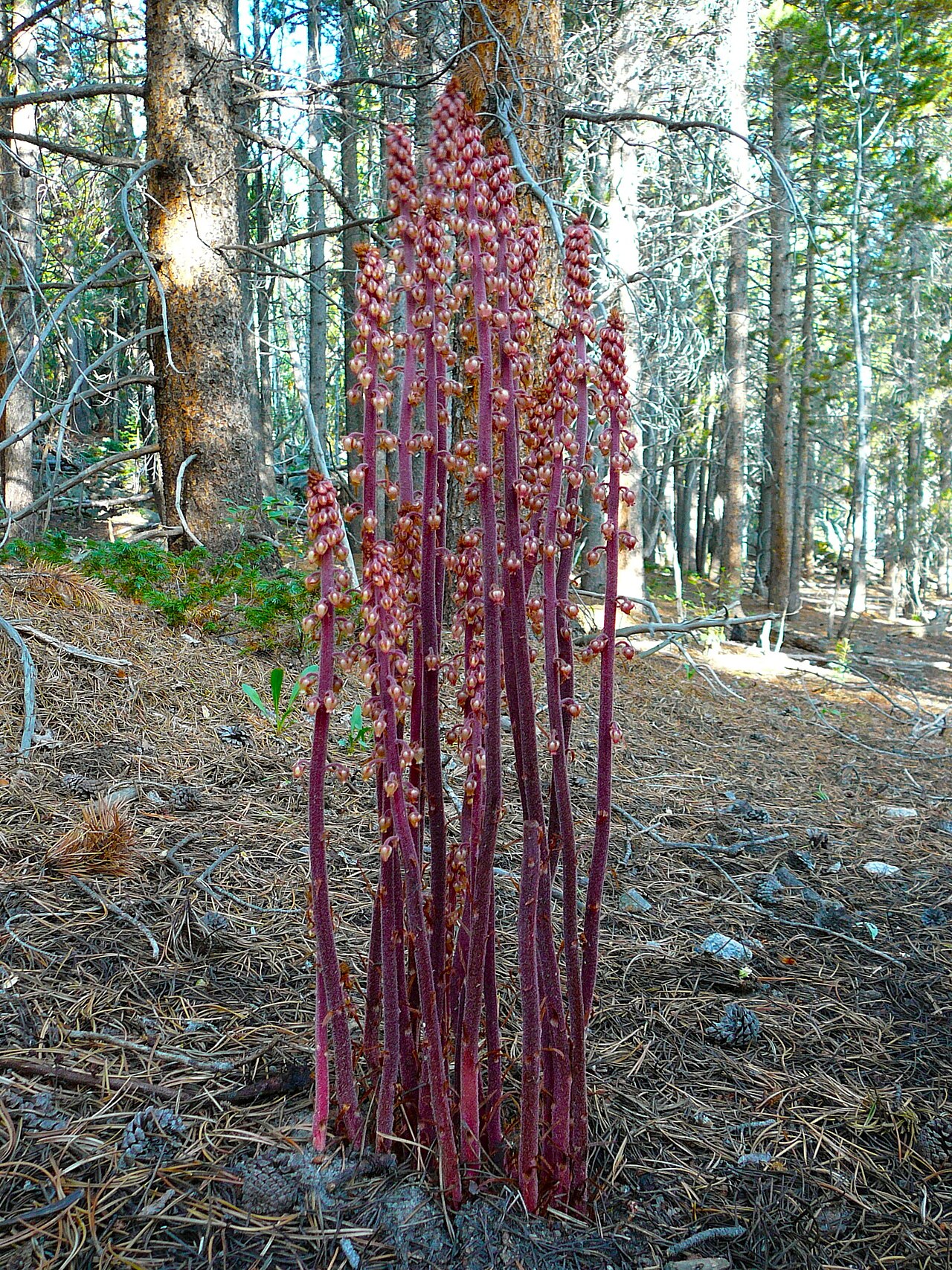
The flowering stem is single and unbranched, usually 1 to 3 feet tall and occasionally taller. It is thick at the base and tapers upward, red-brown to purplish, and covered in short glandular hairs that make it noticeably sticky to the touch. Small insects and bits of debris often stick to it. Several stems commonly rise together from one underground root mass, forming a clump. Each stem lives only one season. The perennial part of the plant is a ball of brittle roots buried in the forest soil, closely wrapped in fungal threads.
Leaves
There are no green leaves. Narrow, brownish scale leaves cluster along the lower part of the stem, especially near the base, and become sparser higher up. They are a remnant of the leaves of the plant’s green ancestors.
Flowers
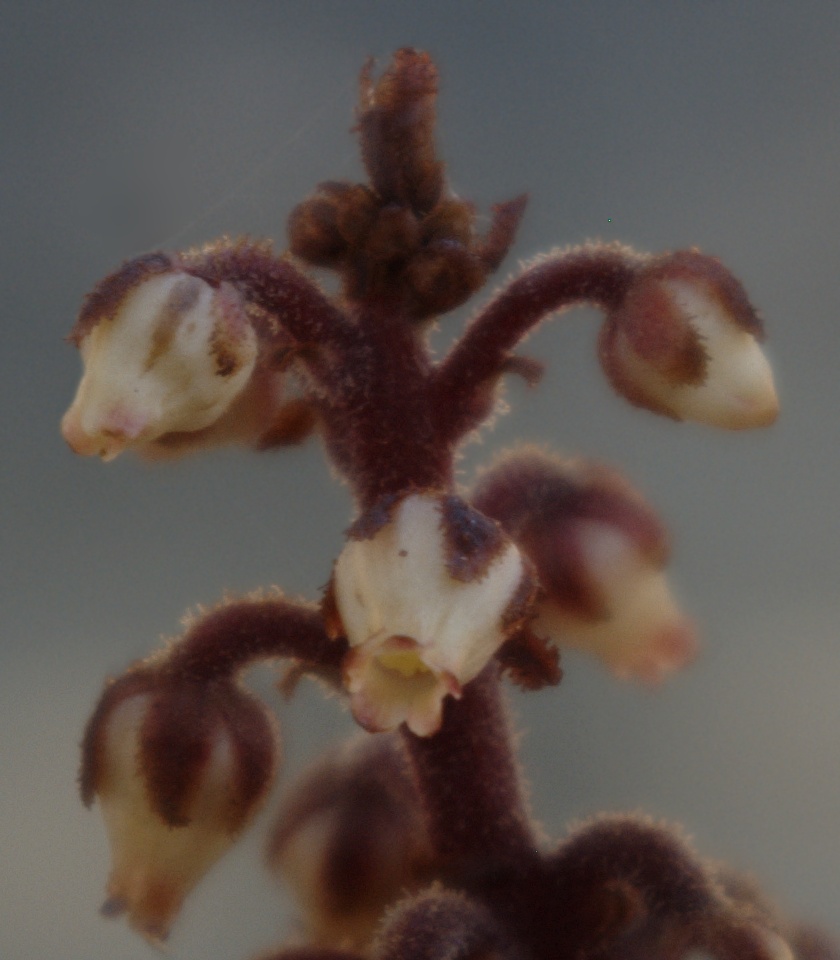
The flowers hang from short, curved, sticky stalks along the upper third to half of the stem, often 30 to 60 or more on a large plant. Each is a small urn or globe about a quarter inch (6 to 8 mm) long, white to cream or pale yellow, sometimes flushed with pink, with five short lobes curled back at the mouth. Five reddish sepals cup the base of the flower. Flowering begins in late spring or early summer at low elevations and runs into August in the mountains and the North.
Fruit & Seeds
After flowering the stalks turn upward and each flower becomes a round, slightly flattened, five-lobed capsule. The capsules dry and split to release great numbers of tiny seeds, each with a broad, papery wing at one end. That wing gives the genus its name: Pterospora means “winged seed” in Greek. The seeds are dust-light, but they can only develop if they land near a compatible Rhizopogon fungus.
Quick Facts
| Scientific Name | Pterospora andromedea Nutt. |
| Family | Ericaceae (heath family), subfamily Monotropoideae; Monotropaceae in USDA PLANTS |
| Plant Type | Mycoheterotrophic perennial herb without chlorophyll |
| Mature Height | 1–3 ft (occasionally taller) |
| Mature Spread | A few inches per stem; stems often grow in clumps |
| Growth Rate | Stalks emerge and reach full height in a few weeks |
| Sun Exposure | Shade to partial shade of conifer forest; not cultivated |
| Water Needs | Not applicable (wild plant); grows in dry to moist forest soils |
| Soil Type | Deep conifer needle litter and humus over well-drained soil |
| Soil pH | Acidic to near-neutral forest soils |
| Bloom Time | June–August |
| Flower Color | White to cream or pale yellow, sometimes pinkish |
| Fall Color | None; stalks dry to rusty brown and persist |
| Fruit | Round, five-lobed capsule with tiny winged seeds |
| Deer Resistant | Rarely browsed; not a garden plant |
| USDA Hardiness Zones | Not cultivated; wild populations in roughly zones 3–8 |
Native Range
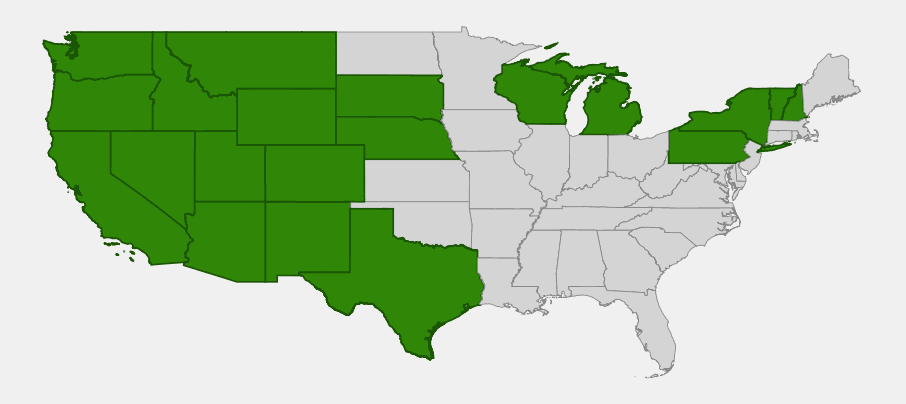
Woodland pinedrops has two quite different parts to its range. In the West it is widespread in conifer forests from British Columbia and Alberta south through Washington, Oregon, Idaho, Montana and California to Nevada, Utah, Colorado, Arizona and New Mexico, and it reaches western Texas in the mountains of the Trans-Pecos and northern Mexico. It also grows in isolated pine forests on the northern Great Plains, such as the Black Hills of South Dakota and the Pine Ridge of northwestern Nebraska. USDA PLANTS records it in 20 states and seven Canadian provinces.
In the East pinedrops is a rarity. Scattered populations grow from Michigan and Wisconsin east through Ontario and Quebec to New York, Vermont, New Hampshire, Pennsylvania, New Brunswick and Prince Edward Island, usually under white pine or in mixed conifer woods on sandy or gravelly soils. Many eastern sites are known from only a few records, and the plant is tracked as rare by natural heritage programs in much of this area.
In the West it is most often found under ponderosa pine, but it also grows with Douglas-fir, lodgepole pine, true firs and other conifers, from fairly low elevations in the Pacific Northwest up into the high mountains. Its distribution follows its fungal partners. Pinedrops can only grow where Rhizopogon fungi are linked to the roots of suitable conifers, so even within its range it is patchy and appears in some years but not others.
📋 Regional plant lists featuring Woodland Pinedrops: New York, Pennsylvania & Northern New Jersey · Idaho, Eastern Oregon & Eastern Washington · Montana & Wyoming · Michigan, Wisconsin & Eastern Minnesota · Nebraska, Kansas & Eastern Colorado · Utah & Western Colorado · New Hampshire, Maine & Vermont · Delaware, Southern New Jersey & Long Island · Arizona & New Mexico
Growing & Care Guide
Pinedrops cannot be grown in gardens. No nursery sells it, because it cannot be propagated or kept alive away from its fungal partners and host trees. Plants that are dug up die, and digging also tears the fungal network that the remaining plants depend on. The sections below describe how to appreciate pinedrops in the wild and how to protect the places where it grows.
Light
Look for pinedrops in the dappled shade of open to fairly dense conifer forest. It does not need light, since it does not photosynthesize, but it grows where its host trees thrive, often in open ponderosa pine stands with sun reaching the forest floor. The best time to photograph it is in soft morning or evening light, when the sticky hairs on the stem glow red.
Soil & Water
Pinedrops grows in deep, undisturbed needle litter and humus over well-drained soils, often on slopes, benches and old forest floors that have not been plowed or bulldozed. Its emergence depends on soil moisture: in dry years many plants stay dormant underground, and after a wet winter and spring they may come up in numbers. Protect these sites from soil compaction, off-trail vehicle use and the removal of litter and logs.
Planting Tips
Do not try to plant, transplant or sow pinedrops. Moving it will kill it. If you own forested land where pinedrops grows, the most helpful thing you can do is keep the conifer canopy and forest floor intact. When building trails, roads or homes in conifer forest, route work around known clumps, and leave mature pines and firs standing nearby, since they are the plant’s ultimate food source.
Pruning & Maintenance
There is nothing to prune. Leave the dried stalks standing: they continue to release seed through autumn and winter and help you relocate the colony next year. Avoid picking flowering stalks for arrangements. Each stalk is the plant’s entire seed crop for the year, and the sticky stems are unpleasant to handle anyway.
Propagation
Pinedrops reproduces only by its tiny winged seeds, which must land near a compatible fungus to germinate. This process has been studied in the laboratory, but it is not a practical way to raise plants, and no legitimate source of propagated plants exists. The best way to help pinedrops spread is to protect mature conifer forests and their soil so that seed and fungi can do their work.
Landscape Uses
- Nature walks and field botany: a memorable summer find on trails through western pine forests
- Photography: tall red stalks and nodding bells make striking subjects in forest light
- Forest ecology education: an easy-to-see example of plants feeding through mycorrhizal fungi
- Habitat stewardship: an indicator worth recording on forested land, especially in the East where it is rare
- Citizen science: records on iNaturalist and with state heritage programs help track scattered eastern populations
Wildlife & Ecological Value
Pinedrops is a small part of the forest by mass, but it is a visible sign of the hidden fungal connections that link conifers, soil fungi and many other forest plants.
For Pollinators
The nodding flowers are visited mainly by bumblebees and other native bees, which hang beneath the bells to reach nectar and pollen. Flies and other small insects also visit.
For Birds
Pinedrops is not an important food for birds. The forests it grows in, especially open ponderosa pine stands, support many birds, including woodpeckers, nuthatches, and Steller’s jays.
For Mammals
Deer and other browsers rarely eat the sticky stalks. The plant’s real link to mammals is indirect but important: Rhizopogon false truffles, its fungal partners, are dug up and eaten by squirrels, chipmunks, voles and other small mammals, which spread the fungal spores through the forest in their droppings.
Ecosystem Role
Pinedrops shows how forests share resources underground. Its Rhizopogon partners form mycorrhizae with pine and fir roots and receive sugars from the trees, and pinedrops taps into that flow without giving anything obvious in return. Research on pinedrops and its relatives has shown that each species is highly specialized, often relying on a narrow group of related fungi. Healthy pinedrops colonies therefore indicate an intact forest soil with both mature host trees and the right fungal partners.
Cultural & Historical Uses
Thomas Nuttall named the genus and species in 1818. The name Pterospora refers to the winged seeds, and andromedea to a resemblance between its urn-shaped flowers and those of Andromeda and related heath-family shrubs, which have similar bell-shaped flowers.
Several Native American peoples of the West knew pinedrops, and ethnobotanical records mention its use in traditional medicine, for example as a preparation for bleeding or lung troubles. These uses are historical. The plant is not a safe or sensible thing to harvest today, both because of its rarity in many areas and because nothing is known about its safety.
For hikers and naturalists, pinedrops is one of the classic surprises of a summer walk in western pine forests, and many people at first mistake it for a fungus or a dead plant. In the East, finding pinedrops is a notable botanical event. Records of new or rediscovered colonies are valuable to state natural heritage programs, so photograph them and report the location rather than collecting anything.
Frequently Asked Questions
Is woodland pinedrops a fungus?
No. Pinedrops is a flowering plant in the heath family, related to blueberries and manzanitas. It has flowers, seeds and roots, but no chlorophyll. It gets its food from soil fungi, which in turn get sugars from the roots of conifers.
Can I grow pinedrops or transplant it to my garden?
No. Pinedrops cannot be grown from nursery stock or moved, and it should never be dug up. It depends completely on specific underground fungi and their host trees, and plants removed from the forest die. Enjoy it where it grows and protect the surrounding forest.
Is pinedrops a parasite?
In a sense. It does not attach directly to tree roots like beechdrops or broomrapes do. Instead it draws its food from mycorrhizal fungi that connect to conifer roots, so it is sometimes called a parasite of fungi. The scientific term is mycoheterotroph.
How is pinedrops different from pinesap and Indian pipe?
All three are leafless heath-family plants that feed through fungi. Indian pipe is waxy white with a single flower per stem, and pinesap is shorter (usually under a foot) with several yellow to reddish flowers in a nodding cluster. Pinedrops is much taller, with a sticky reddish stem and dozens of small bells spread along it.
When and where can I see pinedrops?
Look for flowering stalks from June through August in conifer forests, especially ponderosa pine forests in the western mountains. The dry brown stalks remain standing through winter, so you can find colonies in any season. In the Northeast and Great Lakes it is rare and usually grows under pines on sandy soil.

Looking for a nursery that carries Woodland Pinedrops?
Browse our native plant nursery directory: Arizona · California · Colorado · Idaho · Michigan & Montana · Nebraska, Nevada, New Hampshire, New Mexico & New York · Oregon · Pennsylvania, South Dakota, Texas, Utah & Vermont · Washington · Wisconsin & Wyoming