
Giant Philodendron (Philodendron giganteum)
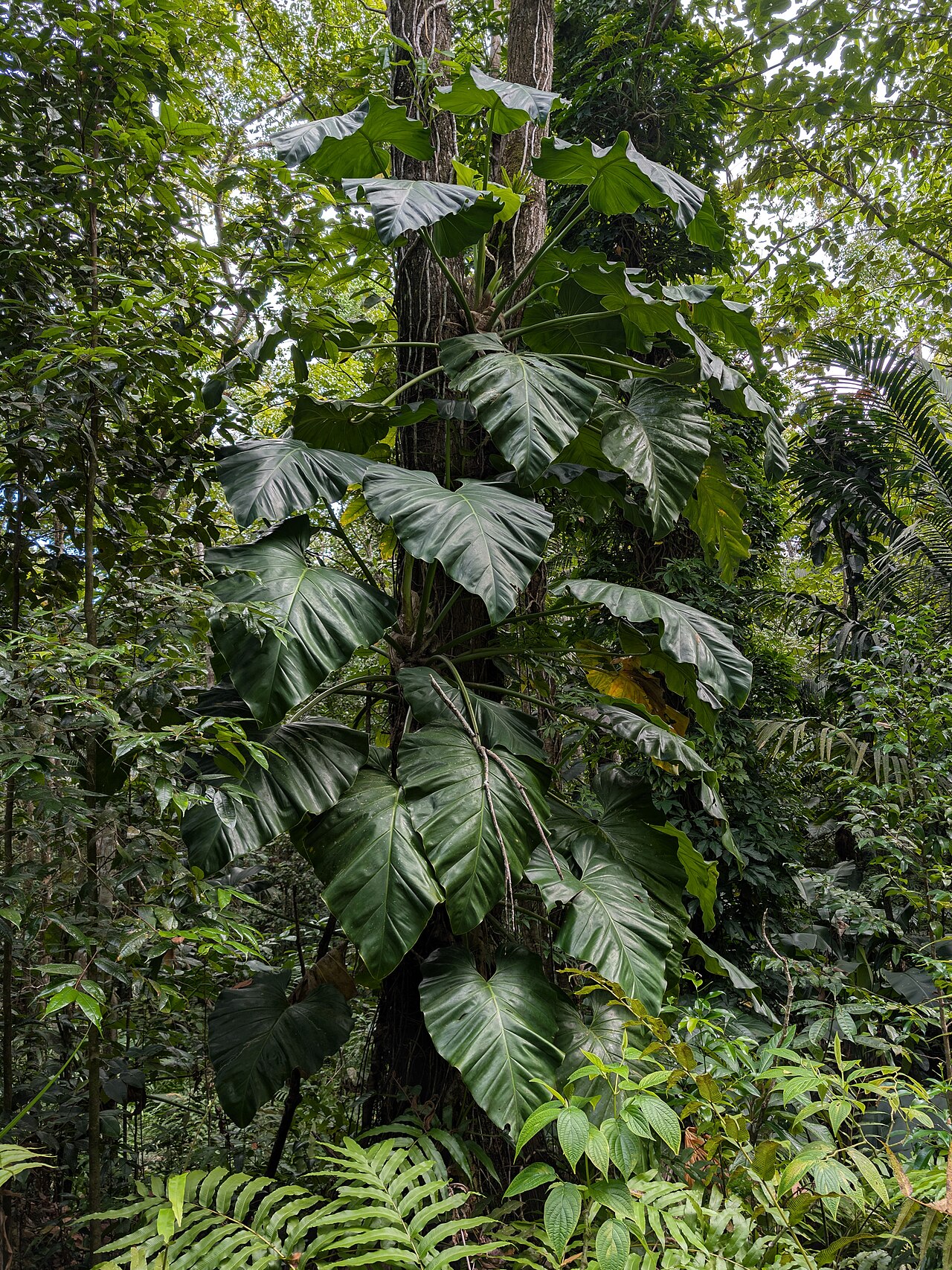
Philodendron giganteum, the Giant Philodendron, is a large native aroid of the Caribbean rain forests and one of the biggest philodendrons in the wild. In Puerto Rico it is called yautía cimarrona, “wild yautía,” because its huge, heart-shaped leaves look like those of the cultivated yautía (tannia, Xanthosoma). A single leaf blade can be about 2 to 2½ feet long and nearly as wide, held on a stalk of similar length. It belongs to the arum family, Araceae.
Giant philodendron begins life on the ground or on rocks and can stay there as a massive, self-supporting clump, or it climbs tree trunks with clasping roots and hangs long, cord-like aerial roots down to the soil. In Puerto Rico the Institute for Regional Conservation records it from El Yunque National Forest in the Luquillo Mountains and from Río Abajo State Forest in the northern karst region, at low and middle elevations up to roughly 3,000 feet. IRC photographs show it growing along roadsides in the Luquillo Mountains.
Philodendrons are among the world’s most popular house plants, but few gardeners know that Puerto Rico has its own native species. This guide covers how to recognize giant philodendron, where it grows, and how to use it in shady gardens in Puerto Rico and in frost-free parts of the U.S. mainland.
Identification
Several large-leaved aroids grow in Puerto Rico’s forests and gardens, including the cultivated yautía and taro, introduced elephant ears, and native climbing philodendrons. Giant philodendron stands out for its size, its thick, leathery, heart-shaped leaves, and its habit of either forming a trunk-like clump or climbing trees.
Stems & Roots
The stem is thick and green, marked with the scars of old leaves. On the ground it grows as a stout, sprawling or short upright stem; on a tree it creeps upward, gripping the bark with short clinging roots. Long, cord-like aerial roots descend from the stem to the soil, sometimes from high in the canopy. Dry, fibrous remains of old leaf sheaths (cataphylls) often cling around the growing tip.
Leaves
The leaves are the plant’s most striking feature. Kew’s description gives petioles 2 to more than 2 feet long (60 to 70 cm) and blades about 20 to 32 inches long and 16 to 24 inches wide (50 to 80 by 40 to 60 cm). The blade is leathery, glossy green, broadly heart-shaped to oval with a short pointed tip, and the two rounded basal lobes form a deep notch where the stalk attaches. A pale midrib and several strong side veins run out from the base. Leaves on young plants are smaller; leaves on plants that have climbed into bright light become the largest.
Flowers
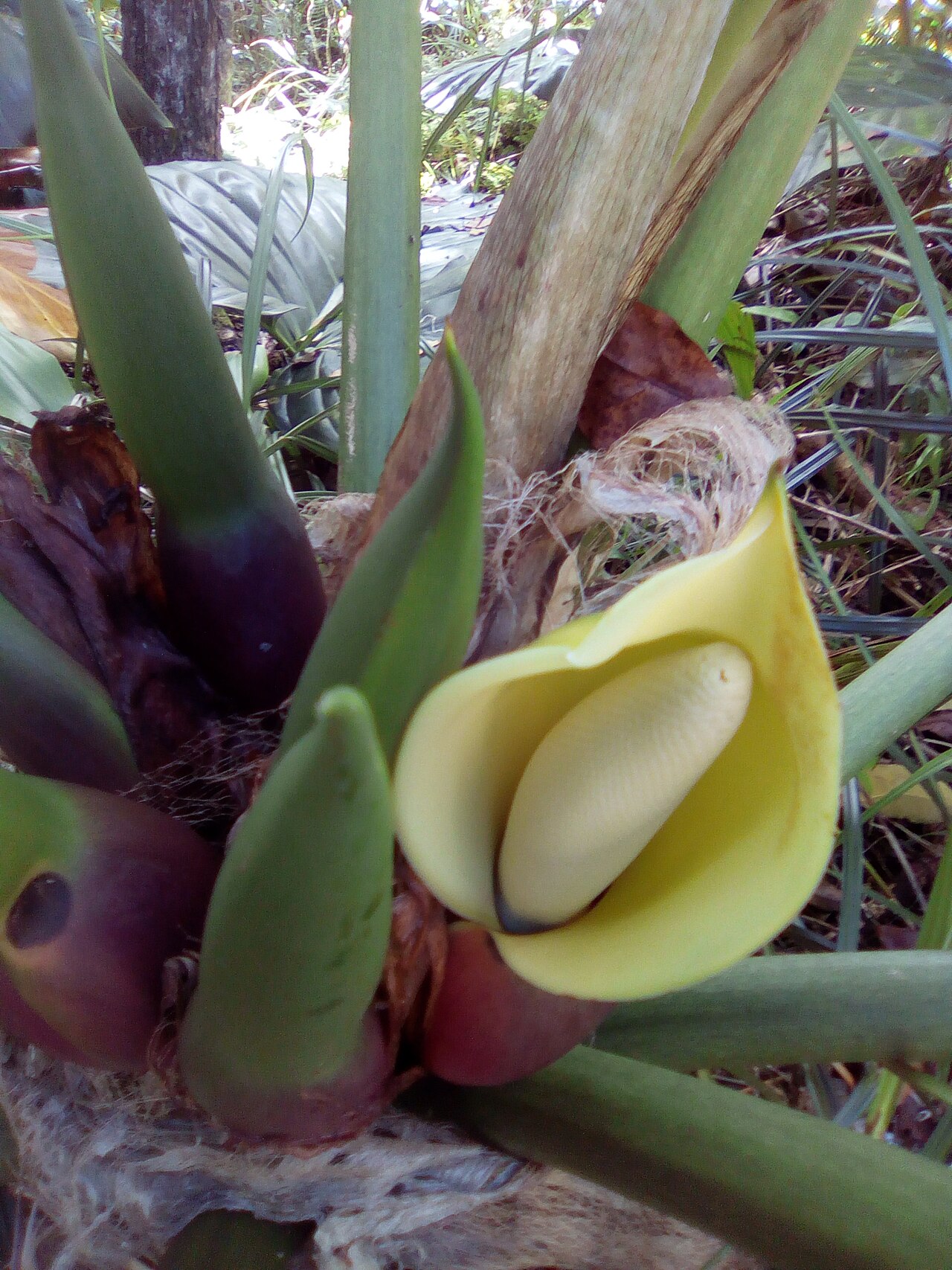
Like all aroids, giant philodendron has tiny flowers packed on a fleshy spike (the spadix) partly enclosed by a large leaf-like bract (the spathe). The inflorescences rise in groups from the leaf axils near the growing tip. The spathe is thick and hooded, green to purplish-red toward the base outside and cream to pale yellow inside, wrapped around a pale, finger-like spadix. Female flowers sit at the base of the spadix and male flowers above them, separated by a band of sterile flowers.
Fruit
After pollination the spadix ripens into a mass of small, juicy berries packed tightly together, each holding tiny seeds. The fruits are eaten by animals, which spread the seeds through the forest.
Quick Facts
| Scientific Name | Philodendron giganteum Schott |
| Family | Araceae (arum family) |
| Plant Type | Large evergreen perennial; terrestrial clump or hemiepiphytic climber |
| Mature Height | 4–8 ft as a ground clump; climbs 20 ft or more up trees |
| Mature Spread | 4–8 ft |
| Growth Rate | Moderate |
| Sun Exposure | Part shade to full shade |
| Water Needs | High; even moisture and high humidity |
| Soil Type | Rich, moist, well-drained forest soil; also limestone and rock |
| Soil pH | About 5.5–7.5 |
| Bloom Time | Irregular; inflorescences may appear at various times of year |
| Flower Color | Spathe greenish or reddish outside, cream to pale yellow inside |
| Fall Color | None; evergreen |
| Fruit | Fleshy spadix of small, tightly packed berries |
| Deer Resistant | Yes; tissues contain irritating calcium oxalate crystals |
| USDA Hardiness Zones | 10b–12 (frost-free); container or conservatory elsewhere |
Native Range
Giant philodendron is native to the Caribbean and northern South America. The Smithsonian’s Flora of the West Indies records it from Hispaniola, Puerto Rico (including Vieques), the Virgin Islands (St. John, St. Thomas and Tortola) and the Lesser Antilles, including Saba, St. Eustatius, St. Kitts, Montserrat, Guadeloupe, Dominica, Martinique and St. Vincent. In South America it reaches Trinidad and Venezuela. USDA PLANTS lists it as native in Puerto Rico.
In Puerto Rico it is a plant of moist forests. The Institute for Regional Conservation lists it from El Yunque National Forest, where it grows in the wet lower montane and tabonuco forest of the Luquillo Mountains, and from Río Abajo State Forest, among the limestone haystack hills (mogotes) of the northern karst. It is found at low and middle elevations, from near sea level to about 1,000 m (3,300 ft), most often in shady ravines, along streams and on forest edges and road banks.
There it grows either on the ground or on rocks, forming large clumps, or as a climber on tree trunks, where its leaves catch the light that filters through the canopy. Plants are especially conspicuous along roads through the Luquillo Mountains, where road cuts provide the bright shade it prefers.
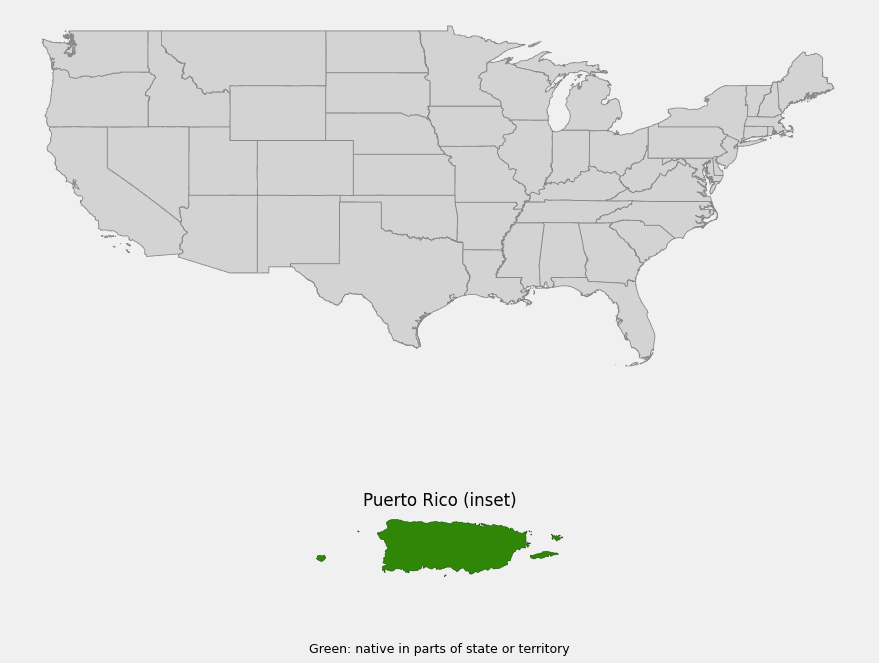
📋 Regional plant lists featuring Giant Philodendron: Puerto Rico
Growing & Care Guide
Giant philodendron is a bold, tropical-looking plant for shady gardens in Puerto Rico, where it is far better adapted than many imported ornamentals. On the U.S. mainland it can be grown outdoors year-round only in frost-free areas, essentially coastal South Florida and the Keys (zones 10b to 11), and it needs shade and regular water there. Elsewhere it is a large container plant for a conservatory, greenhouse or bright indoor room, which can spend summers outdoors in the shade. Buy plants from nurseries; never dig plants from El Yunque or other protected forests.
Light
Give it bright shade or filtered light, like that under a forest canopy. Morning sun is fine, but strong afternoon sun yellows and scorches the leaves, especially in dry air. In deep shade it grows slowly and makes fewer, smaller leaves. Indoors, place it near a bright window out of direct midday sun.
Soil & Water
Plant in rich, moist, well-drained soil with plenty of organic matter, such as composted bark and leaf mold. Water regularly so the soil never dries out completely, but avoid standing water, which rots roots. It appreciates high humidity and responds well to mulch. In containers, use a coarse, chunky aroid mix and water when the top inch of the mix begins to dry. Feed lightly with a balanced fertilizer during the warm, rainy months.
Planting Tips
Give it room: mature leaves are 2 feet or more across, and a ground-grown plant can spread 6 feet or more. Plant it at the base of a large tree or beside a moss-covered wall if you want it to climb, or in an open, shady bed if you prefer a free-standing clump. It works well with tree ferns, palms and native understory shrubs in a shade garden, and on slopes and stream banks where its roots help hold soil.
Pruning & Maintenance
Remove old yellowing leaves at the base. Long aerial roots can be guided into the soil or a pot, or trimmed if they are in the way. Wear gloves when cutting: the sap contains calcium oxalate crystals that irritate the skin, eyes and mouth. Protect container plants from temperatures below about 50°F; cold damages leaves, and frost kills the top growth.
Propagation
The easiest method is stem cuttings. Cut a piece of stem with at least one node and some aerial roots, let the cut surface dry for a day, and plant it in moist, chunky mix in warm shade. Side shoots that form at the base can also be separated with roots attached. It can be grown from fresh seed sown on moist mix, but seed is seldom available.
Landscape Uses
- Shade gardens in Puerto Rico: a native alternative to imported elephant ears and philodendrons
- Climbing on large trees: a natural way to add bold foliage high on a trunk
- Stream banks and ravines: in moist, shaded spots in its native range
- Conservatories and large containers: for dramatic tropical foliage on the mainland
- Forest restoration in Puerto Rico: an understory component of moist and wet forest plantings
Wildlife & Ecological Value
In Puerto Rico’s moist forests, giant philodendron is part of a rich layer of climbing and epiphytic plants that add habitat for animals above the forest floor.
For Pollinators
Philodendrons as a group are pollinated mainly by beetles, especially scarab beetles, which are attracted at night by inflorescences that warm up and give off scent. The beetles feed and mate inside the spathe, then carry pollen to the next inflorescence. The specific pollinators of giant philodendron in Puerto Rico have not been well documented.
For Birds
The broad leaves and climbing stems provide cover and perches for forest birds. Ripe philodendron fruits are eaten by birds and other animals that disperse the seeds, though records for this species are sparse.
For Mammals
Bats and other fruit-eating mammals feed on the fruits of many aroids and help disperse their seeds. Most mammals avoid the leaves, which contain irritating crystals.
Ecosystem Role
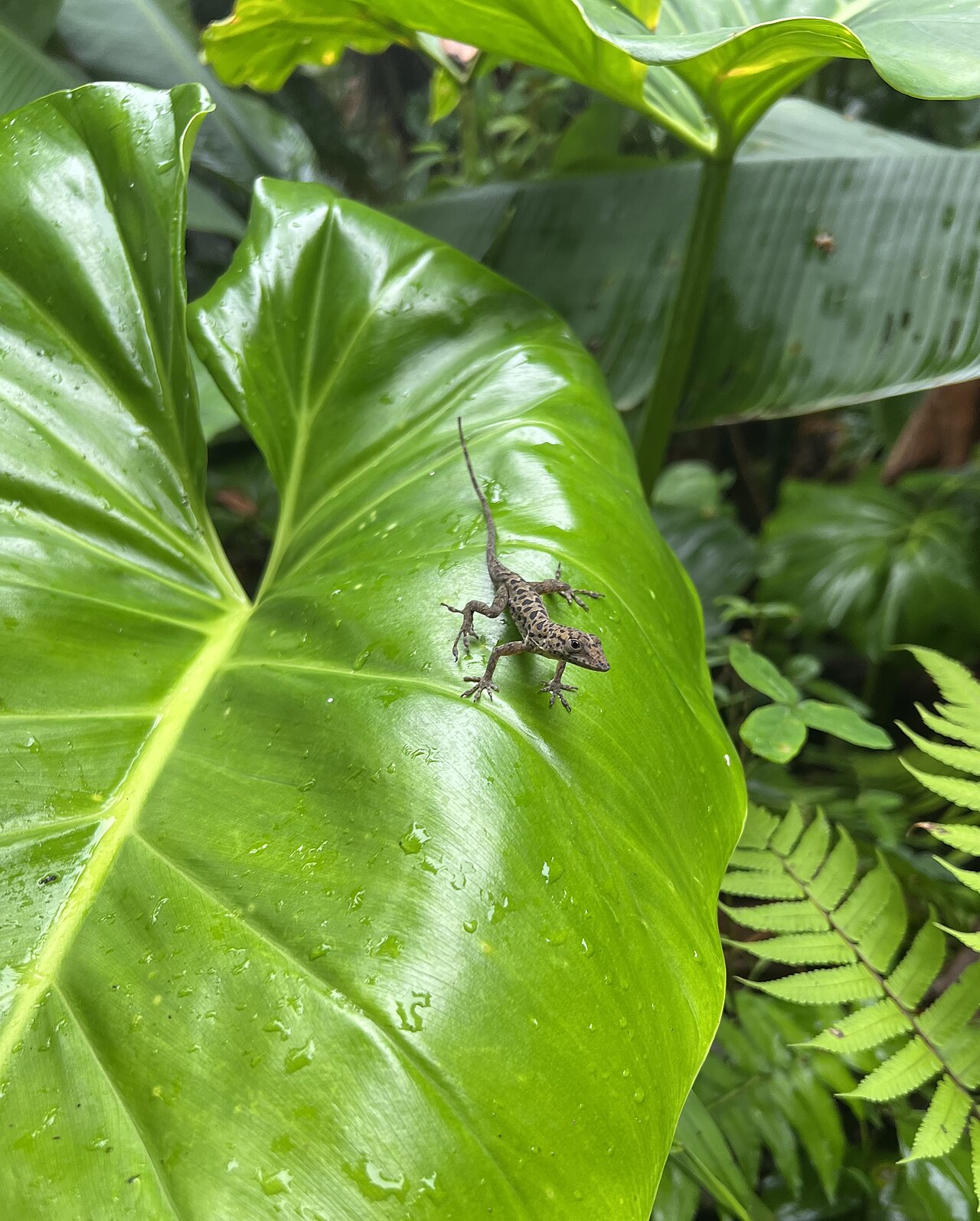
As a hemiepiphyte, giant philodendron links the forest floor and the canopy: its aerial roots trap leaf litter and moisture, and its broad leaves offer shelter and perches for tree frogs such as Puerto Rico’s coquís, anoles and many invertebrates. Its ability to grow on rocks and road banks also helps stabilize slopes in wet mountain forests.
Cultural & Historical Uses
The Austrian botanist Heinrich Wilhelm Schott, who described hundreds of species in the arum family, named Philodendron giganteum in the 19th century. The genus name comes from the Greek for “tree-loving,” referring to the climbing habit of most species, and giganteum refers to the plant’s great size.
Its Puerto Rican name, yautía cimarrona, combines the Taíno-derived name for the edible tannia (yautía) with cimarrona, “wild” or “runaway,” a word used in Puerto Rico for plants and animals that grow wild. Unlike yautía, giant philodendron is not eaten: like all philodendrons, its tissues contain sharp calcium oxalate crystals that make the mouth and throat burn and swell.
Giant philodendron is grown in botanical gardens and parks around the Caribbean for its dramatic leaves, and in conservatories as far away as the Royal Greenhouses of Laeken in Brussels. In Puerto Rico it is one of the most recognizable large-leaved plants of the forests and roadsides of the Luquillo Mountains, and a good example of a native plant that can give a garden the lush look usually sought from imported ornamentals.
Frequently Asked Questions
Is giant philodendron poisonous?
Yes, if eaten. Like other philodendrons, all parts contain calcium oxalate crystals that cause painful burning and swelling of the mouth and throat, and the sap can irritate skin and eyes. Keep it away from children and pets, and wear gloves when cutting it.
Can I grow giant philodendron on the U.S. mainland?
Outdoors only in frost-free areas, essentially coastal South Florida and the Keys, in shade with regular water. Elsewhere it makes an impressive container plant for a conservatory or large, bright room, which can go outside in summer.
Is it the same as the house plant called “elephant ear”?
No. “Elephant ear” usually refers to Colocasia (taro), Alocasia or Xanthosoma (yautía), which are different genera in the same family. Giant philodendron differs by its leathery leaves, its climbing stems with aerial roots, and its inflorescences, which come from the stem rather than from an underground corm.
Where can I see it in the wild?
In Puerto Rico look for it along roads and trails in El Yunque National Forest and in moist forests of the northern karst such as Río Abajo State Forest. Look for huge, glossy, heart-shaped leaves on road banks and on tree trunks.
Does it need a tree to climb?
No. It can grow as a large, free-standing clump on the ground or on rocks. Given a tree, it will climb, and its leaves often get larger as it reaches more light.

Looking for a nursery that carries Giant Philodendron?
Our nursery directory does not yet include Puerto Rico. Browse the native plant nursery directory by state: Alabama–Arkansas · California · Colorado–Hawaii · Idaho–Kansas · Kentucky–Montana · Nebraska–Oklahoma · Oregon · Pennsylvania–Virginia · Washington · West Virginia–Wyoming