Great Leadtree (Leucaena pulverulenta)
Leucaena pulverulenta, commonly called Great Leadtree, Mexican Leadtree, or tepeguaje, is the largest and fastest-growing native legume tree of the Rio Grande Valley. Where many Tamaulipan thornscrub species are low, thorny, and slow, Great Leadtree stands apart as a genuinely large, fast-growing shade tree that can reach 40 to 60 feet, with an airy, fine-textured canopy of fern-like, bipinnately compound leaves that gives it an almost tropical look among its brushier neighbors.
The species name pulverulenta (“powdery” or “dusty”) describes the fine grayish-white pubescence that coats young twigs, leaf stalks, and new growth, giving fresh shoots a dusted appearance that is a useful identification clue. In spring the tree covers itself in small, round, puffball-like white flower heads typical of the mimosoid legumes, followed by clusters of flat, papery brown seed pods.
In the Rio Grande Valley, Great Leadtree is prized as a fast shade tree for large yards, parks, and riparian restoration, valued for both its quick growth and its value to pollinators and seed-eating birds. It needs room to spread and is best suited to larger properties rather than small urban lots, since mature trees develop a broad, open canopy.
Identification
Great Leadtree grows as a single- or multi-trunked tree, often developing several major leaders from near the base, with a light, open, spreading canopy rather than a dense one.
Bark & Stems
Bark on mature trunks is gray to grayish-brown, becoming furrowed and somewhat scaly with age. Young twigs and new growth are covered in a fine, pale, powdery pubescence that gives them a dusty gray-green cast, the source of the species’ name.
Leaves
Leaves are bipinnately compound (twice-divided, like a fern or mimosa), 4 to 8 inches long, with numerous small, narrow leaflets arranged in opposite rows along each division. The fine, feathery texture distinguishes Great Leadtree at a glance from the simple or once-compound leaves of most other thornscrub trees, and the foliage often shows the same pale, dusty coating as the twigs when new.
Flowers
Flowers are tiny and individually inconspicuous but are packed into round, white, puffball-like heads about 1/2 to 3/4 inch across, each made up of many long-stamened flowers radiating from a central point — the classic mimosoid-legume flower structure. Bloom is heaviest in spring, often continuing sporadically into summer, and the flower heads are fragrant and visited heavily by bees.
Fruit & Seeds
The fruit is a flat, thin, papery brown legume pod, 4 to 8 inches long, borne in clusters and splitting open at maturity to release several flattened brown seeds. Pods persist on the tree into fall and winter, rattling in the wind before fully releasing their seeds.
Quick Facts
| Scientific Name | Leucaena pulverulenta |
| Family | Fabaceae (Legume/Pea) |
| Plant Type | Deciduous to Semi-Evergreen Tree |
| Mature Height | 40–60 ft (12–18 m), occasionally taller |
| Mature Spread | 30–50 ft |
| Growth Rate | Fast |
| Sun Exposure | Full Sun |
| Water Needs | Low to Moderate |
| Soil Type | Clay, loam, caliche; tolerates periodic flooding |
| Soil pH | Neutral to alkaline |
| Bloom Time | Spring, sporadically into summer |
| Flower Color | White |
| Fall Color | None notable |
| Fruit | Flat papery brown legume pods, 4–8 in |
| Deer Resistant | No (foliage and pods browsed) |
| USDA Hardiness Zones | 9a–11 |
Native Range
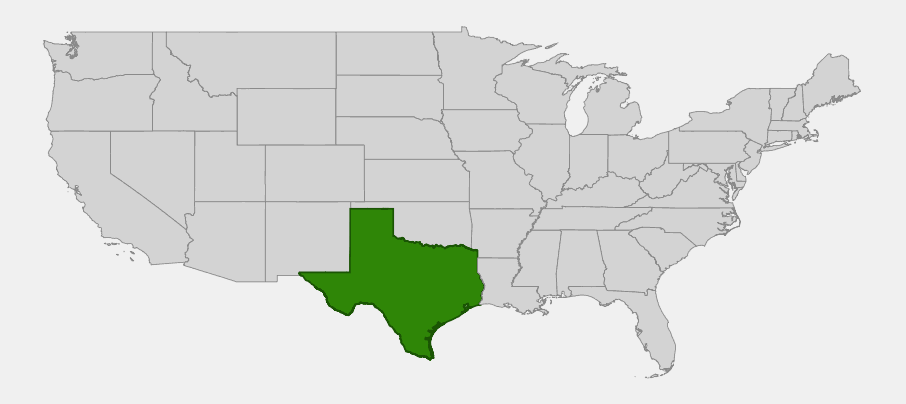
Great Leadtree is native in the United States only to the Rio Grande Valley of South Texas, where it is a signature tree of the riparian forest (resaca and river-bottom) communities along the lower Rio Grande. From there, its range extends south through eastern Mexico into southern Mexico and beyond, making the Valley populations the northernmost extent of a largely Mexican and Central American distribution.
Within the Rio Grande Valley, Great Leadtree is strongly associated with the native riparian forest known locally as Sabal palm/ebony riverine woodland, growing along the river itself and around resacas (old river channels) where its roots can reach reliable moisture even through dry periods. It is far less common away from these riparian corridors, reflecting a real, if somewhat moisture-dependent, affinity within an otherwise dry thornscrub landscape.
Because its native range is narrowly confined to the Valley’s river-bottom habitats, Great Leadtree should be planted within or very near this native range in South Texas, where its size and water relationships make ecological sense, rather than as a general shade tree elsewhere in Texas.
📋 Regional plant lists featuring Great Leadtree: South and West Texas
Growing & Care Guide
Great Leadtree’s fast growth and tolerance of a range of soils make it a satisfying tree for large South Texas properties willing to give it room and, ideally, access to reliable moisture.
Light
Full sun produces the strongest growth and the fullest canopy. Young trees tolerate some light shade but grow noticeably faster and straighter in open sun.
Soil & Water
Great Leadtree performs best in deep, moisture-retentive soils near its native riparian habitats but is adaptable to clay, loam, or caliche-influenced ground as long as drainage is reasonable. It tolerates periodic flooding, reflecting its river-bottom origins, and while established trees handle drought better than young ones, consistent moisture produces faster growth and a fuller canopy. As a legume, it fixes its own nitrogen and generally needs no fertilizer.
Planting Tips
Plant from containers in spring, giving trees 30 to 50 feet of eventual spread — this is not a tree for small urban lots or tight foundation plantings. A site near a drainage swale, pond edge, or seasonally moist low spot mimics its natural riparian habitat and will produce the best growth.
Pruning & Maintenance
Young multi-trunked trees can be trained to a single leader if a classic shade-tree form is wanted, or left multi-trunked for a broader, more naturalistic canopy. Remove crossing or weak branches while the tree is young; mature trees need little regular pruning beyond routine deadwood removal.
Propagation
Propagate from seed collected from mature, dry brown pods; nicking or briefly soaking the hard seed coat improves and speeds germination, a common requirement across the legume family. Seedlings grow quickly once established.
Landscape Uses
- Fast shade tree for large South Texas yards and parks
- Riparian restoration along river corridors and resacas
- Pollinator garden centerpiece during spring bloom
- Wildlife plantings for seed-eating birds
- Windbreak or screen where its fast growth and height provide quick coverage
Wildlife & Ecological Value
As one of the larger native trees of the Rio Grande Valley’s riparian forest, Great Leadtree contributes significantly to the structure and food web of that increasingly rare habitat.
For Pollinators
The round white flower heads bloom heavily in spring and are a strong draw for honeybees and native bees, which work the many long-stamened flowers in each head for both nectar and pollen.
For Birds
Seed-eating birds feed on the seeds released from the papery brown pods through fall and winter, and the tree’s size and open canopy provide nesting and perching sites favored by larger riparian-corridor birds.
Ecosystem Role
Great Leadtree is a canopy-forming component of the Rio Grande Valley’s native riparian forest, one of the most reduced and fragmented habitat types in Texas. As a nitrogen-fixing legume, it also contributes to soil fertility for the understory plants growing beneath it, and mature trees provide shade structure that helps keep streambank and resaca microhabitats cooler and moister.
Cultural & Historical Uses
In its native range in Mexico, tepeguaje wood has traditionally been valued as a durable, termite-resistant timber used for fence posts, construction poles, and firewood, and the tree’s fast growth has long made it a practical source of renewable wood in rural areas. The related genus Leucaena, including this species’ better-known relative Leucaena leucocephala, has also been used historically for fodder and green manure in parts of Latin America, though Great Leadtree itself is primarily valued as a shade and timber tree rather than for livestock forage.
In South Texas, Great Leadtree has long been a familiar tree along the Rio Grande and around Valley resacas, providing shade for homesteads and livestock long before formal landscaping with native plants became common practice.
Today, interest in Great Leadtree centers on its role in riparian restoration and as a fast, genuinely native shade tree for large Rio Grande Valley properties, offering an alternative to non-native fast-growing shade trees that provide far less wildlife value.
Frequently Asked Questions
How big does Great Leadtree get?
Mature trees typically reach 40 to 60 feet tall with a spread of 30 to 50 feet, making it one of the largest native trees available for South Texas landscapes. Give it plenty of room.
Is Great Leadtree the same as the invasive Leucaena leucocephala?
No. They are related species in the same genus, but Great Leadtree (Leucaena pulverulenta) is native to the Rio Grande Valley, while Leucaena leucocephala is a different, non-native species that has become invasive in parts of the tropics. Confirm you have the correct species before planting.
Does Great Leadtree need a lot of water?
It grows fastest and fullest with consistent moisture, reflecting its native riparian habitat, but established trees tolerate drought reasonably well. For the best results, plant it where it can access groundwater or seasonal moisture.
Is Great Leadtree a good shade tree for a small yard?
Not really — its eventual size and spread make it better suited to large properties, parks, and riparian restoration sites than small urban lots where its mature canopy would quickly outgrow the space.
How fast does Great Leadtree grow?
Very fast for a native Texas tree, often adding several feet of height per year under good conditions, which is part of why it is valued for quick shade and canopy restoration along the Rio Grande.

Looking for a nursery that carries Great Leadtree?
Browse our native plant nursery directory: Texas