
Hawaiʻi Jewel Orchid (Anoectochilus sandvicensis)
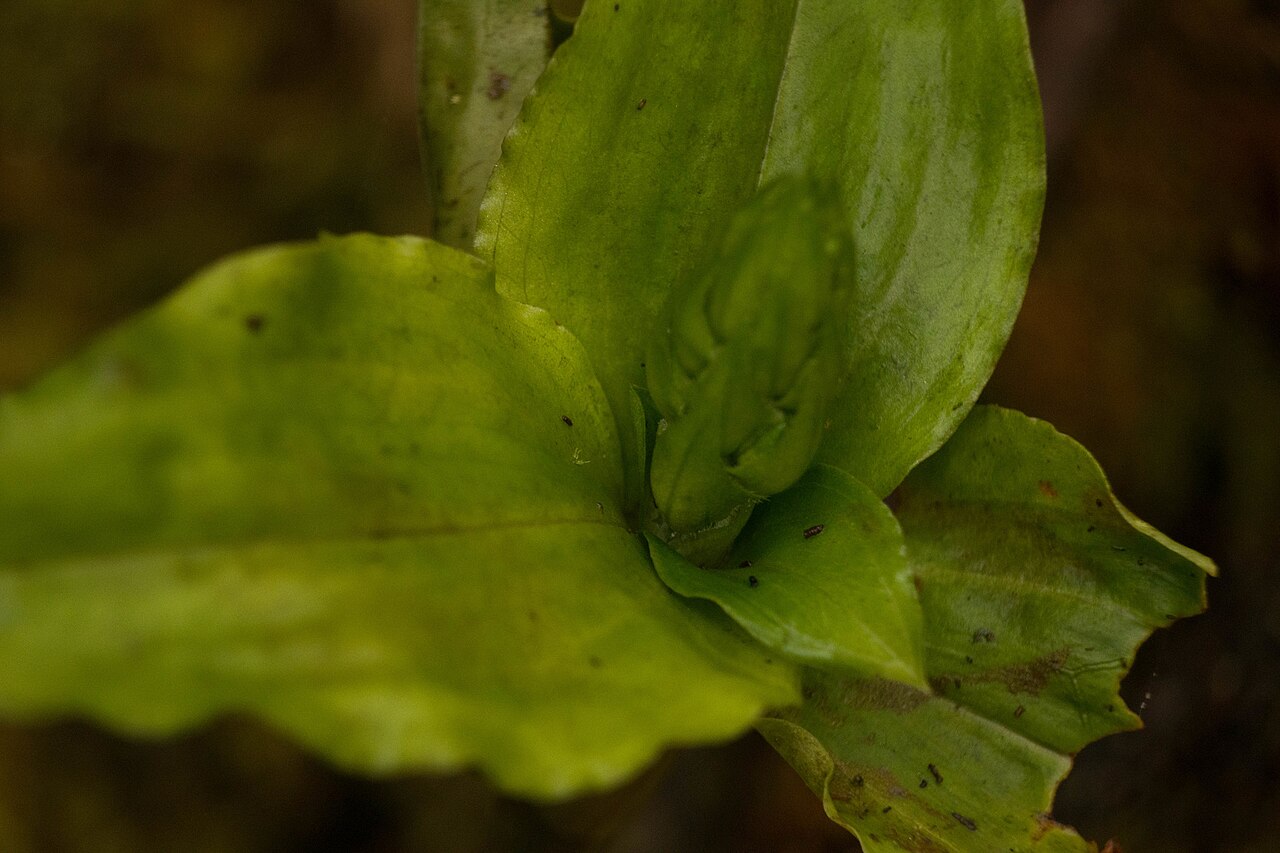
Anoectochilus sandvicensis, the Hawaiʻi jewel orchid (also called the Hawaiʻi jeweled orchid), is one of only three orchids native to the Hawaiian Islands, and it grows nowhere else. It is a small, ground-dwelling orchid of dark, constantly wet rainforest, where it creeps through moss and leaf litter and raises a short spike of small flowers.
Unlike ʻawapuhiakanaloa (Liparis hawaiensis), it has no known Hawaiian name; of the three native orchids, only ʻawapuhiakanaloa has one. Its relatives in Asia are the “jewel orchids,” grown for their velvety leaves with glittering veins, but the Hawaiian species has plain green leaves and is easy to overlook.
The Hawaiʻi jewel orchid is not federally listed under the Endangered Species Act, but it is uncommon and threatened by habitat loss, feral pigs and invasive plants. Honestly, it is very hard to grow outside its rainforest habitat and is not sold by nurseries. Enjoy it where it grows, and never dig or collect plants. This guide covers how to recognize it, where it lives, and why it belongs in the forest rather than the garden.
Identification
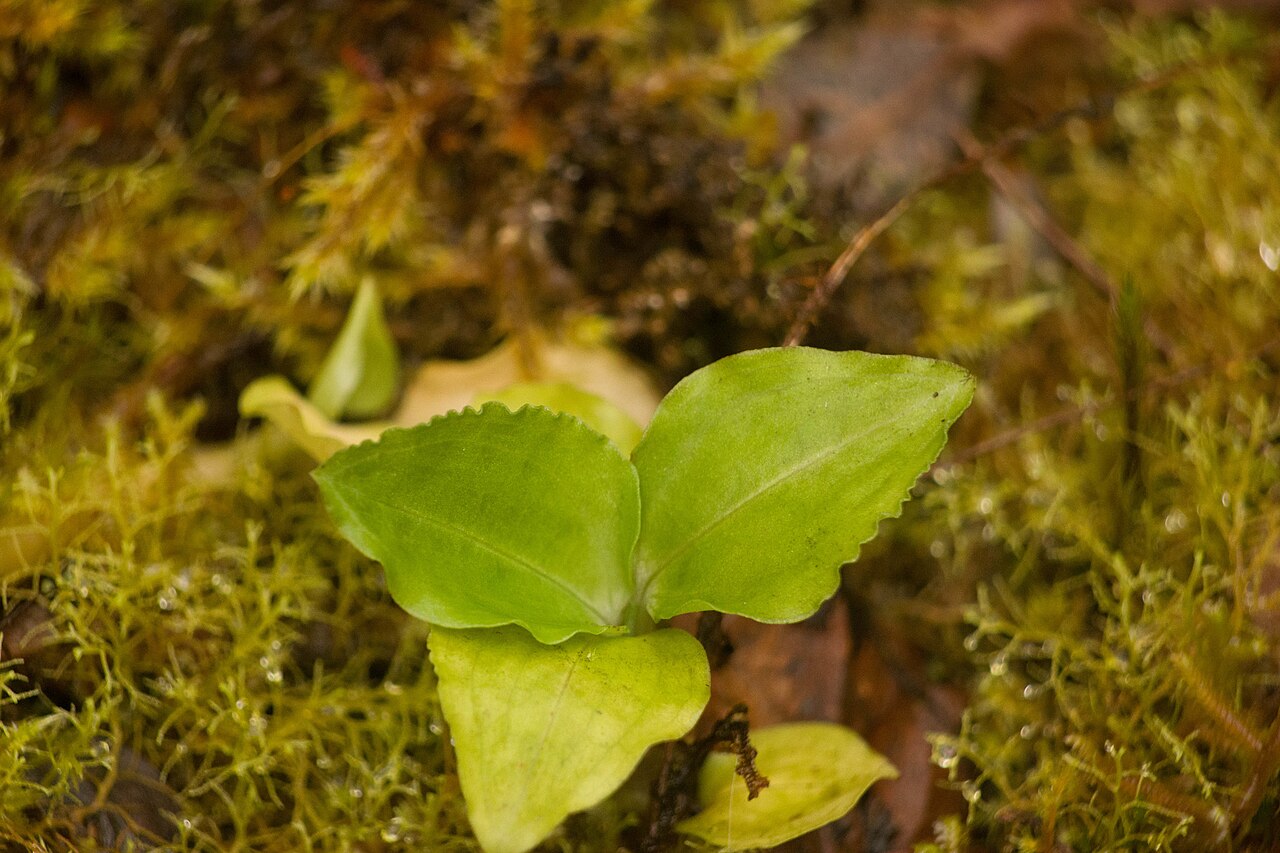
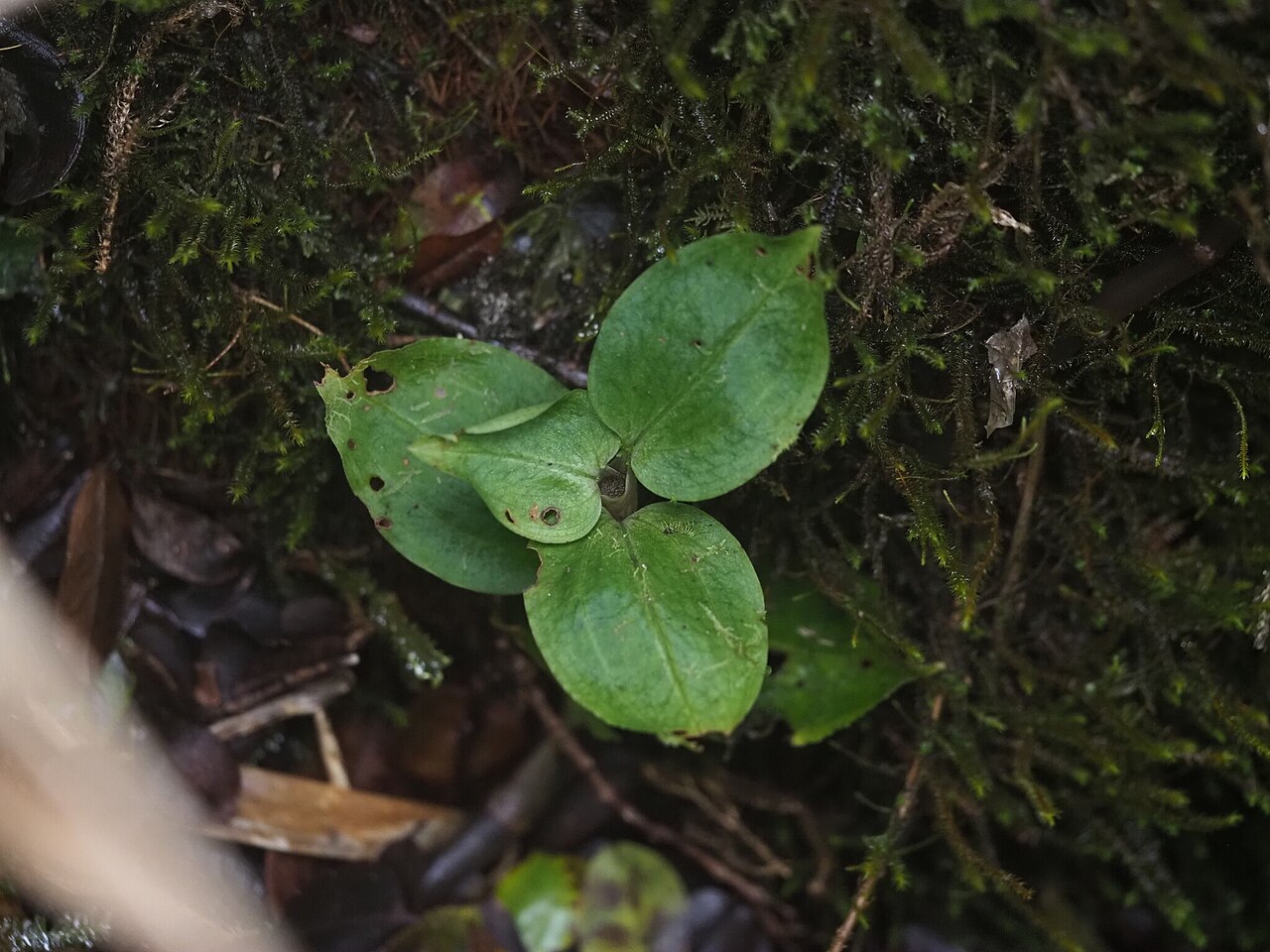
The Hawaiʻi jewel orchid is a low, inconspicuous plant. Look for a small cluster of broad, soft, plain green leaves with wavy edges, sitting on moss or wet soil in deep shade, sometimes with an upright flower spike in the center.
Growth Habit
A small, perennial herb that grows from a fleshy, creeping stem lying on or just under the moss and litter, rooting along its length. The stem turns upright at the tip and carries a loose rosette of leaves. Leafy plants are usually only a few inches tall; in flower the spike can reach about 8 to 20 inches.
Leaves
Each shoot has a few broad, oval to egg-shaped leaves with pointed tips and slightly wavy edges, usually 1 to 3 inches long. They are soft, thin and smooth, medium to yellow-green, and lack the bright, netted veins of the Asian jewel orchids grown as houseplants. The leaf bases wrap around the stem.
Flowers
A single upright spike grows from the center of the rosette, with the developing flowers tightly packed at first. The small flowers open along the spike and are mostly whitish to greenish, with a lip that is typical of jewel orchids. Flowering times are not well documented and vary by site.
Fruit & Look-alikes
The fruits are small capsules that release huge numbers of dust-like seeds. ʻAwapuhiakanaloa (Liparis hawaiensis) has just two glossy leaves from a cone-shaped pseudobulb and spidery pale green flowers. Seedlings of ʻUkiʻuki and other native forest-floor plants can look similar at first, but they lack the creeping, fleshy orchid stem.
Quick Facts
| Scientific Name | Anoectochilus sandvicensis Lindl. |
| Family | Orchidaceae (orchid family) |
| Plant Type | Terrestrial perennial orchid; Hawaiian endemic |
| Mature Height | 2–6 in leafy; flower spike to about 20 in |
| Mature Spread | 3–8 in |
| Growth Rate | Slow |
| Sun Exposure | Deep shade |
| Water Needs | Very high; constantly wet |
| Soil Type | Moss, wet humus and leaf litter |
| Soil pH | Acidic |
| Bloom Time | Not well documented; varies by site |
| Flower Color | Whitish to greenish |
| Fall Color | None |
| Fruit | Small capsule with dust-like seeds |
| Deer Resistant | No; trampled and uprooted by feral pigs, eaten by slugs |
| USDA Hardiness Zones | 10–12 (cool, wet rainforest in Hawaiʻi) |
Native Range
The Hawaiʻi jewel orchid is endemic to the Hawaiian Islands and grows nowhere else in the wild. USDA PLANTS lists it as native only in Hawaiʻi. Recent records come from Kauaʻi, Oʻahu, Molokaʻi, Maui and Hawaiʻi Island, and it is known from protected areas such as Haleakalā National Park on Maui.
It grows in dense, dark, continuously saturated wet forest, often on moss-covered banks, mossy logs and the wet forest floor beneath ʻōhiʻa, tree ferns and native shrubs. It needs the stable, cool, humid conditions found in intact montane rainforest and cloud forest.
It is threatened by habitat loss and by feral pigs, which root up and trample the forest floor, as well as by invasive plants that crowd out the moss layer, and by slugs. Because it is small and green, it is easily missed, but it is uncommon everywhere it grows.
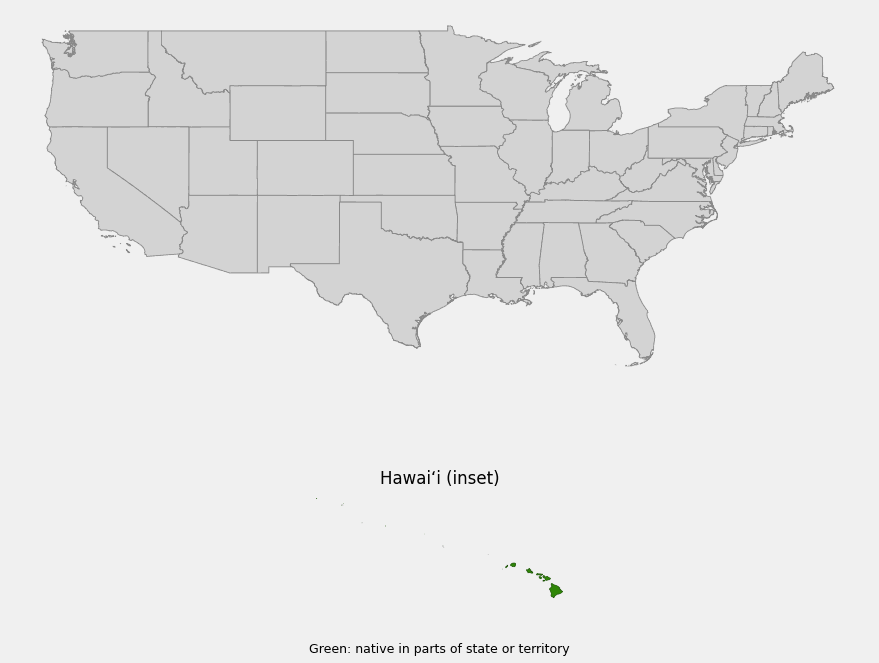
📋 Regional plant lists featuring Hawaiʻi Jewel Orchid: Hawaii
Growing & Care Guide
Honestly, the Hawaiʻi jewel orchid is very hard to grow outside its rainforest habitat, and it is not available from nurseries. Like other orchids, its dust-like seeds need partner fungi to germinate, and the plants depend on constant wetness, deep shade, cool temperatures and a living moss layer. Never dig or collect plants from the wild; wild orchids rarely survive being moved, and every plant matters in small populations. If propagated plants ever become available, buy them only from a Hawaiʻi native plant grower or conservation program. Hawaiʻi restricts bringing plants in from other states, so any plants in Hawaiʻi should come from local growers.
Light
Deep shade. It grows under a dense forest canopy and does not tolerate direct sun.
Soil & Water
It needs a constantly wet, airy medium of living moss and humus, with very high humidity and frequent rain or mist. Drying out is fatal, but stagnant, airless soil is also harmful.
Planting Tips
The best way to help it is to protect its habitat: support fencing and pig removal in watersheds, help with invasive plant control, and stay on trails so you do not trample mossy banks. Specialists with legally propagated plants keep them in shallow pots of moss in a cool, shady terrarium or shade house.
Pruning & Maintenance
No pruning is needed. Slugs and snails are the main pests of potted orchids like this one and must be controlled.
Propagation
It can be propagated by rooting sections of the creeping stem, and orchid seed can be grown in laboratory culture. This is work for conservation programs and specialists, not for home gardeners.
Landscape Uses
- Nature appreciation: one of only three native Hawaiian orchids, best enjoyed in the rainforest
- Habitat protection: benefits from fencing, pig removal and weed control
- Conservation collections: propagation and study by specialists
- Education: an example of how few orchids reached remote Hawaiʻi
Wildlife & Ecological Value
The Hawaiʻi jewel orchid is a small, quiet part of the rainforest floor.
For Pollinators
The small flowers are pollinated by insects; its specific pollinators in Hawaiʻi are not well documented.
For Birds
It has no fleshy fruit and is not a bird food plant, but it is part of the mossy understory where native forest birds forage for insects.
For Mammals
Hawaiʻi’s only native land mammal, the Hawaiian hoary bat, hunts insects over the forest. Introduced feral pigs are among the main threats to the orchid, rooting up and trampling mossy ground.
Ecosystem Role
As an orchid, it depends on soil fungi for germination and nutrition, connecting it to the fungal network of the forest floor. It is an indicator of intact, undisturbed, constantly wet native forest.
Cultural & Historical Uses
The species was described by the English botanist John Lindley, the leading orchid expert of the 19th century. The epithet sandvicensis refers to the Sandwich Islands, the name Captain James Cook gave to Hawaiʻi. The genus name Anoectochilus comes from Greek words meaning “open lip,” referring to the flower’s lip.
Hawaiʻi has only three native orchids: the Hawaiʻi jewel orchid, ʻawapuhiakanaloa and the very rare Hawaiian bog orchid (Platanthera holochila). That is a tiny number for a tropical island group, probably because orchids need both their dust-like seeds and their partner fungi to arrive across thousands of miles of ocean. Only ʻawapuhiakanaloa is known to have a Hawaiian name.
Many more orchids have been introduced to Hawaiʻi and now grow wild, including the bamboo orchid and the Philippine ground orchid. These are sometimes mistaken for native species, but the three native orchids are all small, green-flowered plants of wet forest.
Frequently Asked Questions
Does the Hawaiʻi jewel orchid have a Hawaiian name?
No Hawaiian name is known for it. Of Hawaiʻi’s three native orchids, only ʻawapuhiakanaloa (Liparis hawaiensis) has a recorded Hawaiian name.
Can I grow it?
It is very hard to grow outside its rainforest habitat and is not sold by nurseries. Never collect it from the wild; it is best enjoyed where it grows.
Why is it called a jewel orchid?
It belongs to Anoectochilus, a genus of Asian and Pacific orchids known as jewel orchids for their glittering, netted leaf veins. The Hawaiian species has plain green leaves.
Is it endangered?
It is not federally listed under the Endangered Species Act, but it is uncommon and threatened by habitat loss, feral pigs and invasive plants.
Where can I see it?
In dark, wet, mossy rainforest on Kauaʻi, Oʻahu, Molokaʻi, Maui and Hawaiʻi Island, including Haleakalā National Park. Stay on trails and do not disturb mossy banks.

Looking for a nursery that carries Hawaiʻi Jewel Orchid?
Browse our native plant nursery directory: Hawaii

