Lanceleaf Loosestrife (Lysimachia lanceolata)
Lysimachia lanceolata, commonly called Lanceleaf Loosestrife (also Lance-Leaved Loosestrife), is a modest but charming native perennial wildflower found across much of the eastern and central United States. It belongs to the primrose family (Primulaceae) and is one of several yellow-flowered Lysimachia species native to North America — not to be confused with the Eurasian purple loosestrife (Lythrum salicaria), an aggressive wetland invader that shares only a common-name word with this well-behaved native.
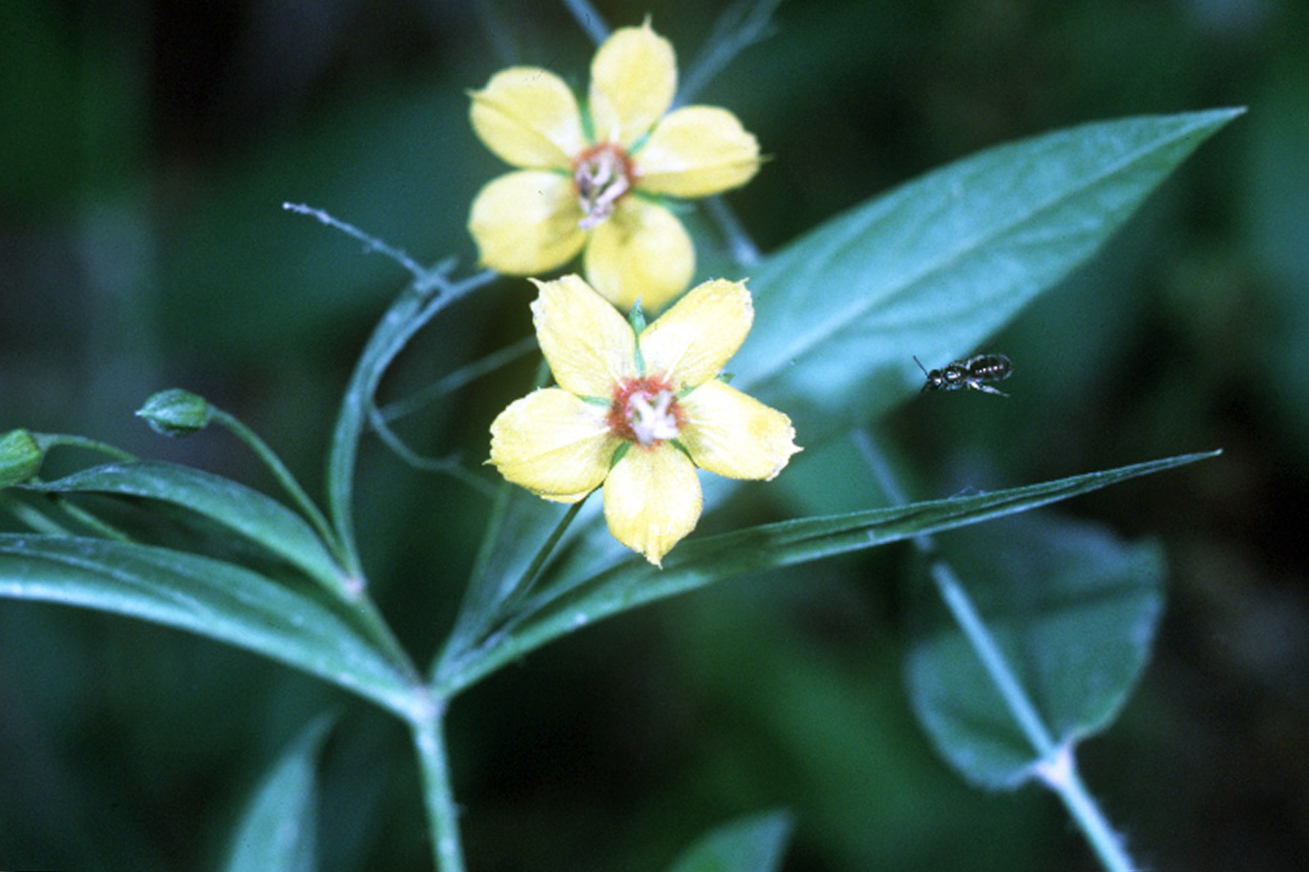
Lanceleaf loosestrife grows as an upright perennial, usually 1 to 2 feet tall, with narrow, lance-shaped leaves arranged in opposite pairs along slightly four-angled stems. From early to midsummer, small nodding yellow flowers with a splash of orange at the center dangle from the upper leaf axils on their own slender stalks. The flowers produce a floral oil rather than nectar, a quirky trait that attracts a specialist bee uniquely adapted to collect it.
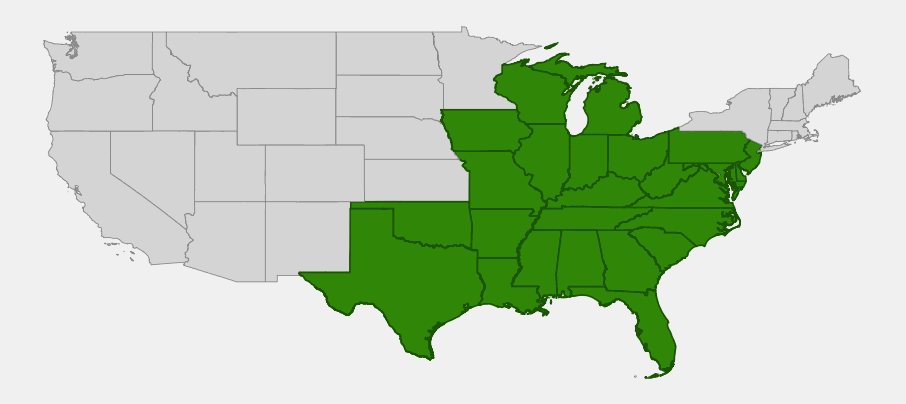
This species occurs in prairies, open woodlands, thickets, glades and old fields from Texas and Oklahoma east to the Atlantic coast and north into the Great Lakes states. It is an unassuming addition to a native wildflower planting — not showy from a distance, but a worthwhile component of a prairie or open-woodland garden where its small colonies and nodding blooms reward a closer look.
Identification
Lanceleaf loosestrife begins as a rosette of angular, rounded leaves before sending up a central flowering stem. The mature plant is erect, 1 to 2 feet tall, with a four-angled, smooth stem and a few short side branches in the upper half.
Leaves
The leaves are opposite, up to 5 inches long and about ¾ inch across, lance-shaped to narrowly ovate, and often fold slightly upward along the midvein. Margins are usually smooth, occasionally fringed with tiny hairs, and the leaves are sessile or have very short, coarsely hairy petioles. The uppermost leaves near the top of the plant are often whorled rather than opposite. The leaf underside is light or whitish green when young, darkening somewhat with age — a detail that helps separate this species from the similar Lysimachia hybrida, whose leaf undersides stay green from the start.
Flowers
From 1 to 4 flowers emerge from the upper leaf axils, each on its own nodding pedicel. Each flower is about ¾ inch across with 5 narrow green sepals, 5 rounded yellow petals (often with ragged or notched outer edges), and 5 yellow-orange stamens surrounding a patch of orange at the base of the pistil. Blooming runs from early to midsummer and lasts about a month, with no noticeable fragrance.
Fruit & Seeds
Flowers are followed by small, roughly spherical capsules with a slender, spike-like tip, about the same height as the surrounding sepals — a useful field mark, since most other Lysimachia species have capsules and sepals of noticeably unequal length. The root system is a taproot combined with rhizomes that produce small plantlets, and plants often form loose colonies by this vegetative spread.
Quick Facts
| Scientific Name | Lysimachia lanceolata |
| Family | Primulaceae (Primrose) |
| Plant Type | Herbaceous perennial wildflower |
| Mature Height | 1–2 ft |
| Mature Spread | 1–1.5 ft, spreading slowly by rhizomes |
| Growth Rate | Moderate |
| Sun Exposure | Partial to Full Sun |
| Water Needs | Average to moist (mesic) |
| Soil Type | Loam or clay-loam; tolerates sandy or rocky soil |
| Soil pH | Neutral to slightly alkaline, tolerant of limestone soils |
| Bloom Time | Early to midsummer |
| Flower Color | Yellow with an orange center |
| Fall Color | None notable |
| Fruit | Small spheroid capsules with a slender tip |
| Deer Resistant | Moderate |
| USDA Hardiness Zones | 5–9 |
Native Range
Lanceleaf loosestrife is native across much of the eastern and south-central United States, from eastern Texas, Oklahoma, Arkansas and Louisiana east through the Gulf and Southeast states to Florida and the Carolinas, and north through the Ohio Valley, the Great Lakes states and the Mid-Atlantic. It is an occasional rather than a common plant through most of this range, turning up in scattered populations rather than forming large stands.
Habitats include moist to mesic black-soil prairies, open woodlands, brushy thickets, swamp margins, gravelly seeps, limestone glades, and old fields on hardpan clay or sandy soil. It tolerates a wide range of soil textures as long as moisture is reasonably consistent, and it is often found growing with other prairie and open-woodland perennials rather than in deep, undisturbed forest.
Along the Mid-Atlantic edge of its range, in Maryland, Delaware and southern New Jersey, lanceleaf loosestrife is notably uncommon and tracked as a plant of conservation concern by some state natural heritage programs, so populations there should be left undisturbed. Gardeners in that region who want this species should buy nursery-propagated stock rather than collecting from the wild.
📋 Regional plant lists featuring Lanceleaf Loosestrife: Georgia, Alabama & Mississippi · Arkansas, Louisiana, Eastern Oklahoma & Eastern Texas · Maryland, Virginia & West Virginia · North Carolina & South Carolina · Kentucky & Tennessee · Ohio & Indiana · Illinois, Iowa & Missouri · Michigan, Wisconsin & Eastern Minnesota · Delaware, Southern New Jersey & Long Island · New York, Pennsylvania & Northern New Jersey
Growing & Care Guide
Lanceleaf loosestrife is an easygoing prairie and woodland-edge perennial once it is sited correctly. It is rarely offered at mainstream garden centers but turns up at native plant nurseries and prairie seed suppliers, often under the synonym Steironema lanceolatum.
Light
Give it partial to full sun. In the wild it grows equally well in open prairie and at woodland edges with filtered light; more sun generally produces a sturdier, more floriferous plant, while part shade is tolerated without much loss of vigor.
Soil & Water
This species prefers a loam or clay-loam soil kept consistently moist to mesic, though it also tolerates sandy or rocky ground as long as moisture does not disappear for long stretches. It is not a plant for dry, fast-draining sites. A neutral to slightly alkaline soil, including limestone-influenced ground, suits it well.
Planting Tips
Start from nursery plugs or direct-sown seed in fall, which allows natural cold stratification over winter. Space plants about 12 to 18 inches apart to let the rhizomes fill in without crowding neighbors too quickly. It combines well in a prairie planting with grasses such as little bluestem, which help support its slender stems.
Propagation
Propagate by division of the spreading rhizomes in early spring, or by collecting ripe seed capsules in late summer and sowing them outdoors in fall for natural stratification. Division is the faster route to a flowering-size plant.
Landscape Uses
- Prairie restoration and reconstruction plantings, where it adds understated summer color
- Open woodland edges with dappled shade
- Rain gardens and seasonally moist beds that stay damp but not waterlogged
- Pollinator gardens focused on specialist native bees rather than showy nectar displays
- Naturalized meadow plantings alongside little bluestem and black-eyed Susan
Wildlife & Ecological Value
Lanceleaf loosestrife plays a small but specific ecological role tied to its unusual floral chemistry.
For Pollinators
Unlike most wildflowers, the flowers of Lysimachia species produce a floral oil rather than nectar. This oil attracts the short-tongued oil-collecting bee Macropsis steironematis, a specialist that gathers both the oil and pollen to provision its larvae. Because the flowers hang downward, visiting bees must cling upside down to reach the reward, a habit thought to help protect the oil from rain. Aside from this specialist, the flowers attract relatively few other insects, mainly occasional pollen foragers.
For Birds & Mammals
Specific information on bird and mammal use of lanceleaf loosestrife is limited, as is typical for a plant valued more for its niche pollinator relationship than for seed or forage value. Its dense colonies likely provide minor cover for small insects and ground-dwelling invertebrates within a prairie or woodland-edge planting.
Ecosystem Role
As a component of tallgrass prairie and open-woodland plant communities, lanceleaf loosestrife adds a layer of mid-summer bloom diversity that supports specialist pollinators other, showier wildflowers do not serve. Its rhizomatous spread also helps stabilize soil in the seeps and moist swales where it often grows.
Cultural & Historical Uses
Lanceleaf loosestrife does not have a well-documented history of use by Indigenous peoples or early settlers, unlike many other prairie wildflowers. Its name has sometimes caused confusion because it shares the word “loosestrife” with both native and non-native plants.
The genus name Lysimachia honors Lysimachus, an ancient Macedonian king and companion of Alexander the Great who, according to legend, calmed an angry ox by offering it a plant of this genus — the origin of the common name “loosestrife,” meaning to loosen or dispel strife.
Today this species is grown mainly by native plant enthusiasts and prairie restoration projects rather than for any practical use, valued for its ecological role and its tidy, long-blooming habit in a naturalistic planting.
Frequently Asked Questions
Is lanceleaf loosestrife related to invasive purple loosestrife?
No. Despite sharing the word “loosestrife” in the common name, lanceleaf loosestrife (Lysimachia lanceolata) is in the primrose family and is a well-behaved native prairie perennial. Purple loosestrife (Lythrum salicaria) is an unrelated, aggressive invasive species from Eurasia that chokes wetlands. The two are not botanically close and should not be confused.
Why do the flowers hang downward?
The nodding habit is thought to help protect the plant’s floral oil reward from rain and to suit the upside-down foraging posture of its specialist pollinator bee, Macropsis steironematis, which clings beneath the flower to collect oil and pollen.
Does lanceleaf loosestrife spread aggressively?
No. It spreads slowly by rhizomes to form small, loose colonies, but it is not aggressive or weedy in a garden setting. Division every few years can keep colonies at the size you want.
What soil moisture does it need?
It prefers consistently moist to mesic conditions and does not tolerate prolonged drought well. A site that stays evenly damp, such as a low prairie swale or a woodland edge that collects runoff, suits it best.
Is it rare anywhere in its range?
Yes. While lanceleaf loosestrife is native across a broad swath of the eastern and south-central United States, it is uncommon at the northeastern edge of its range, including parts of Maryland, Delaware and New Jersey, where some natural heritage programs track it as a species of conservation concern.

Looking for a nursery that carries Lanceleaf Loosestrife?
Browse our native plant nursery directory: Alabama & Arkansas · Delaware, Florida & Georgia · Illinois, Indiana & Iowa · Kentucky, Louisiana, Maryland, Michigan, Mississippi & Missouri · New Jersey, North Carolina, Ohio & Oklahoma · Pennsylvania, South Carolina, Tennessee, Texas & Virginia · West Virginia & Wisconsin