
Little Elephant’s Head (Pedicularis attollens)
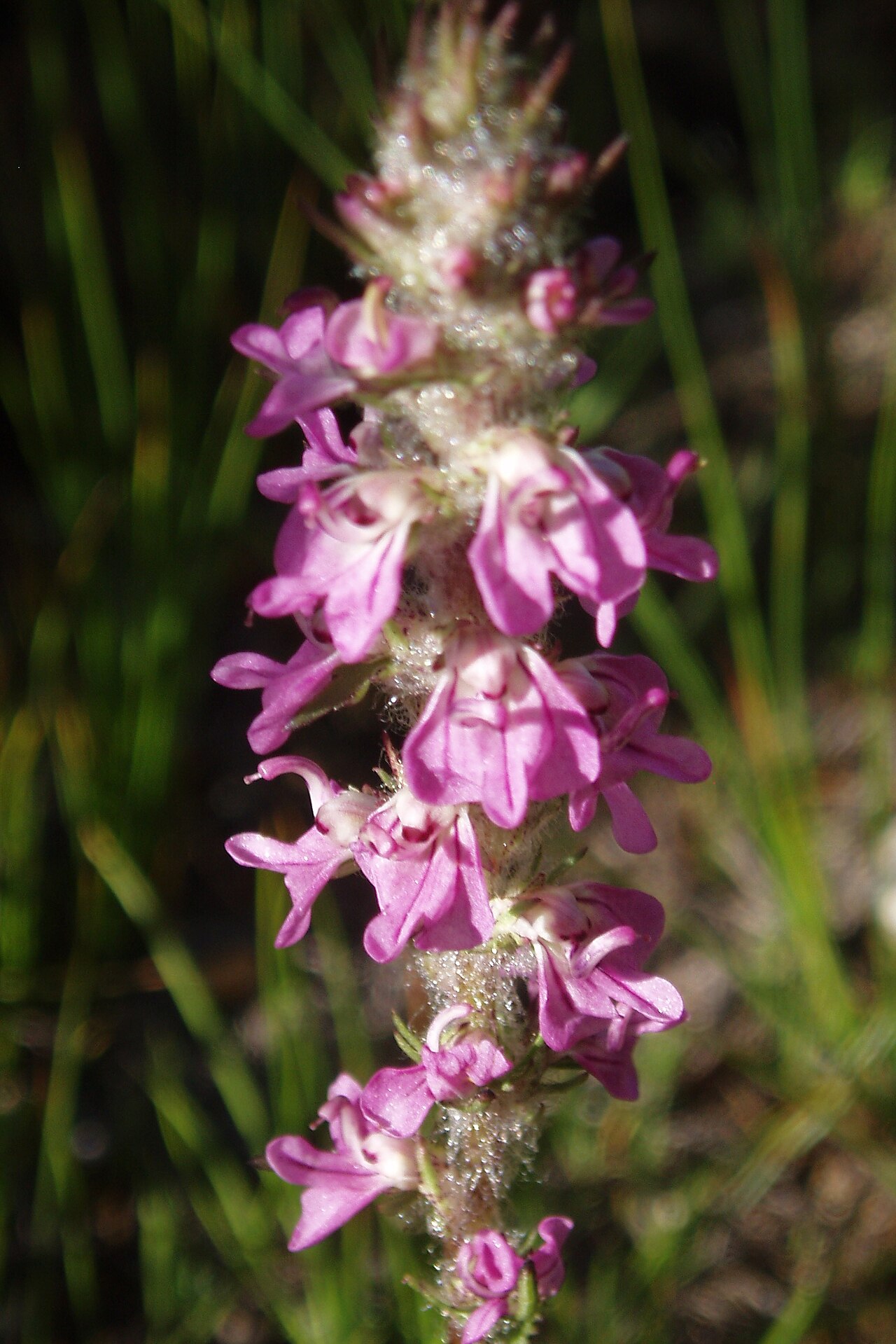
Pedicularis attollens, known as Little Elephant’s Head or little elephantshead, is a perennial wildflower of wet mountain meadows in the Sierra Nevada, the southern Cascades and nearby ranges of California, Oregon and Nevada. In summer it raises slender spikes, 4 to 16 inches tall, packed with small pink to lavender flowers. Each flower is shaped like a tiny elephant’s head, with a curved, upturned trunk and two flaring ears, and the spike is softly woolly with white hairs.
Like other louseworts, it is a hemiparasite. It has green leaves and makes its own food, but its roots also attach to the roots of nearby grasses, sedges and other meadow plants and take water and nutrients from them. It belongs to the broomrape family (Orobanchaceae), which includes many root parasites. Because it depends on these connections and on cold, wet alpine meadows, it is practically impossible to grow in an ordinary garden.
This page is a guide to recognizing and appreciating little elephant’s head in the wild. It is a common and much-loved wildflower along trails such as the John Muir Trail. Enjoy it in place, stay on trails in wet meadows, and never dig plants: they do not survive transplanting. It is often confused with the larger elephant’s head (Pedicularis groenlandica), which grows in the same mountains; the differences are explained below.
Identification
Look in wet subalpine and alpine meadows for slender, woolly spikes of small pink flowers with short, upturned trunks, above a cluster of finely divided, fern-like leaves.
Growth Habit
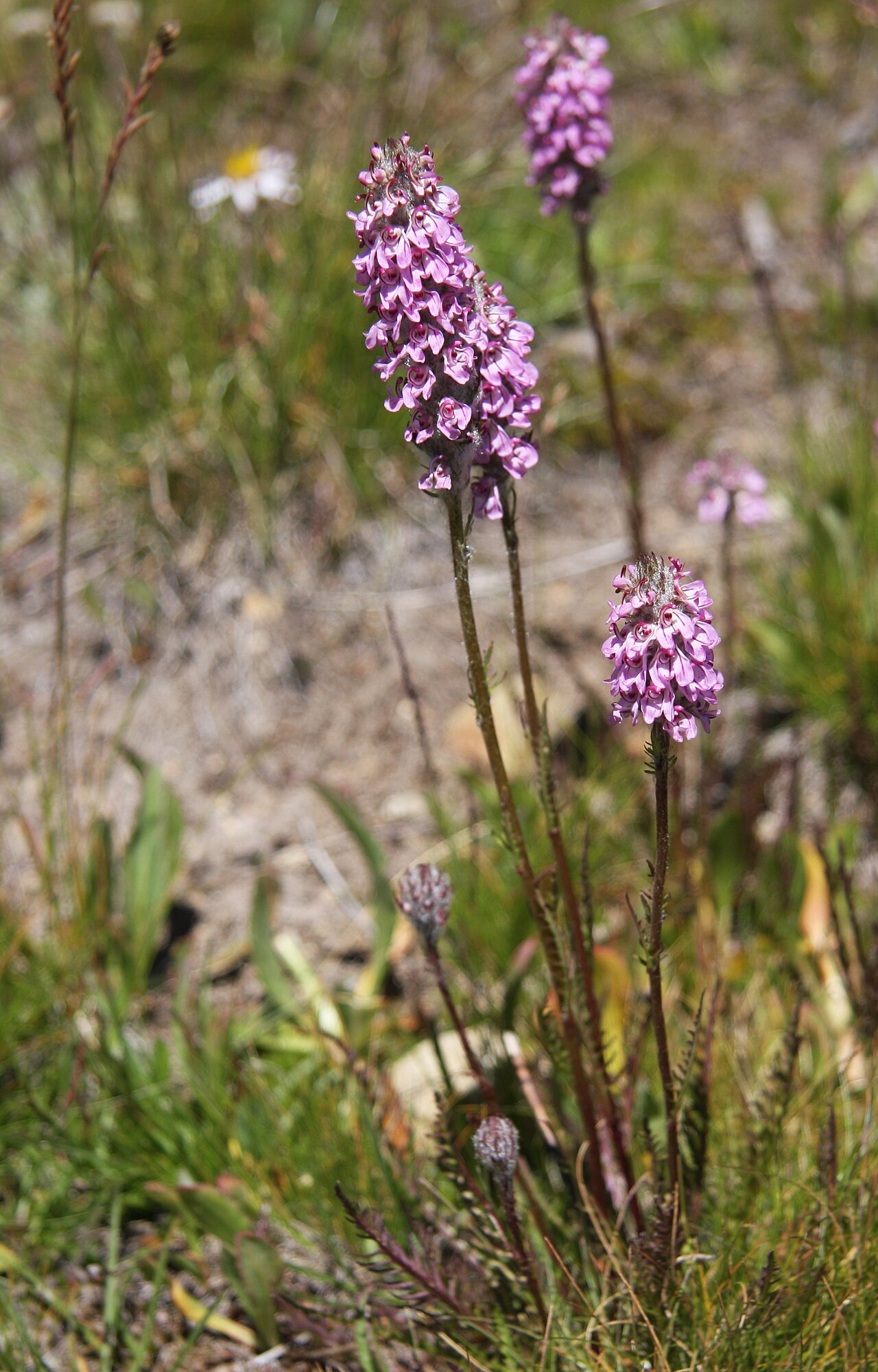
Plants are perennials from a short root crown with fibrous roots. Each plant usually has one to several unbranched flowering stems, 4 to 16 inches tall (occasionally to 2 feet), rising from a basal tuft of leaves. The stems are often reddish.
Leaves
Most leaves are basal, 1 to 6 inches long, and pinnately divided into many narrow, toothed segments, so they look like small fern fronds. A few smaller leaves grow on the stem. Young leaves are often tinged red or purple.
Flowers
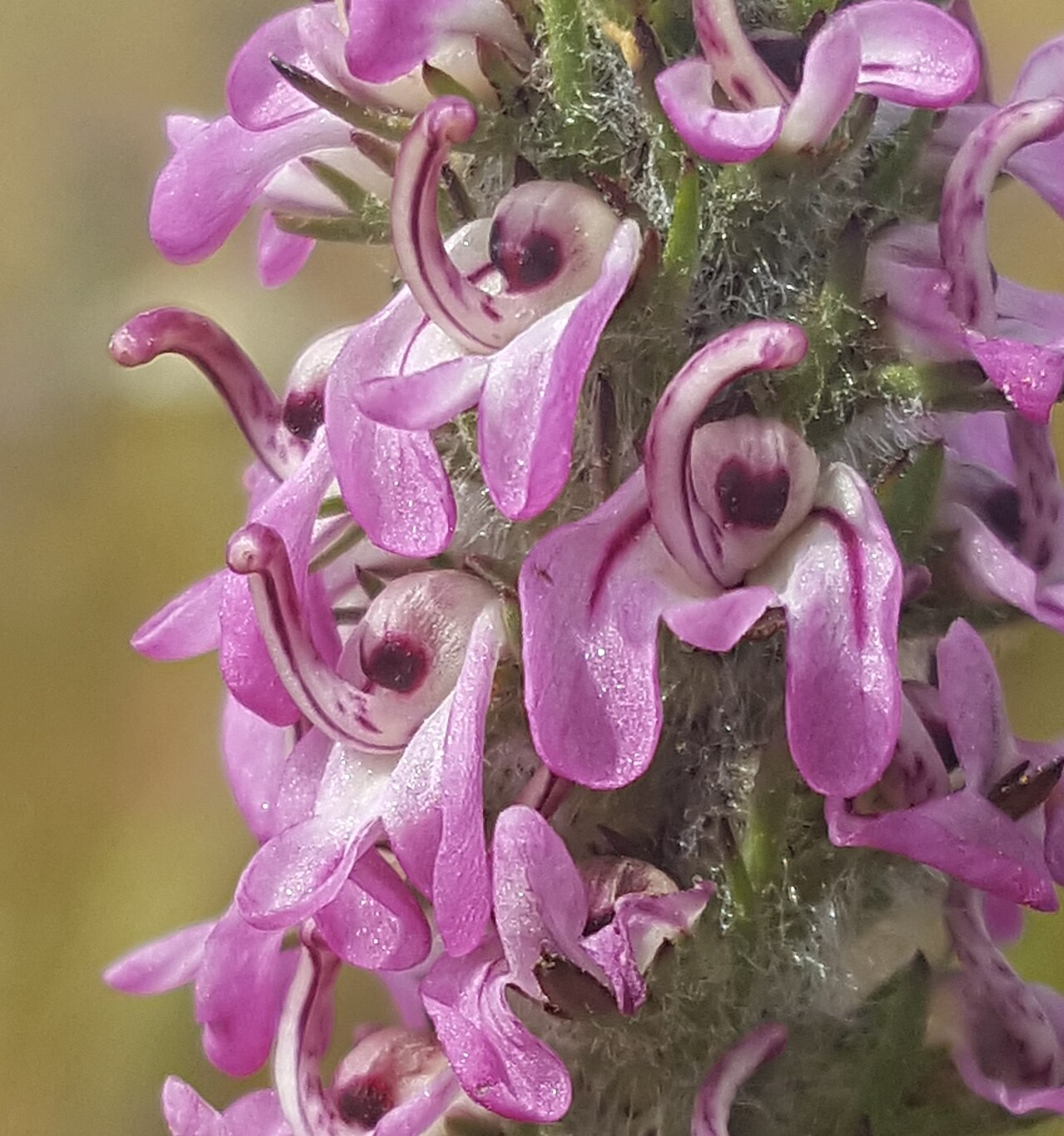
The flowers are crowded in a dense spike, 1 to 6 inches long, that is noticeably woolly with fine white hairs, especially between the flowers and on the bracts and calyces. Each flower is about 1/4 to 3/8 inch long, pink to lavender or nearly white, often with darker purple streaks. The upper lip (galea) narrows into a short, slender beak that curves upward like a raised trunk; the name attollens means “lifting up.” The two side lobes of the lower lip spread like ears. Bloom time is June to September, depending on snowmelt.
Fruit
The fruit is a small, flattened, curved capsule that splits open in late summer to release a few seeds. Dry spikes with open capsules often remain standing into fall.
How It Differs from Elephant’s Head
Elephant’s head (Pedicularis groenlandica) grows in the same kinds of meadows and sometimes alongside it. Elephant’s head has larger, usually deeper reddish-purple flowers with a long trunk, about 1/4 to 1/2 inch, that curves out and up in a sweeping arc, and its flower spikes are smooth, not woolly. Little elephant’s head has smaller, paler pink flowers, a short trunk that turns sharply upward, and a distinctly woolly spike. Little elephant’s head is limited to California, Nevada and southern Oregon, while elephant’s head ranges across western North America and into Canada and Greenland.
Other Look-alikes
Bracted lousewort (P. bracteosa) is taller, with yellow, cream or reddish hooded flowers without a trunk. Sickletop lousewort (P. racemosa) has undivided, toothed leaves and white to pink sickle-shaped beaks. Pink spikes of shooting stars and monkeyflowers in the same meadows have very different flower shapes.
Quick Facts
| Scientific Name | Pedicularis attollens |
| Family | Orobanchaceae (broomrape family); formerly Scrophulariaceae |
| Plant Type | Herbaceous perennial; root hemiparasite |
| Mature Height | 4–16 in (occasionally to 2 ft) |
| Mature Spread | 3–8 in |
| Growth Rate | Slow |
| Sun Exposure | Full sun to light shade |
| Water Needs | High; wet meadows fed by snowmelt |
| Soil Type | Wet, organic or gravelly meadow soil |
| Soil pH | Slightly acidic to neutral (about 5.5–7.0) |
| Bloom Time | June–September |
| Flower Color | Pink to lavender, sometimes nearly white |
| Fall Color | None |
| Fruit | Small flattened capsule |
| Deer Resistant | Unknown; sometimes grazed by livestock |
| USDA Hardiness Zones | Not cultivated; grows in cold mountain climates (about zones 3–6) |
Native Range
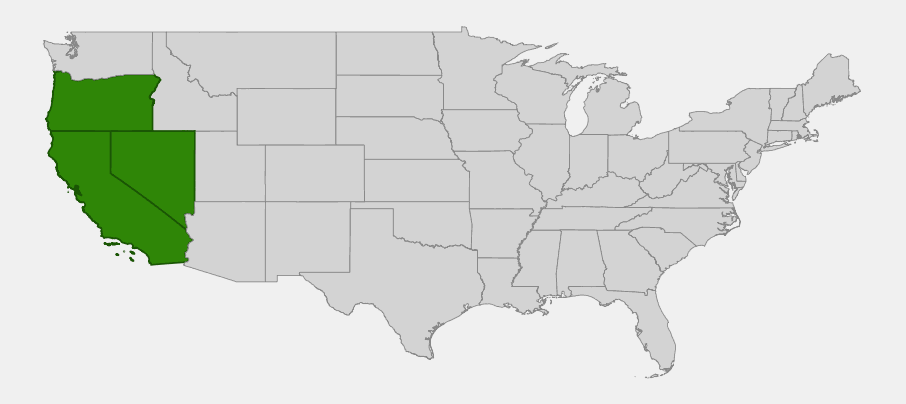
Little elephant’s head is native to the mountains of California, Oregon and western Nevada. USDA PLANTS lists it as native in California, Nevada and Oregon. It is most abundant in the Sierra Nevada, where it is one of the commonest wildflowers of wet subalpine meadows from the Lake Tahoe region south to the high peaks around Mount Whitney.
It also grows in the southern Cascade Range, including the Lassen region of northern California and the high Cascades of southern Oregon, in the Klamath Mountains and the Warner Mountains, in the White Mountains east of the Sierra Nevada, and in the Carson Range and other high ranges of western Nevada.
It grows in wet meadows, along streams and spring-fed seeps, in bogs and around the edges of lakes and ponds, mostly from about 5,000 to 12,500 feet. It needs soil that stays wet from snowmelt well into summer.
📋 Regional plant lists featuring Little Elephant’s Head: Western Oregon & Western Washington · California & Nevada
Can You Grow It?
Honestly, no. Little elephant’s head is not available from nurseries and is not a practical garden plant. It is a root hemiparasite that needs to attach to host plants, and it is adapted to cold, wet, high-elevation meadows with a short summer, deep winter snow and constant snowmelt. Wild plants die when dug, and digging damages fragile meadows. Enjoy it where it grows.
Light
In the wild it grows in full sun to light shade in open meadows and at the edges of lodgepole pine and other subalpine forests.
Soil & Water
It needs soil that stays wet and cool throughout its growing season, usually fed by snowmelt or springs. Garden beds, even irrigated ones, rarely reproduce these conditions, especially at low elevations with hot summers.
Why It Fails in Gardens
As a hemiparasite, it forms root connections (haustoria) with neighboring meadow plants such as sedges, grasses and other wildflowers. A plant dug from a meadow loses these connections and almost always dies. Seedlings need a host nearby to grow well.
Pruning & Maintenance
There is nothing to prune or maintain. The most helpful thing you can do is protect the meadows where it grows: stay on trails, avoid trampling wet ground, and keep camps away from meadow edges.
Propagation
Researchers and specialist growers have raised louseworts from seed sown with host plants, but this is experimental and rarely successful outside alpine botanical gardens. Do not collect seed or plants from the wild, especially in national parks and wilderness areas where collecting is prohibited.
Where to See It
- Sierra Nevada trails: common in wet meadows along the John Muir Trail and Pacific Crest Trail
- National parks: look in meadows of Yosemite, Sequoia-Kings Canyon and Lassen Volcanic National Parks
- Southern Oregon Cascades: high meadows around Crater Lake and nearby peaks
- White Mountains and Nevada ranges: alpine meadows and spring areas at high elevation
- Best time: July and August, a few weeks after the snow melts
Wildlife & Ecological Value
Little elephant’s head is part of the rich wildflower community of Sierra Nevada and Cascade meadows, and its peculiar flowers are adapted to a particular group of pollinators.
For Pollinators
Bumblebees are the main pollinators. A bee grips the flower and vibrates its flight muscles to shake pollen out of the anthers hidden in the beak (buzz pollination), and the curved beak places pollen on the bee’s body. Its flowers are visited mainly for pollen.
For Birds
It provides little direct food for birds, but the wet meadows where it grows are important feeding grounds for many mountain birds.
For Mammals
Deer, marmots and livestock may graze it along with other meadow plants.
Ecosystem Role
As a hemiparasite, it takes some resources from dominant grasses and sedges, which can reduce their vigor and leave more room for other wildflowers. In this way louseworts can increase plant diversity in meadows. It is also an indicator of healthy, wet meadows, which are threatened by drying, overgrazing and changes in snowpack.
Cultural & Historical Uses
The genus name Pedicularis comes from the Latin pediculus, “louse.” European farmers believed that livestock grazing on louseworts became infested with lice, probably because the plants grew in poor, wet pastures where unhealthy animals grazed. The species name attollens means “raising” or “lifting up,” referring to the upturned beak.
The species was described by the American botanist Asa Gray in the nineteenth century from plants collected in California. Its elephant-like flowers have made it a favorite of hikers and wildflower photographers, and it appears in many Sierra Nevada wildflower guides.
There are no well-documented food or medicinal uses for little elephant’s head. Some louseworts can take up toxic compounds from their host plants, so it should not be eaten or used as a remedy.
Frequently Asked Questions
Can I grow little elephant’s head in my garden?
Realistically, no. It is a root hemiparasite of cold, wet alpine meadows, is not sold by nurseries, and dies when transplanted. Enjoy it in the wild.
How is it different from elephant’s head?
Elephant’s head has larger, deeper reddish-purple flowers with a long, arching trunk and smooth flower spikes. Little elephant’s head has smaller, paler pink flowers with a short, upturned trunk and woolly spikes.
Where can I see little elephant’s head?
Look in wet meadows of the Sierra Nevada, such as those in Yosemite and Sequoia-Kings Canyon National Parks, and in the southern Cascades of California and Oregon, in July and August.
What does hemiparasite mean?
A hemiparasite has green leaves and makes its own food by photosynthesis, but also attaches to the roots of other plants and takes water and nutrients from them.
Is little elephant’s head rare?
No. It is common in suitable wet meadows within its range, but those meadows are fragile and should be protected from trampling and digging.

Looking for a nursery that carries Little Elephant’s Head?
Browse our native plant nursery directory: California · Nevada · Oregon

