
Sickletop Lousewort (Pedicularis racemosa)
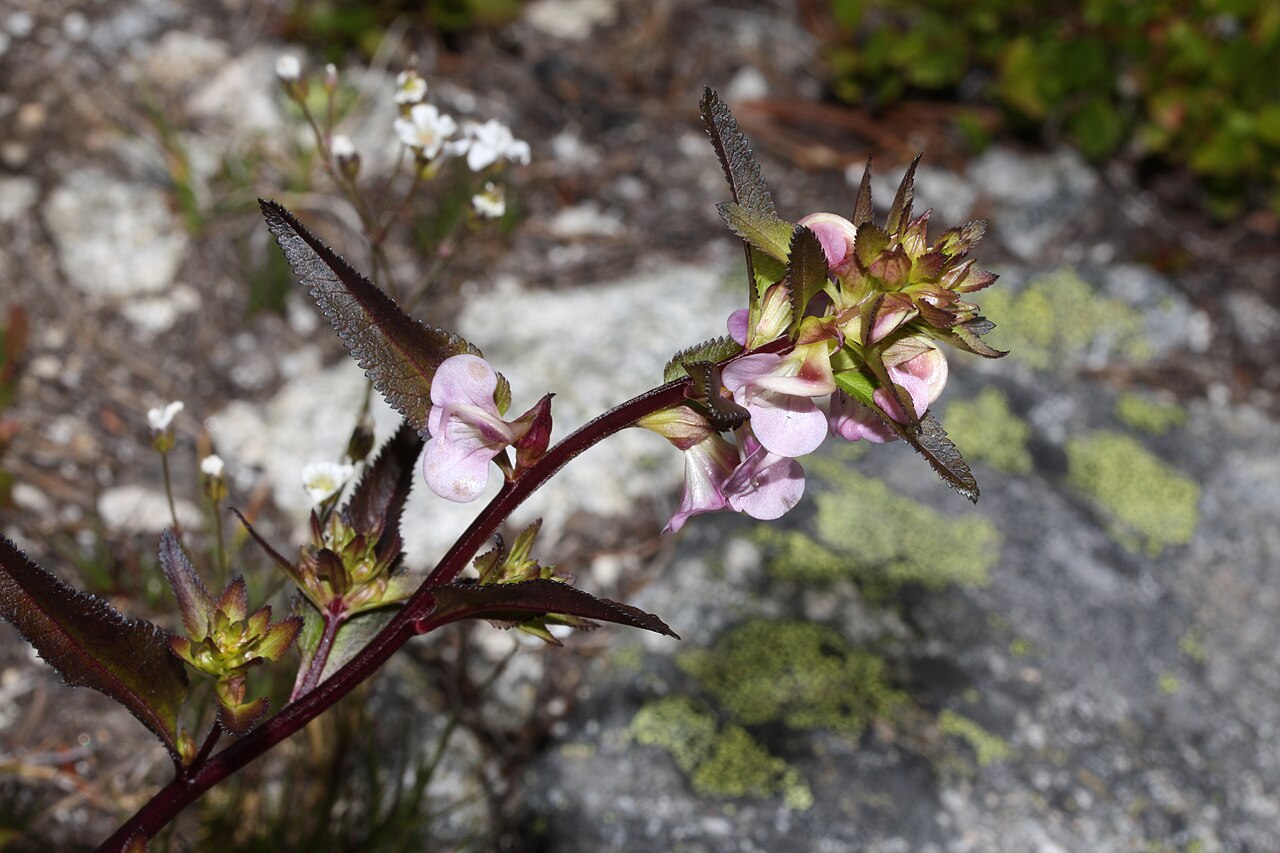
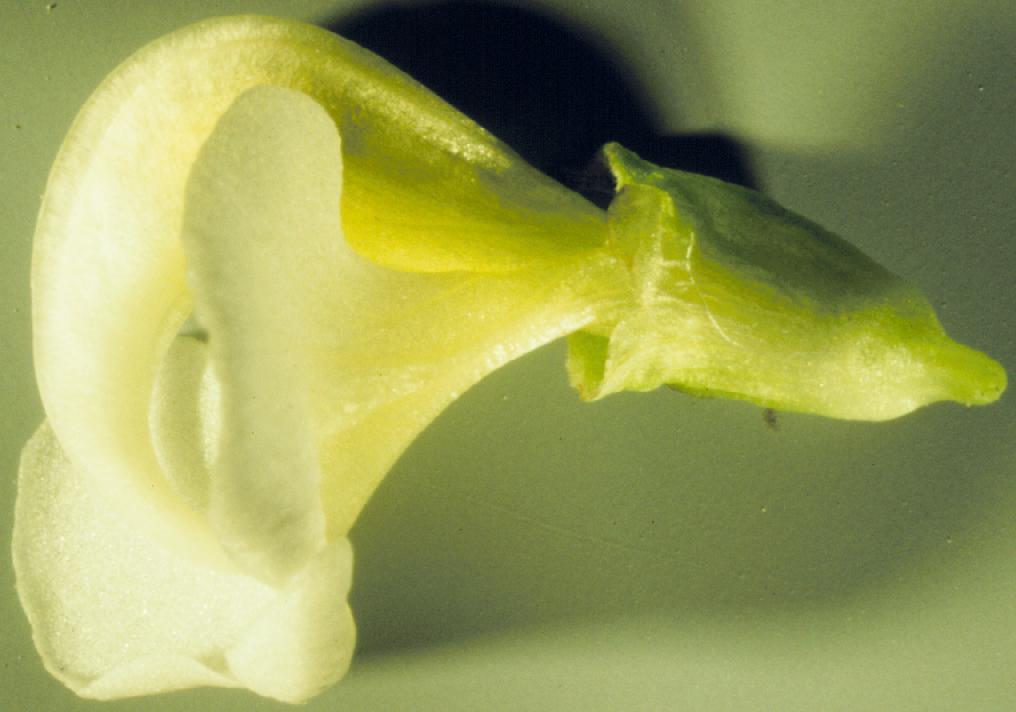
Pedicularis racemosa, known as Sickletop Lousewort, parrot’s beak or leafy lousewort, is a clump-forming mountain wildflower of conifer forests and subalpine slopes in western North America. Its name comes from the shape of its flowers: the upper lip of each flower curves down into a slender, sickle-like beak that nearly touches the broad lower lip, giving the flower the look of a parrot’s head. Flowers are white to cream in the Rocky Mountains and pink to purplish in the Cascades and Pacific Coast ranges.
Unlike most louseworts, which have fern-like, deeply divided leaves, sickletop lousewort has simple, narrow, finely toothed leaves along its stems, often tinged reddish or bronze. It belongs to the broomrape family (Orobanchaceae) and is a root hemiparasite: it has green leaves and makes its own food, but its roots attach to the roots of nearby plants and draw water and nutrients from them.
Because it depends on host plants in a mountain forest community, sickletop lousewort cannot be grown from nursery stock or transplanted into a garden, and it should never be dug up. This guide is an identification and appreciation page: it covers how to recognize the plant, where it grows, why it cannot be cultivated, and where to enjoy it on summer hikes in the western mountains.
Identification
Look for leafy clumps of reddish stems with narrow, toothed, undivided leaves and a few white, cream or pink flowers whose upper lips curve down into a sickle-shaped beak.
Stems & Growth Habit
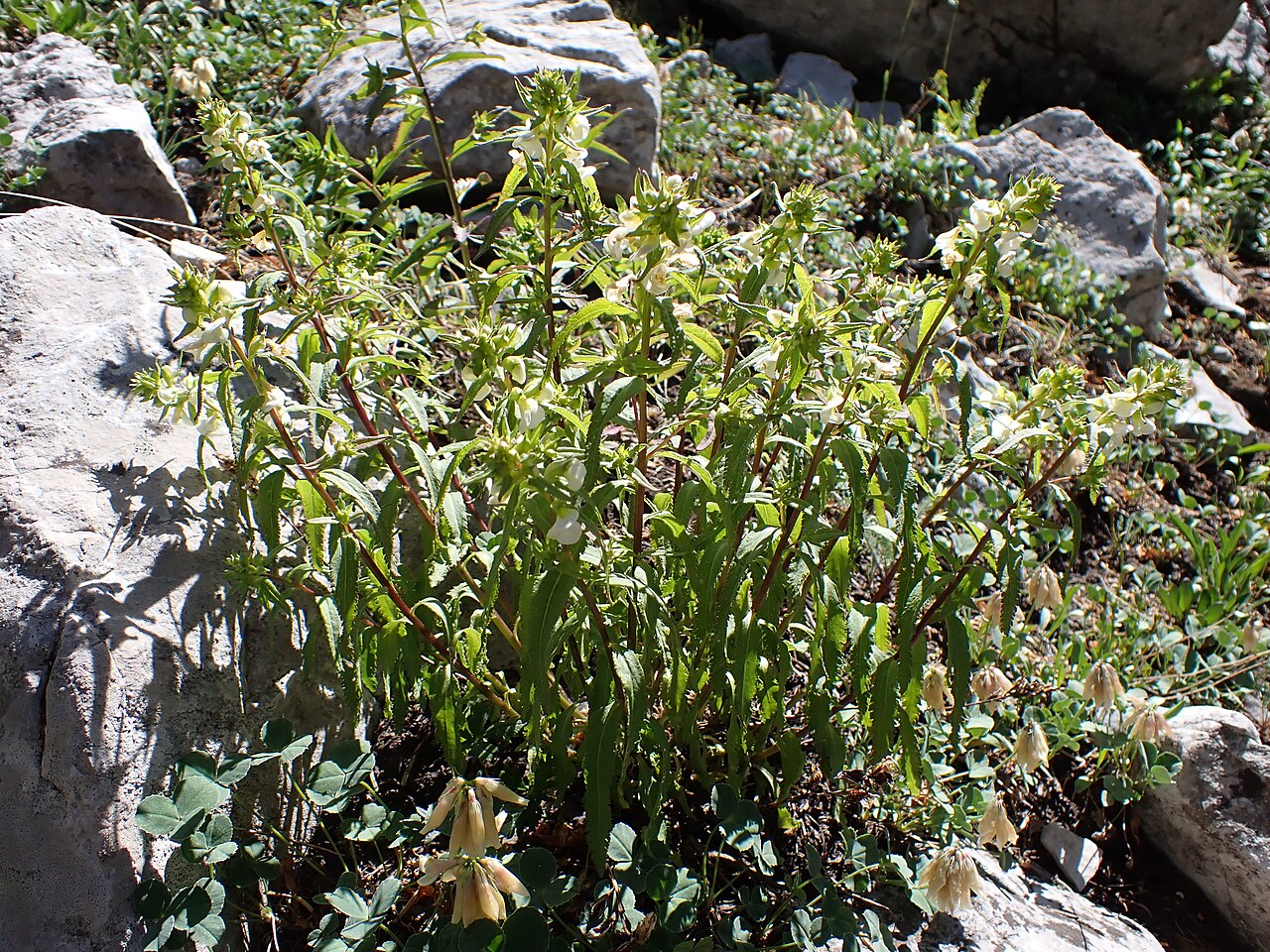
Plants grow in clumps of several unbranched, leafy stems, usually 6 to 20 inches tall, from a short woody rootstock. The stems are smooth or slightly hairy and often reddish or purplish. Clumps can be quite dense where conditions suit them, and a single plant may produce many stems. The above-ground parts die back in fall.
Leaves
The leaves are alternate along the stems, 1 1/2 to 4 inches long, narrowly lance-shaped and pointed, and edged with fine, double teeth. They are not divided, which sets this species apart from most other louseworts. Leaves are often bronze, reddish or purplish, especially when young or in sun, and turn deep red in late summer and fall.
Flowers
The flowers grow singly or in small groups in the axils of the upper leaves, forming a loose, leafy cluster rather than a dense spike. Each flower is about 1/2 inch long and two-lipped. The upper lip (galea) is a narrow hood that tapers into a long, slender beak curving strongly downward and sideways, so it touches or almost touches the large, three-lobed lower lip. Flowers are often twisted on their stalks. Color varies by region: white to creamy yellowish in the Rocky Mountains (subspecies alba) and pink to pinkish-purple in the Cascades and California (subspecies racemosa). It blooms from about June to August, depending on elevation and snowmelt.
Fruit & Seeds
Each flower produces a flattened, curved, oblique capsule about 1/2 inch long that splits to release a few seeds. The dry stalks with open capsules may persist into fall.
Look-alikes
Elephant’s head (Pedicularis groenlandica) grows in wet meadows and has dense spikes of pink-purple flowers shaped like tiny elephant heads, with fern-like leaves. Bracted lousewort (Pedicularis bracteosa) is taller, with fern-like leaves and dense spikes of yellow, red or purple flowers. Coiled lousewort (Pedicularis contorta) has fern-like leaves and white or cream flowers with a coiled beak. Sickletop lousewort is the only common western lousewort with simple, toothed, undivided leaves.
Quick Facts
| Scientific Name | Pedicularis racemosa |
| Family | Orobanchaceae (broomrape family; formerly Scrophulariaceae) |
| Plant Type | Herbaceous perennial; root hemiparasite |
| Mature Height | 6–20 in |
| Mature Spread | 6–18 in |
| Growth Rate | Slow |
| Sun Exposure | Part shade to full sun |
| Water Needs | Low to medium |
| Soil Type | Well-drained, rocky or loamy forest soils |
| Soil pH | About 5.0–7.5 |
| Bloom Time | June–August |
| Flower Color | White to cream (Rocky Mountains) or pink to purplish (Cascades, California) |
| Fall Color | Leaves turn reddish to deep red |
| Fruit | Flattened, curved capsule |
| Deer Resistant | Moderate |
| USDA Hardiness Zones | 3–7 |
Native Range
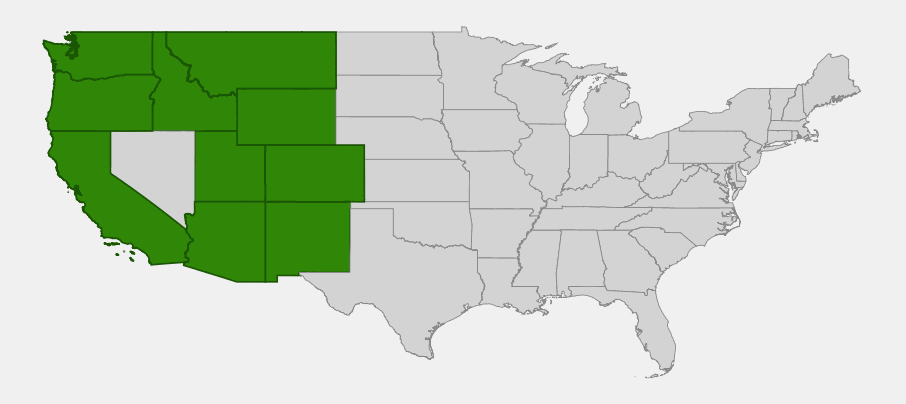
Sickletop lousewort is native to the mountains of western North America. In Canada it grows in British Columbia and southwestern Alberta. In the United States, USDA PLANTS lists it in Washington, Oregon, Idaho, Montana, Wyoming, California, Utah, Colorado, Arizona and New Mexico. It ranges along the Cascades and the Olympic Mountains, through the Klamath Mountains and the Sierra Nevada of California, across the northern Rockies and the Blue Mountains, and south through the central and southern Rockies to the mountains of Arizona and New Mexico.
It grows on both sides of the Cascades in Oregon and Washington, from the Olympic Peninsula and the west-side Cascades, such as the Mount Hood area, to the drier east-side forests and the Blue and Wallowa Mountains. In Idaho, Montana and Wyoming it is a common plant of open conifer forests. Farther south it becomes more confined to high elevations, especially in Arizona, where it is found mainly in the White Mountains and other high ranges.
Its habitat is montane and subalpine coniferous forests and their openings: dry to moist forests of Douglas-fir, lodgepole pine, subalpine fir and Engelmann spruce, forest edges, rocky ridges, open slopes and subalpine meadows with scattered trees. It typically grows in well-drained soils with plenty of other shrubs and herbs that can serve as hosts.
📋 Regional plant lists featuring Sickletop Lousewort: Idaho, Eastern Oregon & Eastern Washington · Montana & Wyoming · Utah & Western Colorado · Arizona & New Mexico · Western Oregon & Western Washington · California & Nevada
Can You Grow It?
No, not in an ordinary garden. Sickletop lousewort is a root hemiparasite that lives connected to the roots of the shrubs, herbs and grasses around it in a mountain forest. It cannot be grown from nursery stock, it is not sold by nurseries, and it does not survive transplanting. Please never dig it up: removing it from the wild kills the plant and damages the community it is part of. The best way to enjoy it is in its natural habitat. For gardeners in the East and Midwest who are curious about growing a lousewort, Canadian lousewort (Pedicularis canadensis) can sometimes be established from seed in prairie and savanna plantings with suitable host plants.
Light
In the wild it grows in partial shade under open conifer canopies and in full sun on ridges and in subalpine openings. It does poorly in deep shade.
Soil & Water
It grows in well-drained, often rocky or gravelly mountain soils with a layer of forest litter, moist from snowmelt in spring and early summer and drier later in the season. These conditions, combined with the right host plants and long, cold winters, are very hard to reproduce at low elevations.
Planting Tips
Do not try to plant it. Wild plants should not be dug, and there is no reliable source of nursery-grown plants. If you own land in its natural range, the best way to keep it is to protect the existing forest community: avoid soil disturbance, heavy equipment and herbicides around known patches.
Pruning & Maintenance
Wild populations need no care. On trails, stay on the path and do not pick the flowers, so the plants can set seed. Land managers can help it by controlling invasive weeds and avoiding heavy grazing or soil disturbance where it grows.
Propagation
Researchers have grown some louseworts from seed by sowing them with host plants, but this is specialized work, and sickletop lousewort has no established horticultural method. Seed collection from wild plants is not recommended, especially on public lands where collecting may require a permit.
Where to See It
- Mountain trails in the Rockies: common in open conifer forests of Montana, Idaho, Wyoming and Colorado in midsummer
- Cascades and Olympic Mountains: pink-flowered plants along forest trails from late June to August
- Subalpine ridges and meadows: clumps with reddish leaves among rocks and scattered trees
- National parks and forests: look for it in Glacier, Yellowstone, Mount Rainier and Rocky Mountain National Parks and surrounding forests
- Late-summer foliage: deep red fall leaves stand out on the forest floor after flowering
Wildlife & Ecological Value
Sickletop lousewort is a small but interesting part of western mountain forests, with flowers built for bumblebees and roots that tap into the plants around it.
For Pollinators
The flowers are pollinated mainly by bumblebees. Studies of louseworts show that the curved beak places pollen on a precise spot on a visiting bee’s body. Queen and worker bumblebees visit it through the short mountain summer.
For Birds
It has little direct value for birds, but it is part of the diverse forest-floor plant community that supports insects eaten by grouse, warblers and other forest birds.
For Mammals
Deer, elk and other browsers may graze it lightly. It is otherwise of little importance to mammals.
Ecosystem Role
As a root hemiparasite, sickletop lousewort forms connections (haustoria) with the roots of a variety of neighboring plants, including shrubs and herbs, and takes water and nutrients from them. Hemiparasites like louseworts can reduce the growth of their hosts and influence which plants dominate a site, and their nutrient-rich leaf litter can speed up nutrient cycling in the soil.
Cultural & Historical Uses
The genus name Pedicularis comes from the Latin pediculus, “louse.” European farmers once believed that livestock grazing on louseworts became infested with lice. The plants do not cause lice. The species name racemosa refers to the flowers being arranged along the stem, and the common name “sickletop” describes the curved beak of each flower.
The genus Pedicularis is very large, with hundreds of species, most in the mountains of Asia. Their varied flower shapes, from short hoods to long, twisted beaks, are a classic example of flowers adapted to bumblebee pollination, and botanists have long studied how the shapes guide pollen onto particular parts of the bee’s body.
Sickletop lousewort is not toxic in a known, documented way, but louseworts can absorb compounds from their host plants, so it should not be eaten or used as a remedy. It is best appreciated with a camera or a hand lens.
Frequently Asked Questions
Can I grow sickletop lousewort in my garden?
No. It is a root hemiparasite that depends on host plants in its natural mountain forest community. It is not sold by nurseries, does not survive transplanting and should never be dug from the wild. Enjoy it on hikes in the western mountains instead.
Why is it called sickletop lousewort?
“Sickletop” describes the upper lip of each flower, which curves down into a sickle-shaped beak. “Lousewort” comes from an old European belief that louseworts gave livestock lice.
Is sickletop lousewort a parasite?
It is a hemiparasite. It has green leaves and makes its own food, but its roots attach to the roots of nearby plants and take water and nutrients from them.
What color are the flowers?
White to cream in the Rocky Mountains and pink to purplish in the Cascades and California. Both forms have the same curved, beaked flowers.
When and where can I see it in bloom?
From about June to August, depending on elevation and snowmelt, in open conifer forests, ridges and subalpine slopes from the Cascades and Sierra Nevada to the Rockies of Montana, Wyoming, Colorado, Utah, Arizona and New Mexico.

Looking for a nursery that carries Sickletop Lousewort?
Browse our native plant nursery directory: Arizona · California · Colorado · Idaho · Montana · New Mexico · Oregon · Utah · Washington · Wyoming