
Yellow Corydalis (Corydalis flavula)
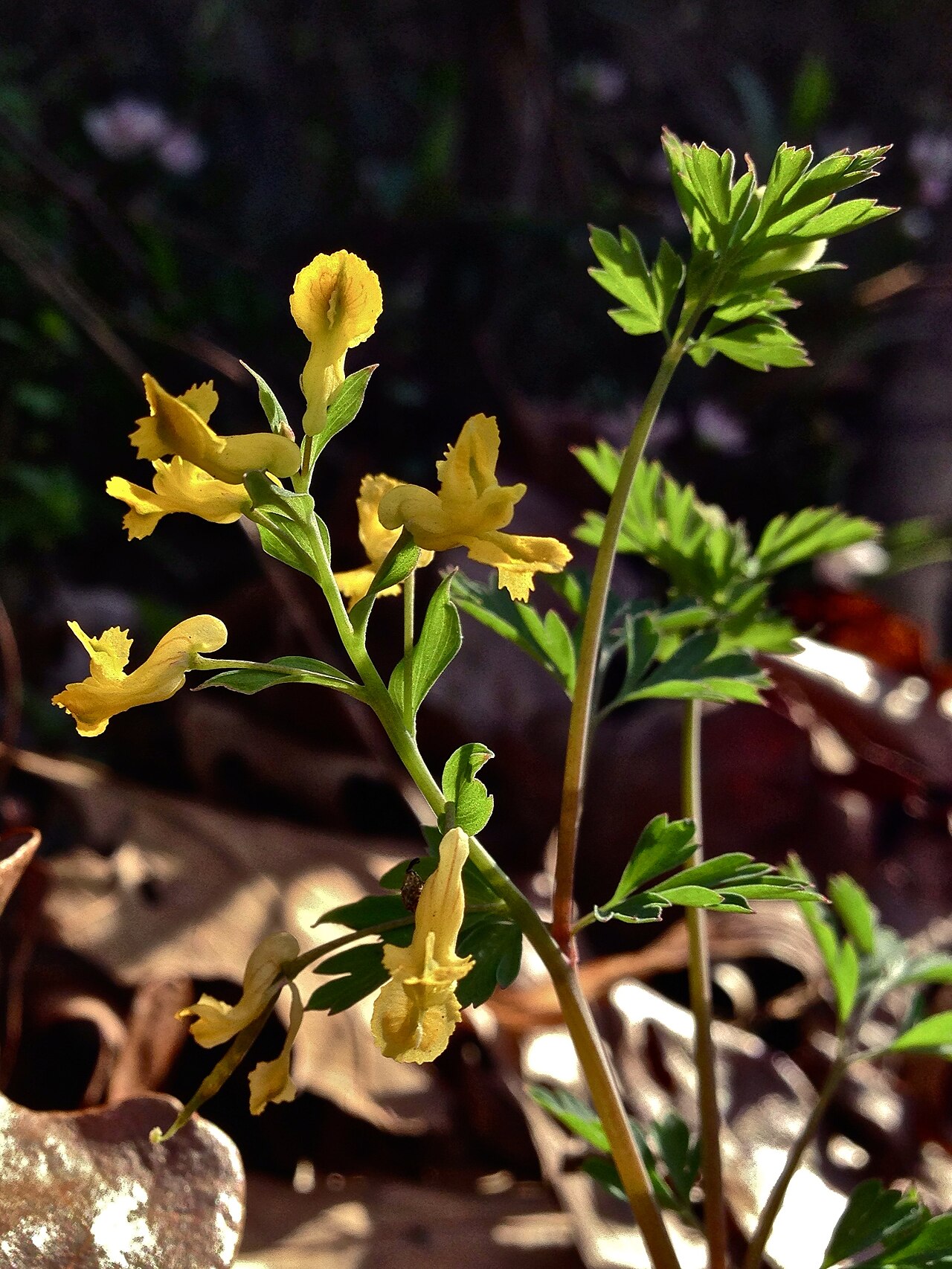
Corydalis flavula, known as Yellow Corydalis, yellow fumewort, yellow harlequin or short-spurred corydalis, is a small, delicate wildflower of rich eastern woodlands and floodplains. In early spring it forms low, sprawling clumps of lacy, blue-green, finely divided leaves, scattered with small, pale yellow, tubular flowers that look like tiny curved trumpets. It is one of the earliest wildflowers to bloom in many eastern forests, often flowering alongside spring beauty, toothworts and Dutchman’s breeches.
Yellow corydalis belongs to the poppy family (Papaveraceae), in the same group as Dutchman’s breeches, squirrel corn and rock harlequin. Unlike those perennials, it is an annual. Seeds sprout in fall, the small plants overwinter as rosettes, and they flower, set seed and die by late spring. That gives it the life cycle of a spring ephemeral, even though it is not perennial.
It is an easy, charming plant for naturalistic shade gardens, where it reseeds and comes back year after year without help. Like other members of the genus, it contains alkaloids that are toxic if eaten, so it should be treated as a look-but-don’t-taste plant around children, pets and livestock.
Identification
Several yellow-flowered corydalis species grow in eastern North America, and they can be tricky to tell apart. Yellow corydalis is best known by its small, pale yellow flowers with a toothed crest and short spur, its early bloom time, and its habitat in rich, moist woods.
Growth Habit
Yellow corydalis is a winter annual. Seeds germinate in late summer or fall and form small rosettes that stay green over winter. In early spring the plant sends out several weak, branching stems 4 to 14 inches long that usually sprawl or lean on neighboring plants rather than standing upright. The whole plant is smooth and often has a whitish, waxy bloom that gives it a blue-green color.
Leaves
The leaves are alternate and two or three times divided into many small, narrow or wedge-shaped lobes, giving them a soft, lacy, fern-like appearance similar to Dutchman’s breeches. Basal leaves have long stalks, and those on the stem become smaller toward the top.
Flowers
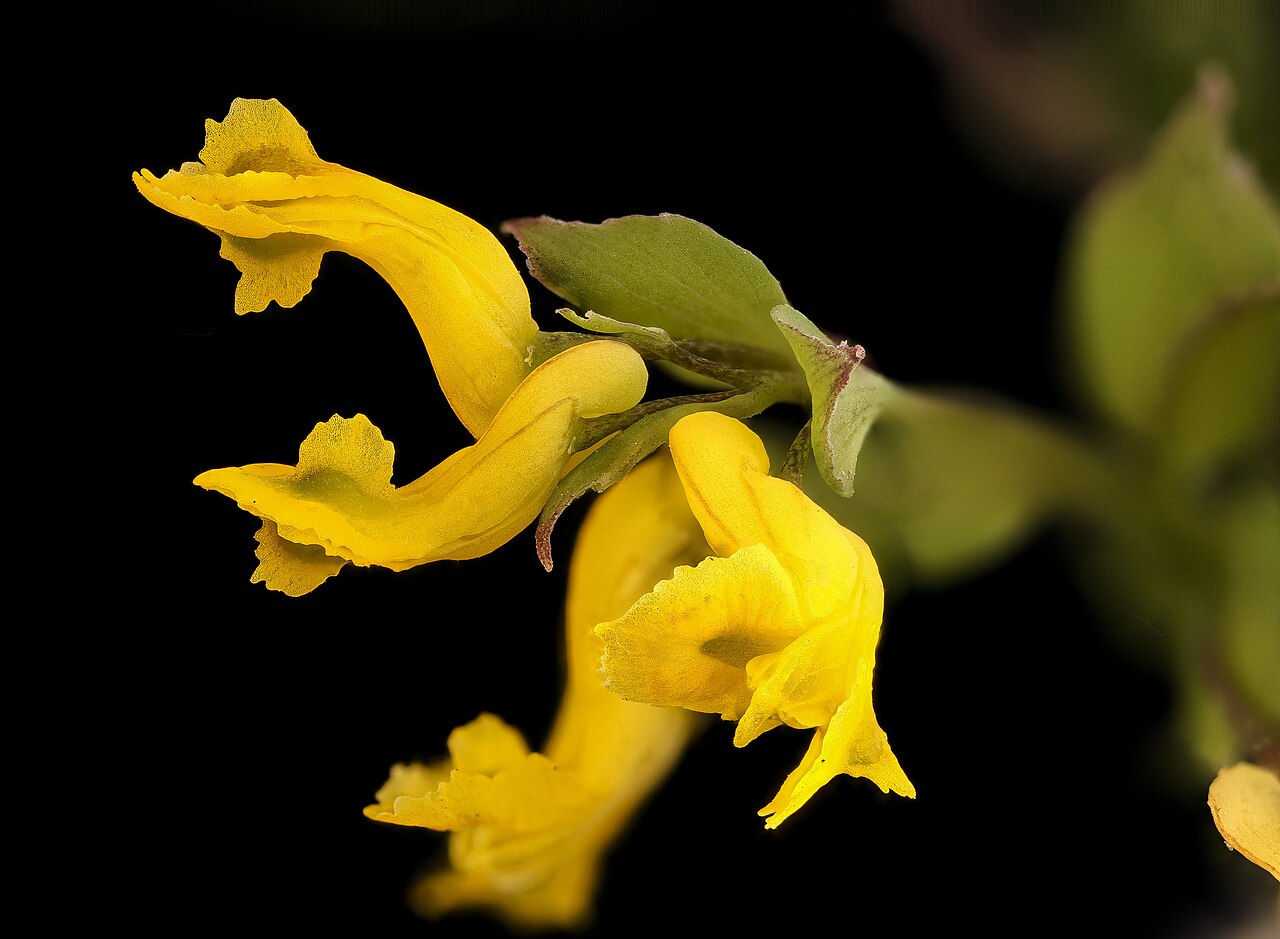
Flowers appear from March to May in small clusters at the tips of the stems and in the leaf axils. Each is about ¼ to ½ inch long, pale to bright yellow, and tubular, with four petals: the upper one forms a short, rounded spur at the back, and the outer petals have a toothed or ruffled crest along their backs. The flower stalks are fairly long and the small leafy bracts under each flower are often visibly toothed.
Small-flowered corydalis (C. micrantha) has smaller flowers with smooth crests and grows more often in open, sandy or disturbed sites. Golden corydalis (C. aurea) has larger, brighter flowers with a longer spur and grows mainly to the north and west. Rock harlequin (C. sempervirens) has pink flowers tipped with yellow and grows on rocky ledges.
Fruit & Seeds
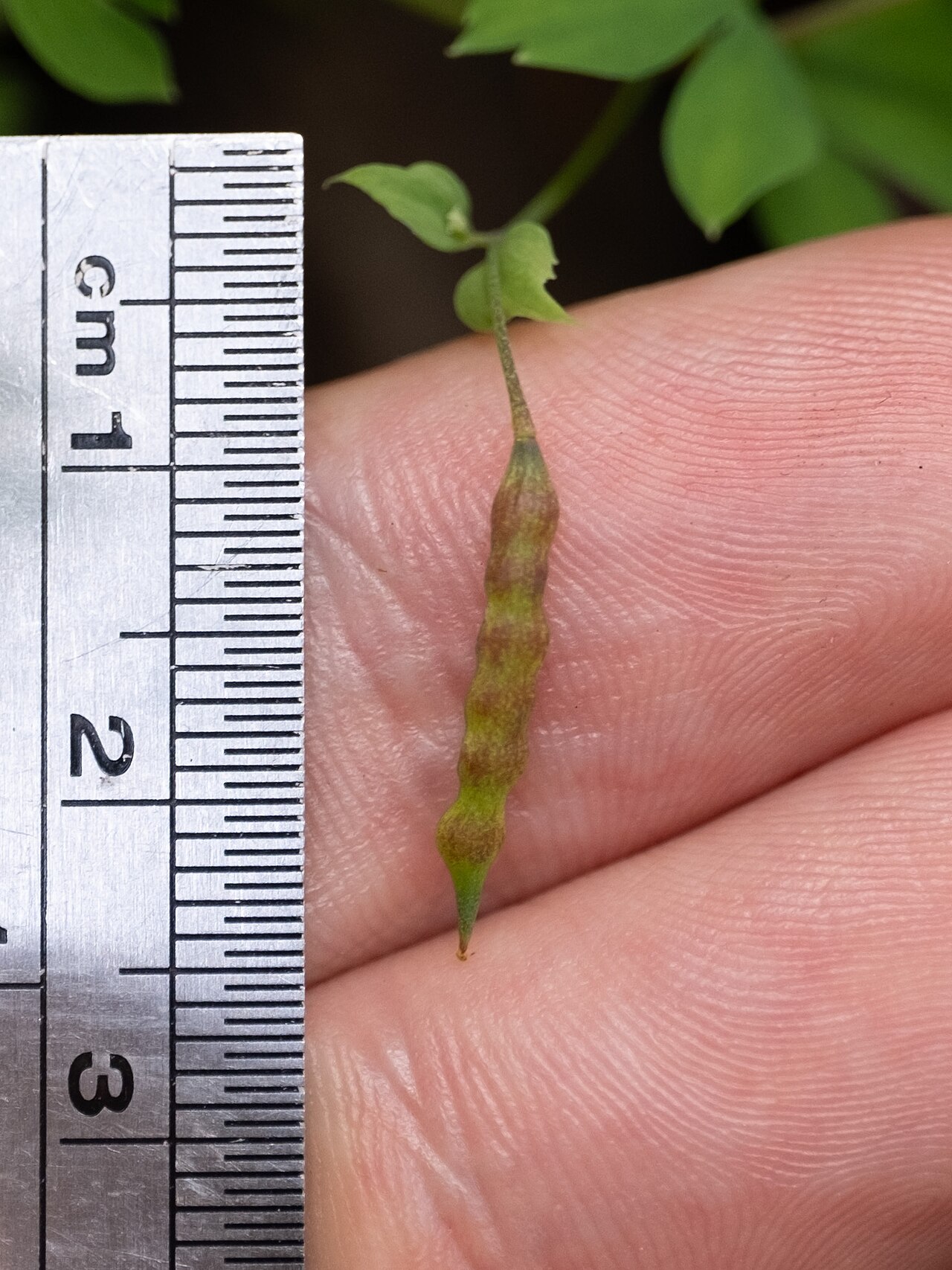
The fruit is a slender, slightly beaded capsule about ½ to 1 inch long. When ripe, it splits open to release a few shiny black seeds, each with a small, whitish, fatty appendage (an elaiosome) that attracts ants.
Quick Facts
| Scientific Name | Corydalis flavula (Raf.) DC. |
| Family | Papaveraceae (poppy family; fumitory subfamily) |
| Plant Type | Winter annual wildflower |
| Mature Height | 4–14 in (stems often sprawling) |
| Mature Spread | 6–12 in |
| Growth Rate | Fast (completes life cycle in one season) |
| Sun Exposure | Partial to full shade (sun before trees leaf out) |
| Water Needs | Moderate; moist soil in spring |
| Soil Type | Rich, loamy woodland soil; alluvial floodplain soils |
| Soil pH | Slightly acidic to neutral (about 5.5–7.5) |
| Bloom Time | March–May |
| Flower Color | Pale to bright yellow |
| Fall Color | None; plants die back by early summer |
| Fruit | Slender, beaded capsule; black seeds with elaiosomes |
| Deer Resistant | Yes; the alkaloid-rich foliage is rarely browsed |
| USDA Hardiness Zones | 5–9 |
Native Range
Yellow corydalis is a plant of the eastern and central United States. USDA PLANTS lists it as native in 27 states, from New York, Connecticut and New Jersey south to Georgia and northern Florida, and west through Ohio, Indiana, Illinois, Michigan and Iowa to Nebraska, Kansas, Oklahoma, Arkansas and Louisiana. In Canada it is known only from southern Ontario, where it is rare.
It is most common in the Ohio and Mississippi river valleys, the Piedmont and the Appalachian foothills, especially in Tennessee, Kentucky, Ohio, Indiana, Virginia and North Carolina. At the edges of its range, including Connecticut, New York, Michigan, Iowa, Nebraska, Kansas, Florida and Louisiana, it is scattered or uncommon.
It grows in rich, moist deciduous woods, floodplain forests, stream banks and terraces, wooded ravines and the bases of rocky slopes. It often carpets alluvial soils along rivers in early spring before the trees leaf out, and it can also appear along shaded trails and woodland edges.

📋 Regional plant lists featuring Yellow Corydalis: New York, Pennsylvania & Northern New Jersey · Ohio & Indiana · Michigan, Wisconsin & Eastern Minnesota · Kentucky & Tennessee · Nebraska, Kansas & Eastern Colorado · Connecticut, Massachusetts & Rhode Island · New Hampshire, Maine & Vermont · Maryland, Virginia & West Virginia · Delaware, Southern New Jersey & Long Island · Illinois, Iowa & Missouri · Alabama, Georgia & Mississippi · North & South Florida · North & South Carolina · Arkansas, Louisiana, Eastern Oklahoma & Eastern Texas
Growing & Care Guide
Yellow corydalis is easy to keep once you have it, because it reseeds itself. The main trick is understanding its annual life cycle: it appears in late winter, flowers in spring and is gone by summer, so plan for it as a seasonal carpet under shrubs and perennials that fill in later.
Light
Partial to full shade under deciduous trees. Like other spring ephemerals, it does most of its growing in early spring, while sunlight reaches the forest floor, and it has finished its life cycle by the time the canopy closes.
Soil & Water
It prefers rich, loose, moist soil with plenty of organic matter, such as leaf mold or alluvial loam. Keep the soil moist in fall and spring, when the plants are growing. It does not need summer water, since it is dormant as seed by then.
Planting Tips
Since it is an annual, it is best started by scattering fresh seed in late spring or early summer onto bare soil or thin leaf litter where you want it to grow. Seed is sometimes available from native seed suppliers, and plants occasionally turn up at native plant sales. It works well among ferns, wild ginger, hostas and late-emerging perennials that cover the ground after it fades. Do not collect plants or large amounts of seed from the wild.
Pruning & Maintenance
No pruning is needed. Let the plants set seed and die back on their own, and avoid heavy mulching or raking in late spring and fall, which can bury seeds or remove the leaf litter that seedlings grow in. Weed out aggressive invasives such as garlic mustard and lesser celandine, which compete with it in moist woods.
Propagation
Propagate by seed only. Collect ripe pods in late spring before they split, and sow the seeds immediately; they lose viability if they dry out. Seeds sprout in fall or the following spring. Once established, a colony maintains itself, with ants helping to spread the seeds.
Landscape Uses
- Shade and woodland gardens: an early-spring carpet of yellow flowers and lacy foliage
- Spring ephemeral plantings: pairs well with spring beauty, toothworts and Dutchman’s breeches
- Floodplain and riparian restoration: native groundcover of rich alluvial woods
- Naturalistic plantings under trees: reseeds into leaf litter without crowding perennials
- Early-season pollinator support: one of the first nectar sources for spring bees
Wildlife & Ecological Value
Yellow corydalis may be small and short-lived, but it plays a useful role in the busy early spring life of eastern woodlands.
For Pollinators
The tubular flowers are visited by early-season bees, especially queen bumble bees and mason bees, which push into the flower to reach nectar in the spur. Some bees bite holes in the spur to “rob” the nectar without pollinating. The flowers can also pollinate themselves, which helps an annual plant set seed in cold, wet springs.
For Birds
It is of little direct value to birds. The rich floodplain and woodland habitats where it grows support many migrating and nesting songbirds in spring.
For Mammals
The foliage contains bitter alkaloids and is rarely eaten by deer, rabbits or other mammals.
Ecosystem Role
Each seed carries an elaiosome, a fatty appendage that ants carry back to their nests. After eating the elaiosome, the ants discard the seed, often in a sheltered, nutrient-rich spot. This form of seed dispersal, called myrmecochory, is shared by many spring wildflowers, including Dutchman’s breeches, bloodroot and trillium. As a winter annual, yellow corydalis also covers bare floodplain soil in early spring, helping to hold it in place after winter floods.
Cultural & Historical Uses
The genus name Corydalis comes from the Greek word for the crested lark, because the spur of the flower resembles the long hind claw or crest of that bird. The species name flavula means “yellowish.” The eccentric naturalist Constantine Rafinesque first described it in the early 1800s as Fumaria flavula, and it was later moved to Corydalis by Augustin Pyramus de Candolle.
Safety note: all Corydalis species contain isoquinoline alkaloids, and several have been linked to livestock poisoning, causing trembling and other nervous symptoms. Yellow corydalis is small and seldom eaten, but no part of it should be eaten by people or pets. Some Asian Corydalis species are used in traditional medicine, but that does not make North American species safe to use, and home remedies made from them are not recommended.
The name fumewort comes from the related fumitories (Fumaria), whose smoky gray-green foliage was said to look like smoke rising from the ground. For many spring wildflower walkers, the first sprinkle of yellow corydalis along a creek bank is one of the early signs that the season has turned.
Frequently Asked Questions
Is yellow corydalis poisonous?
Yes, it should be treated as toxic. Like other corydalis species, it contains alkaloids that can cause trembling and other nervous system symptoms if eaten in quantity, and related species have poisoned livestock. Keep children and pets from eating it.
Is it an annual or a perennial?
It is a winter annual. Seeds sprout in late summer or fall, the young plants overwinter, and they flower and die in spring. Colonies persist because they reseed every year.
How do I tell yellow corydalis from other yellow corydalis species?
Look for small, pale yellow flowers with a short, rounded spur and a toothed crest on the outer petals, early spring bloom, and a habitat in rich, moist woods. Small-flowered corydalis has smaller flowers with smooth crests, and golden corydalis has larger flowers with longer spurs.
Will it spread in my garden?
It reseeds and may slowly spread through moist, shady areas with the help of ants, but it is small and short-lived, so it rarely crowds out other plants.
When does it bloom?
From about March to May, depending on latitude, often before the trees leaf out. By early summer the plants have set seed and disappeared.

Looking for a nursery that carries Yellow Corydalis?
Browse our native plant nursery directory: Alabama & Arkansas · Connecticut, Delaware, Florida & Georgia · Illinois, Indiana, Iowa & Kansas · Kentucky, Louisiana, Maryland, Michigan, Mississippi & Missouri · Nebraska, New Jersey, New York, North Carolina, Ohio & Oklahoma · Pennsylvania, South Carolina, Tennessee & Virginia · West Virginia