Squirrel Corn (Dicentra canadensis)
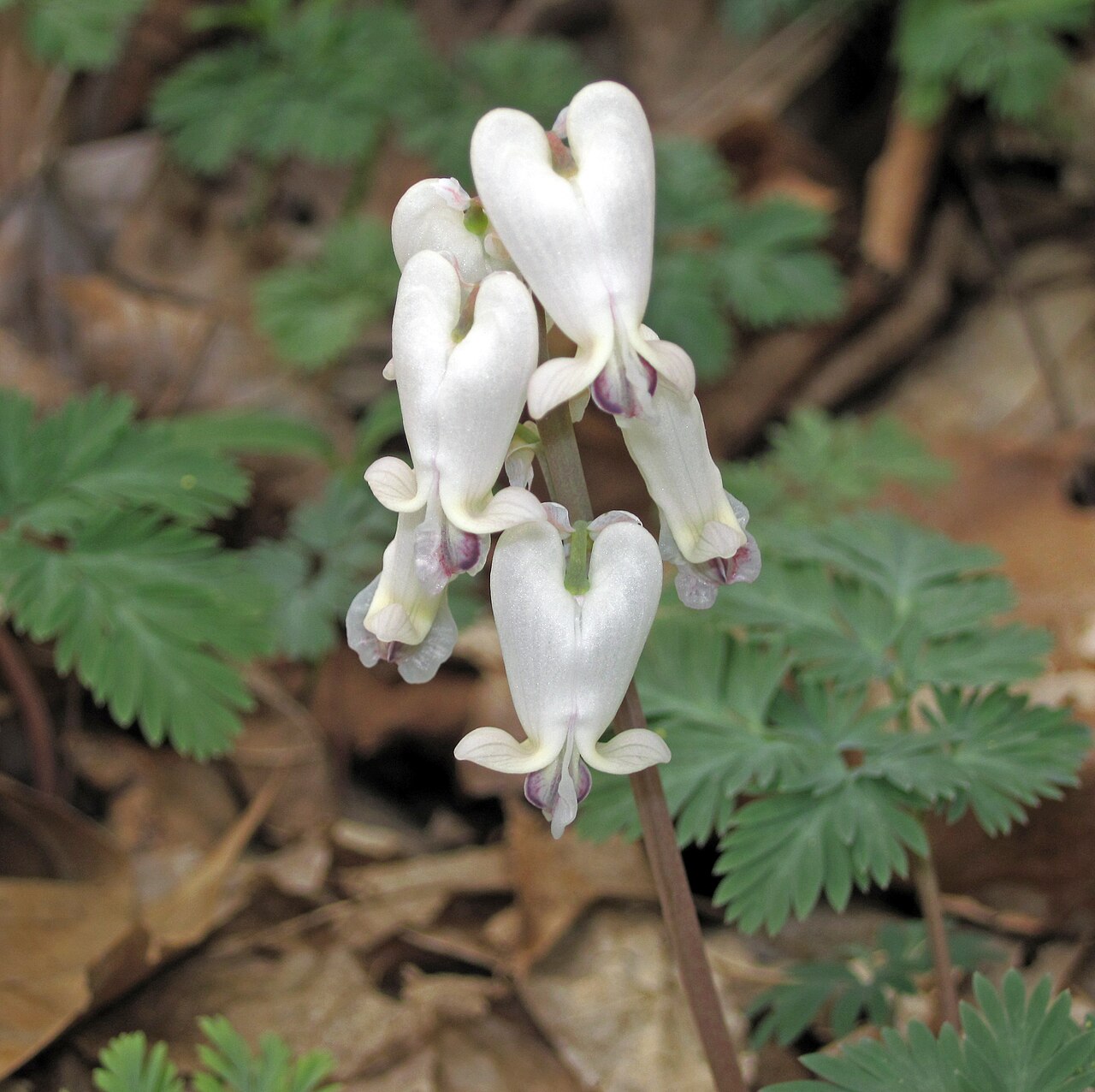
Dicentra canadensis, commonly called Squirrel Corn, is a small spring ephemeral wildflower of eastern deciduous forests, named for the little yellow bulblets clustered at its roots that look uncannily like kernels of dried corn. It belongs to the Papaveraceae (poppy family, subfamily Fumarioideae) along with its close relative Dutchman’s breeches (Dicentra cucullaria), and the two are often found growing side by side in the same rich woods.
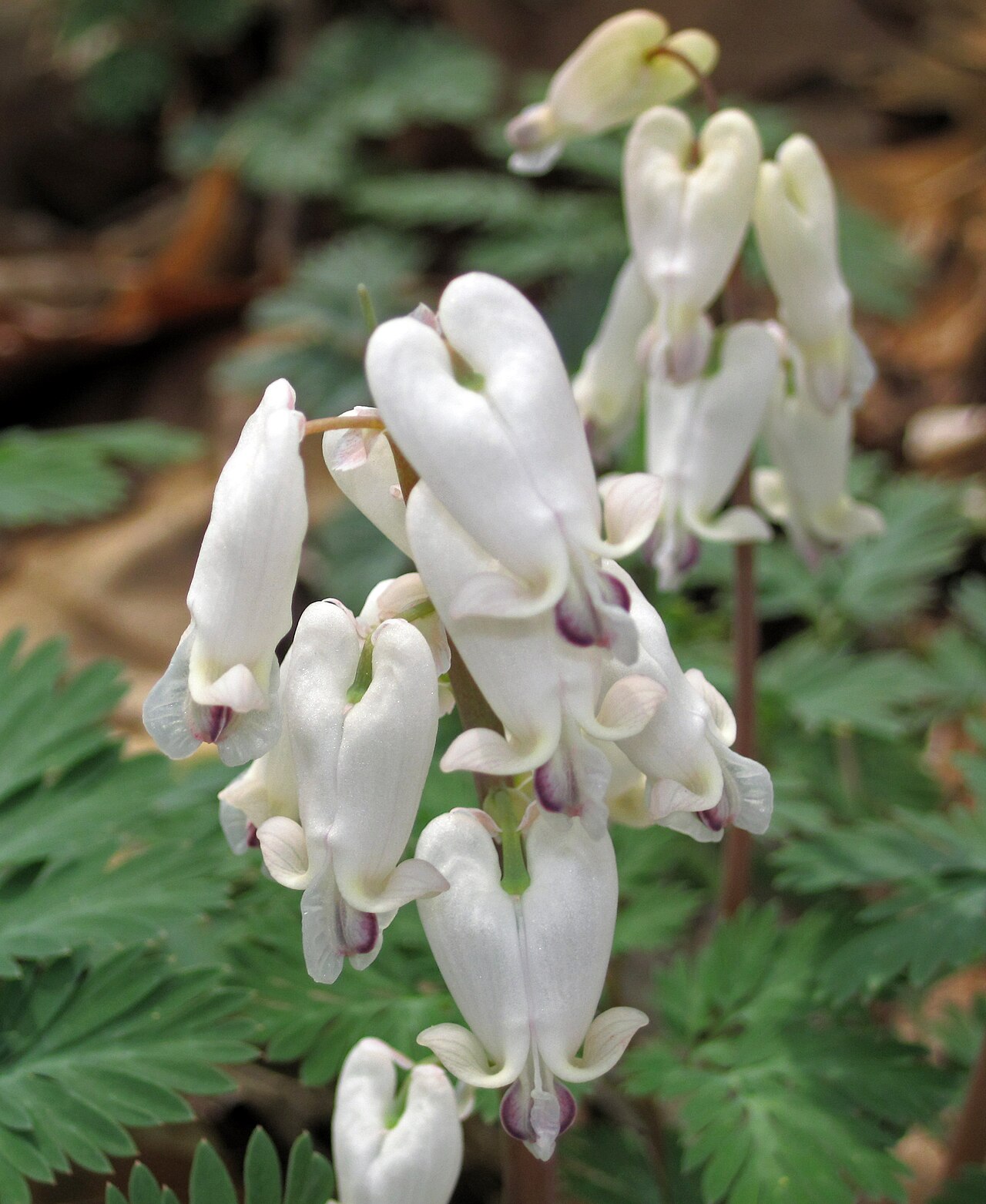
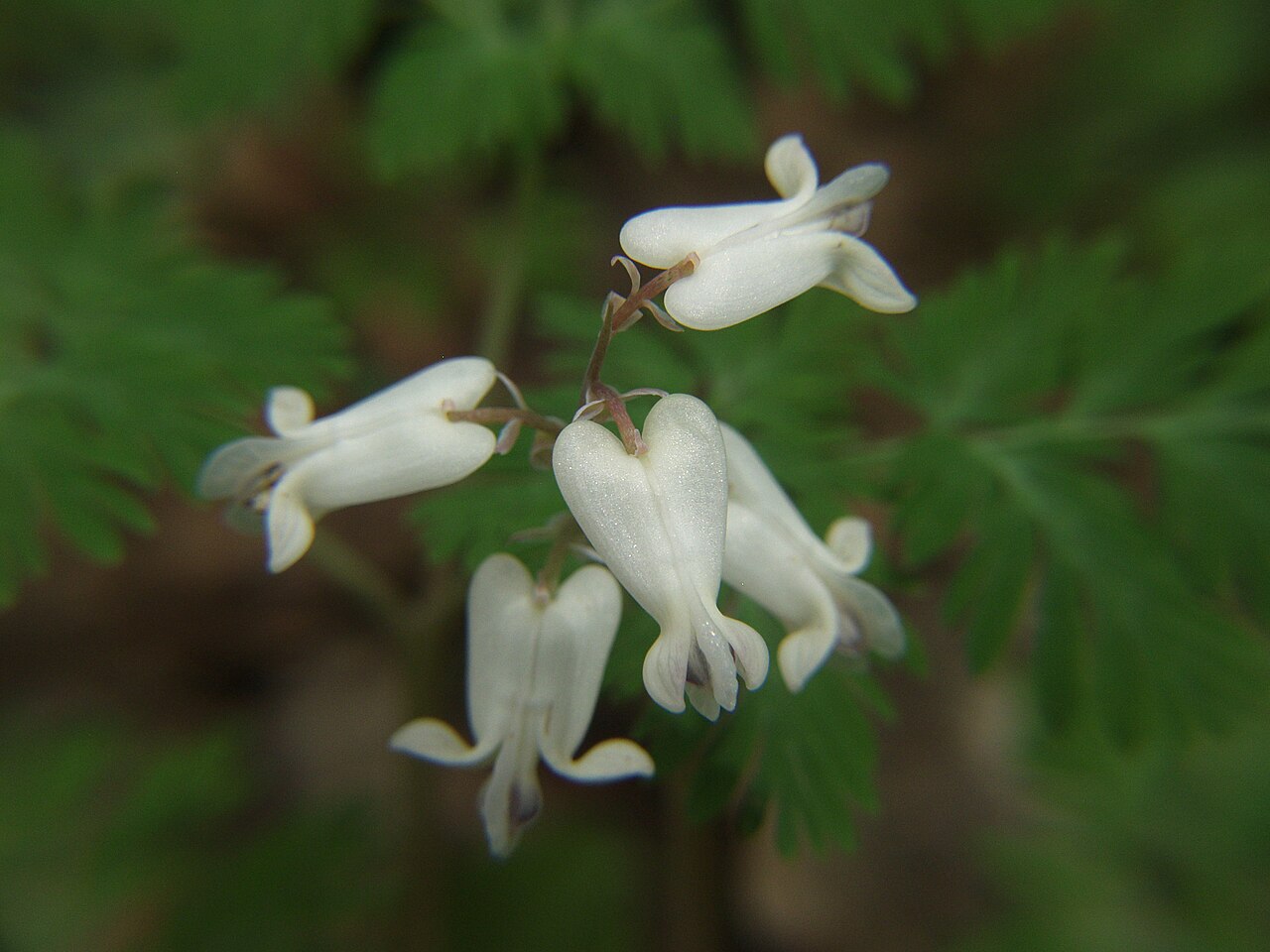
Each plant sends up a single leafless flowering stalk to about 10 inches, lined with nodding, heart-shaped white flowers tinged with pale green at the tip and a faint blush of lavender-pink at the base. Unlike Dutchman’s breeches, whose two spurs splay outward like pantaloons, squirrel corn’s flowers have short, rounded spurs that give them a softer, more balloon-like heart shape, and they carry a light fragrance of hyacinth that Dutchman’s breeches lacks. The blue-green, finely dissected leaves resemble parsley or carrot tops and rise directly from the same underground stem as the flower stalk.
Squirrel corn is a true spring ephemeral: it emerges, flowers, sets seed, and disappears back underground within a matter of weeks, all before the forest canopy leafs out and shades the forest floor. For gardeners with a shaded, humus-rich native woodland bed, it is a choice companion for trillium, bloodroot and wild ginger, though its brief above-ground season means it is best planted where later-emerging ferns or wildflowers can fill the gap it leaves behind in early summer.
Identification
Squirrel corn is a low, clump-forming perennial herb that reaches only 6 to 10 inches tall in flower, with foliage that stays lower still. Everything above ground, leaves and flower stalk alike, dies back to the underground parts by early summer, so the plant is only visible for a short window in spring.
Underground Parts
The most distinctive feature of this species, and the source of its common name, is hidden below the soil surface: a cluster of small, hard, yellow bulblets, each about the size and shape of a kernel of corn, packed tightly around the base of the plant like a tiny ear of corn. These bulblets store the energy the plant needs to re-emerge the following spring and are the easiest way to tell squirrel corn apart from Dutchman’s breeches, which instead has pink, grain-like scaly bulblets in looser clusters.
Leaves
The leaves are basal, arising on their own stalks directly from the underground stem, and are finely divided two or three times into narrow, blue-green segments, giving the whole leaf a lacy, fern-like or parsley-like texture. They are soft-textured rather than leathery, and the foliage yellows and withers away entirely by early to mid-summer as the plant goes dormant.
Flowers
From March into May, a single arching, leafless flower stalk (scape) rises above the foliage, carrying 4 to 10 nodding flowers in a one-sided raceme. Each flower is heart-shaped in outline, about half an inch long, white with a green-yellow tip and a tinge of pink-lavender near the base where the short, rounded spurs are fused into the heart shape. The flowers have a faint, sweet fragrance. Long-tongued bumblebee queens are the main pollinators, able to reach the nectar at the base of the short spurs; many other insects simply rob the nectar by biting through the spur from outside.
Fruit & Seeds
After pollination, each flower develops into a small, narrow capsule containing several shiny black seeds, each bearing a fleshy, pale attachment called an elaiosome. Ants are drawn to the elaiosome and carry the seeds back to their nests, eating the fatty appendage and discarding the seed underground, a seed-dispersal partnership called myrmecochory that is shared by many spring ephemerals including trillium and bloodroot.
Quick Facts
| Scientific Name | Dicentra canadensis |
| Family | Papaveraceae (Poppy, subfamily Fumarioideae) |
| Plant Type | Herbaceous perennial, spring ephemeral wildflower |
| Mature Height | 6–10 in in flower |
| Mature Spread | 6–10 in per clump, slowly spreading by offsets |
| Growth Rate | Slow to establish, then spreads gradually |
| Sun Exposure | Part Shade to Full Shade |
| Water Needs | Average, moist in spring; tolerates summer dryness once dormant |
| Soil Type | Rich, humus-laden, well-drained loam |
| Soil pH | Neutral to slightly acidic or alkaline, about 6.0–7.5 |
| Bloom Time | March – May |
| Flower Color | White with green-yellow tips and pink-lavender base |
| Fall Color | Not applicable (dormant by early summer) |
| Fruit | Small narrow capsule with black, ant-dispersed seeds |
| Deer Resistant | Yes (toxic alkaloids discourage browsing) |
| USDA Hardiness Zones | 3–7 |
Native Range
Squirrel corn is native to the deciduous forests of eastern North America, from New England and the Canadian border west through the upper Midwest to Iowa and Missouri, and south through the Appalachians into North Carolina, Tennessee and the mountains of northern Georgia and South Carolina. It is most abundant in the rich, mesic forests of the Appalachian and Ohio Valley regions and becomes more scattered toward the edges of its range.
Across this range, squirrel corn favors rich, moist, well-drained deciduous woods with deep leaf litter, often on slopes, in ravines, or among rock outcrops near streams where the soil stays cool and humus-rich. It is strongly associated with calcium-rich or circumneutral soils and is frequently found growing beside its close relative Dutchman’s breeches, as well as trillium, Virginia bluebells, spring beauty, trout lily, bloodroot and wild ginger, in the brief window between snowmelt and full canopy leaf-out.
Because it depends on specific soil chemistry, consistent shade from mature trees, and ants for seed dispersal, squirrel corn spreads very slowly on its own and can take years to establish a new colony. Old-growth and long-undisturbed forest tracts tend to hold the largest and healthiest populations, and the species is considered a good indicator of high-quality, undisturbed woodland.
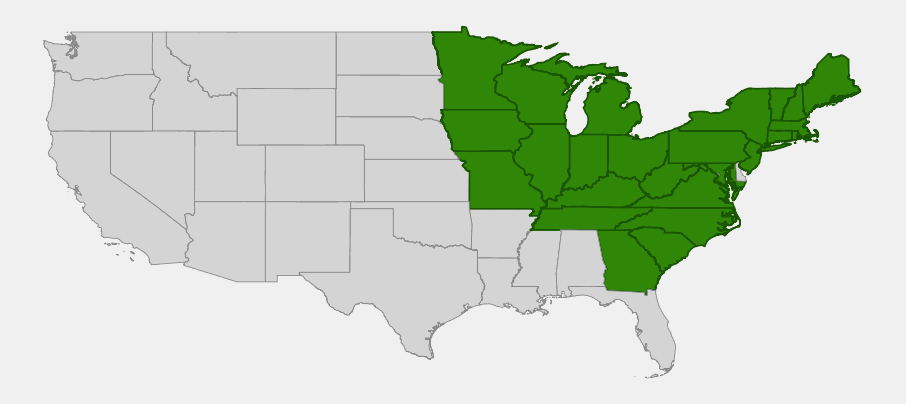
📋 Regional plant lists featuring Squirrel Corn: New Hampshire, Maine & Vermont · Connecticut, Massachusetts & Rhode Island · New York, Pennsylvania & Northern New Jersey · Maryland, Virginia & West Virginia · North Carolina & South Carolina · Georgia, Alabama & Mississippi · Kentucky & Tennessee · Ohio & Indiana · Illinois, Iowa & Missouri · Michigan, Wisconsin & Eastern Minnesota
Growing & Care Guide
Squirrel corn rewards patience. It is not a plant for instant impact, but once established in the right spot it will slowly naturalize into a carpet of early spring flowers that needs almost no maintenance for the rest of the year.
Light
Give squirrel corn the dappled to full shade of a deciduous woodland canopy. In the wild it gets bright, open light in early spring before the trees leaf out, then deep shade all summer, so a spot under deciduous trees mimics its natural cycle perfectly. It does not tolerate hot afternoon sun or sites that stay sunny and dry through summer.
Soil & Water
Plant in rich, humus-laden soil with excellent drainage; squirrel corn’s bulblets are prone to rot in heavy, poorly drained clay. Keep the soil evenly moist from late winter through the spring flowering period, when the plant is actively growing. Once the foliage yellows and the plant goes dormant in early summer, reduce or stop watering, since dormant bulblets prefer to dry out somewhat, much as they would under a closed forest canopy.
Planting Tips
Plant nursery-grown bulblets or container plants in fall, setting them 2 to 3 inches deep in loosened, compost-enriched soil. Space plants about 8 inches apart to allow for slow spreading. Mark the planting spot, since the foliage disappears completely by midsummer and it is easy to accidentally dig into dormant bulblets later in the season. Never dig squirrel corn from the wild; buy only nursery-propagated stock.
Pruning & Maintenance
No pruning is needed. Simply allow the foliage to yellow and die back naturally after flowering, since the plant is still storing energy in its bulblets during this stage. Leave fallen leaves in place over the planting area each fall to replicate the leaf litter squirrel corn relies on in the wild.
Propagation
The easiest method is dividing the small yellow bulblets in late summer or fall, after the plant has gone fully dormant, and replanting them immediately 2 to 3 inches deep. Seed propagation is possible but slow: fresh seed should be sown immediately after collection, since squirrel corn seed does not store well, and seedlings may take two to three years to reach flowering size.
Landscape Uses
Squirrel corn fits naturally into shaded native plantings:
- Woodland wildflower gardens alongside other spring ephemerals
- Shaded rock gardens on slopes with good drainage
- Naturalized plantings under mature deciduous trees
- Companion planting with ferns or hostas that fill in after it goes dormant
- Restoration of degraded woodland understory in appropriate rich-soil sites
Wildlife & Ecological Value
Despite its small size and brief season, squirrel corn plays an outsized role in the early-spring forest community.
For Pollinators
The flowers are specialized for long-tongued bumblebee queens, which are among the first pollinators active in spring and depend on early-blooming woodland flowers like squirrel corn for nectar after emerging from hibernation. Short-tongued insects often rob nectar by piercing the spurs rather than entering the flower normally, but true pollination still depends mainly on bumblebees.
For Mammals
Despite the name, squirrel corn’s bulblets are not a significant food source for squirrels; the resemblance to corn kernels is purely visual. The foliage and bulblets contain isoquinoline alkaloids that make the plant unpalatable and toxic to browsing mammals, which is why deer and rabbits generally leave it alone.
Ecosystem Role
As a spring ephemeral, squirrel corn captures sunlight and nutrients during the narrow window before the forest canopy closes, then returns that energy to the soil food web as its foliage decomposes. Its reliance on ants for seed dispersal (myrmecochory) ties it into the broader web of forest-floor insect activity, and its presence is often used by botanists as a sign of a rich, long-undisturbed woodland.
Cultural & Historical Uses
Squirrel corn has little documented history as a food or utilitarian plant among Indigenous peoples, likely because the entire plant, and especially the bulblets and foliage, is toxic. Some historical ethnobotanical records note limited external or ceremonial use of related Dicentra species, but squirrel corn itself was never a significant food, fiber or medicinal plant.
Early botanists and wildflower writers were charmed mainly by its brief, delicate beauty and its curious corn-kernel bulblets, which gave the plant its lasting common name. Nineteenth- and early twentieth-century nature writers frequently paired it with Dutchman’s breeches in field guides and wildflower books as a classic springtime find in rich eastern woods.
Today, squirrel corn’s main significance is ecological and horticultural rather than practical. It is valued by native plant gardeners and conservationists as an indicator of healthy, undisturbed forest and as an early food source for spring-emerging bumblebees, rather than for any historical harvest or craft use.
Frequently Asked Questions
Is squirrel corn toxic?
Yes. All parts of squirrel corn, especially the yellow bulblets and foliage, contain isoquinoline alkaloids that are toxic if eaten, both to livestock such as cattle (which have been poisoned grazing on Dicentra species in pastures bordering woodland) and to people. Never eat any part of this plant, and keep livestock out of areas where it grows densely.
What is the difference between squirrel corn and Dutchman’s breeches?
The two are close relatives and often grow together, but squirrel corn has short, rounded spurs that give its flowers a heart shape with a faint lavender blush and a light hyacinth fragrance, while Dutchman’s breeches has longer, splayed spurs that look like a pair of white pantaloons and no real scent. Underground, squirrel corn has yellow, corn-kernel-shaped bulblets, while Dutchman’s breeches has pink, grain-like scaly bulblets.
Why did my squirrel corn disappear in summer?
That is normal. Squirrel corn is a spring ephemeral, meaning the foliage and flowers die back completely by early summer once the forest canopy closes overhead, and the plant survives underground as dormant bulblets until the following spring. Mark the spot so you don’t disturb it while it is out of sight.
Can squirrel corn grow in a sunny garden bed?
No, not successfully. It needs the shade and moisture of a deciduous woodland setting, at least during its spring growing season, and will struggle or fail in an open, sunny perennial border. Plant it under deciduous trees or shrubs instead.
How long does it take squirrel corn to spread or fill in?
Slowly. Established colonies spread gradually by offsets and very slowly by ant-dispersed seed, and a newly planted patch may take several years to visibly thicken. Large, dense colonies in the wild are often decades or even centuries old, which is why wild-collected plants should never be dug.

Looking for a nursery that carries Squirrel Corn?
Browse our native plant nursery directory: Connecticut & Georgia · Iowa, Illinois & Indiana · Kentucky, Massachusetts, Maryland, Maine, Michigan, Minnesota & Missouri · North Carolina, New Hampshire, New Jersey, New York & Ohio · Pennsylvania, Rhode Island, South Carolina, Tennessee, Virginia & Vermont · Wisconsin & West Virginia