
Cut-leaved Toothwort (Cardamine concatenata)
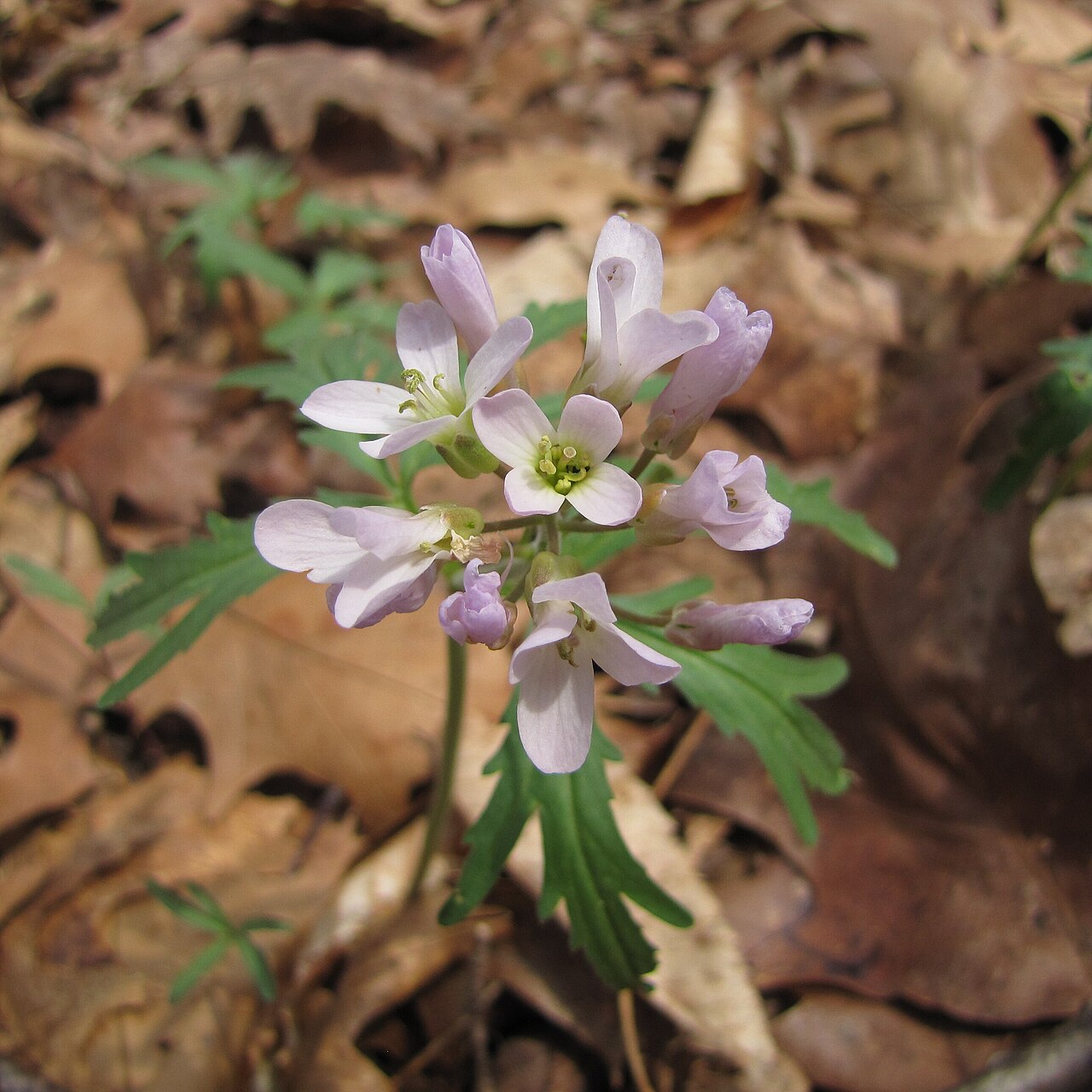
Cardamine concatenata, the Cut-leaved Toothwort (USDA: cutleaf toothwort), is one of the first wildflowers to bloom in the deciduous woods of eastern North America. In early spring a short stem rises from the leaf litter with a whorl of three deeply cut leaves and a small cluster of white to pale pink, four-petaled flowers. It is a member of the mustard family (Brassicaceae), and like many of its relatives it has a mild peppery bite.
Toothwort is a classic spring ephemeral. It sprouts, flowers, sets seed and dies back to its underground rhizome in the few weeks between snowmelt and the closing of the tree canopy. By early summer there is no trace of it above ground. For many years it was placed in the genus Dentaria, as Dentaria laciniata, and that name still appears in older wildflower guides. Botanists now include the toothworts in Cardamine, the bittercresses.
Cut-leaved toothwort grows from southern Quebec and Ontario to Minnesota and the eastern Great Plains, and south to the Gulf Coast. It is an easy, long-lived plant for a shady woodland garden, and it is a larval host for two early-spring butterflies. This guide covers how to identify it, where it grows, how to grow it from nursery stock, and its place in the spring woods.
Identification
Toothwort is small and brief, but the combination of a single whorl of three divided leaves and four-petaled flowers in spring is distinctive. The closest look-alike is its relative two-leaved toothwort (Cardamine diphylla), which has two broader leaves with three toothed leaflets each.
Rhizome & Stems
The plant grows from a shallow, fleshy, whitish rhizome made of small, tuber-like segments joined end to end like links in a chain. The species name concatenata means “linked together”, and it refers to these segments. The pieces break apart easily, and each can grow into a new plant. The flowering stem is unbranched, smooth or slightly hairy, and usually 6 to 15 inches tall (occasionally to about 20 inches).
Leaves
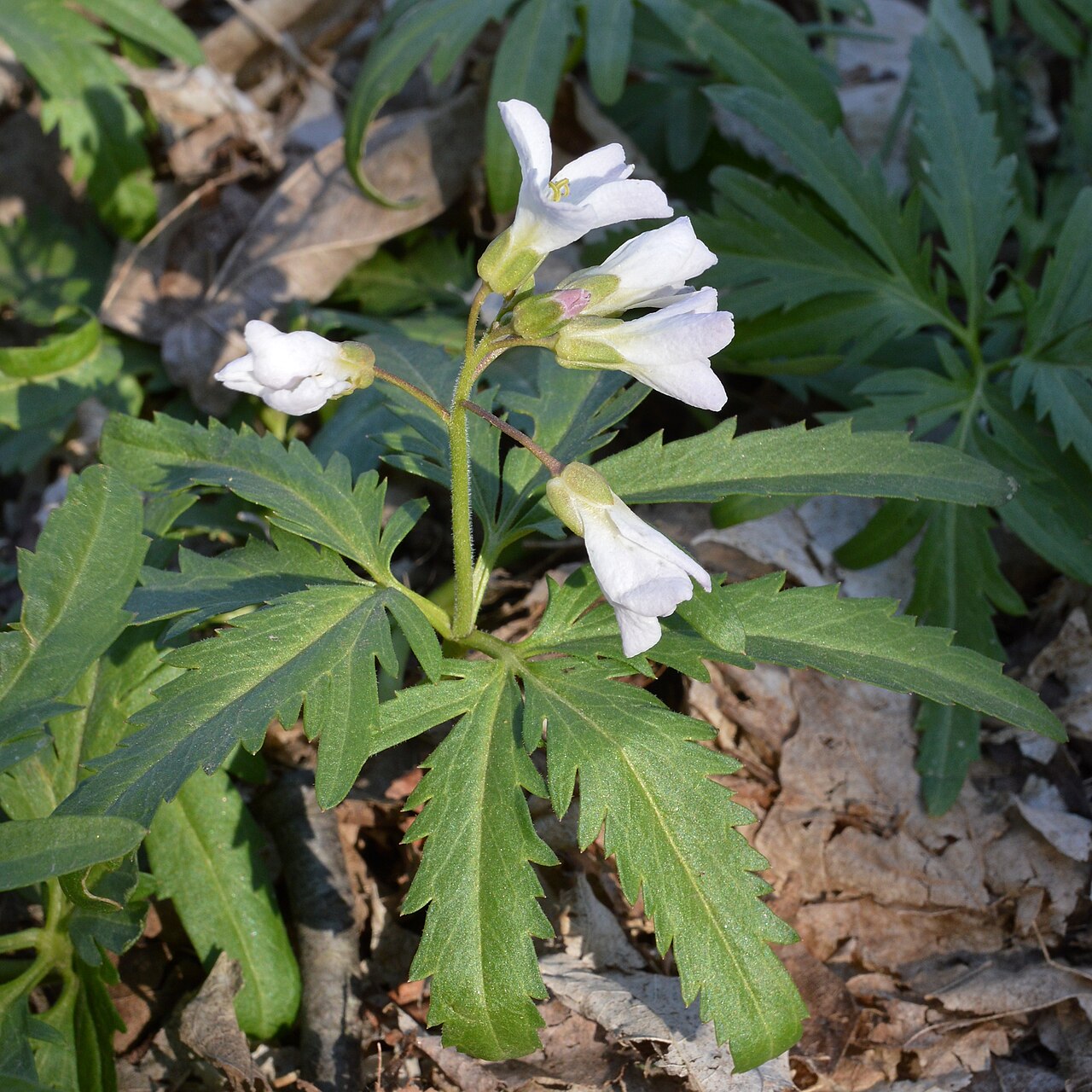
Partway up the stem there is a whorl of three stem leaves. Each one is divided into three (sometimes five) narrow, lance-shaped segments with coarse teeth or lobes along their edges, so the whorl looks like a ring of slender, jagged fingers. Separate basal leaves of a similar shape sometimes come up directly from the rhizome on non-flowering plants. All the leaves wither by late spring or early summer.
Flowers
The flowers grow in a loose cluster at the top of the stem, above the leaf whorl. Each is about 1/2 to 3/4 inch across with four petals in the cross shape typical of the mustard family, six stamens with yellow anthers, and a single green pistil. They are white to pale pink or lavender, and they often open pinkish and fade toward white. On cold or cloudy days the flowers droop and stay partly closed. Bloom is from March to May, starting in late February in the Deep South.
Fruit & Seeds
After flowering the stem keeps growing, and each flower forms a slender, upright seed pod (silique) about an inch long, tipped with a persistent beak. Four to five weeks after bloom the pods dry and split open from the base, and the two sides coil back suddenly and fling the small seeds a short distance from the plant.
Quick Facts
| Scientific Name | Cardamine concatenata (syn. Dentaria laciniata, Dentaria concatenata, Cardamine laciniata) |
| Common Names | Cut-leaved toothwort, cutleaf toothwort (USDA), crow’s toes, pepper root |
| Family | Brassicaceae (mustard family) |
| Plant Type | Herbaceous perennial spring ephemeral from a segmented rhizome |
| Mature Height | 6–15 in (occasionally to about 20 in) |
| Mature Spread | 4–6 in per stem; slowly forms colonies |
| Growth Rate | Slow to moderate |
| Sun Exposure | Part shade to full shade (sun in early spring before trees leaf out) |
| Water Needs | Medium; moist in spring, tolerates drier soil while dormant |
| Soil Type | Rich, humus-rich woodland loam; also floodplain and limestone soils |
| Soil pH | About 6.0–7.5 (slightly acid to circumneutral) |
| Bloom Time | March–May (late February in the Deep South) |
| Flower Color | White to pale pink or lavender |
| Fall Color | None; the plant is dormant from early summer |
| Fruit | Slender upright pod (silique) about 1 in long |
| Deer Resistant | Fairly; browsed only occasionally, and dormant by summer |
| USDA Hardiness Zones | 3–9 |
Native Range
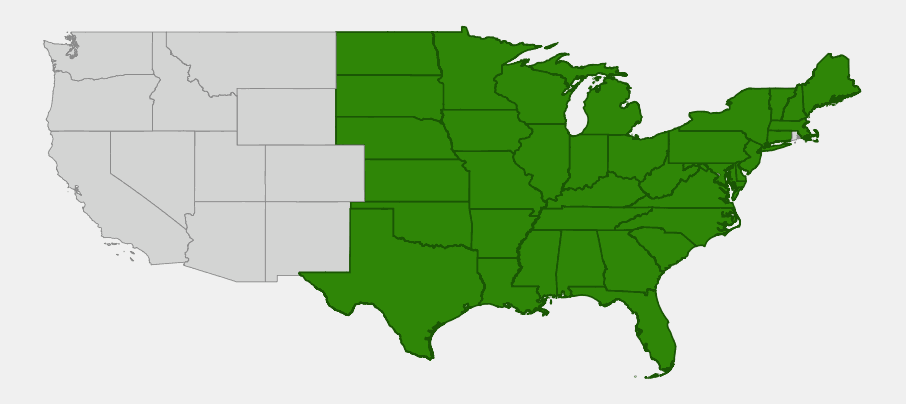
Cut-leaved toothwort is native across most of eastern and central North America. USDA PLANTS records it from 36 states and the District of Columbia, from Maine, Vermont and New Hampshire west through the Great Lakes states to Minnesota and the Dakotas, south through the Ohio and Mississippi valleys to the Gulf Coast, and west to Nebraska, Kansas, Oklahoma and eastern Texas. In Canada it grows in southern Ontario, southern Quebec and New Brunswick.
It is most common in the rich deciduous forests of the Appalachians, the Ohio Valley and the Midwest, where it can carpet slopes and floodplains in April. Toward the edges of its range it becomes patchy. In Florida it is limited to a few rich ravine and bluff forests in the Panhandle, and on the Great Plains it grows only in wooded river valleys.
Within its range it favors moist, fertile woods over limestone or other base-rich rock, wooded floodplains that flood briefly in winter or spring, and rocky, shaded bluffs. It is far less frequent in dry oak woods, pine forests and acid, sandy soils.
📋 Regional plant lists featuring Cut-leaved Toothwort: New York, Pennsylvania & Northern New Jersey · Ohio & Indiana · Michigan, Wisconsin & Eastern Minnesota · Kentucky & Tennessee · Nebraska, Kansas & Eastern Colorado · Connecticut, Massachusetts & Rhode Island · New Hampshire, Maine & Vermont · Maryland, Virginia & West Virginia · Delaware, Southern New Jersey & Long Island · Illinois, Iowa & Missouri · Alabama, Georgia & Mississippi · North & South Florida
Growing & Care Guide
Cut-leaved toothwort is one of the easier spring ephemerals to grow. Given humus-rich soil under deciduous trees it is long-lived and slowly spreads into colonies. Buy plants or dormant rhizomes from nurseries that propagate their own stock, or grow it from seed. Do not dig plants from the wild.
Light
Plant toothwort under deciduous trees or shrubs. It needs bright light in early spring, when it does all its growing, and shade in summer when it is dormant anyway. It will not do well under evergreens, which keep the ground shaded in spring.
Soil & Water
Give it rich, loose, moist soil with plenty of leaf mold. It grows best in slightly acid to neutral soils and tolerates limestone. Keep the soil moist from late winter through bloom. Once the plant is dormant, normal summer dryness under trees does it no harm, and it handles brief spring flooding well.
Planting Tips
Plant dormant rhizome segments in late summer or fall, laying them horizontally about 1 to 2 inches deep. Potted plants can go in during spring while in leaf. Group several plants together for a good show, and mix them with later-emerging perennials such as ferns, wild ginger or woodland phlox, which will cover the bare ground after toothwort disappears. Mark the spot so the dormant rhizomes are not dug up by accident.
Pruning & Maintenance
No pruning is needed. Let the leaves yellow and die back on their own, because that is when the rhizome stores food for next year. Leave fallen leaves in place as a natural mulch in autumn. Keep invasive garlic mustard out of the planting: it competes with toothwort and is a trap for the West Virginia white butterfly (see below).
Propagation
The easiest method is division. While the plant is dormant, break the rhizome into segments, each with a bud, and replant them. Handle the rhizomes gently, since they snap easily. Seed should be sown fresh, as soon as the pods ripen in late spring, on a moist, shaded seed bed or outdoors in pots. Seedlings take three to four years to reach flowering size.
Landscape Uses
- Woodland gardens: early color under deciduous trees, combined with later perennials and ferns
- Spring ephemeral plantings: with bluebells, spring beauty, Dutchman’s breeches and trout lilies
- Butterfly gardens: host plant for the West Virginia white and falcate orangetip
- Floodplain and ravine restoration: in rich, shaded bottomlands within its native range
- Naturalizing: slowly forms colonies in leaf-mold soil with little care
Wildlife & Ecological Value
Toothwort lives above ground for only a few weeks, but in that time it feeds early insects and supports the caterpillars of two specialist butterflies.
For Pollinators
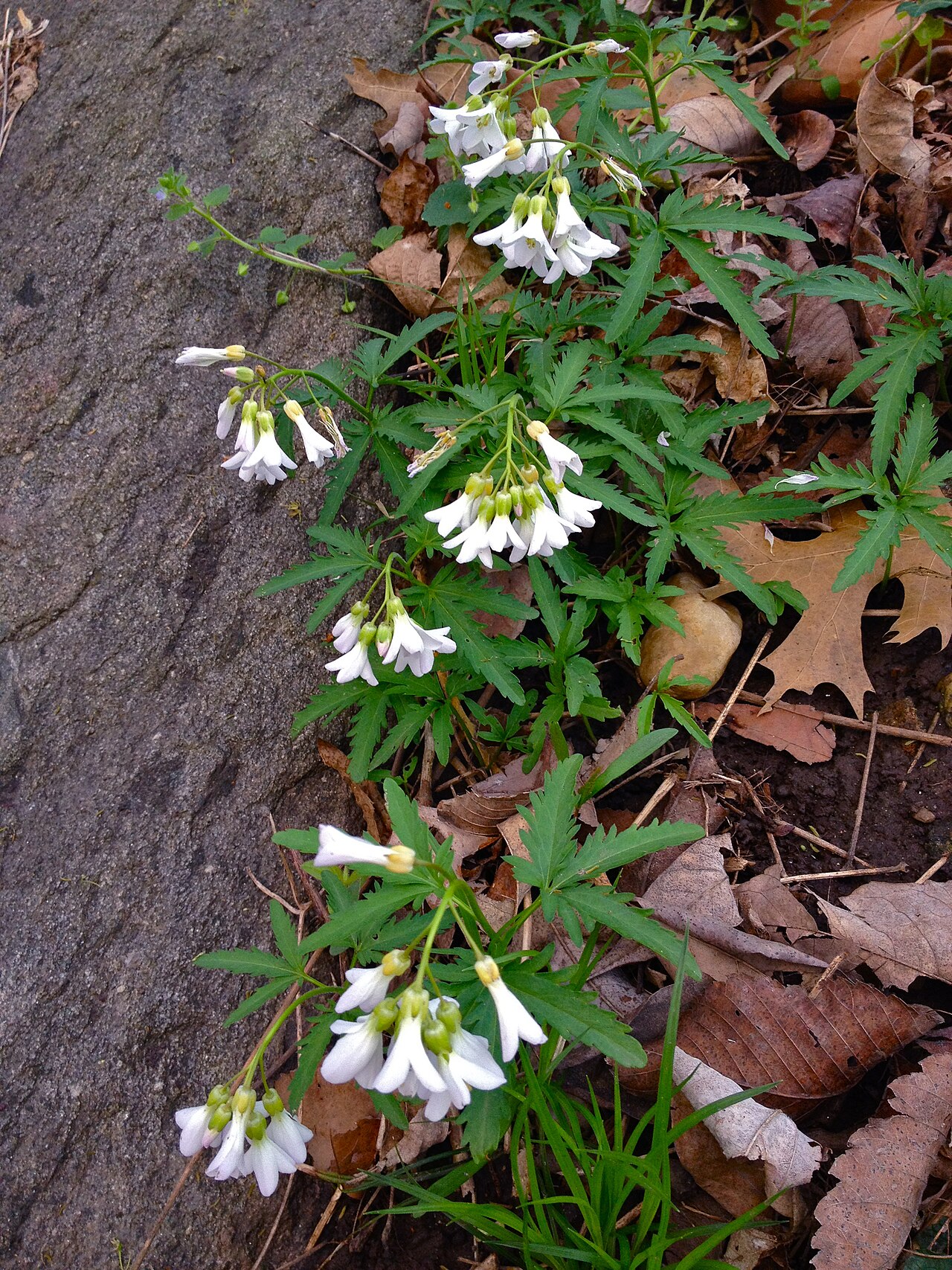
The flowers open when few other nectar sources are available. Queen bumblebees, mining bees (Andrena), small sweat bees, bee flies and early butterflies visit them for nectar and pollen. Cut-leaved toothwort is a larval host for the West Virginia white (Pieris virginiensis) and the falcate orangetip (Anthocharis midea), whose caterpillars feed on the leaves, flowers and young pods. The West Virginia white has declined in many areas where invasive garlic mustard has spread. Females sometimes lay eggs on garlic mustard, and the caterpillars fail to develop on it, so protecting native toothworts and removing garlic mustard both help this butterfly.
For Birds
Toothwort has little direct food value for birds. The early insects it feeds are eaten by migrating warblers, gnatcatchers and other spring songbirds foraging in the same woods.
For Mammals
White-footed mice and other small rodents eat the rhizomes. White-tailed deer browse it occasionally, but it is usually not a preferred food.
Ecosystem Role
Spring ephemerals like toothwort take up nutrients released from thawing soil and decaying leaves at a time when trees are not yet growing. When the plants die back, those nutrients return to the soil. Its seeds are scattered by the exploding pods, and colonies spread slowly by fragmenting rhizomes, so large patches are usually a sign of old, undisturbed woodland.
Cultural & Historical Uses
The name “toothwort” is often linked to the old idea that a plant’s appearance shows its use. The rhizome segments have small tooth-like projections, so the plant was associated with toothache remedies. Other folk names include crow’s toes, for the leaf shape, and pepper root, for the taste of the rhizome.
The crisp rhizomes have a pungent, horseradish-like flavor. Several Native American peoples, including the Iroquois, used toothworts as food and as medicine, and early settlers sometimes added the chopped roots to salads or relishes. Today wild harvesting is discouraged, since digging destroys colonies that take years to establish.
The species was first described by André Michaux in 1803 as Dentaria concatenata. It was best known for most of the twentieth century as Dentaria laciniata. Studies of the mustard family showed that the toothworts belong within Cardamine, and most current floras and USDA PLANTS use Cardamine concatenata.
Frequently Asked Questions
Is cut-leaved toothwort easy to grow?
Yes, as long as it has rich, moist woodland soil under deciduous trees. Plant nursery-grown rhizomes in fall, keep the soil covered with leaf litter, and it will slowly form a colony.
Why does toothwort disappear in summer?
It is a spring ephemeral. It does its growing in the bright weeks before the tree canopy closes, then goes dormant underground until the next spring. This is normal and does not mean the plant has died.
What is the difference between cut-leaved and two-leaved toothwort?
Cut-leaved toothwort has a whorl of three leaves split into narrow, jagged segments. Two-leaved toothwort (Cardamine diphylla) has two leaves, each with three broad, toothed leaflets, and a rhizome that is not obviously segmented.
Is toothwort edible?
The rhizome has a peppery, horseradish-like taste and was traditionally eaten. Wild plants should not be dug, though. Colonies recover slowly, and the plant matters to early pollinators and butterflies.
What was the old name of cut-leaved toothwort?
It was long known as Dentaria laciniata, and older guides list it under the genus Dentaria. That genus has been merged into Cardamine.

Looking for a nursery that carries Cut-leaved Toothwort?
Browse our native plant nursery directory: Alabama & Arkansas · Connecticut, Delaware, Florida & Georgia · Illinois, Indiana, Iowa & Kansas · Kentucky, Louisiana, Maine, Maryland, Massachusetts, Michigan, Minnesota, Mississippi & Missouri · Nebraska, New Hampshire, New Jersey, New York, North Carolina, North Dakota, Ohio & Oklahoma · Pennsylvania, South Carolina, South Dakota, Tennessee, Texas, Vermont & Virginia · West Virginia & Wisconsin