
Pipsissewa (Chimaphila umbellata)
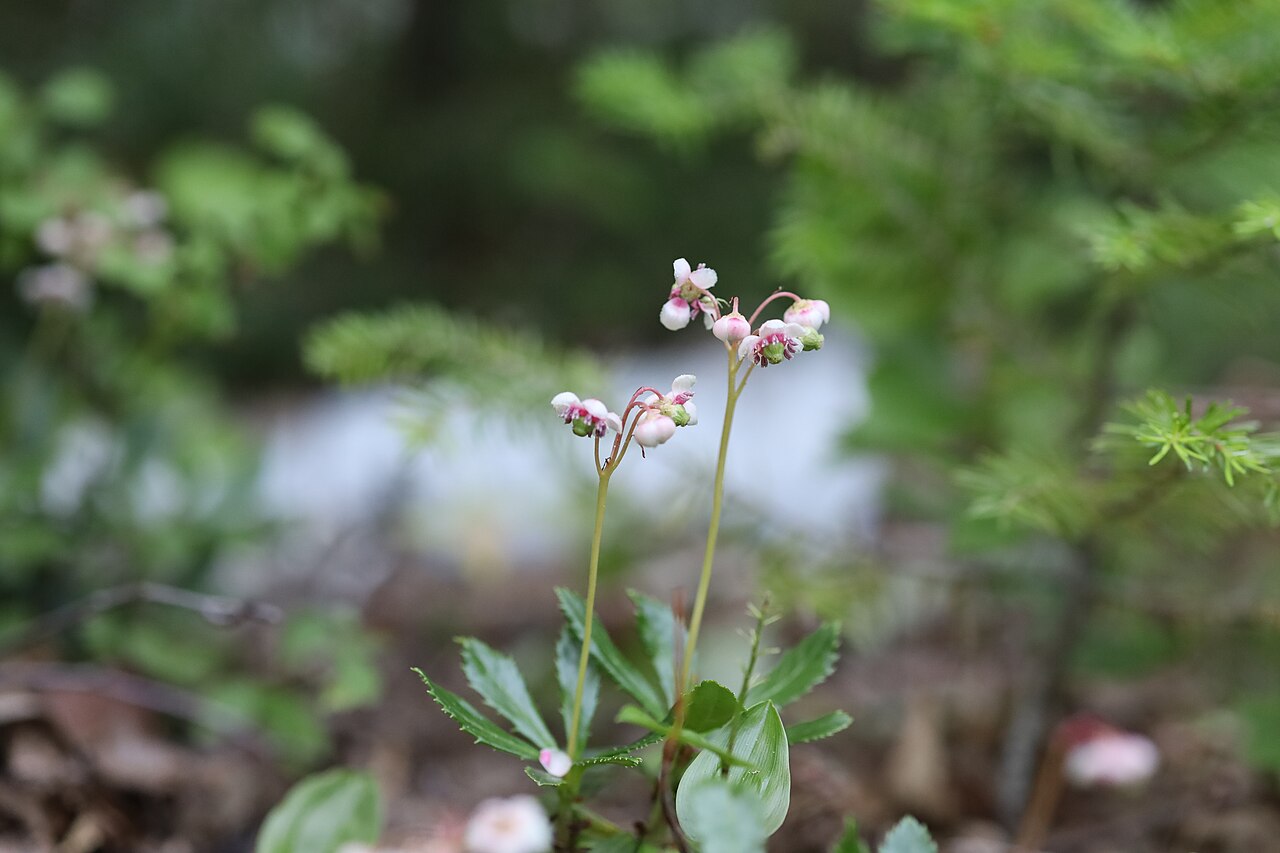
Chimaphila umbellata, known as Pipsissewa, prince’s pine or umbellate wintergreen, is a small evergreen subshrub of dry coniferous and mixed forests across much of the Northern Hemisphere. It grows 4 to 12 inches tall from creeping underground stems and has whorls of glossy, dark green, sharply toothed leaves that stay green all winter. In summer it raises a small cluster of nodding, waxy, pink to white flowers with a ring of rosy color around a plump green center. It belongs to the heath family (Ericaceae), and was formerly placed in the wintergreen family (Pyrolaceae).
Pipsissewa is a plant of shady forest floors, often under pines, firs, oaks and hemlocks, where it grows in dry, acidic, sandy or rocky soils covered by needles and leaf litter. It depends on soil fungi to supplement the food it makes in its leaves, and it is slow-growing and difficult to transplant. In much of the eastern United States it is uncommon, and over-collection for herbal medicine and the woodland plant trade has reduced some populations.
This guide covers how to identify pipsissewa, where it grows across its wide range, the honest limits of growing it, and its long history as a medicinal and flavoring plant. Do not collect it from the wild, and be aware that its leaves contain compounds that can irritate the skin and are not safe in large or long-term doses.
Identification
Pipsissewa is easy to recognize by its glossy, whorled, sharply toothed evergreen leaves. In the East it can be confused with its close relative, striped wintergreen.
Stems & Growth Habit
Plants spread by long, creeping rhizomes just below the forest floor. Upright, woody-based stems rise from these at intervals, usually 4 to 12 inches tall, forming loose colonies. Each stem bears one or several tiers of leaves and, in summer, a flowering stalk at the top.
Leaves
The leaves are arranged in whorls of three to eight around the stem. They are narrowly wedge-shaped to oblanceolate (widest above the middle), 1 to 3 inches long, leathery, glossy dark green and sharply toothed, especially toward the tip. They are evergreen and persist for several years.
Flowers
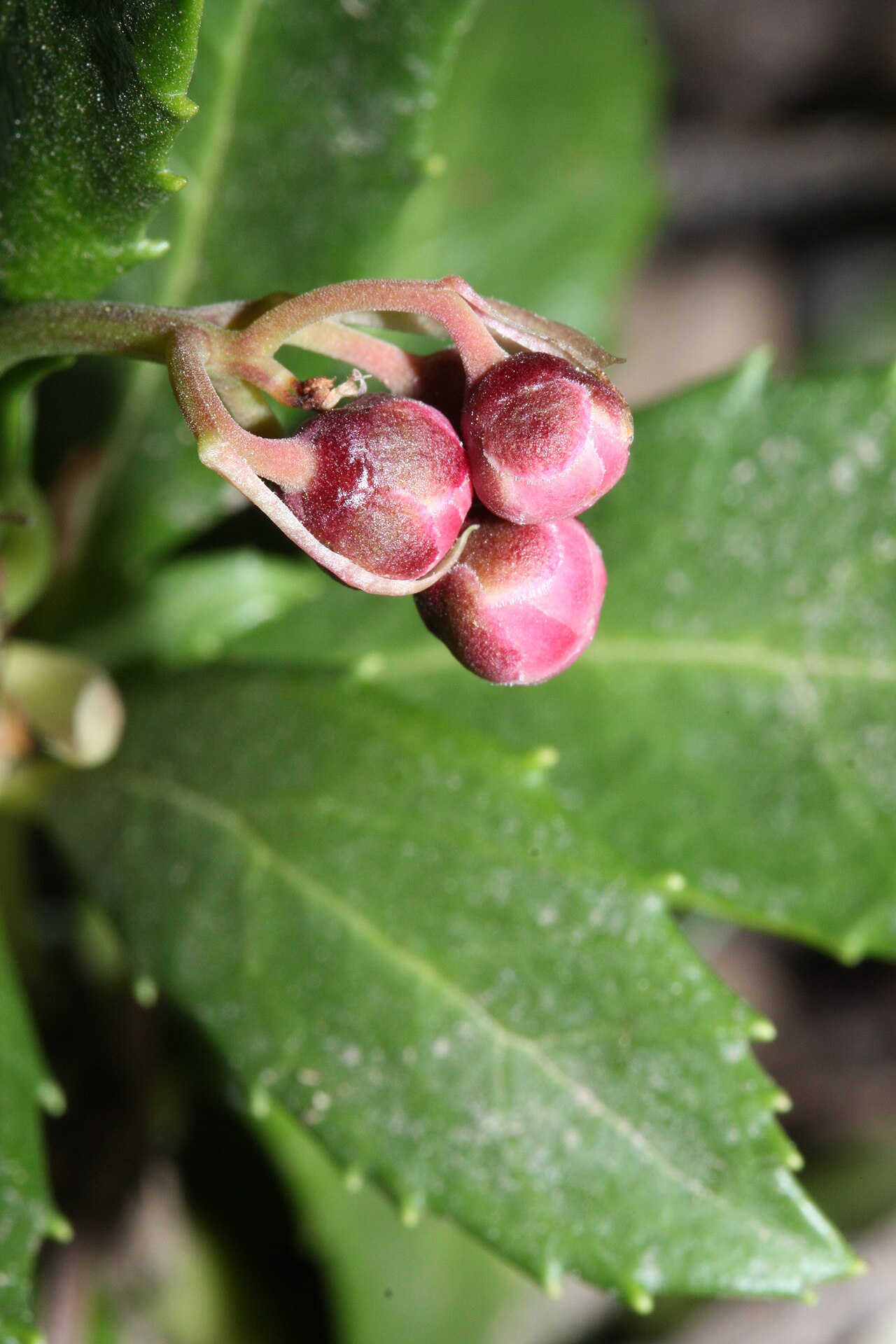
In early to midsummer (June to August), a stalk rises above the leaves carrying a small umbrella-like cluster (umbel or corymb) of 3 to 10 nodding flowers. Each flower is about ½ inch across, with five rounded, waxy, white to pink petals, a ring of pink or violet stamens with swollen bases, and a plump, green, top-shaped pistil in the center. The flowers have a pleasant, light fragrance.
Fruit & Seeds
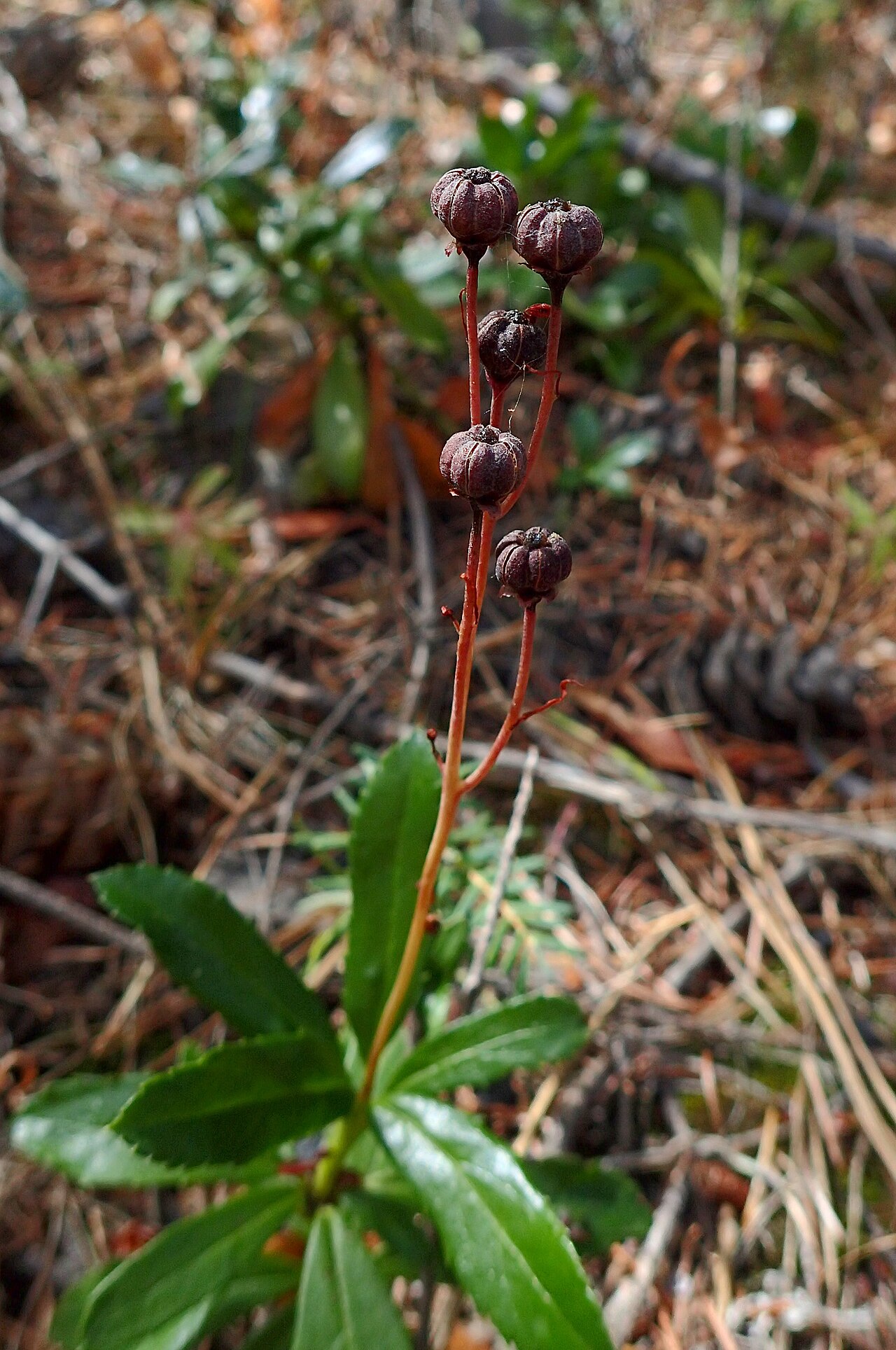
After flowering, the stalks turn upright and each flower forms a round, five-parted brown capsule about ¼ inch across, containing many dust-fine seeds. The dry capsules often stay on the plants through winter and into the next year.
Look-alikes
Striped wintergreen (Chimaphila maculata) has darker, narrower leaves with a white stripe along the midrib and veins. American wintergreen (Pyrola americana) has rounded basal leaves and a taller spike of flowers. Checkerberry has oval leaves, single nodding white flowers and red berries.
Quick Facts
| Scientific Name | Chimaphila umbellata |
| Family | Ericaceae (heath family); formerly Pyrolaceae |
| Plant Type | Evergreen subshrub spreading by rhizomes |
| Mature Height | 4–12 in |
| Mature Spread | 6–12 in; slowly forms colonies |
| Growth Rate | Slow |
| Sun Exposure | Part shade to full shade |
| Water Needs | Low to medium |
| Soil Type | Dry to moist, acidic sandy or rocky soil with needle or leaf litter |
| Soil pH | About 4.5–6.0 (acidic) |
| Bloom Time | June–August |
| Flower Color | White to pink |
| Fall Color | None; evergreen |
| Fruit | Round brown capsule with dust-like seeds |
| Deer Resistant | Moderate |
| USDA Hardiness Zones | 3–8 |
Native Range
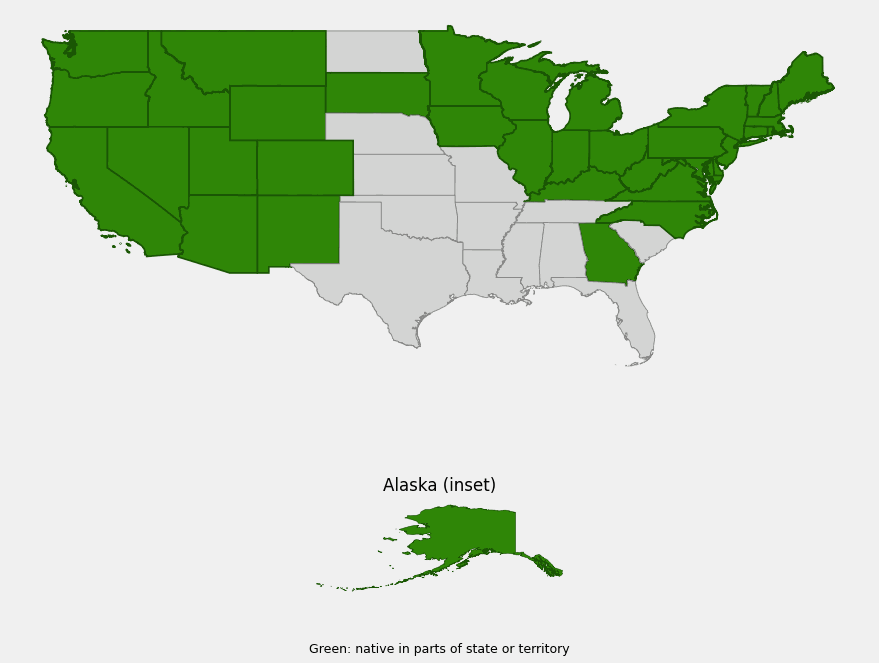
Pipsissewa is circumboreal, growing across the cool forests of North America, Europe and Asia. In the United States, USDA PLANTS records it as native in 35 states plus Alaska. In the East it ranges from Maine and the Great Lakes south through the Appalachians to Virginia, Kentucky, North Carolina and Georgia. In the West it is widespread in the Rocky Mountains, the Cascades, the Sierra Nevada and the Pacific Coast ranges, and in Arizona, New Mexico, Utah and Nevada it is found in mountain conifer forests. In Canada it grows in every province from British Columbia and the Yukon east to Newfoundland.
In the West it is common in dry to moist conifer forests of pine, Douglas-fir and fir, from near sea level in the Pacific Northwest to subalpine forests in the Rockies. In the East it is more scattered and often uncommon, found mostly in dry pine and oak woods on sandy or rocky soils, pine barrens and hemlock slopes. North American botanists often recognize several regional subspecies, including ssp. cisatlantica in the East and ssp. occidentalis in the West.
At the southern and western edges of its eastern range, including parts of the Midwest and the Southeast, it is rare and may be protected under state law. Its decline in some areas is linked to forest clearing, loss of open pine and oak woodlands, and heavy collection for herbal products.
📋 Regional plant lists featuring Pipsissewa: New York, Pennsylvania & Northern New Jersey · Idaho, Eastern Oregon & Eastern Washington · Ohio & Indiana · Montana & Wyoming · Michigan, Wisconsin & Eastern Minnesota · Kentucky & Tennessee · Utah & Western Colorado · Connecticut, Massachusetts & Rhode Island · New Hampshire, Maine & Vermont · Maryland, Virginia & West Virginia · Delaware, Southern New Jersey & Long Island · Arizona & New Mexico · Illinois, Iowa & Missouri · Alabama, Georgia & Mississippi · Alaska
Growing & Care Guide
Pipsissewa is admired for its glossy evergreen leaves and waxy flowers, but it is not an easy garden plant. It depends on mycorrhizal fungi in undisturbed forest soil, grows very slowly, and rarely survives transplanting. Never dig it from the wild. If you want to grow it, buy only nursery-propagated plants from a reputable native plant nursery, and plant them in conditions that closely match a dry, acidic conifer or oak forest floor. Protecting existing colonies is the most effective way to keep it.
Light
Give it part to full shade, such as the dappled shade under pines, oaks or hemlocks. It tolerates morning sun in cool climates but suffers in hot afternoon sun.
Soil & Water
It needs acidic, well-drained, sandy or rocky soil rich in decaying needles or leaves. Do not add lime, compost high in nutrients or fertilizer. Water in prolonged droughts during establishment, but avoid soggy soil. A natural mulch of pine needles or oak leaves is ideal.
Planting Tips
Plant nursery-propagated plants in spring or early fall, disturbing the roots as little as possible. Plant them near conifers, oaks, blueberries or other heath-family shrubs that suggest their natural habitat, and expect slow establishment. Even with care, some plants do not survive.
Pruning & Maintenance
No pruning is needed. Leave leaf litter and needles in place, and avoid foot traffic and digging near the plants. Remove invasive groundcovers that would smother them.
Propagation
Pipsissewa is difficult to propagate. Specialist nurseries use rhizome cuttings or careful divisions taken with their surrounding soil and fungi. The dust-like seeds need specific fungal partners to germinate and are rarely successful in cultivation. Never collect plants from the wild.
Landscape Uses
- Woodland and conifer gardens: an evergreen groundcover accent under pines, oaks and hemlocks
- Protecting existing colonies: keep leaf litter, soil and fungi intact where it already grows
- Shade rock gardens: in acidic, well-drained pockets with needle mulch
- Native forest restoration: within its range, using propagated stock only
- Nature study: an evergreen plant easy to find and observe through the seasons
Wildlife & Ecological Value
Pipsissewa is a small but characteristic plant of conifer and mixed forests, and it is closely tied to the fungi and insects of the forest floor.
For Pollinators
The fragrant, nodding flowers are visited by bumblebees, which buzz the flowers to release pollen, as well as by small bees and flies.
For Birds
Grouse and other ground-feeding birds may occasionally pick at the evergreen leaves, but it is not an important bird food.
For Mammals
Deer, elk and other browsers sometimes eat the leaves, particularly in winter when other green foliage is scarce, but it is not a major food plant.
Ecosystem Role
Pipsissewa forms partnerships with mycorrhizal fungi that also connect to nearby trees. Studies of pipsissewa and its relatives suggest that some of these plants obtain part of their carbon from the fungi in addition to what they make through photosynthesis, a strategy called partial mycoheterotrophy. This dependence on intact forest soil explains why it rarely survives transplanting and why it is a good indicator of undisturbed forest floors.
Cultural & Historical Uses
The name pipsissewa is usually traced to a Cree word meaning roughly “it breaks into small pieces,” from the belief that the plant could break up kidney stones. The genus name Chimaphila means “winter-loving,” from the Greek cheima (winter) and philos (loving), for its evergreen leaves. The name “prince’s pine” refers to its pine-like habitat and evergreen foliage.
Many Native American peoples used pipsissewa medicinally, and it was later adopted by settlers and listed in the official U.S. Pharmacopoeia in the nineteenth century as a diuretic and astringent. Its leaves were also used to flavor root beer and other soft drinks. Safety note: pipsissewa leaves contain arbutin and related compounds that the body converts to hydroquinone, which can be toxic in large doses or with long-term use. Fresh leaves can also irritate the skin. Do not use it as a medicine or beverage without professional guidance, and keep it away from children and pets.
Today pipsissewa is still sold in herbal products, and much of the supply has historically come from wild-harvested plants. Because it grows slowly and does not recover quickly from collection, conservation groups encourage people to avoid wild-harvested pipsissewa and to protect the forests where it grows.
Frequently Asked Questions
Can I dig pipsissewa from the woods for my garden?
No. It depends on specific soil fungi and almost always declines after transplanting, and wild collection harms populations that grow back very slowly. Buy only nursery-propagated plants, or better yet protect existing colonies.
Is pipsissewa poisonous?
It is not highly toxic, but its leaves contain arbutin, which the body converts to hydroquinone, and large or long-term doses can be harmful. Fresh leaves can also irritate the skin. Do not eat it or use it as a medicine without professional advice.
How is pipsissewa different from striped wintergreen?
Pipsissewa has glossy, plain green, sharply toothed leaves. Striped wintergreen (Chimaphila maculata) has dark leaves with a white stripe along the midrib and veins and is found mostly in the eastern United States.
Is pipsissewa used in root beer?
Historically, yes. Pipsissewa leaves were one of the flavorings used in old-fashioned root beer and other soft drinks. Commercial root beers today use other flavorings.
When does pipsissewa bloom?
Usually from June to August, depending on latitude and elevation. The evergreen leaves can be seen year-round, and the dry seed capsules often persist through winter.

Looking for a nursery that carries Pipsissewa?
Browse our native plant nursery directory: Alaska & Arizona · California · Colorado, Connecticut, Delaware & Georgia · Idaho, Illinois, Indiana & Iowa · Kentucky, Maine, Maryland, Massachusetts, Michigan, Minnesota & Montana · Nevada, New Hampshire, New Jersey, New Mexico, New York, North Carolina & Ohio · Oregon · Pennsylvania, Rhode Island, South Dakota, Utah, Vermont & Virginia · Washington · West Virginia, Wisconsin & Wyoming