
Striped Wintergreen (Chimaphila maculata)
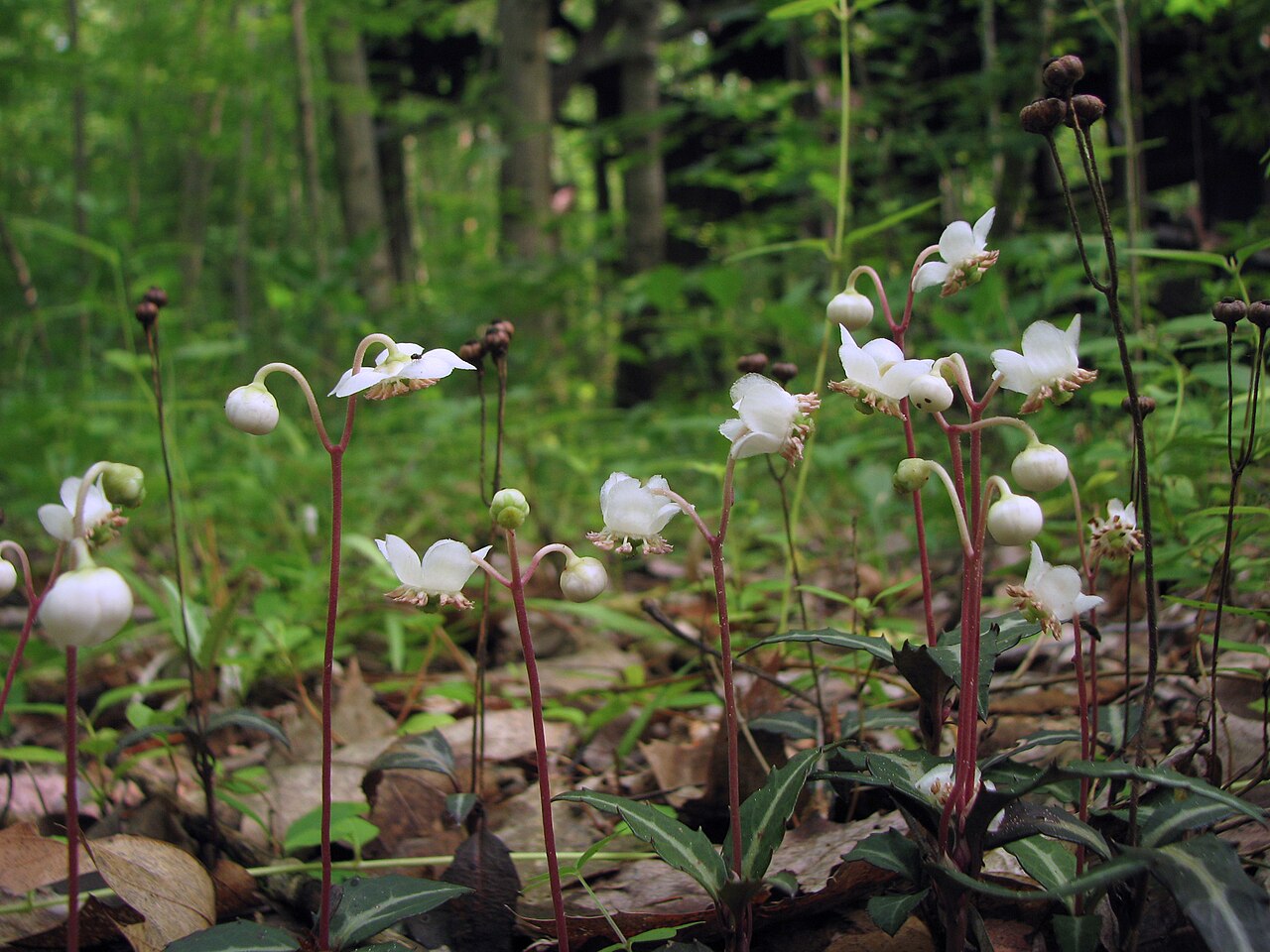
Chimaphila maculata, called Striped Wintergreen, spotted wintergreen or striped prince’s pine, is a small evergreen subshrub of dry eastern forests. It rarely stands more than 4 to 10 inches tall, but it is easy to spot at any time of year. Its narrow, toothed leaves are dark green with a bold white or silvery stripe down the midrib, and they stay green through the winter, standing out against brown oak leaves and pine needles. In early summer a short stalk lifts one to five nodding, waxy white flowers that smell faintly sweet.
Striped wintergreen belongs to the heath family (Ericaceae). USDA PLANTS places it in the older wintergreen family, Pyrolaceae, which most botanists now merge into Ericaceae. It is related to blueberries, mountain laurel and trailing arbutus, and like many of them it depends on root fungi. It is partly mycoheterotrophic: it makes its own sugar in its leaves but also takes carbon and nutrients from the fungi that link it to nearby trees. That partnership is the main reason it is so hard to move or grow from seed.
This guide explains how to identify striped wintergreen, where it grows, and how to look after it where it already grows. Wild plants almost never survive being dug, so it is a plant to protect and enjoy in place rather than one to collect. Gardeners who own a piece of dry oak or pine woods often already have it, and the best “care” is to leave the leaf litter and the trees alone.
Identification
Striped wintergreen is one of the easiest small woodland plants to recognize, because no other eastern plant has the same combination of whorled, toothed, evergreen leaves with a white central stripe. The main look-alike is its close relative pipsissewa.
Stems & Growth Habit
Plants grow from a long, creeping underground rhizome, so what look like separate plants are often upright shoots of one connected colony. Each shoot is a short, somewhat woody stem 3 to 10 inches tall, slightly reddish when young. Shoots live for several years, adding a new whorl of leaves at the tip each season, and colonies spread slowly through the duff of the forest floor.
Leaves
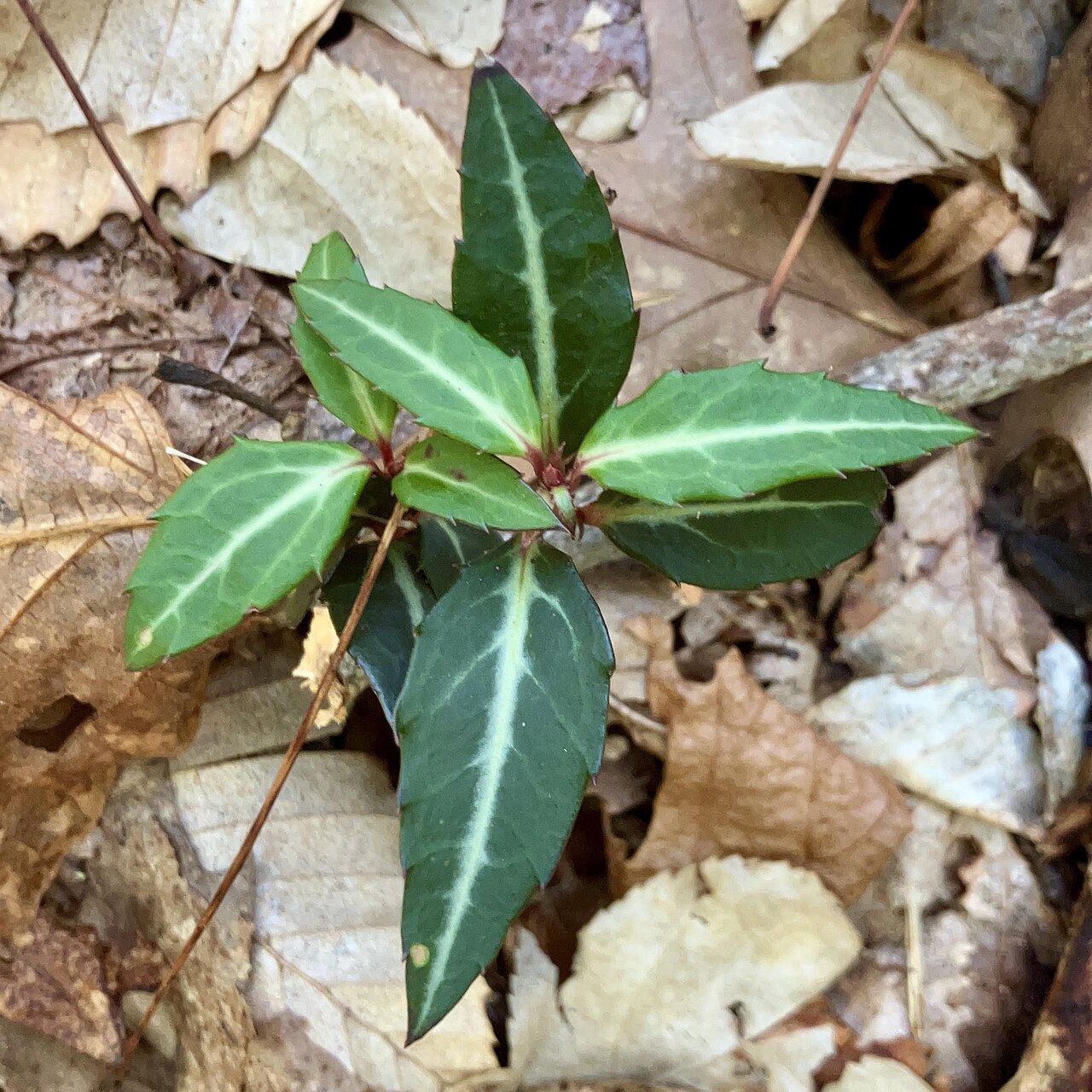
The leaves are arranged in whorls of two to four (sometimes appearing opposite) at one or two levels on the stem. They are leathery, lance-shaped and pointed, about 1 to 3 inches long and a half-inch to an inch wide, with widely spaced sharp teeth along the edges. The upper surface is dark green to bronze-green, with a pale white or gray-green band along the midrib and often along the main veins. The underside is paler and sometimes purplish. In winter the leaves often take on a reddish or bronze tint.
Pipsissewa (Chimaphila umbellata), which shares much of the northern part of the range, has glossy, uniformly green leaves without the stripe, and its leaves are widest above the middle rather than near the base. Rattlesnake plantain orchids (Goodyera) also have white-veined evergreen leaves, but theirs are flat rosettes on the ground, with a net of white veins rather than one central stripe.
Flowers
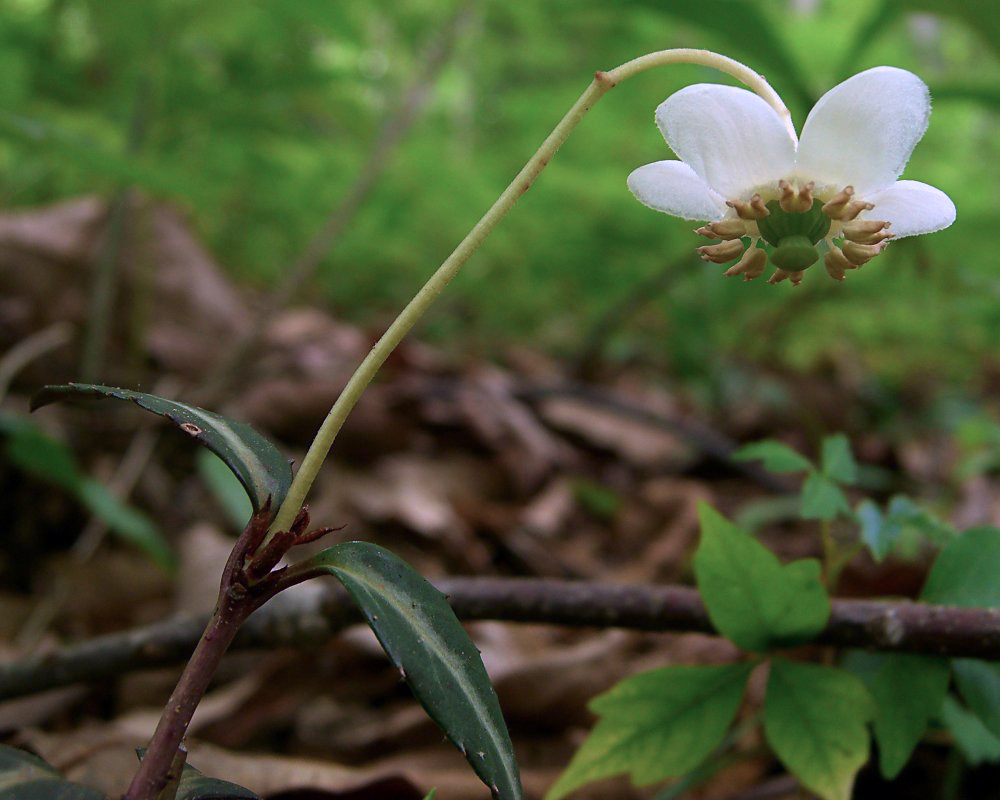
Flowering is from June to August, a little later in the North. A slender stalk, slightly sticky and minutely hairy, rises 2 to 4 inches above the leaves and ends in a small cluster of one to five flowers. Each flower nods downward and is about a half-inch to three-quarters of an inch across, with five round, cupped, waxy white or pale pink petals. In the center sits a plump, sticky, green ovary with a flat, button-like stigma, surrounded by ten stamens with violet or reddish anthers. The flowers have a light, pleasant fragrance.
Fruit & Seeds
After pollination the flower stalk straightens, and the ovary ripens into a round, five-parted brown capsule about a quarter-inch wide that points upward. The dry capsules often stay on the plant through the winter and into the following year, so they are a good clue for identifying the plant out of season. They split open to release very large numbers of dust-fine seeds. Like orchid seeds, these need a compatible fungus to germinate, and seedlings are rarely seen.
Quick Facts
| Scientific Name | Chimaphila maculata (L.) Pursh |
| Family | Ericaceae (heath family); Pyrolaceae in USDA PLANTS |
| Plant Type | Evergreen subshrub, spreading by rhizomes |
| Mature Height | 4–10 in (to about 12 in in flower) |
| Mature Spread | Colonies slowly spread to 1–3 ft or more |
| Growth Rate | Very slow |
| Sun Exposure | Part shade to full shade |
| Water Needs | Low; dry to medium, well-drained soil |
| Soil Type | Acidic sandy, rocky or loamy soil under a layer of leaf litter |
| Soil pH | About 4.5–6.0 (acidic) |
| Bloom Time | June–August |
| Flower Color | White to pale pink, waxy and fragrant |
| Fall Color | Evergreen; leaves often bronze or reddish in winter |
| Fruit | Upright brown capsule that persists through winter |
| Deer Resistant | Mostly; the leathery leaves are seldom browsed heavily |
| USDA Hardiness Zones | 4–9 |
Native Range
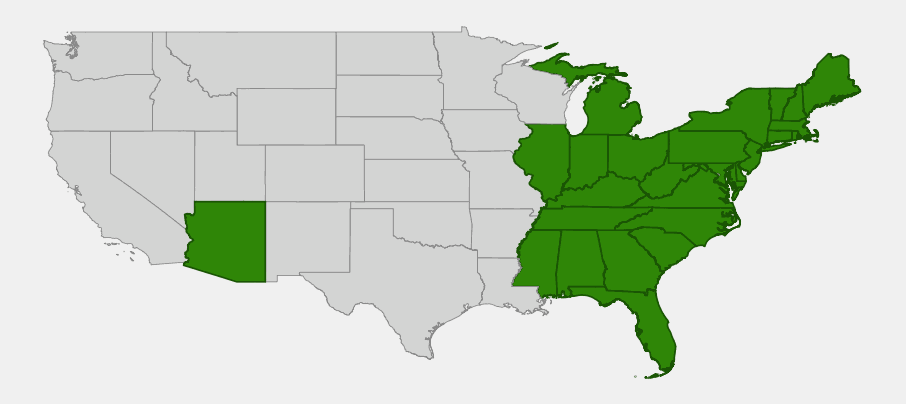
Striped wintergreen is a plant of the eastern United States and southern Canada. USDA PLANTS records it from 26 states and the District of Columbia, from Maine, New Hampshire and Vermont south through New England and the Appalachians to Georgia and northern Florida, and west to Michigan, Illinois, Tennessee, Alabama and Mississippi. In Canada it reaches southern Ontario and southern Quebec, where it is rare and protected as an at-risk species.
It is most common in the Appalachian region and the Piedmont, in dry, acidic oak, oak–pine and pine woods, often on ridges, upper slopes and sandy terraces. It is scattered in the Coastal Plain, where it grows in dry sandy woods and pine barrens, and it thins out at the northern and western edges of its range, where several states treat it as rare. It is also uncommon in the Florida Panhandle and northern peninsula.
A separate group of populations grows far to the southwest, in the mountains of central and southeastern Arizona and south into Mexico and Central America. These western plants, sometimes called var. dasystemma, grow in pine–oak forests and shady canyons and are cut off from the eastern range by more than a thousand miles of prairie and desert.
📋 Regional plant lists featuring Striped Wintergreen: New York, Pennsylvania & Northern New Jersey · Ohio & Indiana · Michigan, Wisconsin & Eastern Minnesota · Kentucky & Tennessee · Connecticut, Massachusetts & Rhode Island · New Hampshire, Maine & Vermont · Maryland, Virginia & West Virginia · Delaware, Southern New Jersey & Long Island · Arizona & New Mexico · Illinois, Iowa & Missouri · Alabama, Georgia & Mississippi · North & South Florida
Growing & Care Guide
Striped wintergreen is not a typical garden plant, and you should not dig it from the wild. Its roots are tied into a network of fungi that also connect to the surrounding trees, and plants moved without that network usually decline over a year or two and die. Seed needs a compatible fungus to germinate. Nursery plants are seldom offered; if you find one, make sure it was propagated (for example from rhizome cuttings) rather than collected. For most people, the right approach is to look after colonies where they already grow.
Light
It grows best in the dappled, shifting shade under oaks and pines, with some sun in early spring before the canopy fills in. Deep, constant shade under dense evergreens weakens it, and full sun scorches the leaves.
Soil & Water
It needs acidic, well-drained, low-nutrient soil, usually sandy or rocky, covered with a layer of decomposing leaves and needles. Established colonies tolerate drought well. They do not need watering, fertilizer or soil amendments, and lime, fertilizer and heavy irrigation all harm it and its fungal partners.
Planting Tips
Plant only nursery-propagated material, in a dry, shady woodland spot under the same kinds of trees it grows with in the wild: oaks, pines or hemlocks. Disturb the roots as little as possible, firm the plant in at the same depth, and mulch with the local leaf litter rather than bark mulch. Expect slow growth, and do not be surprised if the plant fails; even experienced growers lose many.
Pruning & Maintenance
Leave existing colonies alone. Do not rake away the leaf litter, as the plants depend on it, and keep foot traffic, digging and leaf blowers out of the area. Remove invasive groundcovers such as English ivy, vinca and Japanese stiltgrass by hand if they creep in. The only other care is protecting the trees: heavy clearing and soil compaction will destroy a colony along with its fungal network.
Propagation
In the wild it spreads mainly by rhizomes, and seedlings are rare. Specialists sometimes root cuttings of rhizomes with attached shoots in a sandy, acidic mix, keeping some of the original soil to supply fungi. Success is low. Home gardeners should not attempt to propagate it from wild colonies.
Landscape Uses
- Woodland appreciation: a year-round highlight in dry oak and pine woods, especially in winter
- Woodland stewardship: an indicator of healthy, undisturbed forest floor in the yard or on a property
- Shade gardens: only with propagated stock, under existing oaks or pines with intact leaf litter
- Nature study: a clear example of a plant that partly depends on fungi for food
Wildlife & Ecological Value
Striped wintergreen is too small and scattered to be a major food source, but it is part of the specialized community of the forest floor, and its relationships with insects and fungi are interesting.
For Pollinators
The fragrant nodding flowers are visited mainly by bumblebees, which hang beneath them and use sonication (“buzz pollination”), vibrating their flight muscles to shake pollen out of the pores at the tips of the anthers. Small bees and flies also visit. The nectar is modest, but in midsummer, when the woods have few other flowers, it is a welcome resource.
For Birds
Ruffed grouse and wild turkey are reported to eat the evergreen leaves of wintergreens in winter, although striped wintergreen is a minor food. The plant mainly matters to birds as part of the low, evergreen cover of the forest floor.
For Mammals
Deer generally browse it only lightly. It contains bitter compounds and is not a significant mammal food, though white-tailed deer may nibble it in winter when little else is green.
Ecosystem Role
Striped wintergreen is a mixotroph. Its roots form mycorrhizae with fungi, including species that also partner with oaks and pines, and studies with carbon isotopes have shown that it receives some of its carbon from those fungi, especially in deep shade. It is therefore a small part of the underground network that links forest trees. Colonies often increase after light ground fires, which clear competing growth while the rhizomes survive underground.
Cultural & Historical Uses
The genus name Chimaphila comes from the Greek cheima, winter, and philos, loving, a reference to the leaves that stay green all winter. The species name maculata means spotted, which explains the old common name spotted wintergreen even though the leaves are striped rather than spotted. Linnaeus first described it as Pyrola maculata in 1753, and Frederick Pursh moved it to Chimaphila in 1814.
Several Native American peoples, including the Cherokee, used striped wintergreen and pipsissewa medicinally, for example in teas and poultices for rheumatism, fevers and skin complaints, and early settlers adopted similar uses. The leaves contain arbutin and other compounds and should not be eaten or used as a home remedy; they are not the source of the wintergreen flavor, which comes from checkerberry and black birch.
Today the plant is valued as a symbol of quiet, undisturbed woods. Because it is rare at the edges of its range, it is protected in Canada and listed as rare or exploitably vulnerable in several northern states. Collecting it for gardens, terrariums or holiday decorations damages wild colonies that may be decades old.
Frequently Asked Questions
Can I transplant striped wintergreen from the woods?
No. It depends on fungi that connect it to nearby trees, and transplanted plants almost always die within a year or two. Digging also harms the colony, and in some states and in Canada it is protected. Enjoy it where it grows.
What is the difference between striped wintergreen and pipsissewa?
Both are Chimaphila species with whorled evergreen leaves and nodding white flowers. Striped wintergreen has a white stripe along the midrib and leaves that are widest near the base. Pipsissewa (C. umbellata) has plain, glossy green leaves that are widest above the middle.
Is striped wintergreen poisonous?
It is not considered highly toxic, but it contains arbutin and other compounds and is not a food plant. Do not eat it or use it as an herbal remedy, and keep children and pets from chewing it.
Is it the same plant that gives wintergreen flavor?
No. The classic wintergreen flavor comes from checkerberry (Gaultheria procumbens) and black birch. Striped wintergreen is a different plant that simply shares the “wintergreen” name because its leaves stay green.
When does striped wintergreen bloom?
Usually from June into August, with plants in the South starting first. The upright brown seed capsules that follow often last through winter, so you can identify the plant in any season.

Looking for a nursery that carries Striped Wintergreen?
Browse our native plant nursery directory: Alabama & Arizona · Connecticut, Delaware, Florida & Georgia · Illinois & Indiana · Kentucky, Maine, Maryland, Massachusetts, Michigan & Mississippi · New Hampshire, New Jersey, New York, North Carolina & Ohio · Pennsylvania, Rhode Island, South Carolina, Tennessee, Vermont & Virginia · West Virginia