
Tiny Bluet (Houstonia pusilla)
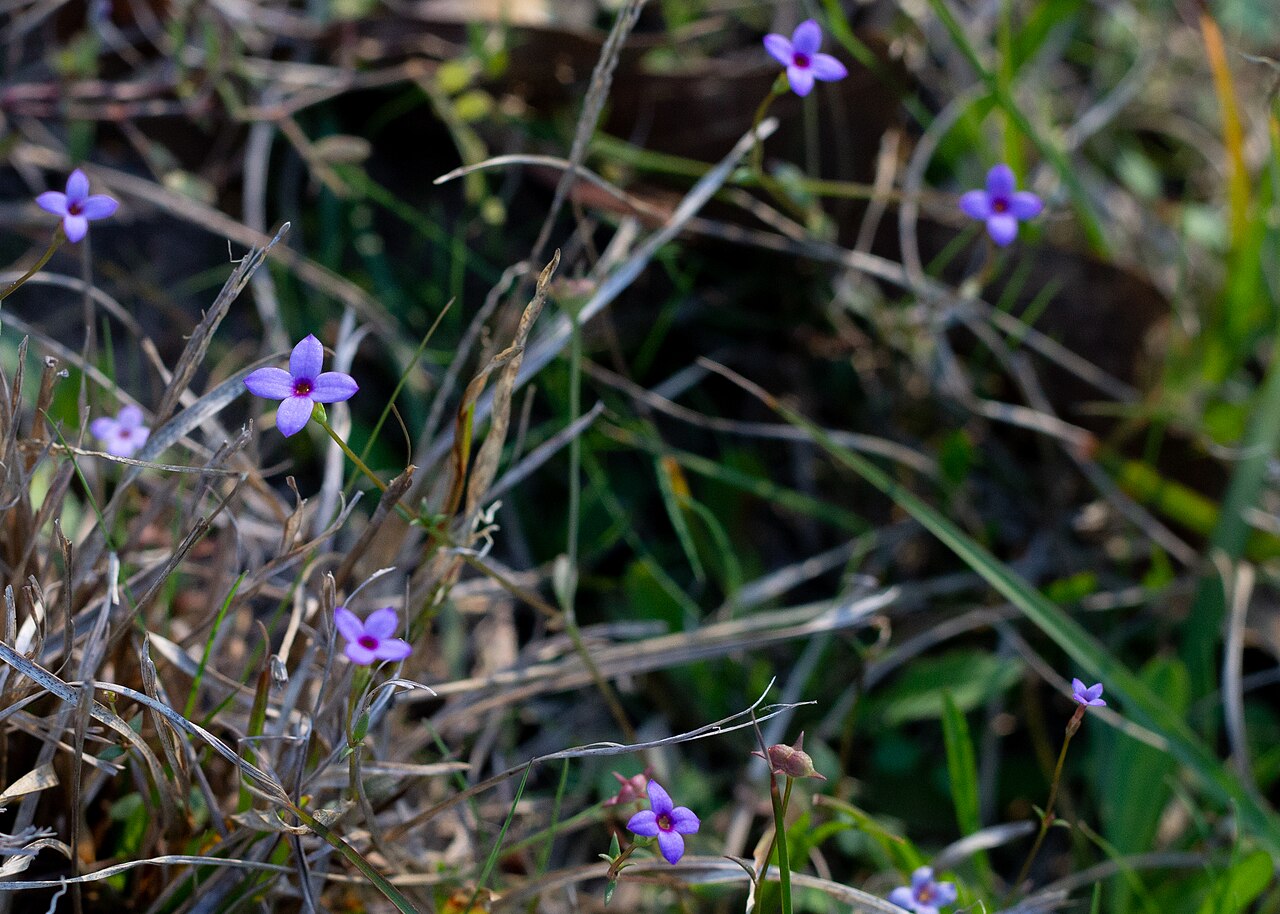
Houstonia pusilla, the Tiny Bluet (also called small bluet, star violet or least bluet), is one of the first wildflowers of the year across the southern and central United States. It is a little winter annual in the coffee family (Rubiaceae), usually only 2 to 4 inches tall, with thread-like stems and four-lobed violet flowers about a quarter inch across. A single plant is easy to miss. In a good year, though, thousands of them open together in late winter and early spring and tint lawns, pastures, roadsides and open fields a misty lavender-blue.
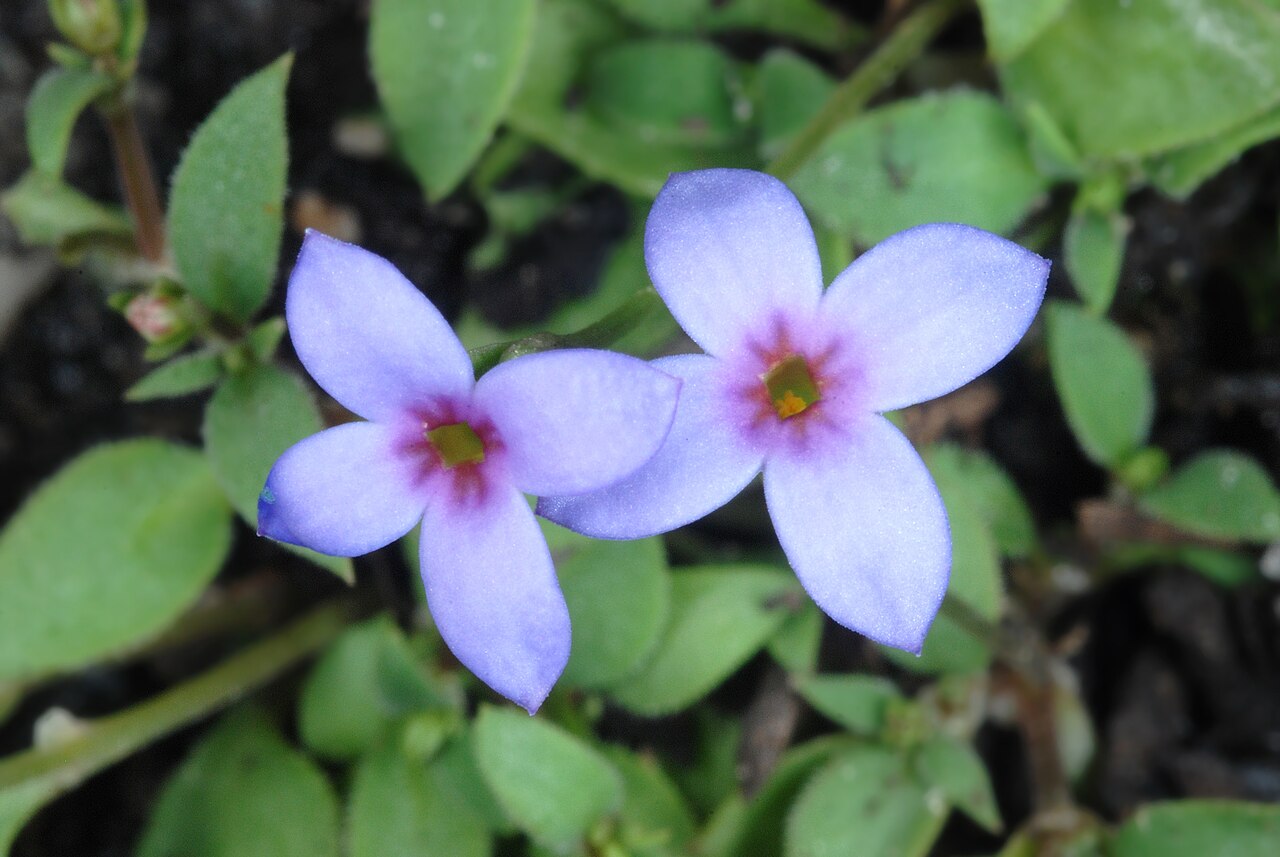
Tiny bluet is a close relative of the better-known azure bluet or Quaker ladies (Houstonia caerulea). The two are easy to tell apart once you know what to look for: tiny bluet has darker violet to purple-blue flowers with a reddish-purple ring around a yellow eye, while azure bluet has paler, sky-blue to white flowers with a plain yellow eye. Tiny bluet is also an annual that lives for only a few months, while azure bluet is a short-lived perennial of moister, shadier ground.
Because it sprouts in fall, flowers early and sets seed before summer heat, tiny bluet fits neatly into thin turf, sandy lawns and meadows that are mowed later in the season. It feeds some of the earliest bees and flies of the year and asks for nothing except open, sunny ground. This guide covers how to identify it, where it grows, and how to encourage it in a lawn or meadow.
Identification
Tiny bluet is best identified in flower, from about January in the Deep South to April or May at the northern edge of its range. Look for a low tuft of thread-like stems, each topped by a single star-shaped flower.
Growth Habit & Stems
Each plant is a winter annual. Seeds germinate in fall, form a small rosette of leaves that sits through winter, and then send up several slender, erect or slightly spreading stems in late winter and spring. Plants are usually 1 to 4 inches tall and rarely more than 6 inches. The stems are smooth or only slightly roughened, and the whole plant dies once its seed is ripe in late spring.
Leaves
The basal leaves are spoon-shaped to oval, about a quarter to half an inch long, and narrow at the base into a short stalk. They often wither by the time the plant is in full bloom. Leaves on the stems are smaller, opposite and widely spaced. All of the leaves are smooth-edged and bright green, sometimes tinged purple in cold weather.
Flowers
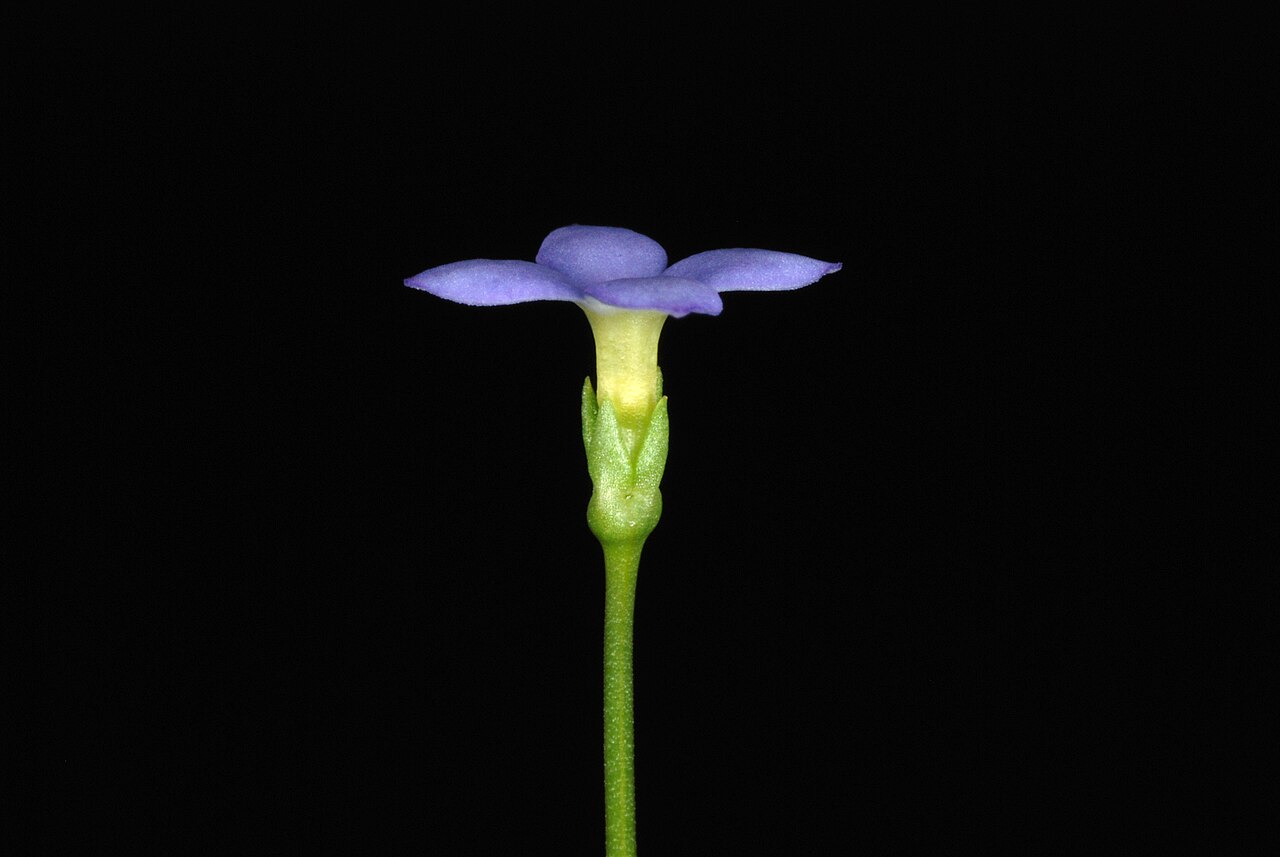
Flowers grow singly at the tips of fine stalks that arise from the upper leaf axils. Each is a small salverform flower: a narrow tube that opens into four flat, spreading, pointed lobes, about 6 to 8 mm (roughly a quarter to a third of an inch) across. The lobes are deep violet, purple-blue or lavender, occasionally almost white, and the throat is yellow with a distinct reddish to purple ring around it. Four short, pointed green calyx lobes cup the base of the tube.
Azure bluet (H. caerulea) is very similar but has paler blue to white lobes and a yellow eye without the red ring. It is a perennial that forms dense mats and grows in damper, often partly shaded places. Purple bluet (H. purpurea) is taller, with clusters of funnel-shaped flowers.
Fruit & Seeds
After flowering, each blossom forms a tiny, flattened two-lobed capsule that is wider than long and sits within the persistent calyx lobes. It opens at the top and releases a few dozen minute, dark seeds that fall close to the parent plant. They lie dormant through the summer and germinate when cool, moist weather returns in fall.
Quick Facts
| Scientific Name | Houstonia pusilla Schoepf (syn. Hedyotis crassifolia, Houstonia patens, H. minima) |
| Family | Rubiaceae (coffee or madder family) |
| Plant Type | Winter annual wildflower |
| Mature Height | 1–4 in (rarely to 6 in) |
| Mature Spread | 1–3 in per plant; spreads by self-sowing into large colonies |
| Growth Rate | Fast; completes its life cycle in one cool season |
| Sun Exposure | Full sun to light shade |
| Water Needs | Low to moderate; moist in winter and spring, dry in summer |
| Soil Type | Thin, sandy, gravelly or rocky soils; compacted lawn and roadside soils |
| Soil pH | Slightly acidic to neutral (about 5.0–7.0) |
| Bloom Time | January–April in the Deep South; March–May farther north |
| Flower Color | Violet to purple-blue with a reddish ring around a yellow eye; rarely white |
| Fall Color | None; plants die back after setting seed |
| Fruit | Tiny two-lobed capsule with minute seeds |
| Deer Resistant | Yes; too small to attract deer |
| USDA Hardiness Zones | 5–9 (as a self-sowing winter annual) |
Native Range
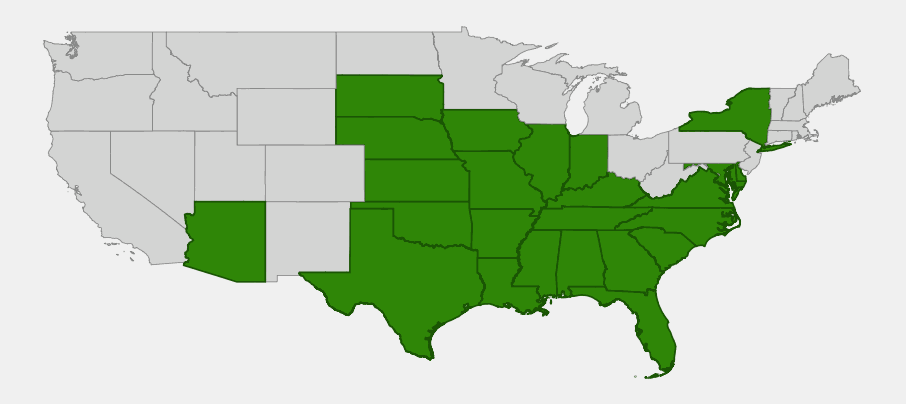
USDA PLANTS records tiny bluet as native in 24 states, mainly across the Southeast and the southern and central Great Plains. Its range runs from Texas and Florida north through the Carolinas and Virginia to Maryland, Delaware and Long Island in New York, and inland through Tennessee, Kentucky, Indiana and Illinois to Missouri, Iowa, Kansas, Nebraska and South Dakota. It does not reach Canada.
The heart of its range is the Coastal Plain and Piedmont of the Southeast and the prairies, savannas and old fields of the south-central states, where it is often abundant in pastures, lawns, cemeteries and roadsides. Toward the north and northwest it becomes local and scattered. A separate, isolated population grows far to the west in Pima County in southern Arizona, which is why Arizona appears on the map.
Tiny bluet has always been a plant of open ground: rock outcrops and granite flatrocks, cedar glades, sandy barrens, prairie openings and the edges of woods. It has adapted well to the open, mowed habitats people create, and today most gardeners meet it in spring lawns and along road shoulders rather than in pristine natural areas.
📋 Regional plant lists featuring Tiny Bluet: New York, Pennsylvania & Northern New Jersey · Ohio & Indiana · Kentucky & Tennessee · Nebraska, Kansas & Eastern Colorado · Maryland, Virginia & West Virginia · Delaware, Southern New Jersey & Long Island · Arizona & New Mexico · Illinois, Iowa & Missouri · Alabama, Georgia & Mississippi · North & South Florida
Growing & Care Guide
Tiny bluet is not a plant you grow in a bed so much as one you allow. It is rarely sold by nurseries, but it often appears on its own in sunny lawns, meadows and roadsides, and once present it can be encouraged to spread into a spring carpet with a few simple changes in mowing and lawn care.
Light
Give it full sun or light shade during late winter and spring. Since it flowers before most trees leaf out, it also grows well under deciduous trees with a high canopy. It disappears where turf or other plants grow thick and tall enough to shade the ground in early spring.
Soil & Water
Tiny bluet prefers lean, thin soils: sand, gravel, shallow soil over rock, or compacted ground where lawn grasses are sparse. It needs moisture from fall through spring, which normal rainfall usually supplies, and then tolerates dry summers easily because it spends them as seed. Avoid fertilizer, which thickens turf and crowds it out.
Planting Tips
The easiest way to introduce tiny bluet is to scatter ripe seed collected (with permission) from a local lawn or roadside, in late spring when the capsules are dry, or in early fall. Sow onto bare or thinly covered soil and do not bury the seed. Small plugs can also be moved in early spring with a generous ball of soil, though mature annuals transplant poorly.
Pruning & Maintenance
Delay the first mowing of the season until the plants have finished flowering and the capsules have turned tan, usually by late April in the South and May farther north. After that you can mow normally. Avoid pre-emergent herbicides and broadleaf weed killers in areas where you want bluets, since both will eliminate them.
Propagation
Propagation is by seed. Plants self-sow readily where the soil surface is open, and colonies can expand steadily over a few years. Seed needs a warm summer and then cool fall conditions to germinate, so sowing in late spring or early fall mimics its natural cycle.
Landscape Uses
- Flowering lawns: a lovely early-spring accent in thin, sunny turf that is mowed after mid-spring
- Rock gardens and gravel gardens: fits between stones and in shallow, lean soils
- Meadows and prairie plantings: fills gaps on bare ground before taller natives emerge
- Paths and stepping stones: tolerates light foot traffic and compacted soils
- Early pollinator forage: one of the first nectar sources of the year for small bees and flies
Wildlife & Ecological Value
Tiny bluet is small, but it flowers when little else is in bloom. On warm late-winter days, a colony of bluets can be busy with the year’s first insects.
For Pollinators
The flowers provide small amounts of nectar and pollen to early small native bees, such as mining bees and sweat bees, and to bee flies, whose long mouthparts reach easily into the narrow corolla tube. Early butterflies and small skippers may also visit them on sunny days. Because they bloom so early, they help bridge the gap before most spring wildflowers and fruit trees open.
For Birds
The seeds are far too small to be a significant bird food. Ground-feeding birds such as sparrows and juncos forage in the same lawns and fields, but tiny bluet itself is not an important food source for birds.
For Mammals
Tiny bluet is too small to be much of a forage plant. Rabbits and deer may nibble it along with other low plants, but it is rarely damaged and usually escapes notice.
Ecosystem Role
As a winter annual, tiny bluet occupies bare and disturbed ground during the cool season, holding soil and cycling nutrients before the summer flora takes over. On rock outcrops and glades it is part of a specialized community of small annuals that survive on very thin soil by growing only in the cool, moist months. In mowed landscapes it is one of the native plants that can thrive alongside people with no help beyond a little restraint with the mower.
Cultural & Historical Uses
The genus Houstonia was named by Linnaeus in honor of William Houstoun, an 18th-century Scottish surgeon and botanist who collected plants in the Caribbean and Mexico. The species name pusilla is Latin for “very small,” an apt description. The species was described by Johann David Schoepf, a German physician who traveled in the newly independent United States in the 1780s.
Over the years tiny bluet has been placed in several genera and given several names, including Hedyotis crassifolia and Houstonia minima, and older field guides may list it as Hedyotis. Most current treatments, including USDA PLANTS, keep it in Houstonia.
In the South, the haze of lavender that tiny bluets spread over lawns, churchyards and pastures in February and March is a familiar sign that winter is ending. Common names such as star violet reflect that affection, even though the plant is not a violet. For gardeners interested in more natural lawns, it is a reminder that the plants that bloom in our turf are not always weeds.
Frequently Asked Questions
Is tiny bluet a weed in my lawn?
It is a native wildflower, not an invasive weed. It lives only a few months, does not compete strongly with lawn grasses and disappears by early summer. Many gardeners now encourage it as an early-spring flowering lawn plant.
How do I tell tiny bluet from azure bluet?
Tiny bluet has darker violet to purple-blue flowers with a reddish ring around the yellow center and grows as an annual in dry, sunny ground. Azure bluet (Houstonia caerulea) has paler sky-blue to white flowers with a plain yellow eye and grows as a perennial mat in moister, often shadier spots.
When does tiny bluet bloom?
It is one of the earliest wildflowers. In Florida, the Gulf Coast and Texas it can bloom from January into March, and farther north mostly in March through May.
Can I buy tiny bluet plants?
It is rarely sold because it is a small annual. The best way to establish it is to sow seed collected from a local population, or simply to stop fertilizing and delay spring mowing in areas where it already appears.
Is tiny bluet the same as a violet?
No. It is sometimes called star violet, but it belongs to the coffee family (Rubiaceae), not the violet family. Its flowers have four symmetrical lobes, while true violets have five unequal petals.

Looking for a nursery that carries Tiny Bluet?
Browse our native plant nursery directory: Alabama, Arizona & Arkansas · Delaware, Florida & Georgia · Illinois, Indiana, Iowa & Kansas · Kentucky, Louisiana, Maryland, Mississippi & Missouri · Nebraska, New York, North Carolina & Oklahoma · South Carolina, South Dakota, Tennessee, Texas & Virginia