
American Cancer-root (Conopholis americana)
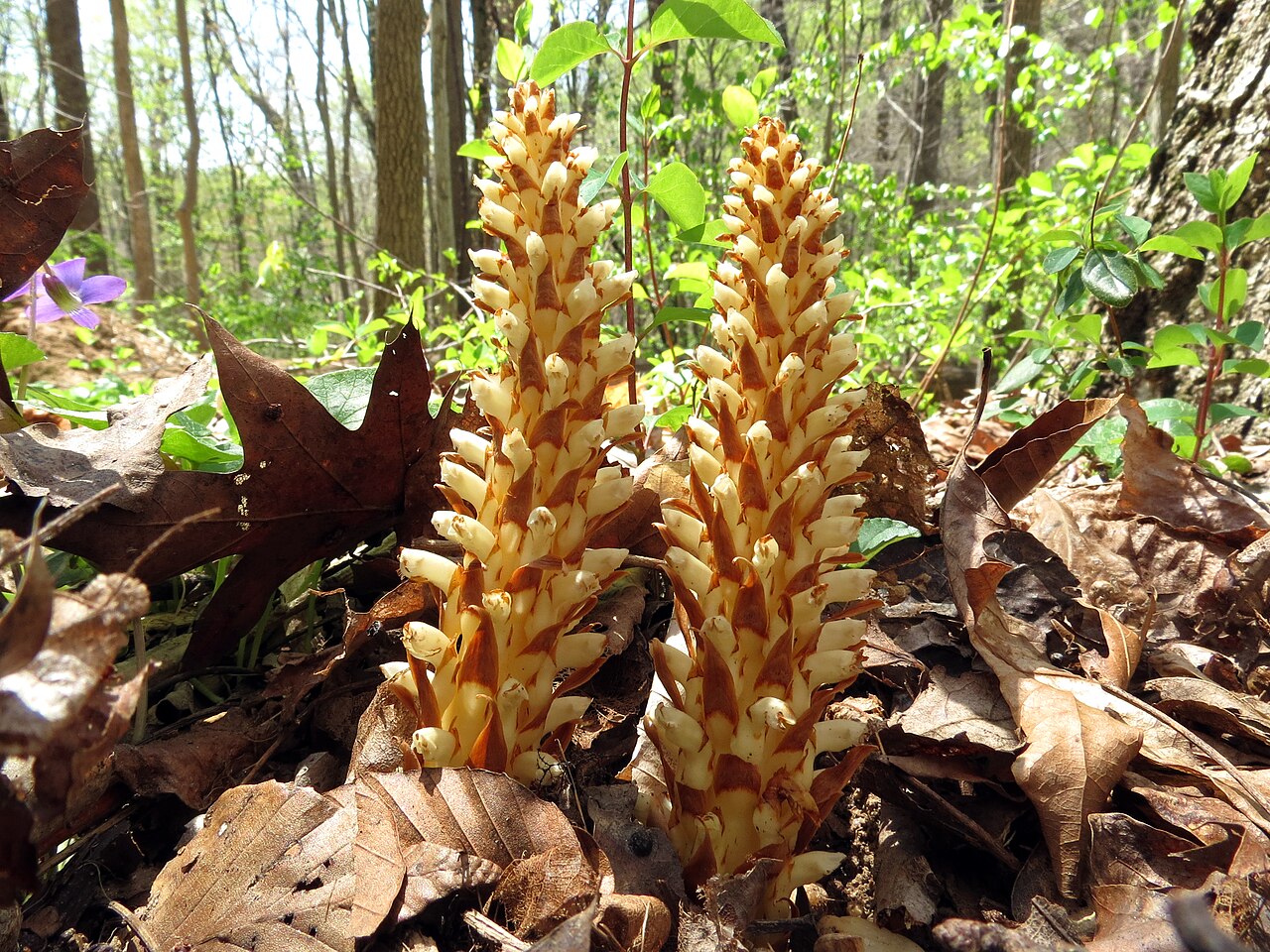
Conopholis americana, known as American Cancer-root, squawroot or bear corn, is one of the oddest wildflowers of eastern oak forests. It has no green leaves and no chlorophyll at all. In spring, clusters of thick, fleshy, yellow to cream stalks 3 to 8 inches tall push up through the leaf litter, covered in overlapping scales and small two-lipped flowers. Most people who find it for the first time think they have found a mushroom or a pine cone stuck in the ground.
Cancer-root is a root parasite in the broomrape family (Orobanchaceae). Everything it needs comes from the roots of trees, mainly oaks. Underground it grows a knobby, woody swelling where it joins the host root, and it can live there for years, sending up flowering stalks each spring. Because it depends entirely on a living tree, it cannot be grown from nursery stock, potted, or transplanted. Digging it up kills it. This page is an identification and appreciation guide, not a growing guide.
The plant is widespread in the eastern United States and southeastern Canada but rarely common, and it is listed as rare in a few New England and Mid-Atlantic states. The best way to “garden” for it is to protect mature oaks and the undisturbed forest floor around them. Where cancer-root appears, it is a sign of old, healthy oak woods.
Identification
Cancer-root is easy to identify once you know it. Few other plants in eastern forests are entirely yellow-tan, leafless and shaped like a cone. Its relatives beechdrops and one-flowered broomrape are the main look-alikes, and both differ clearly in shape.
Stems & Overall Shape
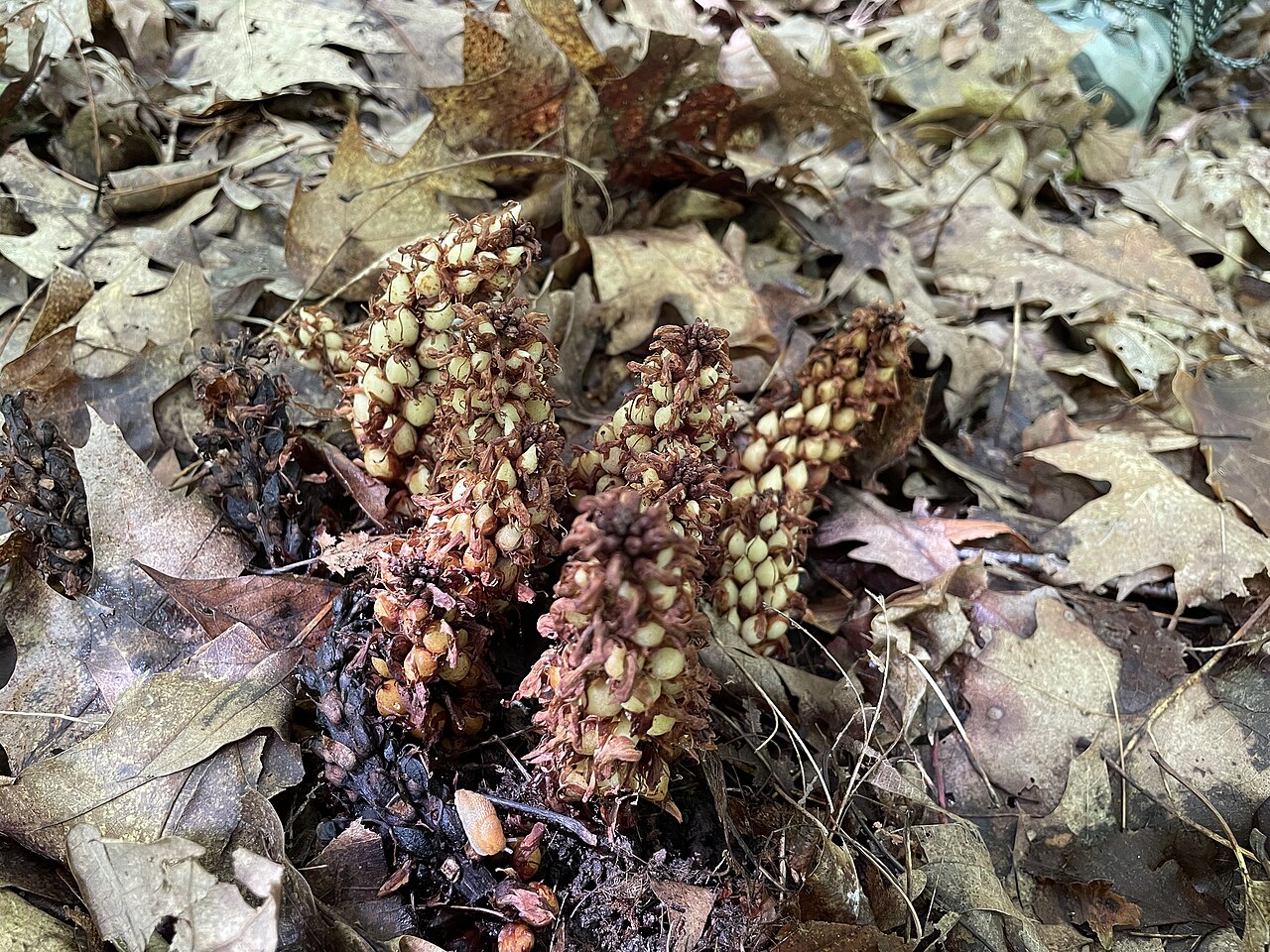
The visible part of the plant is a stout, unbranched flowering stalk about ½ to 1 inch thick and usually 3 to 8 inches tall. Stalks often come up in tight clusters of a few to a dozen or more around the base of an oak. Fresh stalks are pale yellow to cream or tan. As the season goes on they turn brown and finally black, and the dead stalks can stand through summer and into winter. Below ground the plant attaches to the host’s roots through a rounded, woody knob, which may stay alive for several years.
Leaves (Scales)
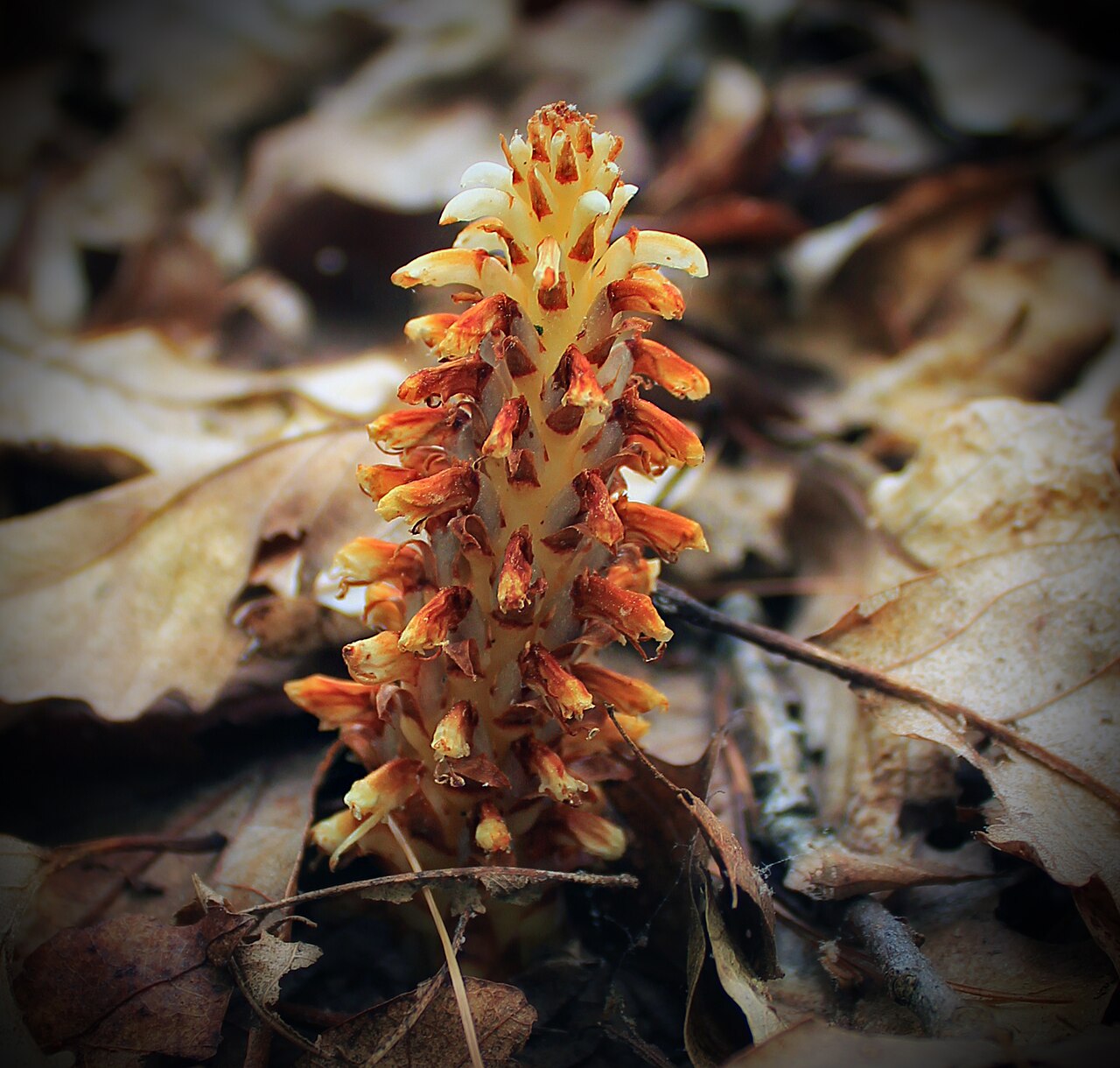
There are no true leaves. Instead the stem is covered with stiff, pointed, overlapping scales about ½ inch long, yellow to brown, one below each flower. The scales are what give the plant its pine cone or ear-of-corn appearance, and the genus name says the same thing: Conopholis comes from Greek words for “cone” and “scale.”
Flowers
Flowers are crowded all around the upper stalk. Each is a curved, two-lipped tube about ⅓ to ½ inch long, pale yellow to whitish, with the upper lip forming a little hood and the lower lip divided into three small lobes. The stamens stick out slightly. Flowers appear from April into June, earlier in the South and later in the North, and they have little or no scent.
Fruit & Seeds
Each flower is followed by an egg-shaped capsule about ½ inch long that holds many tiny seeds. Ripening capsules make the aging stalks look knobby and brown, like a weathered ear of corn. Seeds are washed into the soil, and a new plant only starts if a seed germinates near a suitable oak root. Exactly how the seeds find their hosts is still not well understood.
Look-alikes
Beechdrops (Epifagus virginiana) grows only under American beech and has slender, branched, brownish stalks with widely spaced flowers. One-flowered broomrape (Aphyllon uniflorum) has single, long-stalked white to lavender flowers. Pinesap and Indian Pipe are not root parasites of trees in the same way, and their stalks nod at the tip and lack the dense, cone-like scales.
Quick Facts
| Scientific Name | Conopholis americana (syn. Orobanche americana) |
| Family | Orobanchaceae (broomrape family) |
| Plant Type | Perennial root parasite without chlorophyll; not a garden plant |
| Mature Height | 3–8 in (occasionally to about 10 in) |
| Mature Spread | Clumps of stalks up to about 12 in across |
| Growth Rate | Slow; attached to host roots for several years |
| Sun Exposure | Shade to part shade under oak canopy |
| Water Needs | Natural forest moisture; depends entirely on its host tree |
| Soil Type | Undisturbed forest soil and leaf litter over oak roots |
| Soil pH | Acidic to near-neutral woodland soils |
| Bloom Time | April–June |
| Flower Color | Pale yellow to cream |
| Fall Color | None; stalks turn brown to black and may persist |
| Fruit | Egg-shaped capsule with many tiny seeds |
| Deer Resistant | No; deer, bears and other animals eat the stalks |
| USDA Hardiness Zones | Not applicable (grows only on living host trees; wild range roughly zones 4–9) |
Native Range
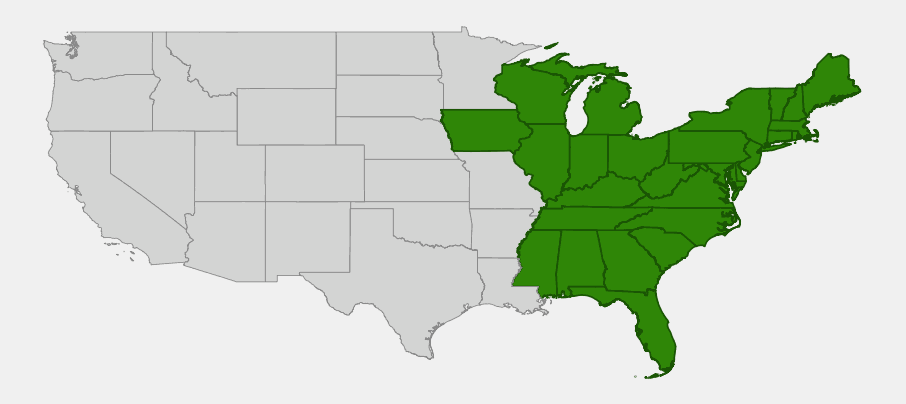
American cancer-root is a plant of eastern North America. USDA PLANTS records it as native in 28 states and the District of Columbia, from Maine, Vermont and the Great Lakes states south to Florida, Alabama and Mississippi, with Iowa and Wisconsin at the western edge. In Canada it grows in Manitoba, Ontario, Quebec and Nova Scotia. Closely related cancer-roots, sometimes included in the same species, grow in the mountains of the Southwest and Mexico, but those are usually treated as Conopholis alpina.
Within this range it follows oak forests. It is most often found in mature upland woods of red, black, white and chestnut oaks, on slopes, ravines and ridges where the soil and roots have been left undisturbed for a long time. It is more frequent in the Appalachians and the hilly country of the Ohio Valley and the Northeast than on the flat, wet Coastal Plain, and it is scattered and uncommon near the edges of its range.
Several states at the margins of its range consider it rare. It is tracked as vulnerable in New Hampshire and Vermont and as imperiled in Rhode Island and Delaware. Because each population depends on old host trees, logging, clearing, and soil disturbance around oaks are the main local threats.
📋 Regional plant lists featuring American Cancer-root: New York, Pennsylvania & Northern New Jersey · Ohio & Indiana · Michigan, Wisconsin & Eastern Minnesota · Kentucky & Tennessee · Connecticut, Massachusetts & Rhode Island · New Hampshire, Maine & Vermont · Maryland, Virginia & West Virginia · Delaware, Southern New Jersey & Long Island · Illinois, Iowa & Missouri · Alabama, Georgia & Mississippi · North & South Florida
Growing & Care Guide
American cancer-root cannot be grown from nursery stock, and you will not find it for sale. It has no roots or leaves of its own that can live independently; it is fused to the roots of a living oak. A plant that is dug up loses its connection to the host and dies, and the seeds only germinate in contact with suitable host roots in the soil. Please never dig, pick or transplant it. The sections below explain how to protect it where it already grows.
Light
In the wild it grows in the shade or dappled light of oak woods. Light does not matter to the cancer-root itself, since it does not photosynthesize. What it needs is a healthy, mature host tree with a full crown.
Soil & Water
Leave the soil around host oaks undisturbed. Digging, rototilling, trenching and heavy foot or vehicle traffic damage both the oak roots and the parasite. Do not rake away the leaf litter where it grows, and avoid irrigating or fertilizing the forest floor, which changes the conditions the oaks and their partners are adapted to.
Planting Tips
There is nothing to plant. If you own wooded land with mature oaks, the best way to keep cancer-root is to keep the oaks. Planting and protecting young native oaks, such as red, black and white oak, is the long-term way to provide future hosts. Mark known clumps so they are not trampled during spring yard or trail work.
Pruning & Maintenance
Leave the stalks alone after they flower. The brown, knobby stalks are ripening seed, and animals that eat them may help spread it. Do not cut them, pull them, or “tidy” them away. If trail or construction work must happen near a population, keep it outside the drip line of the host trees where possible.
Propagation
It cannot be propagated in gardens or nurseries. Seeds scattered on the soil under oaks in suitable woods may eventually produce new plants, but this happens on its own and over many years. Leaving seeds where they fall is the best thing to do.
Landscape Uses
- Wildflower walks: a memorable plant to show children and new naturalists in spring oak woods
- Nature study: a clear example of a parasitic plant that lives without chlorophyll
- Woodland stewardship: a sign of mature, undisturbed oak forest worth protecting
- Photography: striking clumps of yellow “cones” in the leaf litter from April to June
- Wildlife food: eaten by black bears, deer and small mammals in the woods where it grows
Wildlife & Ecological Value
Cancer-root takes its food from oaks, but it gives back to the forest food web in the form of flowers, pollen, nectar, fleshy stalks and seeds.
For Pollinators
The flowers are visited mainly by bumblebees, which push into the two-lipped tubes for nectar and pollen early in the season, when few other flowers are open in the shade of the forest. Smaller bees and other insects may also visit.
For Birds
Birds do not depend on cancer-root directly. It grows in mature oak forests that support many woodland birds, which feed on the insects oaks host.
For Mammals
The name “bear corn” is earned. Black bears eat the fleshy stalks in spring, and white-tailed deer, squirrels, chipmunks and other small mammals also feed on the stalks and seed heads. Animals that eat the stalks may carry seeds to new places.
Ecosystem Role
As a root parasite, cancer-root takes water, sugars and minerals from its host through the knobby swellings it forms on oak roots. It is not known to seriously harm healthy oaks. Its presence indicates an old, intact oak forest with undisturbed soil, the same habitat that supports oak-dependent caterpillars, acorn-eating wildlife and many spring wildflowers.
Cultural & Historical Uses
Linnaeus first described this plant in 1767 as Orobanche americana, placing it with the broomranges. It was later moved to its own genus, Conopholis, a name that describes the cone of scales. The common name “squawroot” appears in many older field guides, but it is offensive to many Indigenous people, and “American cancer-root” and “bear corn” are now widely preferred.
The name “cancer-root” reflects old folk-medicine use of this and related plants, applied to sores and growths. There is no evidence that it treats any disease, and it should not be collected. Its parasitic lifestyle puzzled early botanists, who had trouble explaining how a plant without leaves could grow at all.
Today cancer-root is mostly a plant for naturalists and spring wildflower walks. Finding a clump at the foot of an old oak is a small spring event in many eastern woods, and the plant is a good way to explain how much of a forest’s life goes on underground, among roots, fungi and parasites that most people never see.
Frequently Asked Questions
Can I grow American cancer-root in my garden?
No. It is a parasite that lives on the roots of established oaks and cannot survive on its own. It is not sold by nurseries, and plants dug from the wild die. The way to have it on your land is to protect mature oaks and leave the forest floor undisturbed.
Does cancer-root harm oak trees?
It takes some water and nutrients from the oak roots it attaches to, but it is not known to seriously damage healthy trees. Oaks and cancer-root have coexisted for a very long time, and its presence is usually a sign of old, healthy woods.
Why is it called bear corn?
Older brown stalks covered in seed capsules look like small ears of corn, and black bears eat the fleshy stalks in spring. Deer and small mammals eat it too.
Is it a mushroom?
No. It is a flowering plant in the broomrape family. It has true flowers and seeds, but it has no chlorophyll, so it is yellow to brown instead of green. Mushrooms are fungi and have no flowers.
When can I find it?
Look under oaks from April to June, when the fresh yellow stalks are up and in flower. The brown, dried stalks often stand through summer and fall, so a clump found in autumn shows where to look for flowers the next spring.

Looking for a nursery that carries American Cancer-root?
Browse our native plant nursery directory: Alabama · Connecticut, Delaware, Florida & Georgia · Illinois, Indiana & Iowa · Kentucky, Maine, Maryland, Massachusetts, Michigan & Mississippi · New Hampshire, New Jersey, New York, North Carolina & Ohio · Pennsylvania, Rhode Island, South Carolina, Tennessee, Vermont & Virginia · West Virginia & Wisconsin