Partridgeberry (Mitchella repens)
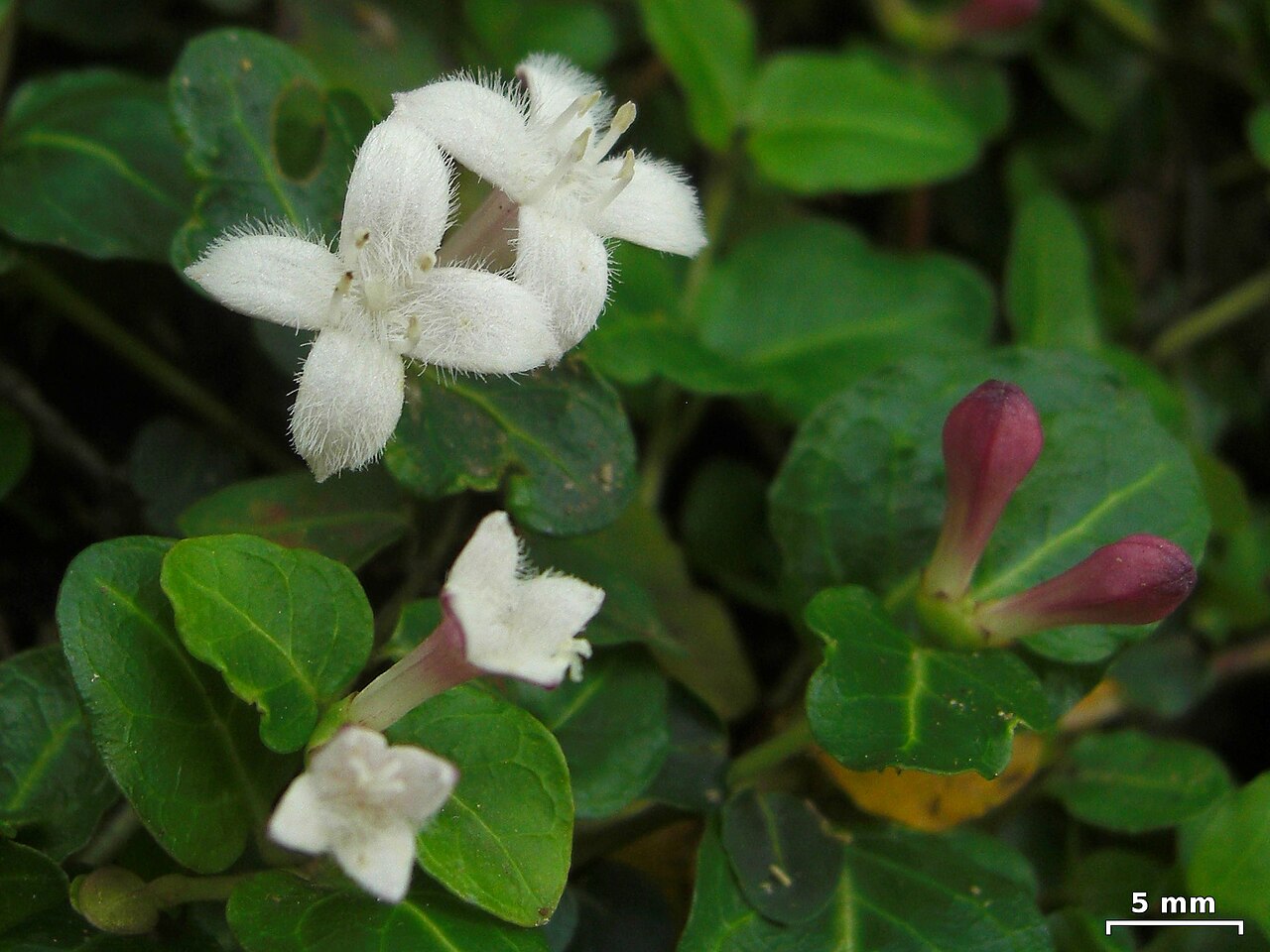
Partridgeberry (Mitchella repens) is a native woodland groundcover for people who enjoy small details. Slender stems travel along the soil surface, carrying pairs of glossy little leaves. White flowers open just above them, and a red fruit may remain visible long after the surrounding deciduous plants have died back. At roughly 1–3 inches tall, it changes the texture of a woodland planting without hiding stones, roots, or the bases of taller plants.
It is also a plant that asks the gardener to reset expectations. Partridgeberry is slow, delicate, and best appreciated in a small, protected area. It is not the native equivalent of a rapidly spreading commercial groundcover installed to smother weeds in one season. The New England regional table’s two-inch height and shade requirement capture its scale well; average moisture means a shaded, humus-rich root environment rather than a sun-baked bed watered only when it visibly wilts.
Choose it for a mossy-looking border edge, a quiet space under native shrubs, or a woodland path where you can notice the distinctive flowers and fruits. Use nursery-propagated plants, keep vigorous neighbors at a respectful distance, and make the site ready before planting. A few healthy patches that grow into their surroundings are more successful than dozens of plants scattered through an unsuitable dry, compacted bed.
Identification
Stems & Growth Habit
The very thin, creeping stems remain close to the ground and can root at nodes where they contact suitable soil. They are only slightly woody, so this plant is variously described as a creeping perennial or a tiny subshrub. Trace a stem visually and you will see repeated pairs of leaves rather than a tuft of foliage at the end of an upright shoot. A large patch consists of many interlaced stems, not a broad crown that can be dug and moved as though it were a hosta.
Leaves
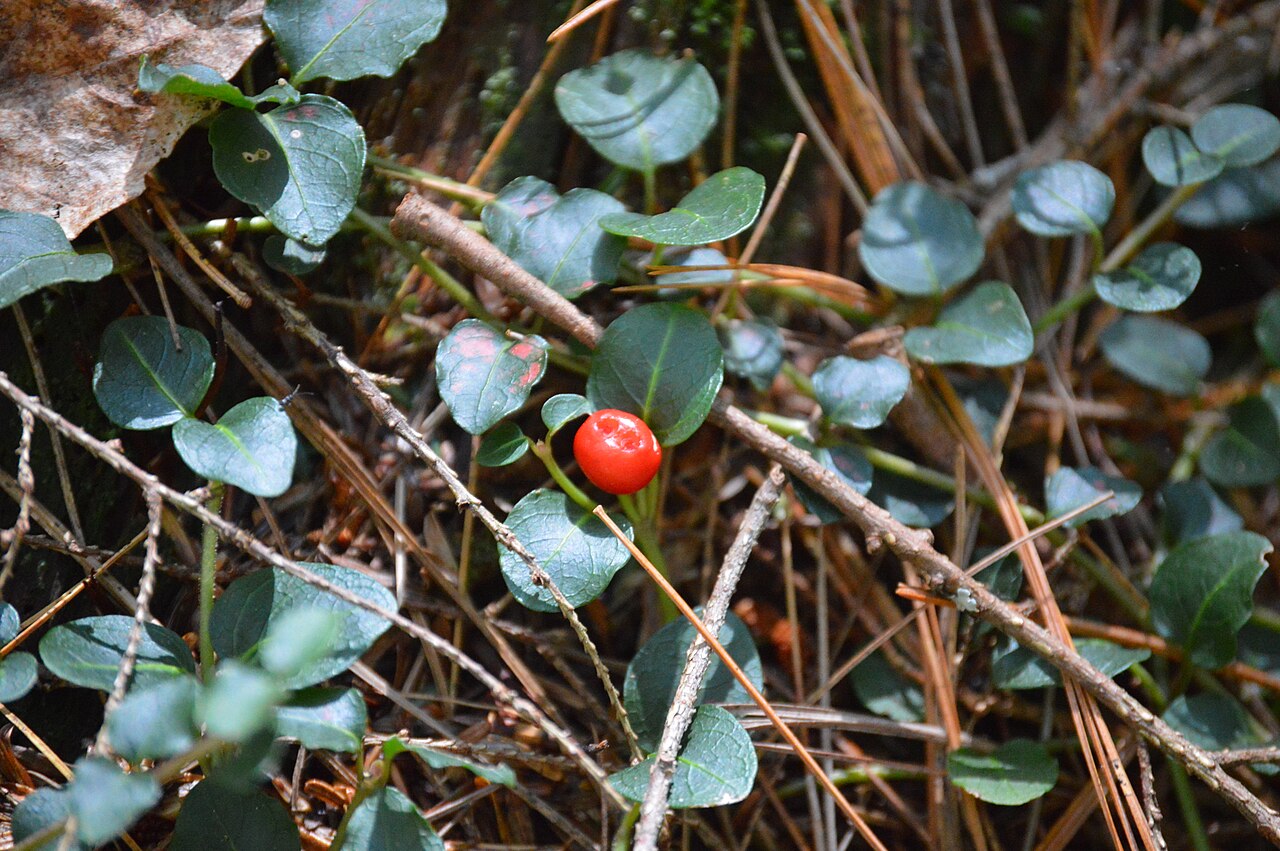
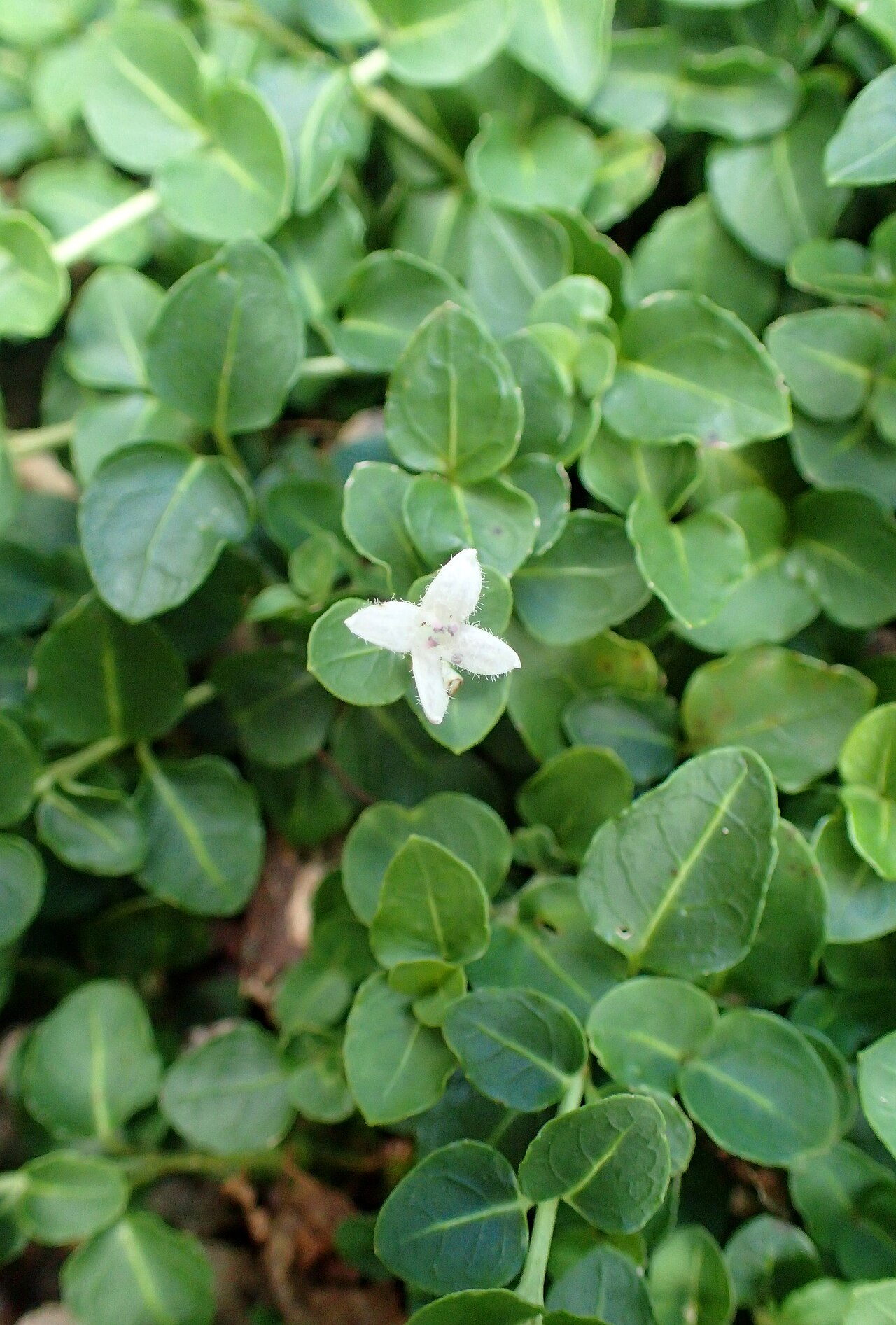
The opposite leaves are small, rounded to oval or slightly heart-shaped, with smooth edges and a pale central vein. They remain green through winter and give the plant its fine, beadlike texture. Checkerberry, Gaultheria procumbens, is an easily confused common-name neighbor, but its leathery leaves are larger and its shoots more upright. Do not identify partridgeberry by red fruit alone; leaf arrangement and the creeping habit are much more reliable when the two species grow together.
Flowers
Flowers usually occur in pairs near the ends of the stems. Each is a little white or faintly pink tube opening into four lobes, with conspicuous hairs inside the opening. Flowering is generally in late spring or early summer, with timing dependent on location. A hand lens or a close photograph reveals much more than a distant view of the patch. The pairing is not just decorative: the two flowers are involved in producing the single paired fruit characteristic of this species.
Fruit & Seeds
The round red fruit has two floral marks because it develops from the paired flowers. This feature explains the common name twinberry, though that name is also used for unrelated plants. Fruits can persist into winter among the small evergreen leaves. They are part of the plant’s appeal to both gardeners and wildlife, but this ornamental guide is not a foraging identification key. Leaving them in place gives birds and small mammals access and lets you observe how long they remain on a particular patch.
Quick Facts
| Scientific Name | Mitchella repens L. |
| Family | Rubiaceae (madder family) |
| Plant Type | Native creeping evergreen perennial or very low subshrub |
| Mature Height | 1–3 inches; about 2 inches is typical in the regional table |
| Mature Spread | About 12–16 inches for an established small patch; stems can extend farther over time |
| Growth Rate | Slow |
| Sun Exposure | Shade to part shade; protect from strong afternoon sun |
| Water Needs | Average to moist, well-drained soil; consistent moisture during establishment |
| Soil Type | Humus-rich woodland soil with an undisturbed surface |
| Soil pH | Acidic to mildly acidic conditions preferred |
| Bloom Time | Late spring to early summer, varying regionally |
| Flower Color | White, sometimes pink-tinged |
| Fall Color | Evergreen leaves remain green |
| Fruit | Red paired fruit with two floral scars; often persistent |
| Deer Resistant | Moderately resistant, not immune to browsing or trampling |
| USDA Hardiness Zones | 3–8 |
Native Range
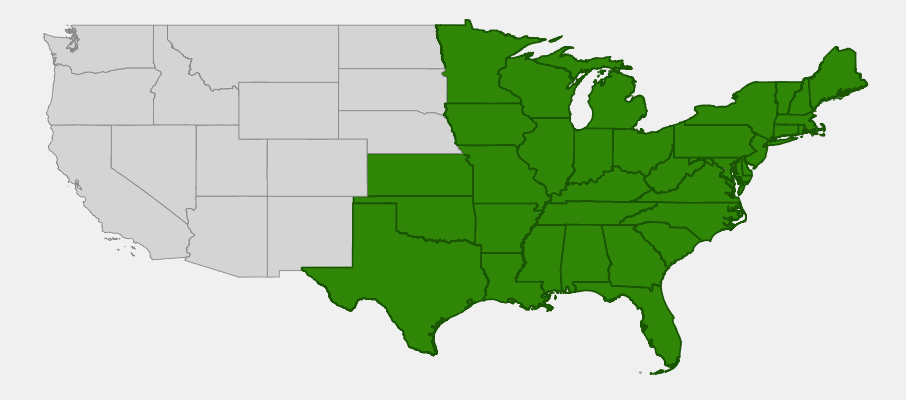
Partridgeberry is native across a broad part of eastern North America. The U.S. Forest Service describes a range extending from eastern Canada to Florida and west toward the central states and eastern Texas. Kew also recognizes native populations farther south in Mexico and Guatemala. This broad geographic spread should not obscure the importance of local habitat: it is a plant of sheltered ground-level conditions, not an all-purpose groundcover for every garden inside those boundaries.
Native Plant Trust documents it in all six New England states. It occurs on forest floors and forest edges, including sites that are moderately dry to moderately moist, and the species can also occupy mossy banks, shaded ledges, and rotting wood. Its roots experience the buffering effects of canopy shade, litter, and nearby vegetation. Recreating that protected surface environment is more useful than attempting to duplicate the name of one forest type.
The map combines the Forest Service state list with the additional Louisiana and Rhode Island native records recognized by Kew and Native Plant Trust. State shading is a broad orientation aid, not a statement that every locality is occupied. For a restoration project, consult county records and local expertise, and obtain regionally appropriate stock rather than choosing the most distant available source simply because it carries the same species name.
📋 Regional plant list: New England
Growing & Care Guide
Light
Give partridgeberry shade or gentle filtered light. A site under a deciduous or mixed canopy can provide spring light without the heat of an exposed summer border. Where a woodland edge receives afternoon sun, use another plant in the brightest strip and place partridgeberry farther under cover. Its small leaves can remain attractive in a sheltered setting, but their persistence should not be read as a promise of tolerance for sudden canopy removal or reflected heat from paving. Observe the site through the summer before planting a large area.
Soil & Water
A loose, humus-rich, well-drained woodland surface is the starting point. Keep newly planted roots moist without creating a saturated pocket. A plant that naturally threads through litter needs contact with soil at its rooting nodes, so avoid placing a thick layer of coarse bark between its stems and the ground. Mature patches may endure occasional dryness better than fresh divisions, but drought tolerance is not the same as rapid establishment in dry shade. During dry spells, inspect beneath the leaves and litter and water slowly enough to moisten the shallow root zone.
Planting Tips
Prepare a small weed-free planting space and preserve the surrounding tree roots. Set nursery plants at their original depth, gently spreading trailing shoots over the surface rather than burying them. Water thoroughly and keep foot traffic out of the area. If the nursery pot contains several rooted sections, do not fragment it into tiny pieces simply to cover more space; a stronger starter patch is often easier to maintain. Mark the planting discreetly so that dormant-season cleanup or spring bulb work does not disturb the nearly flat stems.
Pruning & Maintenance
There is very little to prune. Trim a damaged stem if needed, but routine shearing removes the very detail that makes the plant valuable. The main maintenance is selective weeding and preventing vigorous neighbors from covering the patch. Lift weeds with care so that an entire web of rooted stems does not come away with them. In autumn, retain a light, natural litter layer but remove dense wet piles that completely blanket the leaves. Use hand tools rather than a rake dragged through the planting, and never treat the patch as a convenient walking route.
Propagation
Division of cultivated, rooted stems is the practical method for most gardeners. Separate a section that already has roots and enough foliage to support recovery, replant promptly, and keep it shaded and evenly moist. Do not lift wild colonies to supply the garden. Seed propagation is possible but is a slower undertaking and should follow a nursery protocol appropriate to fresh seed and its dormancy requirements. If you are creating habitat rather than reproducing one ornamental selection, ask about seed-grown or multiple-source nursery stock to avoid relying exclusively on one clone.
Designing Around Slow Growth
Leave visible space for partridgeberry to expand, but make that space easy to reach for weeding. A tight planting between fast-spreading perennials sets up a competition it is unlikely to win. Put taller plants behind it and allow the creeping stems to meet a stone or path edge where they can be seen. Photograph the patch at the same season each year to judge real expansion; its low habit makes small gains easy to overlook. If the planting stays thin, improve site fit rather than repeatedly buying replacements for the same unsuitable spot.
Landscape Uses
- A close-view native groundcover beside a shaded footpath, with traffic kept on the path.
- A small evergreen patch below open native shrubs where fallen leaves can be managed gently.
- A woodland rock-garden detail at the base of a stone rather than in a hot, exposed crevice.
- A low companion to restrained woodland perennials that will not bury its stems.
- A winter-interest planting where the red fruit and tiny leaves remain visible after neighboring plants die back.
Wildlife & Ecological Value
For Pollinators
The paired tubular flowers invite close attention to woodland insect life. Avoid spraying the groundcover when it is flowering, and provide other native flowers around it so the small patch is part of a longer seasonal sequence. The plant’s unusual paired-flower structure is also a useful teaching feature: visitors can follow flowers into fruit without picking the stems. A garden managed for that observation benefits from leaving some sections undisturbed rather than grooming every leaf and faded flower away.
For Birds
The fruits are used by songbirds and ground-feeding birds, including grouse, turkeys, and quail in the species’ wider range. Which of these occurs in a particular garden is a separate question. A small suburban patch is not a substitute for woodland habitat, but it adds a native fruit resource at ground level. Leave nearby cover and avoid collecting all of the fruits for decorative use. Their persistence lets the planting contribute interest and potential food beyond the flowering season.
For Mammals
Small mammals also use the fruits. Moderate resistance to deer damage is reported, but that does not protect a newly planted patch from trampling or guarantee that deer will ignore it under heavy browsing pressure. If leaves disappear, look for the actual cause rather than assuming a single animal is responsible. Physical protection during establishment can be more useful than chemical treatments, especially where the goal is to retain a small, functioning piece of native understory.
Ecosystem Role
Partridgeberry occupies the lowest layer of a woodland planting. Its creeping stems fit around litter, small roots, and mossy surfaces, adding living cover without forming a tall competing canopy. Keep that role in perspective: a delicate patch is not engineered slope stabilization and should not be used to repair serious erosion. Protecting the forest floor from compaction and repeated disturbance is the important management contribution. In an intact woodland, preserving existing colonies is usually more valuable than digging them up to make a new ornamental bed elsewhere.
Cultural & Historical Uses
The species name repens refers to the creeping habit, an especially useful Latin name because it describes what the plant actually does in the garden. The genus honors John Mitchell, the eighteenth-century Virginia physician and naturalist. Modern botanical references retain Mitchella repens as the accepted name, making it a stable label to use when checking nursery stock or regional planting lists.
Its common names emphasize different details: partridgeberry points toward wildlife use, while twinberry points toward the paired flowers and the single fruit they form. Common names can also overlap with unrelated plants. Record the scientific name on a planting plan and nursery invoice so a replacement order brings the same species rather than a similarly named groundcover with different behavior.
The best contemporary use is not to force it into a high-speed landscaping role but to preserve its woodland character. Nursery propagation makes it possible to enjoy the plant without removing colonies from forest habitat. A carefully placed patch offers a chance to watch evergreen growth, paired flowers, and persistent fruit at close range, and to learn why small native plants deserve as much attention as showier trees and shrubs.
Frequently Asked Questions
Will partridgeberry replace my lawn?
No. It is low but delicate, slow-growing, and not suited to regular foot traffic or mowing. Use it in a protected shaded patch, not as a walkable groundcover.
Why are there two marks on one red fruit?
The fruit develops from a pair of flowers. The two floral scars are a useful identification feature and explain the name twinberry. Check the opposite leaves and creeping stems as well.
Can it grow in dry shade?
An established colony can tolerate occasional dryness, but new plants need consistent moisture and a suitable woodland soil surface. Dense tree-root competition and very dry soil can make establishment difficult. Test a small area before committing to a broad planting.
Is it the same plant as wintergreen?
No. American wintergreen is Gaultheria procumbens, a heath-family dwarf shrub with larger leaves and urn-shaped flowers. Partridgeberry belongs to Rubiaceae and has tiny opposite leaves and paired tubular flowers.
How should I handle fallen leaves?
Retain a loose natural litter layer while gently removing thick wet piles that bury the foliage. Do not rake hard through the creeping stems. A little careful hand work is better than stripping the soil bare or covering the patch with heavy mulch.
Sources & Further Reading
- NC State Extension: Mitchella repens
- US Forest Service FEIS: partridgeberry
- Native Plant Trust Go Botany: partridge-berry
- Kew Plants of the World Online: Mitchella repens
- USDA PLANTS: Mitchella repens
Find Native Plants
Ask growers about nursery propagation and regional provenance. Browse our Maine native plant nurseries, New Hampshire native plant nurseries, Vermont native plant nurseries, Connecticut native plant nurseries directory for suppliers.