Mexican Palo Verde (Parkinsonia aculeata)
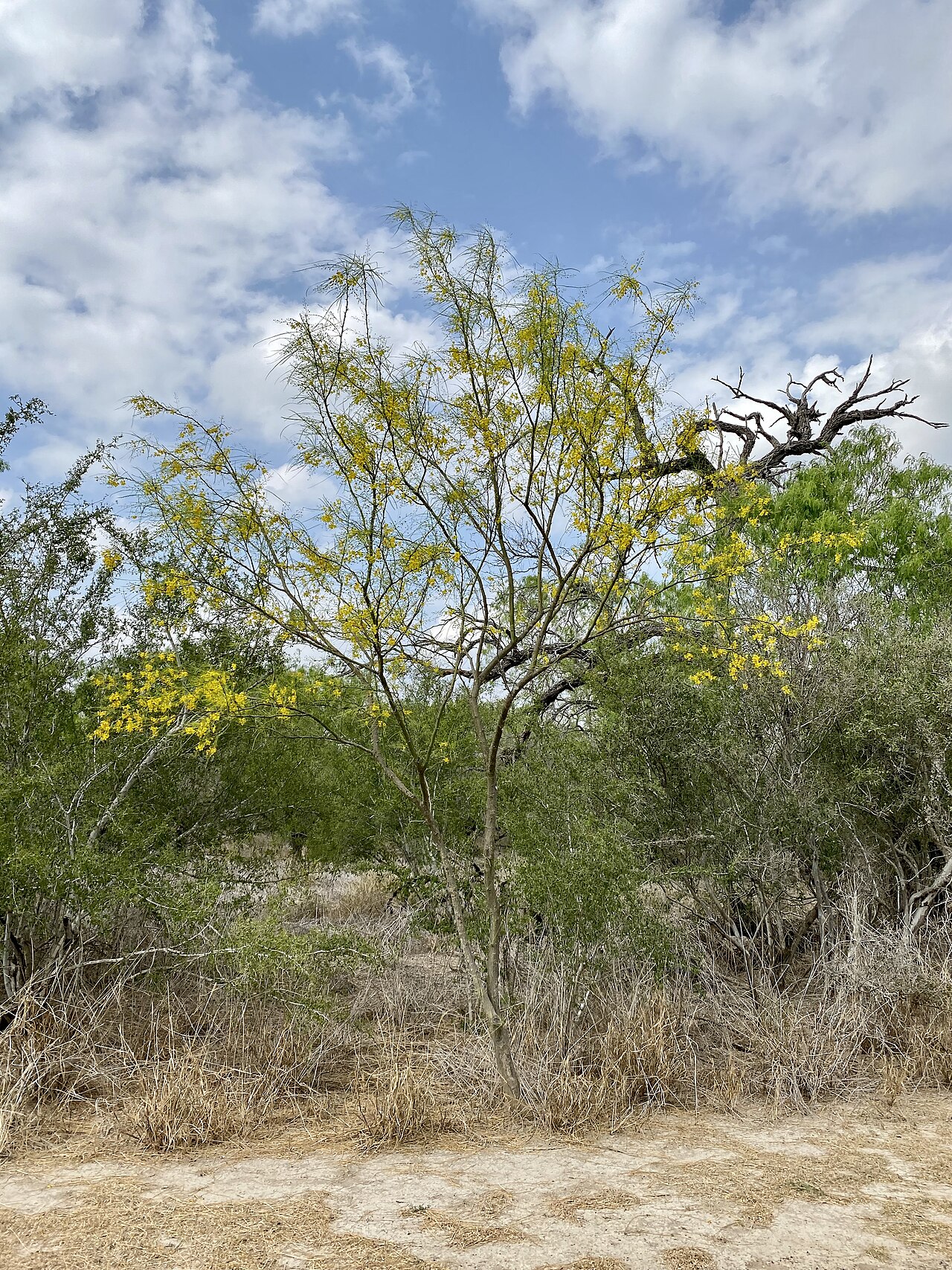
Parkinsonia aculeata, commonly known as Mexican Palo Verde, Retama, or Jerusalem Thorn, is a fast-growing, drought-tough small tree of the brushlands and river bottoms of the southern borderlands. Its name comes from “palo verde,” Spanish for “green stick,” describing the smooth, photosynthetic green bark that lets the tree keep making food even after it drops its leaves in dry weather. With its graceful, weeping canopy of airy foliage and long sprays of bright yellow, orange-flecked flowers, it is one of the most recognizable small trees of the Rio Grande brush country.
In its home range, Mexican Palo Verde grows along washes, floodplains, and disturbed brush where few other trees can establish, reaching 15 to 30 feet tall with long, slightly drooping branches armed with short, stout spines. The tiny, fast-shedding leaflets and green bark are drought adaptations that let the tree keep a low profile through the hottest, driest stretches of the year, then flush with color through an extended spring-to-summer bloom, especially after rain.
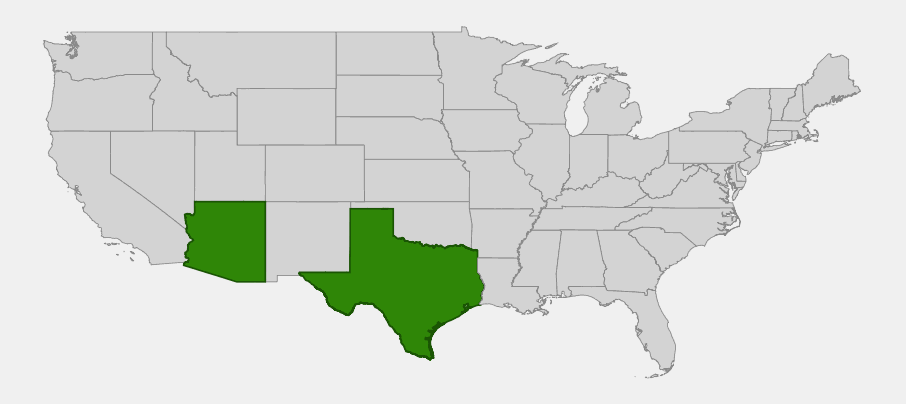
Mexican Palo Verde is native only to the southern half of Texas and adjacent Arizona in the United States, extending south through Mexico and Central America. Outside that native range it has been planted widely as an ornamental and has escaped and naturalized in parts of California, Florida, the Southeast, and Hawaii, where it can spread aggressively, especially along disturbed waterways. Gardeners outside its native Southwest should check local invasive-plant guidance before planting it, and should never plant it where it can escape into natural areas.
Identification
Mexican Palo Verde has a distinctive, almost leafless look through much of the year, with its function shifted from leaves to bark — a combination of features that makes it easy to tell apart from true mesquites and other thorny Southwest trees once you know what to look for.
Bark & Stems
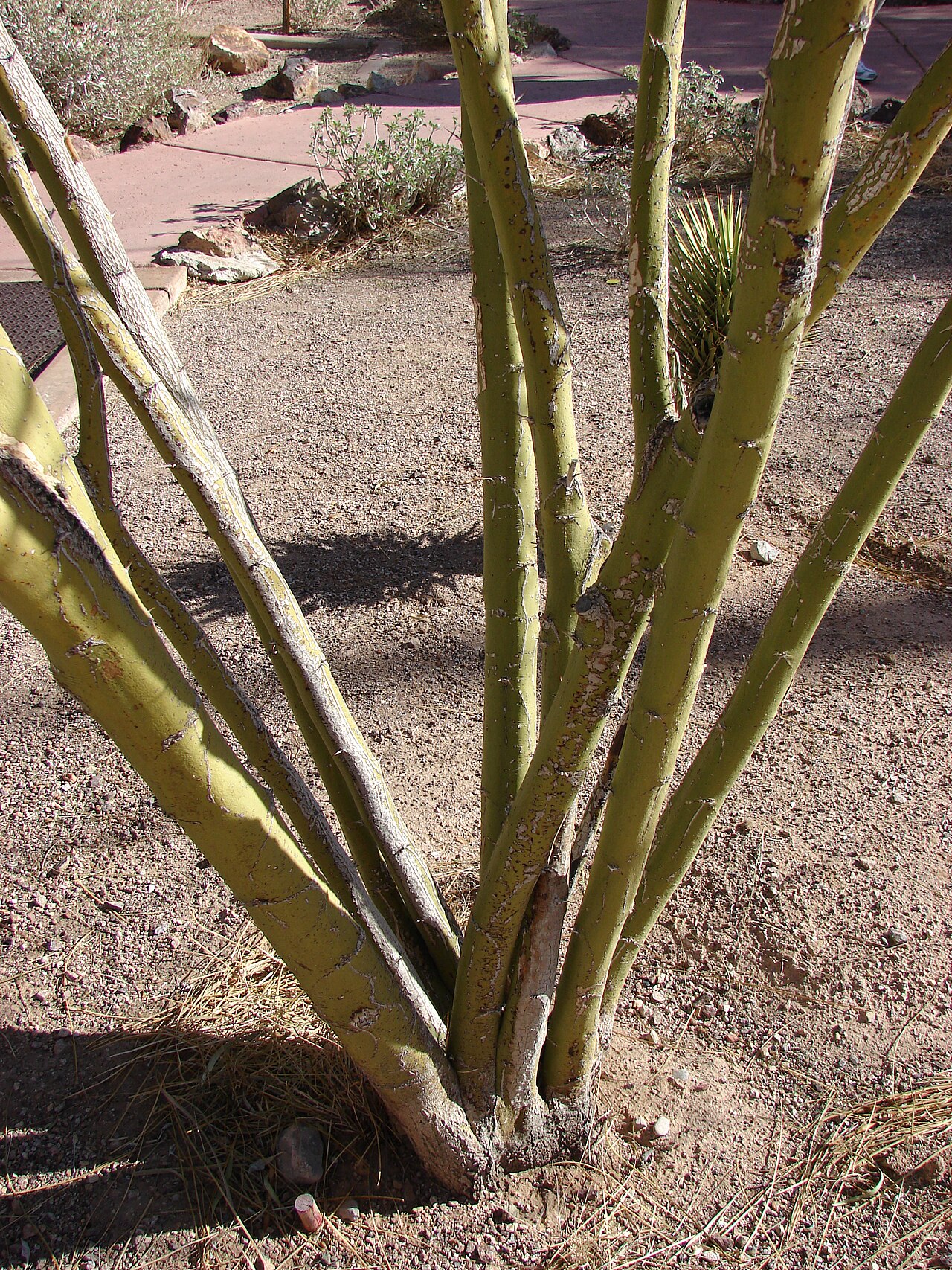
The bark and young branches are smooth and bright yellow-green, the tree’s signature feature, and remain photosynthetically active even when the tree is leafless. Branches are slender, arching, and somewhat weeping, armed with short, stout spines (modified stipules) at the leaf nodes — the source of the “Jerusalem Thorn” name. Mature trunks develop thin, scaly, olive-brown bark near the base while upper branches stay green.
Leaves
Leaves are bipinnately compound but highly reduced: each leaf produces two long, flattened, almost thread-like stalks (rachises) 8 to 15 inches long, bearing many pairs of tiny oblong leaflets just 1/8 to 1/4 inch long. The small leaflets drop quickly in drought or cold, leaving the green, flattened leaf stalks to continue photosynthesis — an unusual adaptation shared with few other North American trees.
Flowers
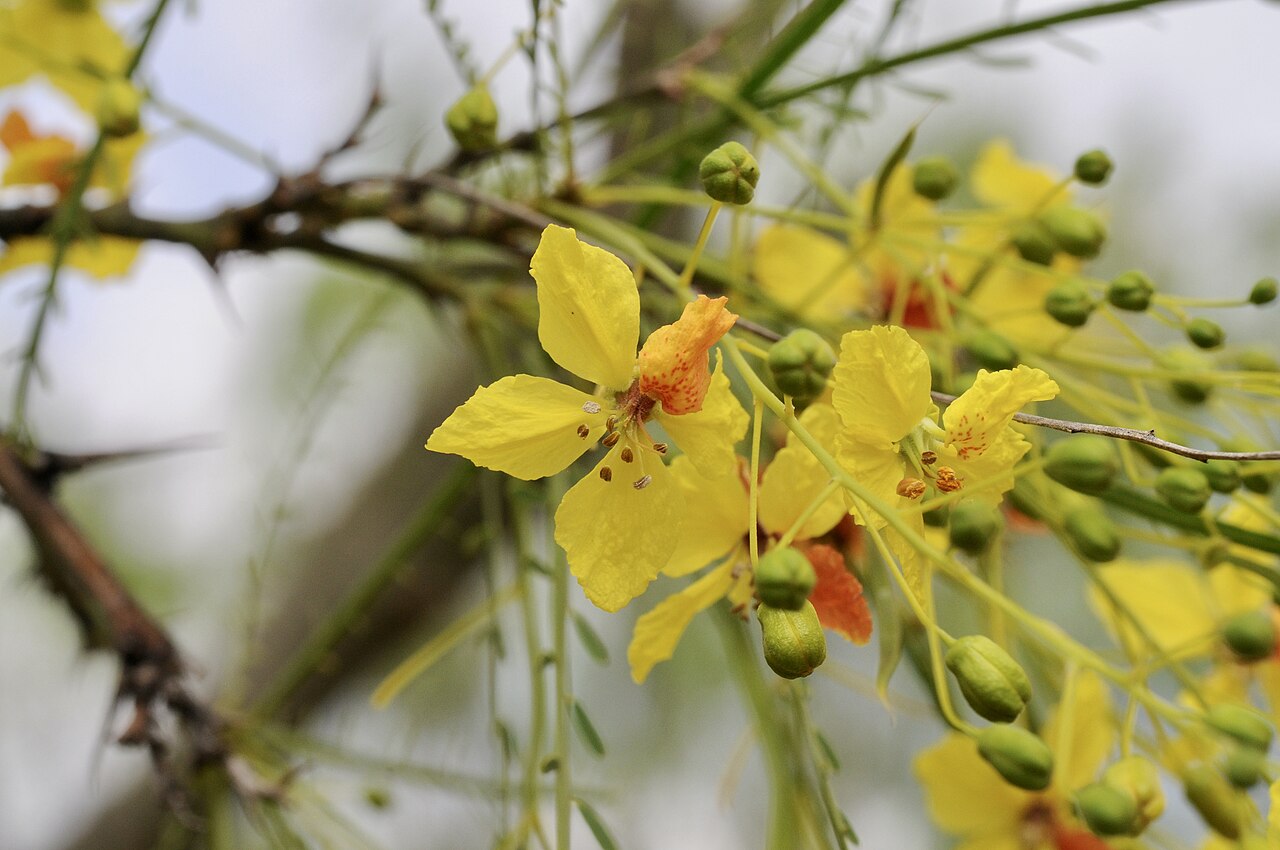
Fragrant yellow flowers, about 3/4 inch across with five rounded petals, appear in loose, drooping racemes 5 to 6 inches long. One petal is marked with a contrasting orange-red blotch at the base that fades as the flower ages, giving blooming branches a two-toned yellow-and-orange look. Bloom is heaviest in spring and early summer but can repeat after any good rain through the warm months.
Fruit & Seeds
The fruit is a narrow, leathery seedpod 2 to 5 inches long, strongly constricted between the seeds like a string of beads, maturing from green to tan. Each pod holds several hard, oblong, olive-brown seeds that can remain viable in the soil for years, helping the species persist through dry spells and recolonize disturbed ground after flooding.
Quick Facts
| Scientific Name | Parkinsonia aculeata |
| Family | Fabaceae (Pea/Legume) |
| Plant Type | Deciduous Small Tree |
| Mature Height | 15–30 ft |
| Mature Spread | 15–25 ft |
| Growth Rate | Fast |
| Sun Exposure | Full Sun |
| Water Needs | Low |
| Soil Type | Any well-drained soil, including caliche, sand and clay |
| Soil pH | 6.0–8.5 (tolerates alkaline) |
| Bloom Time | April – August, repeating after rain |
| Flower Color | Yellow with orange-red marking |
| Fall Color | None notable; green bark stays colorful year-round |
| Fruit | Narrow, beaded tan seedpods, 2–5 in |
| Deer Resistant | Moderate (spines discourage heavy browsing) |
| USDA Hardiness Zones | 8–11 |
Native Range
In the United States, Mexican Palo Verde is native only to the southern half of Texas and adjacent southern Arizona, extending south through Mexico, Central America, and into northern South America. Within Texas, it is most common along the Rio Grande in the brushlands of the Lower Rio Grande Valley and south-central Texas, growing in washes, floodplains, and disturbed caliche or clay soils. In Arizona it occurs more locally, mainly in low desert washes and riparian corridors in the southern part of the state.
Outside this native southern-TX-to-southern-AZ range, Mexican Palo Verde has been planted extensively as a fast, tough ornamental tree in warm climates and has naturalized in California, Nevada, Utah, Florida, the Gulf Coast states, and Hawaii. In several of these areas, especially Florida and Hawaii, it is considered a problem invasive that crowds out native streamside and coastal vegetation, so plantings in those regions should be avoided. Even within Texas and Arizona, the tree seeds out readily along disturbed drainages and can become locally weedy where it is overwatered.
Within its true native range, Mexican Palo Verde is a classic pioneer of disturbed and flood-scoured ground, often among the first woody plants to colonize gravel bars and eroded washes after storms. It typically grows alongside other dryland legumes such as honey mesquite and huisache, and its deep, wide-ranging roots help stabilize loose soils along intermittent watercourses.
📋 Regional plant lists featuring Mexican Palo Verde: Arizona & New Mexico
Growing & Care Guide
Mexican Palo Verde is about as low-maintenance as trees get in hot, dry climates, but it needs to be sited and watered carefully to keep its naturally graceful form and to avoid the weak wood and rank growth that come from overwatering.
Light
Give it full sun. This is a tree built for open, intensely bright desert and brush country, and it flowers most heavily and holds its best open form in full sun. Partial shade produces a sparser, less floriferous tree reaching awkwardly for light.
Soil & Water
Mexican Palo Verde tolerates nearly any well-drained soil, including caliche, rocky, sandy, and clay sites, and handles alkaline and saline soils better than most ornamental trees. Established trees need little to no supplemental water and are among the most drought-tolerant small trees for Southwest landscapes. Avoid regular irrigation near the trunk — overwatered trees grow fast but weak, with brittle branches prone to storm damage, and can seed out aggressively into surrounding beds.
Planting Tips
Plant from containerized nursery stock in fall or early spring, choosing a site at least 15 to 20 feet from structures and walkways to allow for the spreading, thorny canopy. Stake young trees loosely for their first year if the site is windy, since fast top growth can outpace root establishment. Give it full sun and sharp drainage from the start — it rarely thrives in heavy, poorly drained soil.
Pruning & Maintenance
Prune to remove crossing, weak, or storm-damaged branches and to raise the canopy for clearance over paths, ideally while the tree is young so major cuts aren’t needed later. Because the wood can be brittle, especially on overwatered trees, avoid heavy pruning that leaves large wounds. Wear thick gloves and eye protection when working around the tree — the spines are sharp and plentiful.
Landscape Uses
Within its native Southwest range, Mexican Palo Verde fits several practical roles:
- Fast, low-water shade tree for xeriscape and desert gardens
- Erosion control on disturbed washes and caliche slopes
- Wildlife and pollinator plantings in native Southwest gardens
- Barrier or security hedge, using its dense spiny growth
- Restoration plantings along degraded Rio Grande brushland sites
Fire Ecology
Mexican Palo Verde grows in arid thornscrub and desert wash habitats where natural fire is infrequent and typically patchy. Mature trees can resprout from the base after top-kill by fire, but the species is not considered fire-adapted or fire-dependent, and repeated fire can reduce stands in brushland where fine fuels have increased due to invasive grasses.
Wildlife & Ecological Value
Mexican Palo Verde plays an outsized ecological role for a tree of such a harsh, dry habitat, offering food, shelter, and nesting structure in landscapes where woody cover is scarce.
For Pollinators
The abundant, fragrant flowers are a major nectar source for native bees and honeybees across its blooming season, and beekeepers in south Texas value it for the distinctive honey it produces. Butterflies also visit the flowers regularly through the long bloom period.
For Birds
The dense, thorny branching provides excellent protective nesting sites for small birds, which favor the cover the spines give against predators. Seed-eating birds such as quail and sparrows feed on the mature seeds that fall from the dry pods.
For Mammals
Foliage and pods are browsed by deer and other wildlife, and historically the pods have been used as emergency livestock forage during drought in south Texas ranch country. Small mammals also feed on fallen seeds, helping disperse them along washes and disturbed ground.
Ecosystem Role
As a nitrogen-fixing legume and an early colonizer of flood-scoured washes and disturbed brush, Mexican Palo Verde helps stabilize soil and add fertility to the harsh, low-nutrient ground of the Tamaulipan thornscrub and Sonoran desert margins. Its canopy provides one of the few sources of shade in open brushland, moderating ground temperatures for understory plants and animals.
Cultural & Historical Uses
Mexican Palo Verde has long been a familiar tree to ranching and border communities in south Texas and northern Mexico, where its Spanish name “retama” is still the common local name. Ranchers historically relied on its pods and foliage as drought-season forage for livestock when other feed was scarce, and its dense, thorny growth made it a practical living fence or barrier planting around homesteads.
The tree’s toughness and fast growth also made it a popular shade and ornamental tree well beyond its native range, planted widely across warm regions of the world from the Mediterranean to Australia and Hawaii. That same toughness is part of why it has naturalized so readily outside the Southwest, and why many of those regions now manage it as an invasive species rather than a garden asset.
The common name “Jerusalem Thorn” is often assumed to reference the Middle East, but it is actually a corruption of the Spanish and Portuguese word “girasol,” meaning “turning toward the sun,” reflecting the tree’s intense light requirement rather than any Biblical connection. Various plant parts have been used in folk and traditional medicine in parts of its range, a history noted here for background only and not as a guide to use.
Frequently Asked Questions
Is Mexican Palo Verde the same as Blue Palo Verde or Foothill Palo Verde?
No. Mexican Palo Verde (Parkinsonia aculeata) has drooping, weeping branches and long, bead-like seedpods, and is native to south Texas and southern Arizona. Blue Palo Verde (Parkinsonia florida) and Foothill Palo Verde (Parkinsonia microphylla) are separate Arizona desert species with more upright, rounded forms and different bark color.
Is Mexican Palo Verde invasive?
Within its native range in south Texas and southern Arizona, it is not considered invasive, though it can seed out locally in overwatered landscapes. Outside that native range — notably in Florida, Hawaii, and parts of California — it has escaped cultivation and is classified as an invasive species, so it should not be planted in those areas.
How much water does Mexican Palo Verde need?
Very little once established. It is adapted to arid brushland and desert wash conditions and thrives on natural rainfall alone in its native range. Regular irrigation produces fast but weak, brittle growth and should be avoided except to establish young trees.
Are the thorns dangerous?
The spines are short but sharp and plentiful along the branches, so plant it away from paths, play areas, and parking. The spines are not toxic, but deep punctures should be cleaned to avoid infection, and thick gloves are recommended for any pruning work.
How fast does Mexican Palo Verde grow?
Very fast for a desert-adapted tree, often adding several feet per year under good conditions. That speed comes with a tradeoff: fast-grown wood is comparatively weak, so storm damage and limb breakage are more common than in slower-growing native trees.