Mountain Camellia (Stewartia ovata)
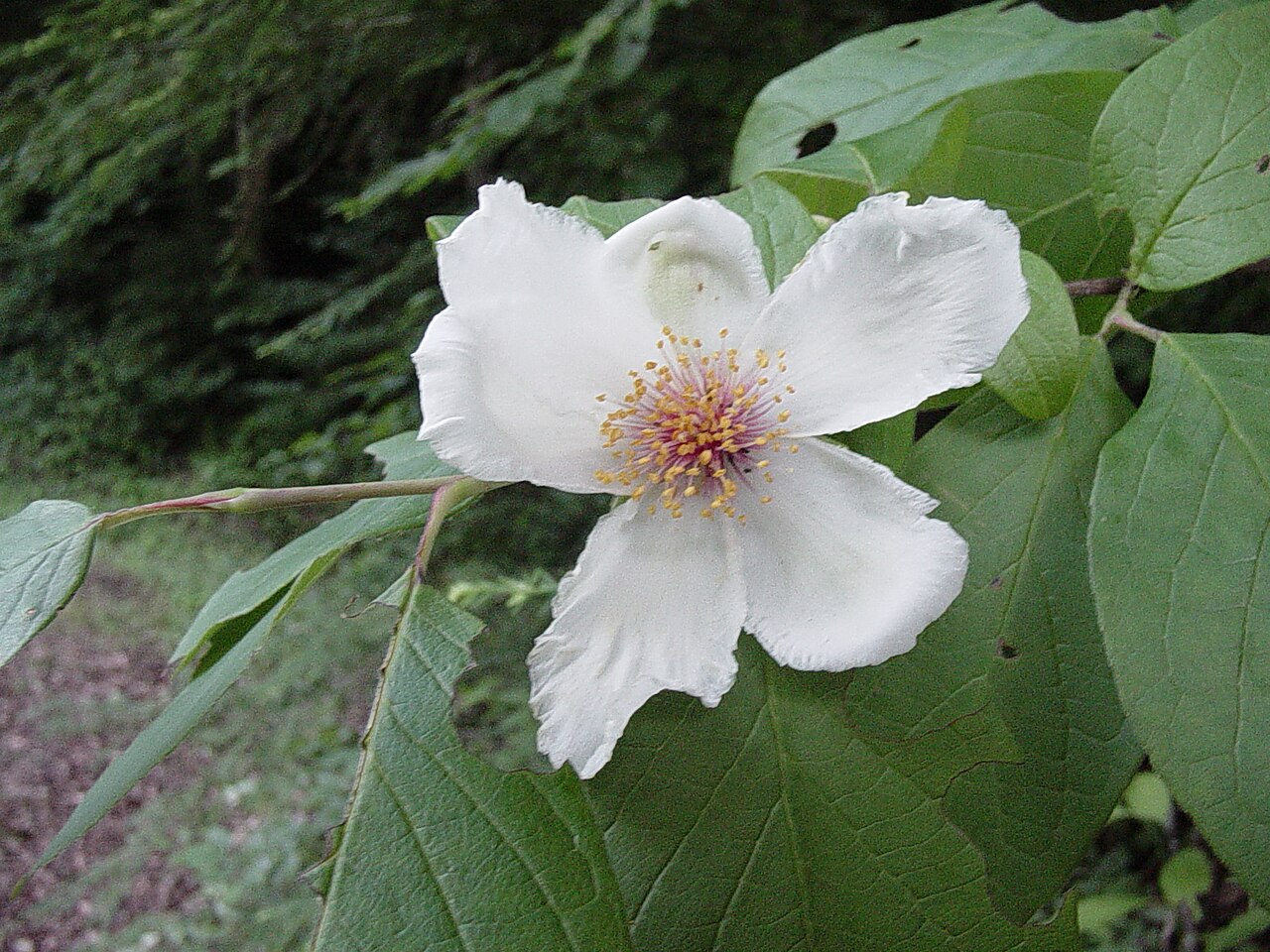
Stewartia ovata, commonly called Mountain Camellia (also known as Mountain Stewartia), is an uncommon understory tree or large shrub of the southern Appalachian Mountains and adjacent Piedmont. A member of the tea family (Theaceae), it is a close relative of the garden camellia, and its large white summer flowers with a boss of orange-to-purple stamens make it one of the most striking native flowering shrubs of the eastern woodlands. Despite its beauty, mountain camellia is rarely seen in the wild — it grows in scattered, often small populations along shaded streambanks and ravine slopes, and many botanists consider it a conservation priority throughout its range.
In the landscape, mountain camellia behaves as a slow-growing, multi-stemmed small tree or large shrub, typically 10 to 20 feet tall, with an irregular, open crown. Its broad, oval leaves turn shades of orange, red, and burgundy in autumn, and its smooth gray bark develops attractive fissures with age. The solitary, cup-shaped flowers — each up to 4 inches across — open from early to midsummer, later than most other native flowering shrubs, extending the woodland garden’s season of bloom.
Because it is adapted to moist, acidic, well-drained soils in filtered shade, mountain camellia is best suited to woodland gardens, shaded stream banks, and naturalistic plantings that mimic its native cove-forest habitat. It is slow to establish and intolerant of soil disturbance or drought, so gardeners should treat it as a long-term investment rather than a quick landscape fix. Once established, however, it rewards patience with decades of understated beauty and genuine rarity value.
Identification
Mountain camellia is most easily recognized in summer by its large, white, rose-like flowers, but its leaves, bark, and seed capsules offer identification clues through the rest of the year.
Bark & Stems
Young stems are smooth and gray-brown, maturing to a smooth, ash-gray bark that develops shallow, flaky fissures and faint vertical striping with age. Unlike many understory trees, mountain camellia rarely has showy exfoliating bark; its bark is more subtly textured than that of its showier Asian relatives. Branching is often low and multi-stemmed, giving older plants a broad, vase-shaped silhouette.
Leaves
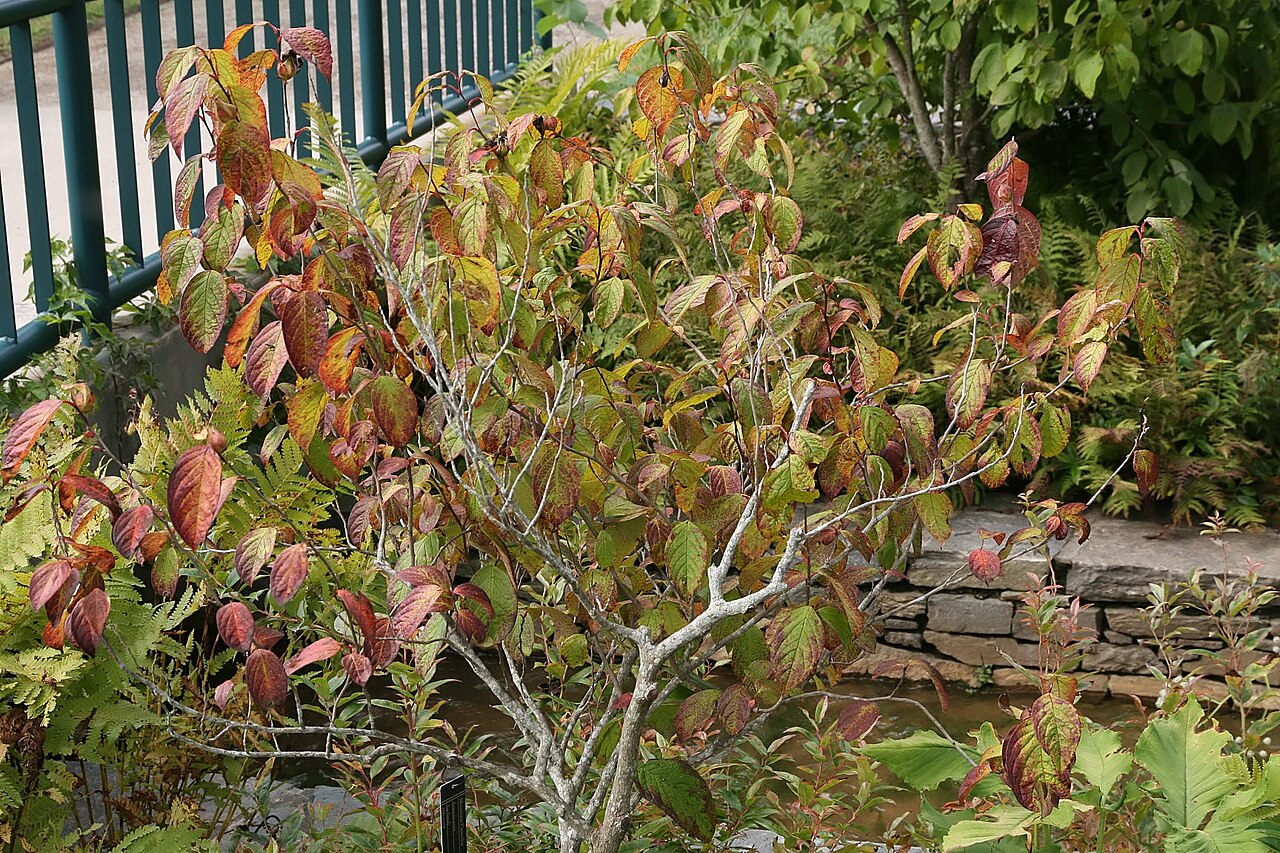
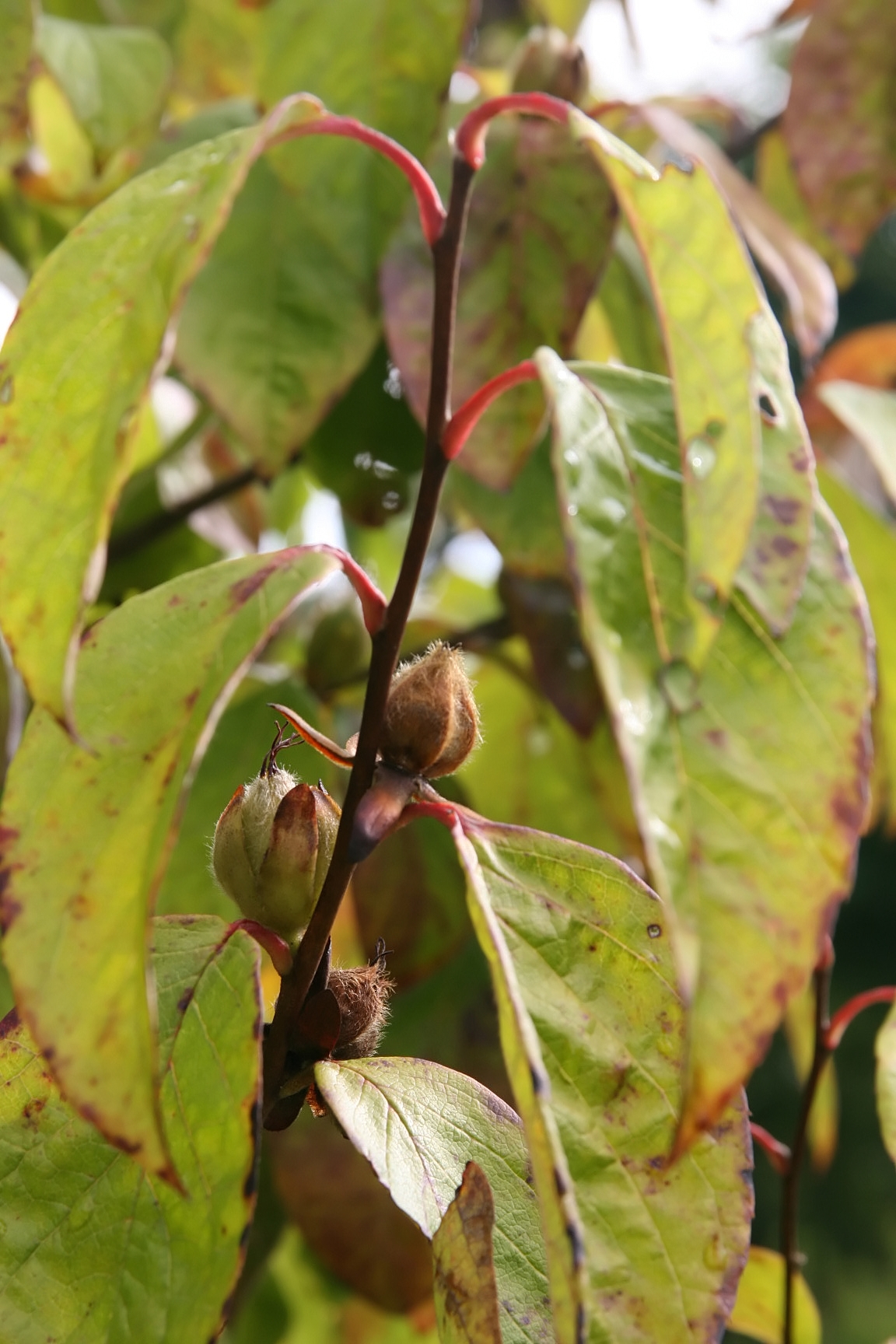
Leaves are simple, alternate, and elliptic to obovate, 3 to 5 inches long, with finely toothed margins and a short point at the tip. The upper surface is dull to semi-glossy medium green; the underside is paler and may show fine hairs along the veins. In fall, foliage turns orange, red, bronze, or burgundy, often with several colors appearing on the same branch, as shown in the photo above.
Flowers
Flowers are solitary, borne singly in leaf axils along the current season’s growth, and open from late June into July or early August depending on latitude and elevation. Each flower is 3 to 4 inches across, with five to seven crinkled, white petals surrounding a dense central cluster of stamens that range from bright orange-yellow to a striking purple, depending on the individual plant. The flowers have a light, pleasant fragrance and typically last only a day or two once open, though a healthy shrub produces a long succession of blooms over several weeks.
Fruit & Seeds
After flowering, mountain camellia produces a woody, five-valved seed capsule about ¾ inch long, pointed at the tip, which ripens from green to brown in early fall and splits open to release several flattened, dark brown seeds. The capsules often persist on the bare branches well into winter, visible among the fall-colored foliage, as seen in the photo below.
Quick Facts
| Scientific Name | Stewartia ovata |
| Family | Theaceae (Tea family) |
| Plant Type | Deciduous Large Shrub / Small Tree |
| Mature Height | 10–20 ft |
| Mature Spread | 8–15 ft |
| Growth Rate | Slow |
| Sun Exposure | Part Shade to Shade |
| Water Needs | Moderate to High |
| Soil Type | Moist, well-drained; humus-rich |
| Soil pH | 5.0–6.5 (acidic) |
| Bloom Time | Late June – August |
| Flower Color | White with orange or purple stamens |
| Fall Color | Orange, red, burgundy |
| Fruit | Woody 5-valved seed capsule |
| Deer Resistant | Moderate |
| USDA Hardiness Zones | 6–9 |
Native Range
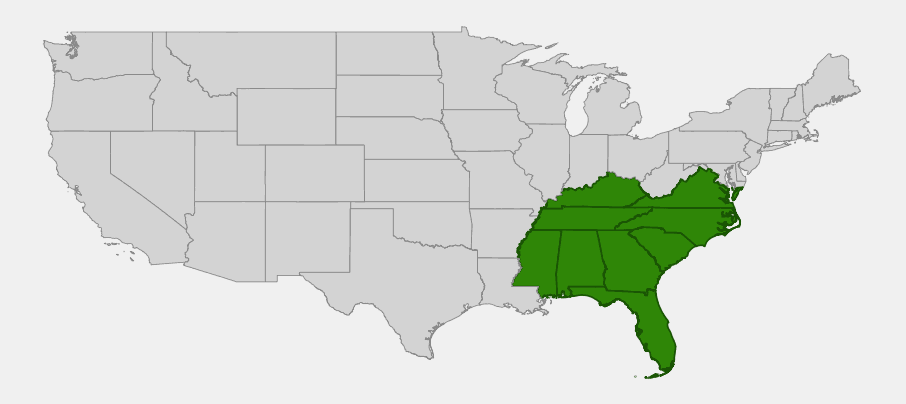
Mountain camellia is native to the southern Appalachian Mountains and adjacent Piedmont, with its core range running from Virginia southwest through the Carolinas, Tennessee, and Kentucky to Georgia, Alabama, and Mississippi, with a disjunct population reaching the Florida Panhandle. Throughout this range it is considered uncommon to rare, occurring in scattered, often small colonies rather than as a widespread understory species.
It is a plant of shaded coves, bluffs, and stream terraces, typically found at low to mid elevations below about 4,000 feet. It favors moist, acidic, well-drained soils along wooded streambanks, in rich cove forests, and on north-facing slopes where soil moisture stays relatively constant through the growing season.
Mountain camellia is sometimes cultivated outside its native range in gardens and arboreta from the mid-Atlantic to New England, where it can be grown successfully with attentive siting, but it is not considered native north of Virginia; gardeners in those regions should treat it as an introduced ornamental rather than a native plant.
📋 Regional plant lists featuring Mountain Camellia: Maryland, Virginia & West Virginia · Kentucky & Tennessee · North Carolina & South Carolina · Georgia, Alabama & Mississippi
Growing & Care Guide
Mountain camellia asks for patience more than skill. Give it the cool, moist, acidic conditions of its native cove forests and it will reward you with decades of early-summer flowers and reliable fall color, but it will sulk — or fail outright — in hot, dry, or alkaline sites.
Light
Part shade to full shade suits mountain camellia best, especially filtered light beneath a high deciduous canopy that mimics its native forest understory. Morning sun with afternoon shade works well in cooler climates; in the hotter parts of its range, more consistent shade helps prevent leaf scorch and keeps soil moisture more even.
Soil & Water
Plant in humus-rich, consistently moist, well-drained, acidic soil (pH 5.0–6.5). This species does not tolerate compacted clay, standing water, or prolonged drought, so improving soil structure with leaf compost before planting pays off for years afterward. A steady layer of organic mulch — 2 to 3 inches, kept away from the trunk — helps retain moisture and keeps roots cool.
Planting Tips
Set out container-grown plants in fall or early spring, choosing a sheltered site near the dappled shade of larger trees, ideally on a gentle slope or streambank where water drains but soil stays evenly moist. Avoid windy, exposed sites. Because mountain camellia resents root disturbance, handle the root ball gently and avoid transplanting established specimens once settled.
Pruning & Maintenance
Little pruning is needed beyond removing dead, damaged, or crossing branches in late winter. Because flowers form on new growth, light shaping after flowering will not sacrifice the next year’s bloom, but heavy pruning can stress an already slow-growing plant and should be avoided.
Propagation
Mountain camellia is notoriously slow and difficult to propagate. Fresh seed requires a period of warm stratification followed by cold stratification and may still take a year or more to germinate; softwood cuttings taken in early summer under mist can succeed but often root slowly and unevenly. Most gardeners obtain plants from specialty native-plant nurseries rather than propagating their own.
Landscape Uses
Mountain camellia fits naturally into shaded, woodland-style gardens:
- Woodland understory beneath tall deciduous trees
- Shaded streambank or rain-garden margins with consistent moisture
- Specimen planting where its summer flowers can be appreciated up close
- Native plant collections focused on Appalachian cove-forest species
- Naturalistic shade gardens paired with rhododendron and mountain laurel
Wildlife & Ecological Value
Though not a heavy wildlife food source compared to fruiting shrubs, mountain camellia contributes meaningfully to the ecology of the cove forests where it grows.
For Pollinators
The large, showy summer flowers attract native bees and other pollinating insects at a time when few other woody plants in the shaded forest understory are blooming, making mountain camellia a valuable mid-summer nectar source in shaded habitats.
For Birds
Small songbirds use the dense branching structure for cover and nesting sites, and the open, multi-stemmed form provides perching and foraging habitat within the shrub layer of mature forests.
For Mammals
Deer browse mountain camellia only occasionally compared to more palatable understory shrubs, which can give it a modest advantage in establishing within forests with heavy deer pressure.
Ecosystem Role
As a long-lived component of rare cove-forest and streamside plant communities, mountain camellia adds structural and seasonal diversity to the shrub layer, and its persistence in undisturbed sites makes it something of an indicator species for high-quality, intact Appalachian forest habitat.
Cultural & Historical Uses
Mountain camellia has no significant history of medicinal, culinary, or material use among Indigenous peoples or early settlers, likely owing to its rarity and scattered distribution rather than any lack of botanical interest. Its closest documented relationship with people has been ornamental and scientific rather than practical.
Botanists and horticulturists have long prized mountain camellia for its unusual combination of camellia-like flowers and cold hardiness unmatched by its more tender Asian relatives in the genus. It was collected and described by early American botanists exploring the southern Appalachians, and it remains a sought-after specimen among collectors of native woody plants.
Because of its naturally sparse and localized populations, mountain camellia has also become something of a conservation symbol for intact cove-forest habitat, and several southeastern states monitor or protect populations found on public lands.
Frequently Asked Questions
Is Mountain Camellia the same as a garden camellia?
No, but they are relatives. Both belong to the tea family (Theaceae), and mountain camellia’s flowers resemble single-form camellia blooms, but mountain camellia is a cold-hardy North American native, while ornamental camellias (Camellia japonica and relatives) are native to East Asia.
Why is Mountain Camellia so hard to find in nurseries?
It is slow-growing and difficult to propagate from both seed and cuttings, and demand has historically been low relative to faster, easier-to-grow landscape shrubs. Specialty native-plant nurseries within its range are the most reliable source.
How long does it take for Mountain Camellia to flower?
A young plant typically takes several years to reach blooming size, and because it grows slowly, gardeners should expect a multi-year wait before the first flush of summer flowers.
Can Mountain Camellia tolerate full sun?
It can tolerate some morning sun in cooler climates, but full, all-day sun generally causes leaf scorch and stress, especially where soil moisture is inconsistent. Part shade to shade gives the best results.
Is Mountain Camellia rare or protected?
It is uncommon throughout its range and considered a species of conservation concern in parts of several states, though it is not federally listed. Gardeners should always obtain nursery-propagated stock rather than collecting from the wild.

Looking for a nursery that carries Mountain Camellia?
Browse our native plant nursery directory: Virginia, Tennessee & South Carolina · North Carolina · Georgia & Florida · Alabama · Kentucky & Mississippi