Eve’s Necklace (Styphnolobium affine)
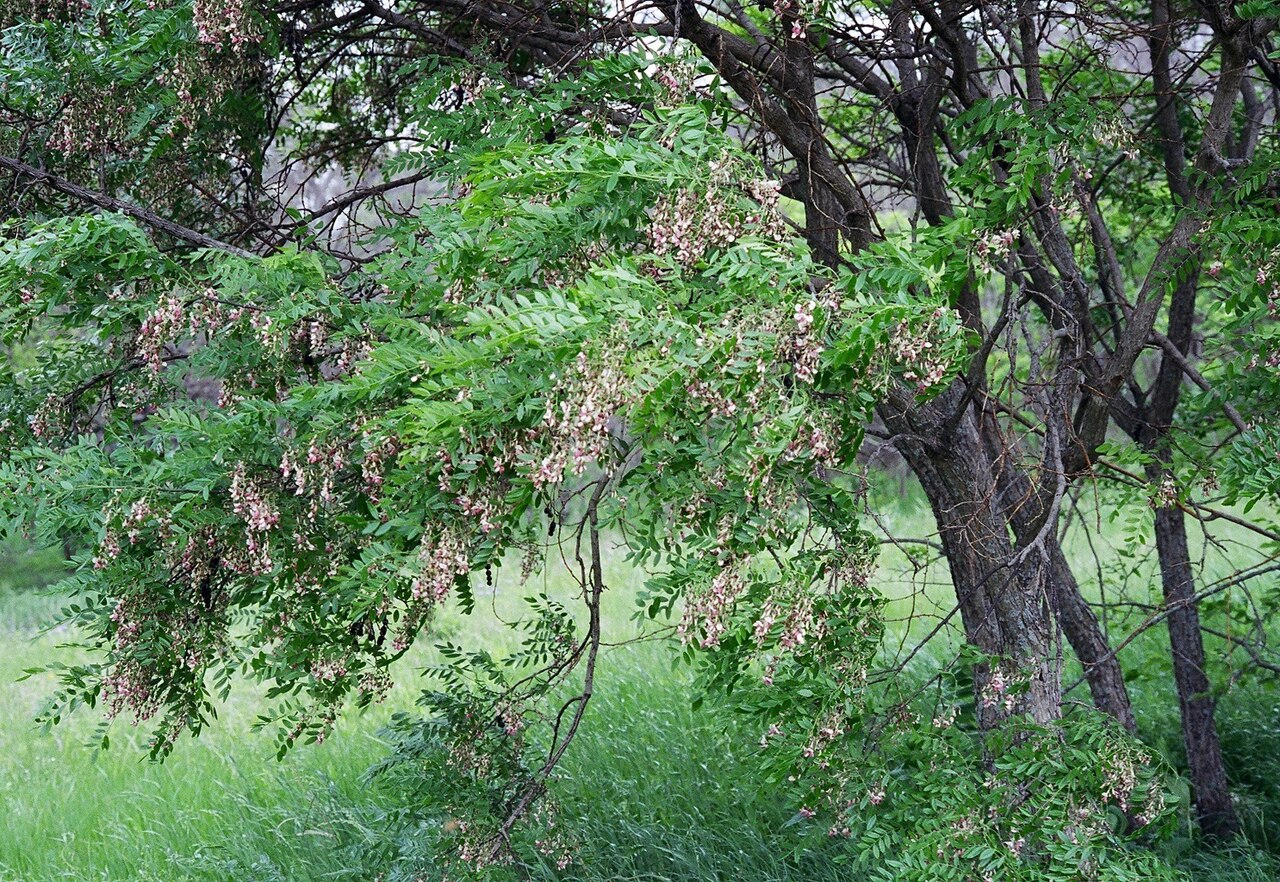
Styphnolobium affine, commonly called Eve’s Necklace (also sold as Eve’s necklacepod or Texas sophora), is a small, graceful tree native to the limestone prairies and woodland edges of the south-central United States. A member of the pea family (Fabaceae), it earns its common name from the long, bead-like seed pods that dangle from its branches in late summer and fall, pinched in tight at each seed like beads strung on a cord. In late spring, the tree produces long, drooping clusters of fragrant, wisteria-like flowers in shades of white, cream, and pale pink to maroon, making it one of the more ornamental native legumes of the Texas Hill Country and surrounding region.
Eve’s necklace typically grows as a small, multi-trunked tree or large shrub, 15 to 20 feet tall with an equal or greater spread, and an irregular, often weeping or arching form that gives it character even in winter when bare of leaves. Its compound, locust-like leaves provide dappled shade, and its smooth gray bark and twisting trunks add visual interest to the winter landscape. It is well adapted to the thin, rocky, alkaline soils common across its native range, tolerating heat and drought once established.
Because every part of the plant — and especially the seeds inside those distinctive necklace-like pods — is considered toxic if ingested, Eve’s necklace is best sited away from areas where children or pets might be tempted to handle the fallen pods, though the risk is mitigated by the fact that the seeds are bitter and unpalatable. With that single caution in mind, it is an excellent small flowering tree for xeriscapes, native hedgerows, and naturalistic plantings throughout its range.
Identification
Eve’s necklace is identifiable year-round by its compound leaves, smooth bark, and — most distinctively — its constricted, bead-like seed pods.
Bark & Stems
Young branches are smooth and gray-brown, often with a slightly zigzag growth pattern between leaf nodes. Mature bark is smooth to finely ridged, pale gray, and the trunks frequently lean or twist, giving older specimens a sculptural, irregular silhouette. Branching tends to be low, and the overall form is often as wide as it is tall.
Leaves
Leaves are pinnately compound, 6 to 10 inches long, with 7 to 13 oval leaflets, each 1 to 2 inches long, bright to medium green above and paler beneath. The fine-textured foliage casts light, dappled shade, and the leaves drop in fall without significant color change, typically turning a muted yellow-green before falling.
Flowers
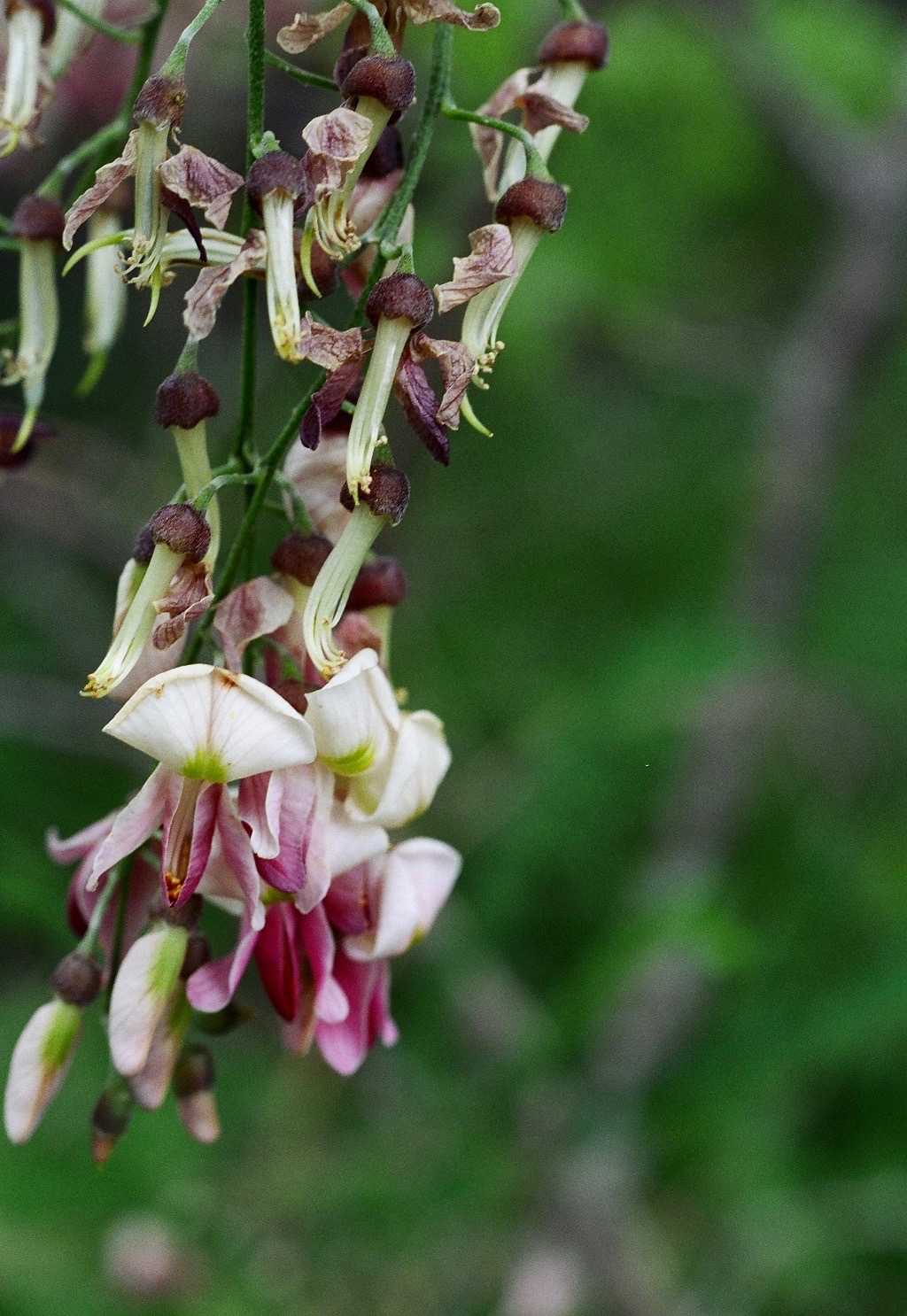
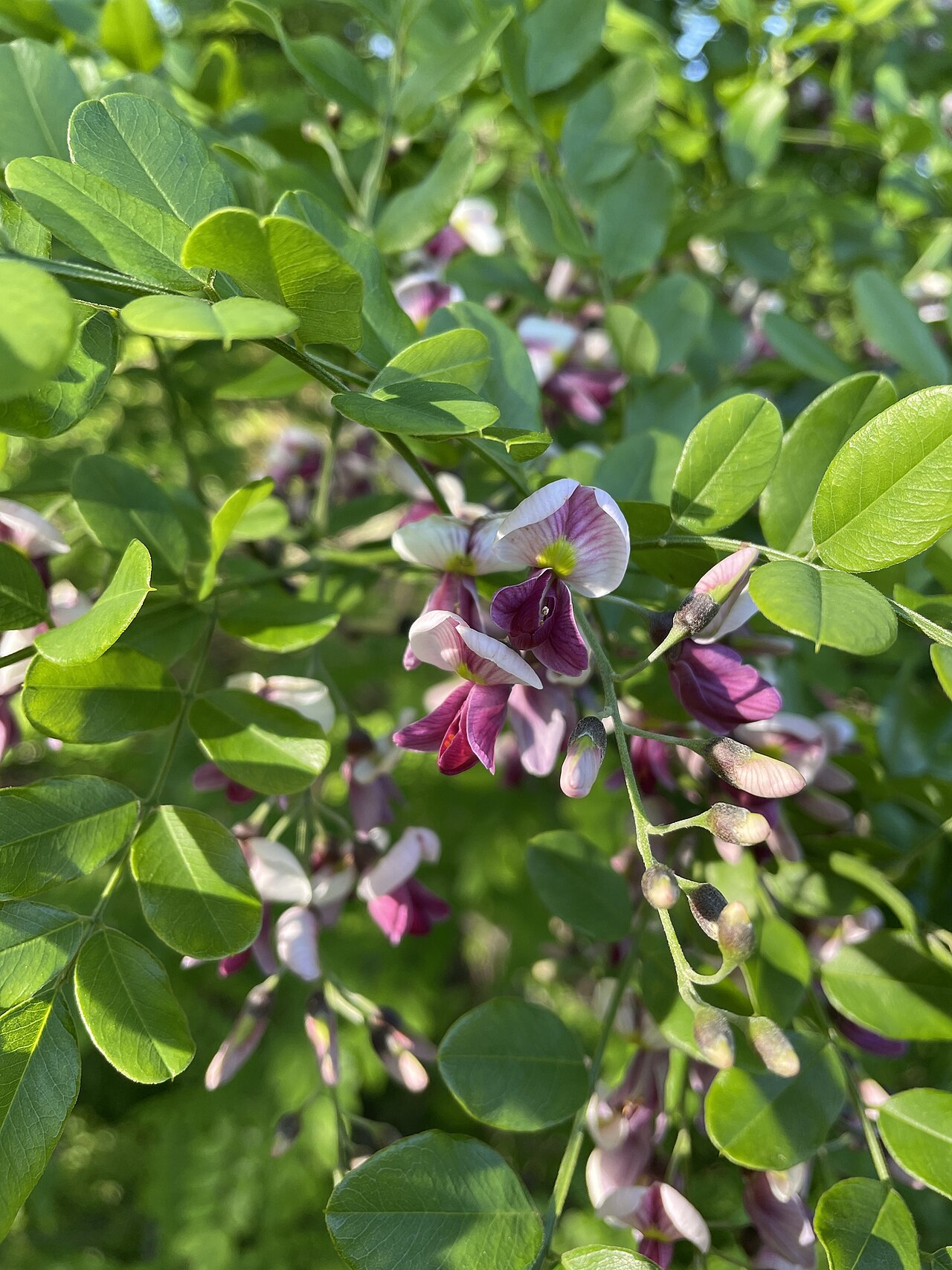
Flowers appear in long, drooping racemes 6 to 10 inches long at the branch tips from April through June, depending on latitude. Individual flowers are pea-shaped, roughly ½ inch long, and range from creamy white to pale pink or maroon-tinged, often with several color variations present within the same raceme. The blossoms are lightly fragrant and attract numerous pollinating insects during their bloom window.
Fruit & Seeds
The defining feature of this species is its fruit: a narrow, leathery seed pod 2 to 8 inches long that is deeply constricted between each seed, giving it a segmented, bead-like or “necklace” appearance. Pods ripen from green to tan or brown in late summer and persist on the bare branches well into winter. The seeds inside these pods are toxic if ingested and should never be eaten; keep fallen pods away from small children and pets, and always wash hands after handling plant material.
Quick Facts
| Scientific Name | Styphnolobium affine (syn. Sophora affinis) |
| Family | Fabaceae (Pea family) |
| Plant Type | Deciduous Small Tree / Large Shrub |
| Mature Height | 15–20 ft |
| Mature Spread | 15–20 ft |
| Growth Rate | Slow to Moderate |
| Sun Exposure | Full Sun to Part Shade |
| Water Needs | Low to Moderate |
| Soil Type | Rocky, well-drained; tolerates limestone |
| Soil pH | 6.5–8.0 (neutral to alkaline) |
| Bloom Time | April – June |
| Flower Color | White to pale pink or maroon |
| Fall Color | Muted yellow-green |
| Fruit | Constricted, bead-like seed pods (toxic seeds) |
| Deer Resistant | Good |
| USDA Hardiness Zones | 6–9 |
Native Range
Eve’s necklace is native to the south-central United States, with its core range centered on central and eastern Texas and extending into southeastern Oklahoma, Arkansas, and Louisiana. Within Texas, it is especially common across the Edwards Plateau, Blackland Prairie, and Cross Timbers regions, where it grows on limestone and other calcareous soils.
It is typically found on rocky hillsides, limestone outcrops, stream terraces, and the edges of oak-juniper woodlands and prairies, often growing as an understory or edge tree alongside other drought-tolerant hardwoods. It tolerates both the thin, alkaline soils of the Hill Country and the heavier clay soils found further east within its range.
Eve’s necklace is sometimes planted as an ornamental well outside this native range, but gardeners east of Louisiana or north of Oklahoma should consider it an introduced landscape tree rather than a native plant in their area.
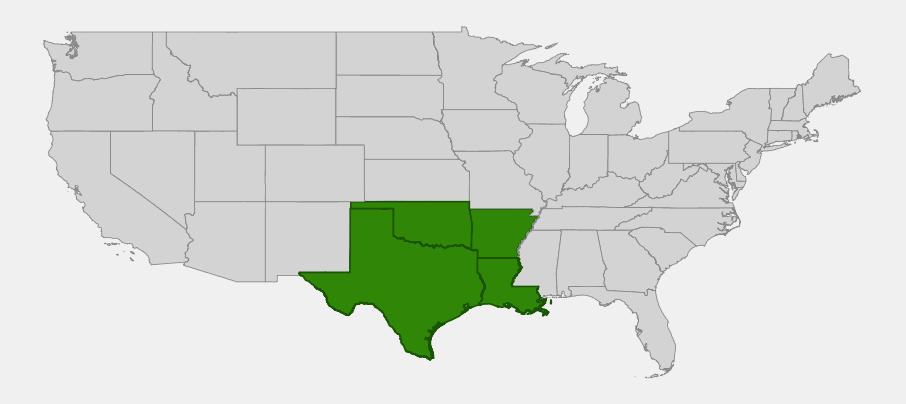
📋 Regional plant lists featuring Eve’s Necklace: Arkansas, Louisiana, Eastern Oklahoma & Eastern Texas
Growing & Care Guide
Eve’s necklace is a forgiving, low-maintenance small tree once established, suited to the heat, alkaline soils, and periodic drought typical of its native range.
Light
Full sun produces the densest flowering and most compact form, though the tree also performs well in part shade, especially as an understory tree beneath taller oaks. In hotter, drier sites, a bit of afternoon shade can reduce summer stress.
Soil & Water
Eve’s necklace thrives in rocky, well-drained, neutral to alkaline soils, including thin limestone soils where few other flowering trees succeed. It is drought-tolerant once established, needing only occasional deep watering during extended dry spells, and it does not tolerate waterlogged or poorly drained sites.
Planting Tips
Plant in fall or late winter to allow roots to establish before summer heat arrives. Because it naturally grows as a multi-trunked, somewhat irregular tree, stake young trees only if needed for the first year or two, and allow the natural arching form to develop rather than forcing a single straight trunk.
Pruning & Maintenance
Prune in late winter to remove dead or crossing branches and to shape young trees if a cleaner silhouette is desired. Mature trees need little upkeep beyond occasional removal of deadwood; avoid heavy pruning, which can reduce the following season’s flower display.
Propagation
Propagate from seed after scarifying the hard seed coat and soaking in water for 24 hours, which improves and speeds germination. Fresh seed sown in fall or stratified seed sown in spring generally germinates reliably. Cuttings are less commonly used and root with variable success.
Landscape Uses
Eve’s necklace brings fine texture and spring fragrance to dry, sunny landscapes:
- Specimen tree for small yards where its arching form can be appreciated
- Xeriscape and rock garden plantings on thin or rocky soils
- Native hedgerows and informal screens
- Pollinator gardens paired with other spring-blooming natives
- Understory planting beneath taller oaks in woodland-edge landscapes
Wildlife & Ecological Value
Eve’s necklace is a valuable, if modestly sized, contributor to the wildlife communities of Texas Hill Country woodlands and prairies.
For Pollinators
The fragrant spring flower racemes attract a wide range of native bees and other pollinating insects during a period when many other woody plants in the region have already finished blooming, making it a useful late-spring nectar source.
For Birds
The dense, twiggy branching provides nesting sites and cover for small songbirds, and the open, light canopy allows understory plants that support additional bird foraging habitat to persist beneath it.
For Mammals
Deer generally avoid browsing Eve’s necklace, likely due to the toxic compounds present throughout the plant, which gives it a practical advantage in landscapes with heavy deer pressure.
Ecosystem Role
As a nitrogen-fixing legume, Eve’s necklace can improve soil fertility in the rocky, often nutrient-poor limestone soils where it grows, and its presence along woodland edges and prairie margins adds structural diversity to these transitional habitats.
Cultural & Historical Uses
Eve’s necklace has a limited history of practical use, largely because the toxicity of its seeds discouraged consumption by Indigenous peoples and early settlers alike. Its most notable cultural association has always been ornamental and descriptive: the necklace-like appearance of its pods, strung with hard seeds like beads, gave rise to its enduring common name.
Historically, the hard seeds themselves have occasionally been strung as decorative beads once thoroughly dried, a craft use documented in Texas folk tradition, though this practice required care given the seeds’ toxicity if accidentally ingested. The wood has seen limited use for small turned items and fence posts, though the tree’s modest size has kept it from commercial timber use.
Today, Eve’s necklace is valued primarily as a durable, low-water ornamental tree for native and drought-tolerant landscaping throughout its range, particularly in the Texas Hill Country where water-wise gardening is increasingly prioritized.
Frequently Asked Questions
Is Eve’s Necklace poisonous?
Yes. The seeds inside the bead-like pods are toxic if ingested, and the plant should be kept away from areas where children or pets might handle or chew on fallen pods. The flowers and foliage are not typically a concern with normal garden contact, but no part of the plant should be eaten.
Why is it called Eve’s Necklace?
The name comes from its distinctive seed pods, which are tightly constricted between each seed, giving the pod a segmented, bead-like appearance reminiscent of a strung necklace.
How fast does Eve’s Necklace grow?
It grows at a slow to moderate rate, typically reaching its mature height of 15 to 20 feet over one to two decades, somewhat faster with consistent water during the first several years after planting.
Can Eve’s Necklace handle alkaline, rocky soil?
Yes — it is naturally adapted to the thin, alkaline limestone soils of the Texas Hill Country and nearby regions, making it an excellent choice where many other flowering trees struggle.
Is Eve’s Necklace deer resistant?
Generally yes. Deer tend to avoid browsing this species, likely due to the toxic compounds present in its tissues, making it a reasonably reliable choice in areas with heavy deer pressure.