Mountain Paper Birch (Betula cordifolia)
Betula cordifolia, known as Mountain Paper Birch or heart-leaved birch, is a medium-sized deciduous tree of cool, high-elevation and northern forests in the Northeast and eastern Canada. For much of the twentieth century it was treated as a variety of the familiar Paper Birch (Betula papyrifera var. cordifolia), and the USDA PLANTS database still lists it that way; most modern floras, including Flora of North America and regional plant atlases, now recognize it as a distinct species based on its heart-shaped leaf bases, hairless young shoots, resin-dotted foliage, and a different chromosome number from true Paper Birch.
Mountain Paper Birch favors the cooler, wetter, higher ground that true Paper Birch tends to leave to it: moist, rocky slopes and open subalpine forest from roughly 2,600 to 6,500 feet in the mountains of New England and New York, descending to lower elevations farther north in the Canadian Maritimes and Quebec. In the southern Appalachians it survives as a rare, disjunct relict on isolated high peaks such as Mount Mitchell and the Black Mountains of North Carolina — cool, high-elevation refuges hundreds of miles south of its main range, left over from colder climatic periods.
Where the two birches grow close together, as in the Adirondacks and northern New England, they tend to sort out by elevation: Mountain Paper Birch mostly above about 2,600 feet, Paper Birch generally below it. The species is a good choice for cold-climate native gardens at higher elevations, offering the same handsome white, peeling bark that makes Paper Birch a landscape favorite, in a tree better suited to mountain and far-northern conditions.
Identification
Mountain Paper Birch is a single- or multi-trunked tree typically reaching 40 to 60 feet (12–18 m) tall, with a trunk up to about 2.5 feet (0.75 m) in diameter at maturity, though trees at high, exposed elevations are often smaller and more wind-shaped. Its overall look is very close to Paper Birch, and the two are most reliably told apart by close inspection of the leaves and twigs rather than by silhouette alone.
Bark
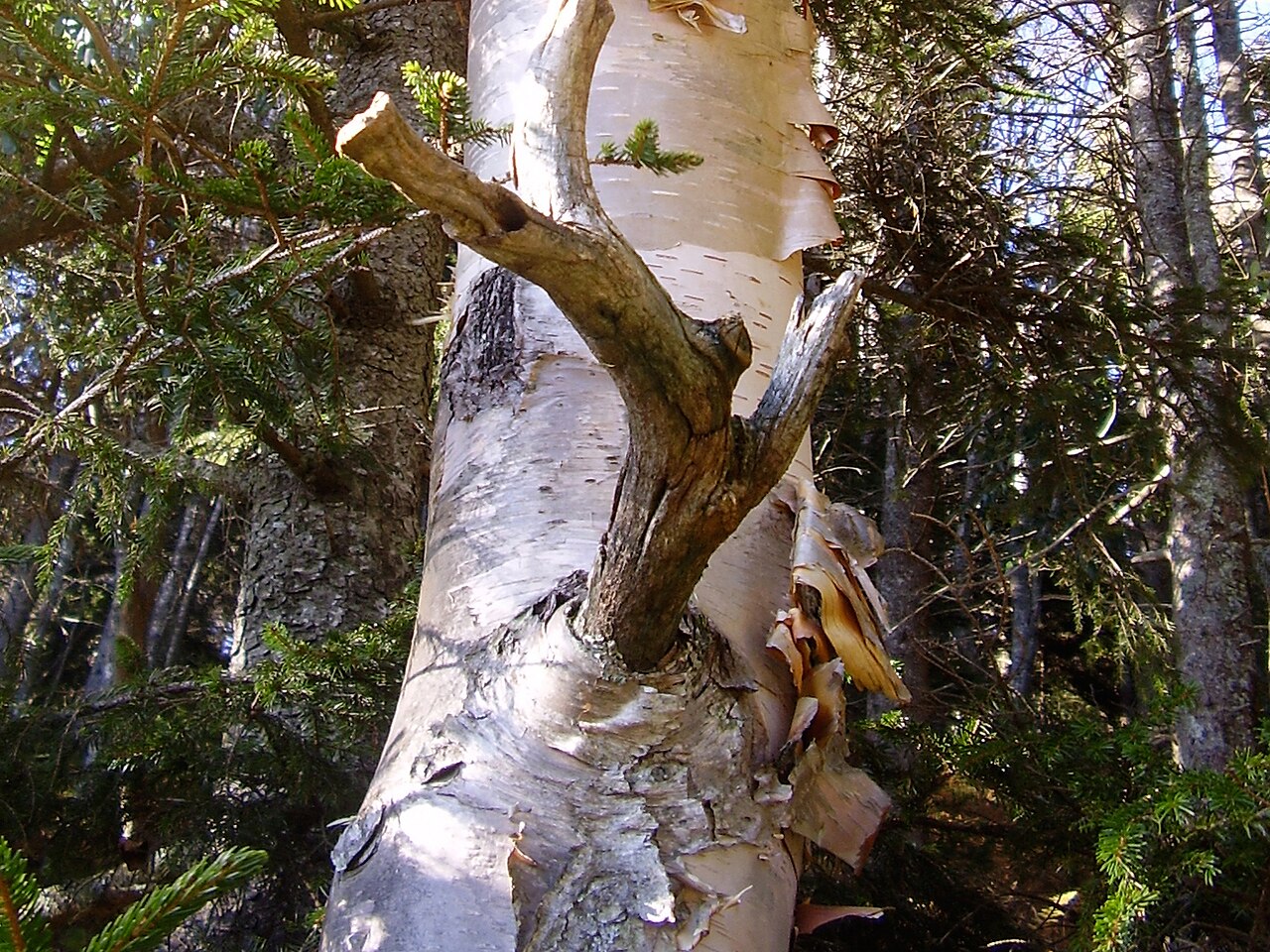
Mature bark is white to bronze-white, smooth, and peels away in thin, papery horizontal layers, exposing copper-colored inner bark beneath. Young bark and twigs are shiny reddish-brown with pale lenticels (small raised pores) and, unlike young Paper Birch twigs, are hairless. The peeling white bark is the tree’s most ornamental feature and its most obvious shared trait with Paper Birch.
Leaves
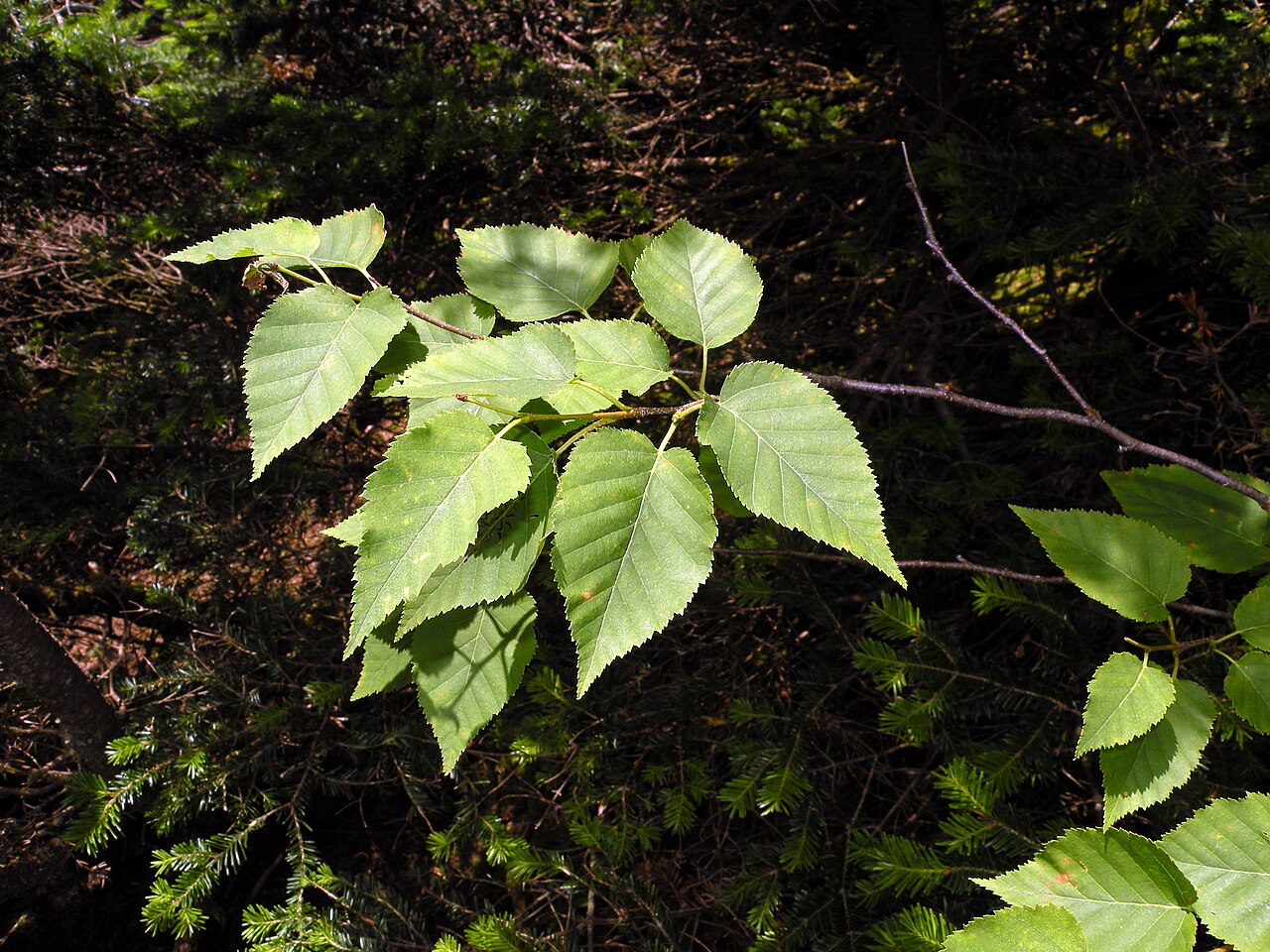
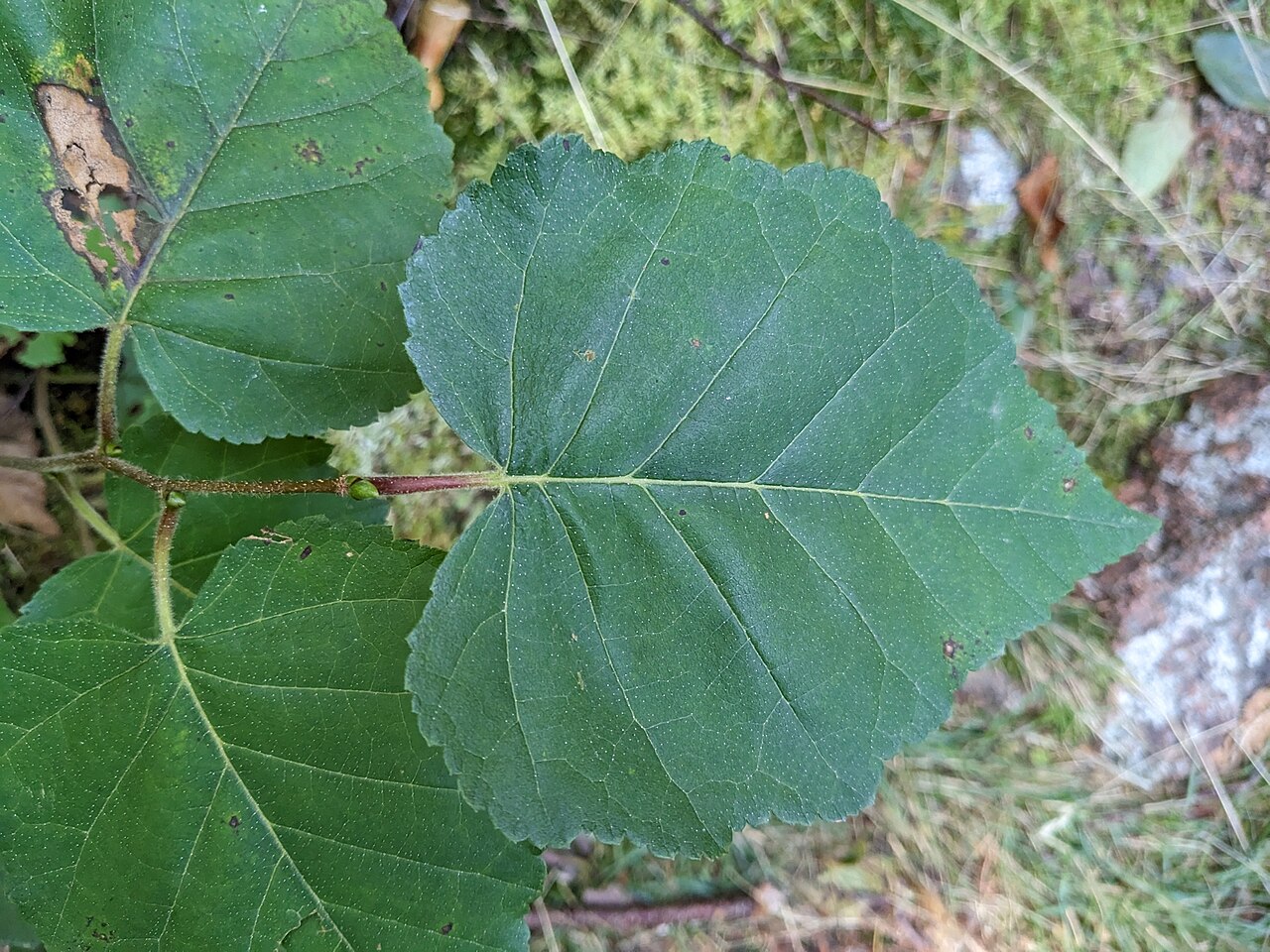
Leaves are alternate, egg-shaped (ovate), 2.5 to 5 inches (6–12 cm) long, with sharply double-toothed margins. The feature that gives the species its name is the leaf base, which is often distinctly heart-shaped (cordate) rather than rounded or tapering — though this trait can vary and is not present on every leaf, so it should be checked across several leaves on a branch rather than judged from one. The leaf surface is dotted with small resin glands, visible as tiny raised specks, especially on the underside. Leaves turn yellow in fall.
Flowers & Fruit
Like other birches, Mountain Paper Birch is wind-pollinated, with slender male catkins forming in fall and opening the following spring, and shorter, more compact female catkins developing on the same branches. After pollination, the female catkins mature over summer into cylindrical, drooping fruiting structures that disintegrate in fall, releasing large numbers of tiny winged seeds (nutlets) that disperse on the wind across snow and open ground.
Quick Facts
| Scientific Name | Betula cordifolia (syn. Betula papyrifera var. cordifolia) |
| Family | Betulaceae (Birch) |
| Plant Type | Deciduous Tree |
| Mature Height | 40–60 ft (12–18 m) |
| Trunk Diameter | Up to 2.5 ft (0.75 m) |
| Growth Rate | Moderate |
| Sun Exposure | Full Sun to Part Shade |
| Water Needs | Moderate; prefers consistently moist soil |
| Soil Type | Moist, rocky or well-drained loam |
| Soil pH | 5.0–6.5 (acidic to slightly acidic) |
| Bloom Time | April – May (catkins; inconspicuous) |
| Flower Color | Greenish-brown (catkins) |
| Fall Color | Yellow |
| Fruit | Small winged nutlets in drooping catkins; not showy |
| Deer Resistant | Moderate (occasionally browsed, not preferred) |
| USDA Hardiness Zones | 2–5 |
Native Range
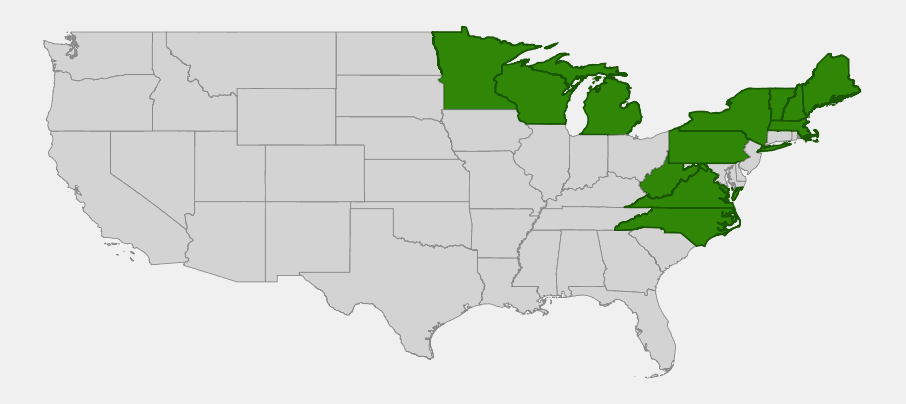
Mountain Paper Birch is native to eastern Canada and the northeastern United States, found in Maine, New Hampshire, and Vermont across much of their higher terrain, in the Adirondacks and Catskill-adjacent uplands of New York, in the mountains of Pennsylvania, in western Massachusetts, around Lake Superior in Michigan, Wisconsin, and the Arrowhead region of far northeastern Minnesota, and disjunctly at high elevation in the Appalachians of Virginia, West Virginia, and North Carolina.
It grows at roughly 2,600 to 6,500 feet (800–2,000 m) in the mountains of its core New England and New York range, on moist, rocky slopes and in rich, open subalpine forest, often near treeline. Farther north in the Canadian Maritimes and Quebec it descends to much lower elevations, including near sea level along the Gulf of St. Lawrence. The southern Appalachian populations in Virginia, West Virginia, and North Carolina are rare, isolated relicts confined to the highest peaks, such as Mount Mitchell and the Black Mountains, where cool, moist, high-elevation conditions mimic the climate of its main range far to the north.
Mountain Paper Birch is easily confused with the much more widespread Paper Birch (Betula papyrifera), which overlaps it through most of this range but tends to grow at lower elevations and extends far beyond it across the northern U.S. and Canada. In the Minnesota Arrowhead and the Adirondacks, the two species occupy noticeably different elevation bands rather than mixing freely.
📋 Regional plant lists featuring Mountain Paper Birch: New Hampshire, Maine & Vermont · Connecticut, Massachusetts & Rhode Island · New York, Pennsylvania & Northern New Jersey · Michigan, Wisconsin & Eastern Minnesota · Maryland, Virginia & West Virginia · North Carolina & South Carolina
Growing & Care Guide
Mountain Paper Birch asks for the same cool, consistently moist growing conditions it finds on its native slopes. It is best suited to cold-winter gardens, particularly those at higher elevation or in the northern part of its range, and struggles where summers are hot and humid.
Light
Full sun to part shade suits this tree well. In its native subalpine habitat it often grows in fairly open stands with abundant light; in warmer, lower-elevation gardens, light afternoon shade can help reduce summer heat stress on the shallow root system typical of birches.
Soil & Water
Give it moist, well-drained, acidic to slightly acidic soil — rocky or loamy ground that mimics its mountain habitat works well. Like other birches, it has a shallow, fibrous root system and does not tolerate prolonged drought; consistent soil moisture, especially during establishment and in hot weather, is important. Avoid heavy clay that stays waterlogged, which promotes root rot.
Planting Tips
Plant in fall or early spring in a site with reliably cool, moist soil; a north-facing slope or a spot with some afternoon shade helps in warmer parts of its range. Mulch generously to keep roots cool and moist, since birches are notably sensitive to soil heating and drying around the root zone. This species is best reserved for gardens at higher elevation or in genuinely cold-winter climates — it is not a good choice for warm, humid, or low-elevation sites even within its general native states.
Pruning & Maintenance
Prune only in mid-summer or fall; birches “bleed” sap heavily if cut in late winter or early spring. Remove dead, damaged, or crossing branches as needed. Watch for the same pests that trouble Paper Birch, including bronze birch borer, which is most likely to attack stressed trees — keeping the tree cool, moist, and unstressed is the best defense.
Landscape Uses
Mountain Paper Birch brings northern character and its handsome peeling bark to cold-climate landscapes:
- Specimen tree for the ornamental white bark, especially in winter
- Naturalized woodland plantings in cold, moist, rocky sites
- High-elevation and mountain gardens where Paper Birch may struggle with summer heat
- Restoration plantings on disturbed subalpine or northern forest sites
- Wildlife plantings supporting birds and small mammals that use birch seed and browse
Wildlife & Ecological Value
Mountain Paper Birch functions much like its lowland relative Paper Birch as a valuable, if less widespread, food and habitat resource in the cold northern and high-elevation forests where it grows.
For Birds
Seeds released from the catkins in fall and winter are eaten by finches, chickadees, and other seed-eating songbirds, which also use birch twigs and bark for foraging insects. Cavity-nesting birds and woodpeckers use mature and dead birch trunks for nest sites and foraging.
For Mammals
White-tailed Deer and Moose browse young shoots and twigs, especially in winter when other forage is scarce, and Snowshoe Hare feed on seedlings and low branches. Red Squirrels and other small mammals eat the seeds. Beavers will fell birches near water for food and dam material where the species grows along streams and lake edges.
Ecosystem Role
As a relatively short-lived, fast-colonizing tree, Mountain Paper Birch helps stabilize disturbed, rocky, or recently cleared ground at higher elevations, often moving in after fire, windthrow, or logging alongside conifers such as Balsam Fir and Red Spruce. Its isolated southern Appalachian populations are considered climate relicts of conservation interest, persisting as small, vulnerable outposts far from the species’ main northern range.
Cultural & Historical Uses
Like Paper Birch, Mountain Paper Birch’s thin, waterproof, peeling bark has a long history of practical use among Indigenous peoples of the Northeast and eastern Canada, including for canoe skins, baskets, and temporary shelter covering, wherever it grew alongside or in place of true Paper Birch. Because the two species were not formally distinguished until relatively recently, most historical ethnobotanical records refer simply to “paper birch” or “white birch” without separating which species was used in a given location.
Botanically, Mountain Paper Birch has a notable history of taxonomic back-and-forth: described and redescribed through the twentieth century, it spent decades classified as a variety of Paper Birch before accumulating enough evidence — including leaf shape, bark and twig differences, and a distinct chromosome count — to be widely recognized as its own species. The USDA PLANTS database has not yet updated to reflect this and continues to list it as Betula papyrifera var. cordifolia.
Today the tree is mostly of interest to foresters, ecologists, and native-plant gardeners in cold, high-elevation parts of the Northeast, valued for its cold hardiness and ornamental bark rather than for any distinct commercial use.
Frequently Asked Questions
Is Mountain Paper Birch the same as Paper Birch?
They are closely related but now generally treated as separate species. Mountain Paper Birch has heart-shaped leaf bases, hairless young twigs, and resin-dotted leaves, and grows at higher elevations in a more restricted eastern range; Paper Birch is more widespread, usually grows at lower elevations, and has hairy young twigs. The two can overlap and are sometimes difficult to distinguish without close inspection.
Why does the USDA list it as a variety instead of a species?
The USDA PLANTS database follows an older taxonomic treatment that classified Mountain Paper Birch as Betula papyrifera var. cordifolia. Flora of North America and most current regional floras now recognize it as the distinct species Betula cordifolia based on consistent morphological and chromosomal differences.
Why is it found so far south in North Carolina?
The North Carolina populations, found only at the highest elevations of the Black Mountains including Mount Mitchell, are disjunct relicts — isolated remnants left behind as climate warmed after the last ice age. The cool, moist, high-elevation conditions there mimic the climate of the species’ main range far to the north, allowing small populations to persist in isolation.
Can I grow Mountain Paper Birch outside its native range?
It can succeed in other cold-winter climates with cool, moist conditions, but it performs poorly in hot, humid, or low-elevation sites, even within states where it is otherwise native. Gardeners outside its elevation and climate comfort zone are usually better served by true Paper Birch or another regionally appropriate species.
How do I tell the heart-shaped leaf base on this tree?
Look at where the leaf blade meets the stalk (petiole): on many Mountain Paper Birch leaves, the base curves inward on both sides before meeting the stalk, like the top of a heart, rather than rounding evenly or tapering to a point. This trait is variable, so check several leaves on healthy, undamaged branches rather than judging from a single leaf.

Looking for a nursery that carries Mountain Paper Birch?
Browse our native plant nursery directory: Maine, Massachusetts & Michigan/Minnesota · New Hampshire, New York & North Carolina · Vermont, Pennsylvania & Virginia · Wisconsin & West Virginia