
Mountain Pink Currant (Ribes nevadense)
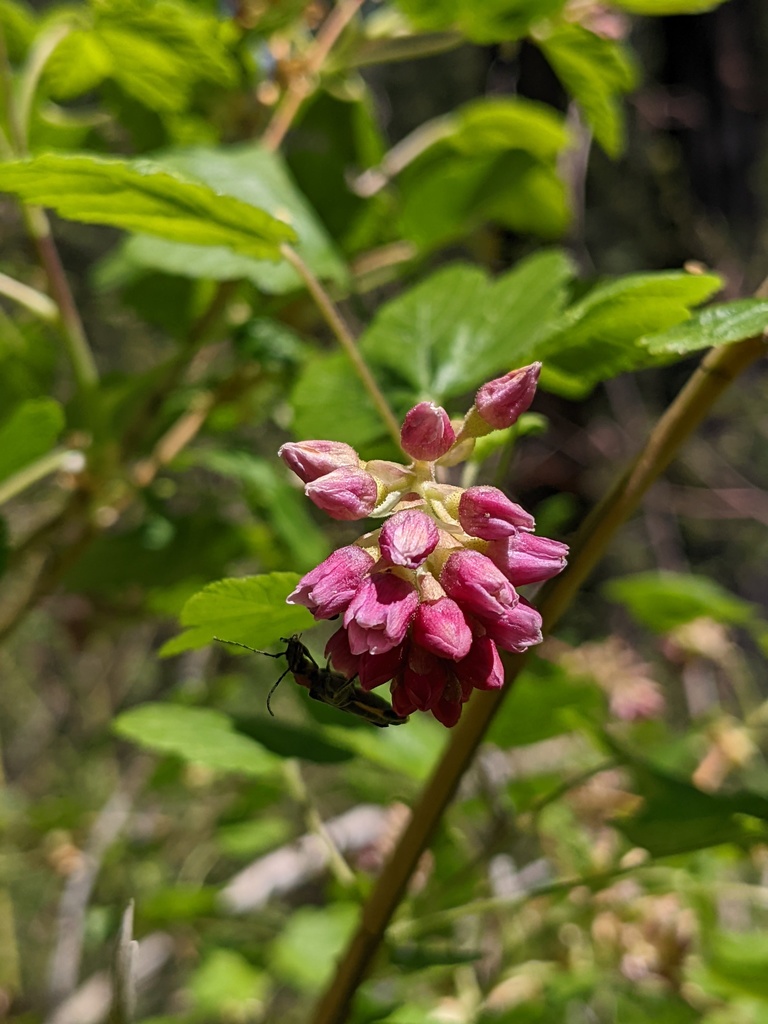
Ribes nevadense, known as Mountain Pink Currant and listed by USDA PLANTS as Sierra currant, is a deciduous, thornless shrub of moist mountain forests in California, western Nevada and southwestern Oregon. In late spring and early summer it hangs short, drooping clusters of rose-pink flowers among soft, maple-like leaves, and by late summer it bears blue-black berries dusted with a pale, waxy bloom. It belongs to the currant and gooseberry family (Grossulariaceae).
It is a plant of streambanks, wet meadow edges and openings in conifer forest, from the foothills to high in the Sierra Nevada and the mountains of Southern California. Hummingbirds visit the flowers heavily, and birds and mammals eat the fruit, making it one of the most valuable wildlife shrubs in its habitat.
In gardens it is a graceful, open shrub for moist, partly shaded spots in mountain and foothill landscapes, similar in effect to its better-known relative, red-flowering currant, but adapted to colder winters. Gardeners in areas with five-needle pines should know that all currants can host white pine blister rust; that is discussed below.
Identification
Look in moist mountain woods for a spineless shrub with three- to five-lobed, maple-like leaves, hanging clusters of small pink bell-shaped flowers in spring, and blue-black, whitish-dusted berries in summer.
Growth Habit
Mountain pink currant is an upright to spreading deciduous shrub, usually 3 to 6 feet tall and about as wide, with several arching stems from the base. The stems have no spines or prickles. Young twigs are finely hairy and often glandular; older bark is gray to reddish-brown and becomes shreddy.
Leaves
The leaves are alternate, roughly round in outline, about 1 to 3 inches across, and palmately divided into three to five shallow, rounded lobes with toothed edges, much like a small maple leaf. They are thin, bright to medium green, and finely hairy and sometimes slightly glandular, especially underneath. In fall they turn yellow before dropping.
Flowers
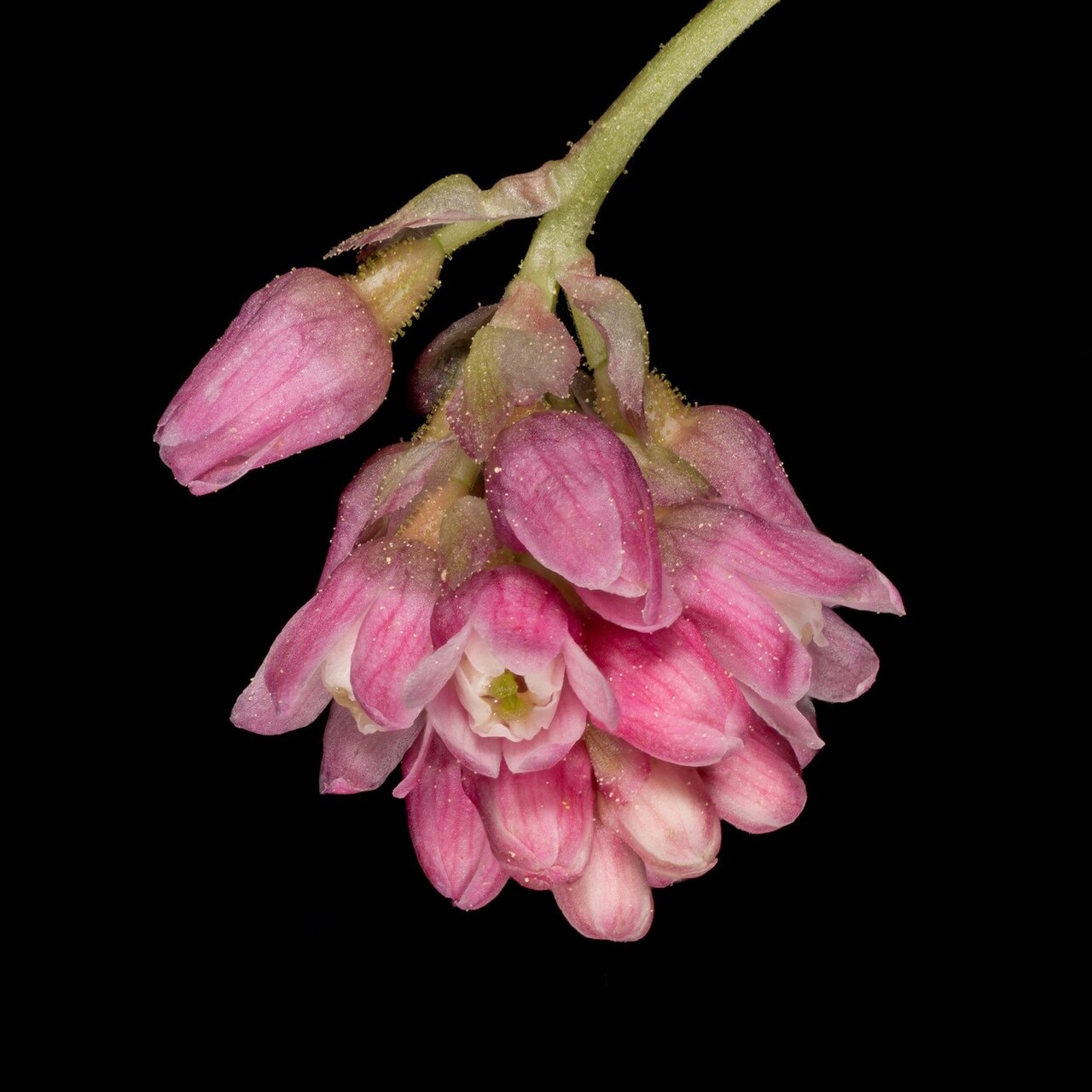
The flowers open from about April to July, depending on elevation. They hang in short, drooping clusters (racemes) of about 8 to 20 flowers from the leaf axils. Each flower is about 1/4 to 3/8 inch long, with a short, bell-shaped tube and five spreading pink to rose-red sepals surrounding five smaller white petals. The flowers are lightly fragrant.
Fruit
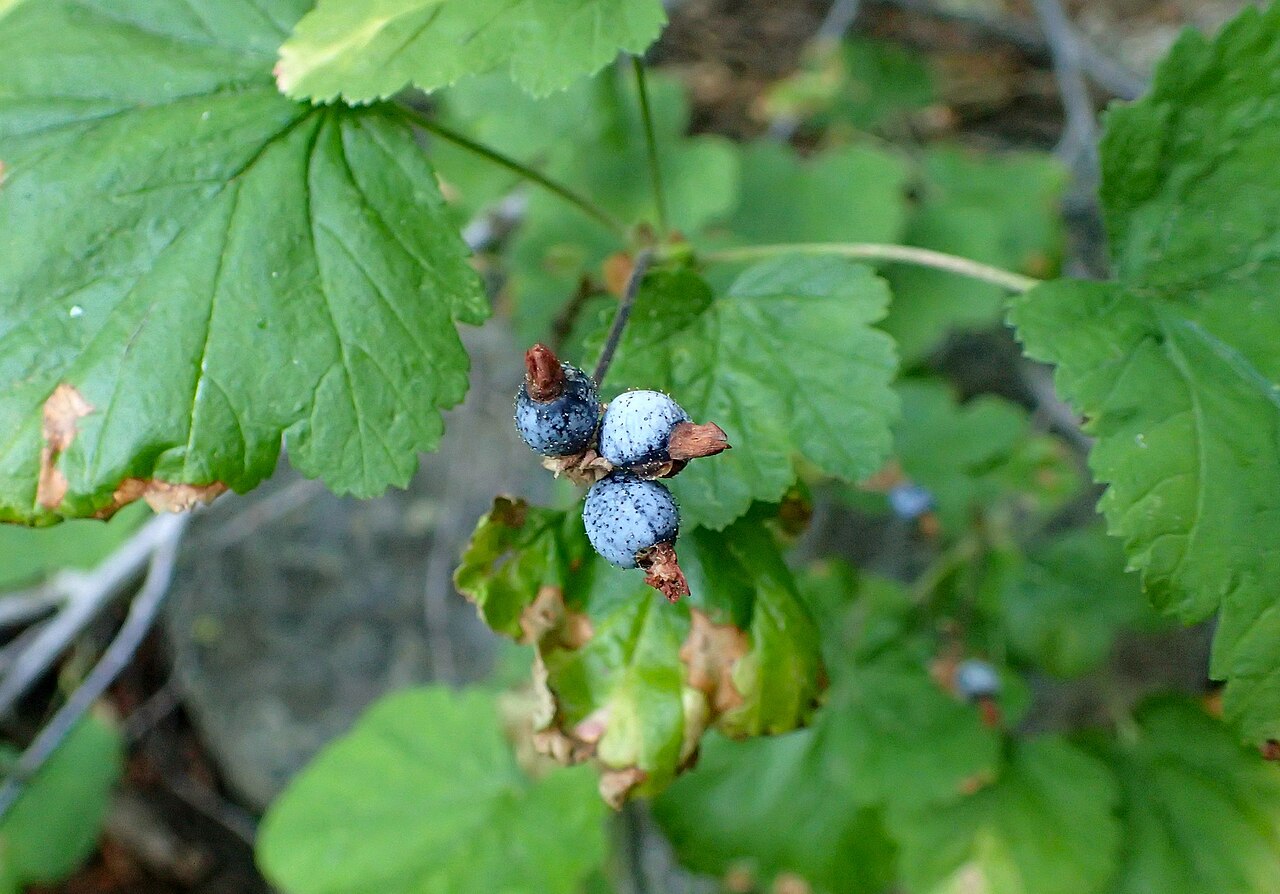
The berries are round, about 1/4 to 3/8 inch across, blue-black and covered with a whitish, waxy bloom, sometimes with a few glandular hairs. They ripen from mid to late summer. They are edible but bland to bitter, and are much more valued by birds than by people.
Look-alikes
Red-flowering currant (Ribes sanguineum) is very similar, with longer, showier flower clusters; it grows mostly at lower elevations near the coast and in the Coast Ranges, while mountain pink currant replaces it in the Sierra Nevada and higher mountains. Wax currant (R. cereum) has smaller, sticky leaves, white to pale pink tubular flowers and red berries, and grows on drier, rocky slopes. Gooseberries have spines at the nodes.
Quick Facts
| Scientific Name | Ribes nevadense |
| Family | Grossulariaceae (currant and gooseberry family) |
| Plant Type | Deciduous shrub |
| Mature Height | 3–6 ft |
| Mature Spread | 3–6 ft |
| Growth Rate | Moderate |
| Sun Exposure | Part shade to full sun |
| Water Needs | Medium to high; moist soil |
| Soil Type | Moist, well-drained loam or gravelly soil with organic matter |
| Soil pH | Slightly acidic to neutral (about 5.5–7.0) |
| Bloom Time | April–July (varies with elevation) |
| Flower Color | Rose-pink to red with white petals |
| Fall Color | Yellow |
| Fruit | Blue-black berries with whitish bloom |
| Deer Resistant | Moderate; sometimes browsed |
| USDA Hardiness Zones | 5–9 |
Native Range
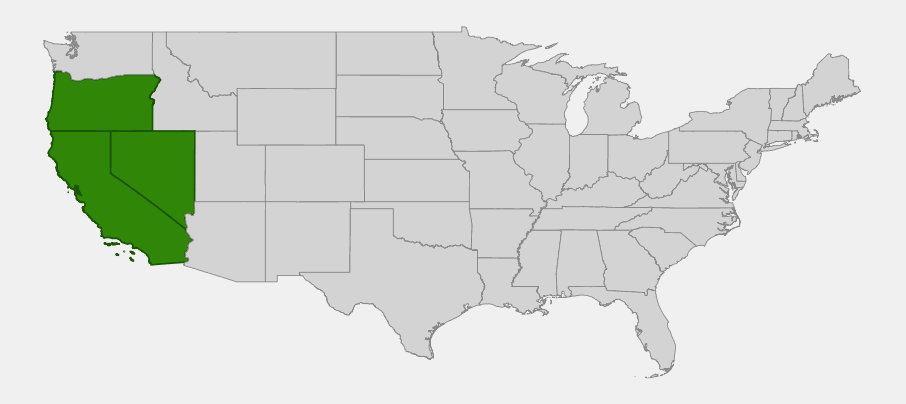
Mountain pink currant is native to the far western United States. USDA PLANTS records it from California, Nevada and Oregon. Most of its range is in California, where it grows throughout the Sierra Nevada, the southern Cascades around Mount Shasta and Lassen, the Klamath and North Coast ranges, the Tehachapi Mountains, and the Transverse and Peninsular ranges of Southern California, including the San Gabriel, San Bernardino and San Jacinto mountains and the mountains of San Diego County.
In Nevada it grows on the eastern slope of the Sierra Nevada and in the Carson Range around Lake Tahoe. In Oregon it is found mainly in the southwest: the Siskiyou Mountains of Josephine and Jackson counties, around Mount Ashland and in the southern Cascades. These Oregon sites are on the western, Siskiyou and Cascade side rather than in the dry interior east of the Cascades.
It grows from about 3,000 to 10,000 feet in moist places: along streams and seeps, on the edges of meadows, in aspen groves and in openings and understories of mixed conifer, red fir and pine forests.
📋 Regional plant lists featuring Mountain Pink Currant: Western Oregon & Western Washington · California & Nevada
Growing & Care Guide
Mountain pink currant is a good choice for gardens in or near the western mountains, where it handles cold winters and grows well in moist, partly shaded spots. It is offered by some California native plant nurseries; buy nursery-grown plants rather than digging wild ones.
Light
Part shade to full sun. In mountain gardens and cool coastal climates it takes full sun if the soil stays moist. In hot inland valleys give it afternoon shade or dappled light under taller trees.
Soil & Water
Plant in moist, well-drained loam or gravelly soil enriched with leaf litter. It is a streamside and meadow-edge plant, so it needs regular water through summer in lowland gardens, unlike many drought-tolerant California shrubs. Avoid waterlogged, airless clay.
Planting Tips
Plant in fall in mild climates or in spring at higher elevations. Space plants 4 to 6 feet apart for an informal hedge or thicket, or use one as a specimen near a water feature. A mulch of leaf litter or bark keeps roots cool and moist.
Pruning & Maintenance
Prune lightly right after flowering if needed, removing a few of the oldest stems at the base every few years to keep the shrub open and vigorous. Plants may drop leaves early in hot, dry summers; this is a sign they need more water or shade.
Propagation
Grow it from seed cleaned from ripe berries and given about 3 months of cold, moist stratification, or from hardwood cuttings taken in late fall and winter. Semi-hardwood cuttings in early summer also root fairly easily.
Landscape Uses
- Hummingbird gardens: early-season nectar in mountain and foothill gardens
- Streamside and rain gardens: suits moist banks and the edges of swales
- Woodland edges: a soft, open shrub under pines and firs
- Wildlife hedgerows: flowers for pollinators and berries for birds
- Habitat restoration: riparian and meadow-edge plantings in the Sierra and Southern California mountains
Wildlife & Ecological Value
Mountain pink currant feeds wildlife from spring to late summer and is an important shrub in moist mountain habitats.
For Pollinators
Its flowers bloom just as hummingbirds arrive in the mountains, and Anna’s, rufous, calliope and black-chinned hummingbirds all visit currants. Bumble bees and other native bees also gather nectar and pollen. Currants are host plants for several moths and for some butterflies, such as the zephyr anglewing, in western mountains.
For Birds
Robins, thrushes, grosbeaks, tanagers, jays and other birds eat the berries in summer. Its arching stems give cover and nesting sites near streams and meadows.
For Mammals
Chipmunks, ground squirrels, black bears and foxes eat the fruit. Deer browse the leaves and young twigs at times.
Ecosystem Role
Along streams it helps stabilize banks and shade the water. Currants are also the alternate host of white pine blister rust (Cronartium ribicola), an introduced fungus that kills five-needle pines such as sugar pine, western white pine and whitebark pine. The rust must spend part of its life cycle on currant leaves before it can infect pines. In the 20th century, foresters tried to control the disease by pulling out wild currants, a program that was eventually abandoned. Today, rust-resistant pine breeding is the main approach, but planting currants right next to valuable white pines is still best avoided.
Cultural & Historical Uses
The species name nevadense refers to the Sierra Nevada, where it is common; it does not mean the plant is limited to the state of Nevada. The USDA common name, Sierra currant, makes the same point.
California Native Americans gathered many kinds of currants and gooseberries for fresh fruit. Mountain pink currant’s berries are edible but not very tasty, and are best left to wildlife.
Some states, mainly in the Northeast, have regulated or restricted the planting of certain Ribes because of white pine blister rust. Check local rules if you live near commercial or high-value white pine forests.
Frequently Asked Questions
Is mountain pink currant the same as Sierra currant?
Yes. USDA PLANTS calls Ribes nevadense Sierra currant. Mountain pink currant is another common name for the same shrub.
Are mountain pink currant berries edible?
Yes, but they are bland to bitter. They are much more popular with birds, chipmunks and bears than with people.
Does mountain pink currant attract hummingbirds?
Yes. Its pink flowers open in spring just as hummingbirds return to the mountains, and they are a favorite nectar source.
Can currants harm pine trees?
Currants are the alternate host of white pine blister rust, which damages five-needle pines. Avoid planting currants close to sugar pine, western white pine or whitebark pine you want to protect.
How is it different from red-flowering currant?
Red-flowering currant usually has longer, showier flower clusters and grows mainly at lower elevations near the coast. Mountain pink currant grows in the Sierra Nevada and other high mountains and tolerates colder winters.

Looking for a nursery that carries Mountain Pink Currant?
Browse our native plant nursery directory: California · Nevada · Oregon

