Mueller Oak (Quercus cornelius-mulleri)
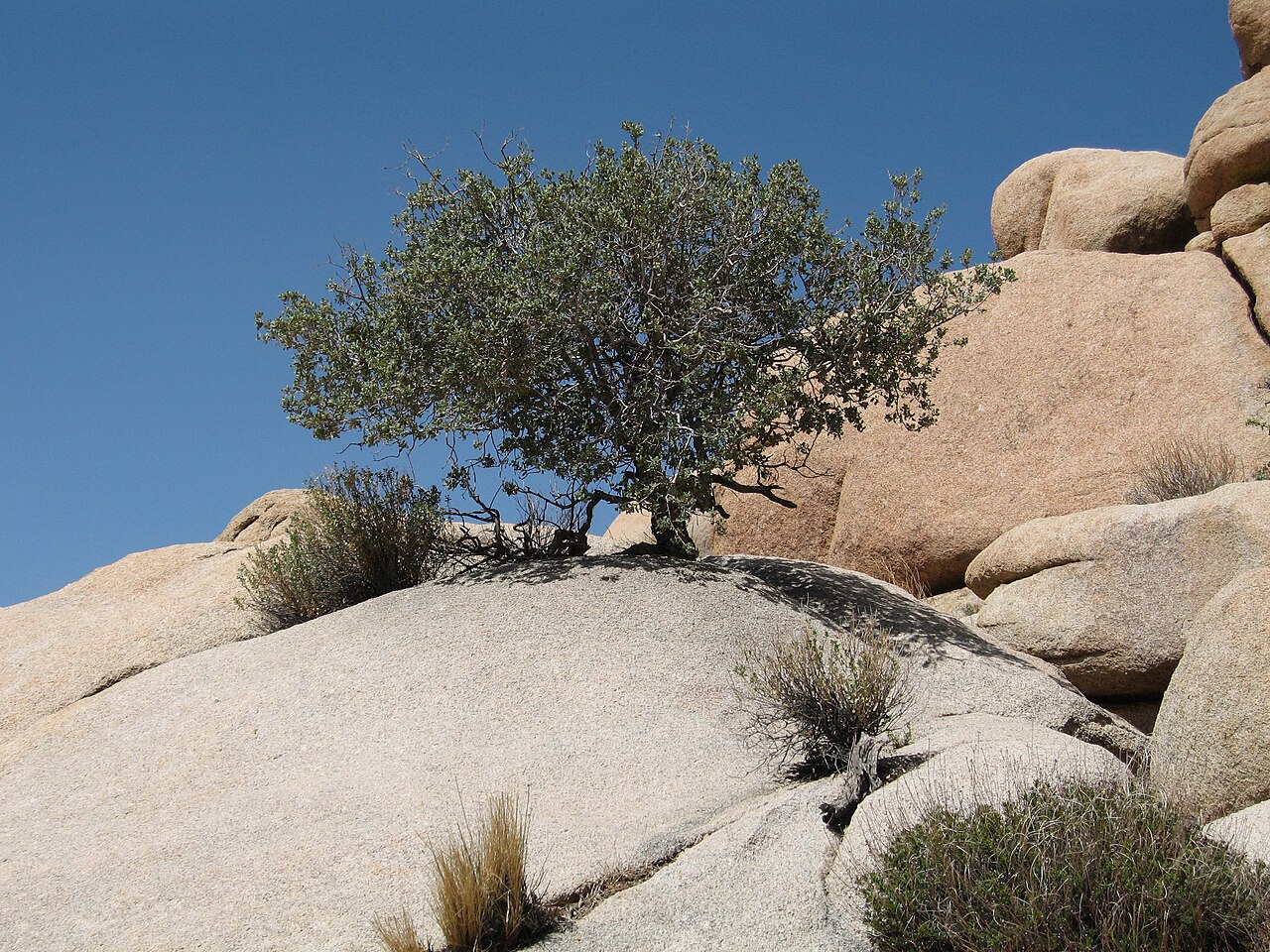
Quercus cornelius-mulleri, commonly known as Mueller Oak (also spelled Muller Oak), is a tough, desert-edge scrub oak of Southern California’s dry foothills and mountain washes, where chaparral gives way to the Mojave and Colorado deserts. A member of the Fagaceae (beech family), it was only recognized as its own species in 1981, after botanists determined that plants long lumped into the broader Quercus dumosa complex actually represented a distinct desert-adapted taxon — named in honor of ecologist Cornelius Herman Muller, who spent decades studying California’s oaks.
Visually, Mueller Oak is easy to pick out once you know what to look for: its leaves are strikingly bicolored, dull blue-green above and densely pale-woolly beneath, and its acorns are unusually large for a shrub oak, sitting in deep, warty cups. It is one of the most drought- and heat-tolerant native oaks in California, routinely found rooted directly in cracks of exposed granite boulders — exactly the setting that makes it such a signature plant of places like Joshua Tree National Park.
Because it thrives in conditions that would kill most other oaks, Mueller Oak is an excellent, nearly indestructible choice for xeriscape and desert-edge native gardens in Southern California, provided it has the sharp drainage its granite and decomposed-granite habitat tells you it needs.
Identification
Mueller Oak grows as a dense, rounded, evergreen shrub, usually 3 to 10 feet (1–3 m) tall, occasionally reaching small-tree stature in favorable sites, but most often forming a compact, many-branched mound anchored in rocky, well-drained ground.
Bark & Stems
Young twigs are slender and covered in fine grayish hairs; older bark is gray to grayish-brown and smooth to finely scaly. Branching is dense and intricate, giving mature shrubs a tight, wind- and browse-resistant structure well suited to exposed desert-margin sites.
Leaves
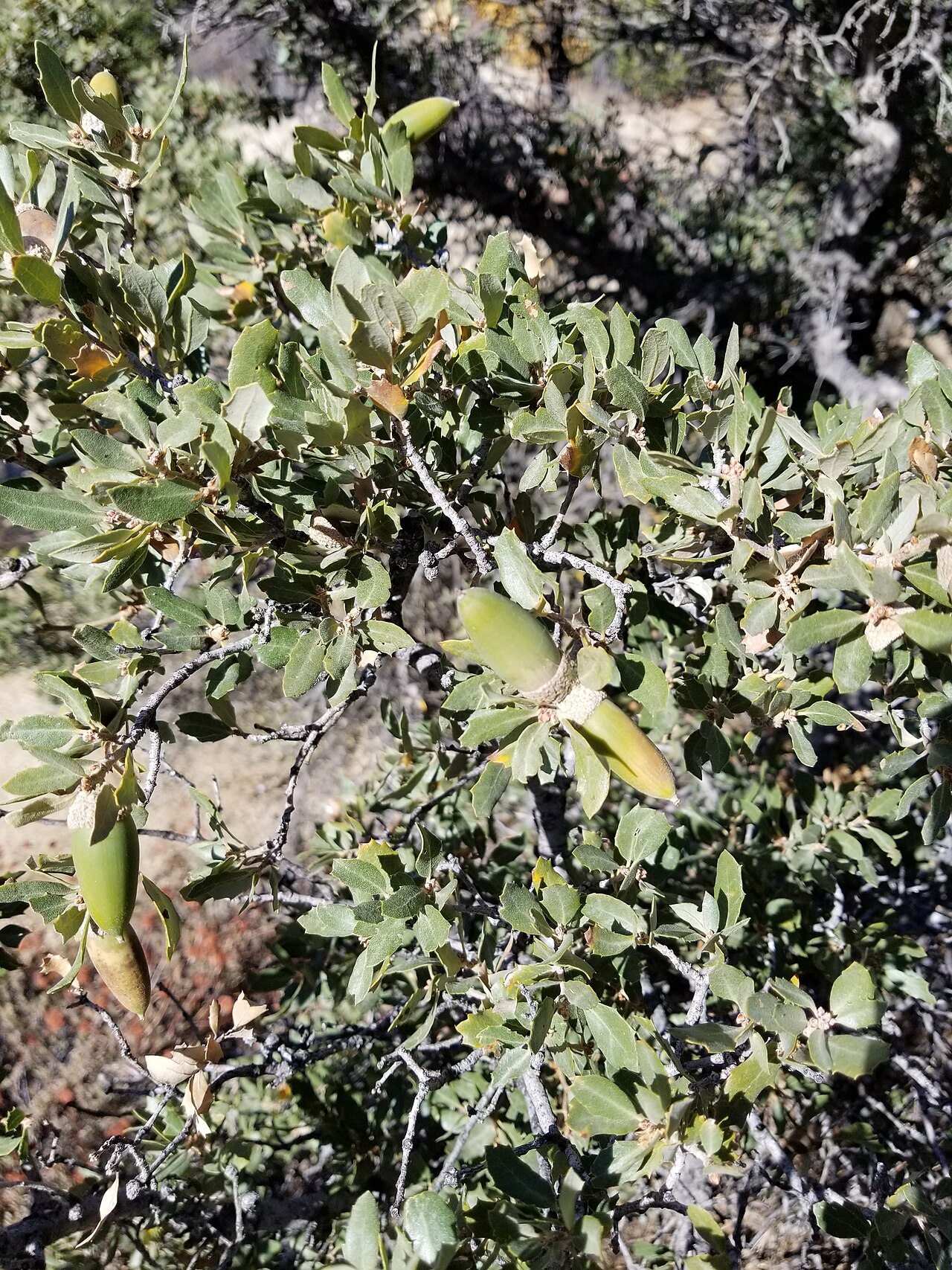
Leaves are evergreen, alternate, oval to elliptic, ¾ to 1½ inches (2–4 cm) long, with spine-tipped teeth along the margins in the holly-leaved scrub oak tradition. The most distinctive identification feature is the strong bicoloration: the upper surface is a dull, grayish blue-green, while the underside is densely covered in short, pale, felt-like hairs (tomentose), giving a two-toned look that is more pronounced than in most other California scrub oaks.
Flowers
Mueller Oak is monoecious, with separate male and female flowers on the same plant, blooming in spring as new growth emerges. Male flowers hang in slender, pale yellow-green catkins; female flowers are tiny and inconspicuous, located near the branch tips.
Fruit & Seeds
Acorns are notably large for a shrub oak, ¾ to 1¼ inches long, broadly oval, and seated in a deep, thick cup covered in distinctive warty, knobby scales — one of the most reliable ways to separate this species from similar-looking scrub oaks nearby. Acorns mature in a single season and are an important, calorie-dense food source in the desert-chaparral ecotone.
Quick Facts
| Scientific Name | Quercus cornelius-mulleri |
| Family | Fagaceae (Beech) |
| Plant Type | Evergreen Shrub |
| Mature Height | 3–10 ft |
| Mature Spread | 6–12 ft |
| Growth Rate | Slow |
| Sun Exposure | Full Sun |
| Water Needs | Very Low (once established) |
| Soil Type | Granitic, rocky, or decomposed granite; sharply drained |
| Soil pH | 6.0–7.5 |
| Bloom Time | March – April |
| Flower Color | Pale yellow-green catkins |
| Fall Color | Evergreen (no fall color change) |
| Fruit | Large acorns, single-season, deep warty cups |
| Deer Resistant | Mostly (spiny leaves discourage browsing) |
| USDA Hardiness Zones | 8–10 |
Native Range
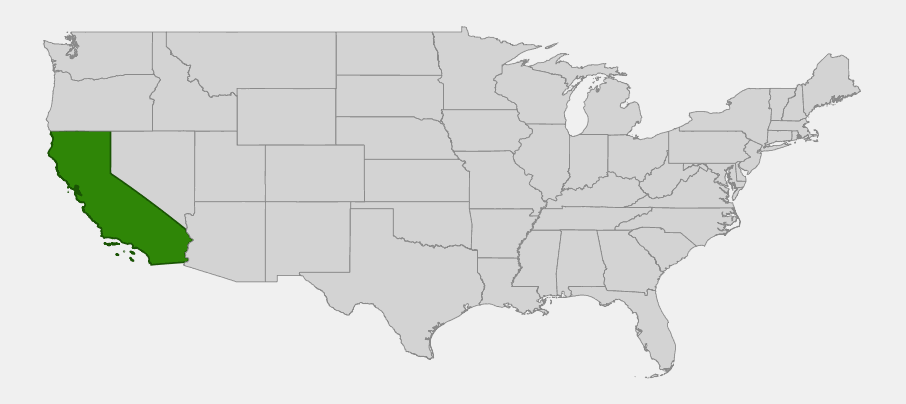
Mueller Oak is native to Southern California, concentrated in the dry foothills and mountain washes along the western margins of the Mojave and Colorado deserts in San Bernardino, Riverside, and San Diego counties, with its range extending south into northern Baja California, Mexico. It is especially well known from Joshua Tree National Park, where it is a conspicuous component of the park’s pinyon-juniper and desert chaparral vegetation.
Within this range it grows on dry slopes, rocky washes, and alluvial fans, typically on granitic or decomposed granite soils, at elevations from roughly 2,000 to 6,000 feet — the transition zone where coastal-influenced chaparral meets true desert. It associates with desert scrub oak relatives, pinyon pine, California juniper, and various high-desert chaparral shrubs, often rooting directly in cracks and pockets among exposed granite boulders where little soil appears to exist at all.
Mueller Oak is notable for hybridizing with other scrub oaks where their ranges overlap, which can make field identification tricky at range margins; the large, warty-capped acorns and strongly bicolored, felted-underside leaves remain the most reliable distinguishing features.
📋 Regional plant list featuring Mueller Oak: California & Nevada
Growing & Care Guide
Mueller Oak is about as low-maintenance as a native shrub gets, provided it is given the sharp drainage and minimal water its granite-boulder habitat demands. It is poorly suited to rich garden soil or regular irrigation.
Light
Requires full sun. This is a plant of open, exposed desert-chaparral slopes and performs poorly in shade or dense plantings.
Soil & Water
Needs sharply drained, rocky, or decomposed-granite soil; it is intolerant of heavy clay, poor drainage, or summer irrigation once established, both of which invite root rot. It is among the most drought-tolerant native oaks in California and, after an establishment period, should need no supplemental water in a typical Southern California climate.
Planting Tips
Plant container stock in fall to take advantage of the cool, wet winter months for root establishment. Choose the sunniest, best-drained spot available — a rocky slope or raised bed mimics its native granite habitat well. Water deeply but infrequently through the first one to two summers, then reduce watering sharply as the plant matures.
Pruning & Maintenance
Little pruning is needed beyond removing dead wood. The naturally dense, rounded form requires minimal shaping, and because growth is slow, heavy pruning should be avoided — the plant recovers gradually.
Landscape Uses
Mueller Oak is an excellent fit for dry, rocky Southern California landscapes:
- Xeriscape and desert-edge native gardens
- Rock garden or boulder planting — thrives rooted directly among stones
- Wildlife hedge or informal screen in low-water landscapes
- Habitat restoration in desert-chaparral transition zones
- Fire-conscious, low-maintenance foundation planting
Wildlife & Ecological Value
In the demanding desert-chaparral transition zone, Mueller Oak provides food and structural cover that few other woody plants can match.
For Birds
Scrub-jays, acorn woodpeckers, and other desert-chaparral birds forage on and cache the large acorns, while the dense, spiny canopy offers secure nesting and roosting habitat in an otherwise sparse, exposed landscape.
For Mammals
Acorns provide an important, calorie-rich food source for desert woodrats, California ground squirrels, and other small mammals, while larger animals such as mule deer and bighorn sheep browse the foliage lightly where their ranges overlap with this species.
For Pollinators
Like other oaks, Mueller Oak is primarily wind-pollinated, though its spring catkins provide incidental pollen for native bees active in the desert-chaparral transition during the brief spring bloom window.
Ecosystem Role
As one of the few substantial woody, acorn-bearing plants able to establish directly in rocky, desert-margin terrain, Mueller Oak adds critical structural and nutritional diversity to the desert-chaparral ecotone, and its deep root systems help stabilize the steep, rocky slopes and washes it occupies.
Cultural & Historical Uses
Indigenous peoples of Southern California’s desert and chaparral margins gathered acorns from scrub oaks including Mueller Oak as part of the broader regional acorn economy, processing them by leaching out bitter tannins before grinding the nuts into meal — a traditional practice, not a casual modern use, since raw acorns remain bitter and tannic until properly processed.
The species carries relatively little separate cultural documentation of its own, in part because it was only formally recognized as distinct from the broader Quercus dumosa complex in 1981; much older ethnobotanical literature would have referenced these desert-margin scrub oaks without distinguishing this species specifically. Today, Mueller Oak’s significance is primarily ecological and horticultural — valued by native plant gardeners for its extreme toughness and by botanists for its role illustrating how California’s “scrub oak” complex actually contains several distinct, range-limited species.
No toxicity concerns are associated with the plant itself; as with all oaks, raw acorns contain tannins that make them bitter and require processing before any food use.
Frequently Asked Questions
How do I tell Mueller Oak apart from other California scrub oaks?
Look for the strongly bicolored leaves — dull blue-green above, densely pale-felted beneath — combined with unusually large acorns in deep, warty cups. Other scrub oaks typically have less pronounced leaf color contrast and smaller, smoother-capped acorns.
Can Mueller Oak handle regular garden watering?
No — it is adapted to very dry, sharply drained granite soils and is prone to root rot with regular summer irrigation. Treat it as a true xeriscape plant once established.
Does Mueller Oak grow true to form from seed, or does it hybridize?
It is known to hybridize with other scrub oaks where ranges overlap, which can blur identification at range margins. Nursery-propagated plants from reputable native plant growers are the most reliable way to get a true-to-type specimen.
How tall and wide does it really get?
Most individuals stay in the 3 to 10 foot range as a dense, rounded shrub; it very rarely approaches tree form, unlike some other California oaks.
Is Mueller Oak good for fire-prone landscapes?
Its low-water, low-maintenance nature and naturally sparse desert-chaparral setting make it a reasonable choice for fire-conscious landscaping, though like most woody chaparral plants it should be sited with defensible space in mind and not planted directly against structures.
For more on building a low-water landscape suited to this kind of tough, granite-loving native, see our guide to low-maintenance shrubs for California. Its dense, acorn-producing structure also makes it a strong desert-edge choice for native hedgerows for birds, and it fits naturally into the strategies covered in our best habitat gardens for wildlife guide.

Looking for a nursery that carries Mueller Oak?
Browse our native plant nursery directory: California