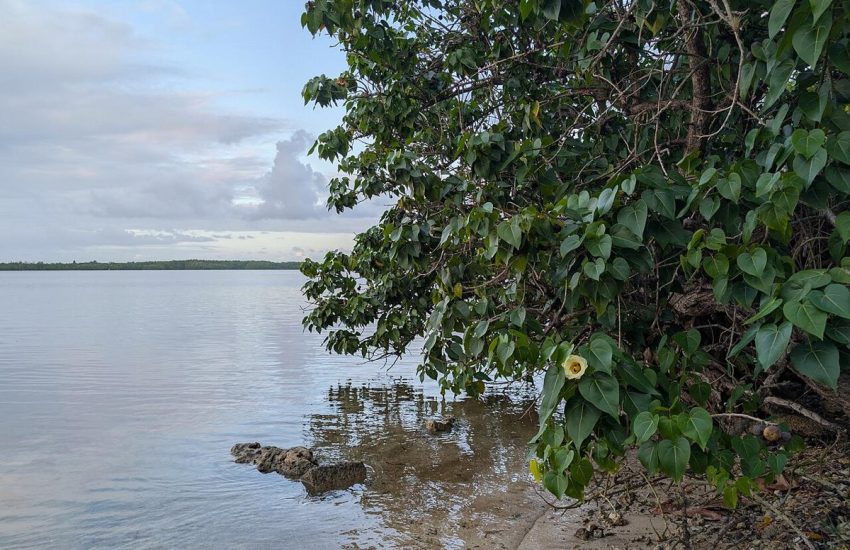
Hooker Willow (Salix hookeriana)
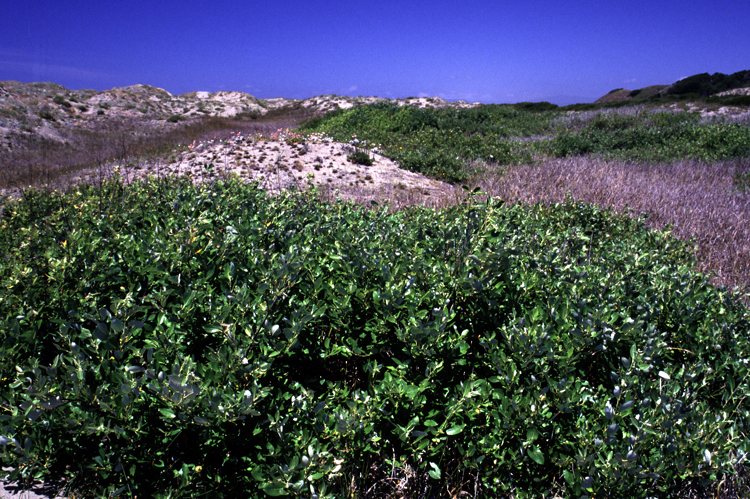
Salix hookeriana, commonly known as Hooker Willow (also called Dune Willow or Coastal Willow), is a stout, broad-leaved willow of the fog-belt beaches and dune hollows of the Pacific coast. Named for the English botanist Sir William Jackson Hooker, this member of the Salicaceae (willow family) is one of the few trees tough enough to root directly in blowing sand, and it is a familiar sight wherever the coastline meets open dune or marsh from Alaska’s Gulf Coast south to the redwood country of northern California.
Rather than growing tall and narrow like river willows, Hooker Willow takes the form of a dense, rounded, often multi-stemmed shrub or small tree, usually 6 to 20 feet tall, with thick velvety leaves that resist salt spray and sand abrasion. In late winter its stout, woolly catkins open well before the leaves emerge, turning the dunes silver-gray and then bright yellow with pollen, feeding some of the earliest native bees of the season. Its dense, low canopy also gives beach-nesting songbirds crucial cover in an otherwise open, wind-scoured landscape.
Because it tolerates salt wind, shifting sand, and seasonally wet swales equally well, Hooker Willow is one of the most useful native shrubs for stabilizing coastal soil and rebuilding wildlife habitat along the Pacific shoreline. It is not a plant for a typical inland yard, but for gardeners and restoration crews working within a mile or two of the coast, it is close to irreplaceable.
Identification
Hooker Willow grows as a many-stemmed shrub or small tree 6 to 20 feet (2–6 m) tall, occasionally reaching 30 feet in sheltered sites, with a broad, rounded crown shaped by onshore wind. Stems are stout and gray-brown, often leaning or layering where sand has buried the lower trunk.
Bark & Stems
Young twigs are thick, stiff, and densely covered in soft gray-white hairs (tomentose), giving new growth a felted, silvery look that is a useful field mark among Pacific willows. Older bark is gray-brown and becomes smooth to slightly fissured with age. The stout, hairy twigs persist as one of the easiest ways to separate this species from the thinner-stemmed Sitka Willow it often grows beside.
Leaves
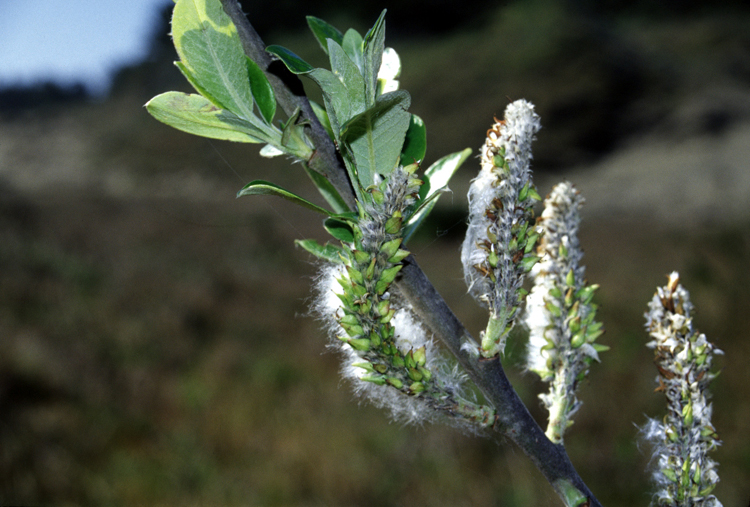
Leaves are alternate, simple, and notably broad for a willow — elliptic to oval, 2 to 5 inches (5–13 cm) long and 1 to 2.5 inches (2.5–6 cm) wide, among the widest leaves of any willow on the Pacific coast. The upper surface is dark green and finely wrinkled (rugose) from the sunken veins; the underside is pale and densely woolly-haired, especially when young. Margins are shallowly toothed or nearly entire. This combination of broad, hairy, strongly veined leaves is the quickest way to tell Hooker Willow from the narrower-leaved willows that share its dune and marsh habitat.
Flowers
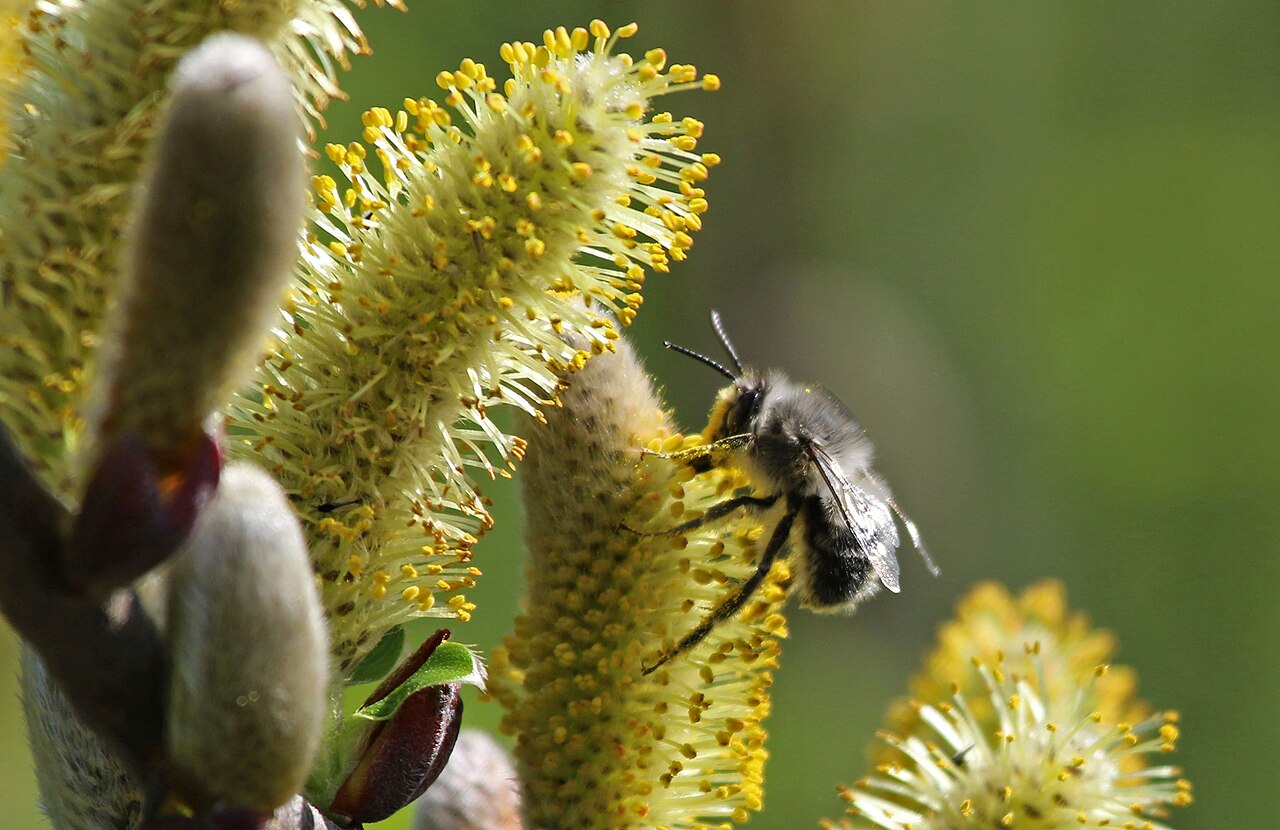
Like all willows, Hooker Willow is dioecious, with male and female catkins borne on separate plants. The catkins are thick, densely woolly, and conspicuous, appearing from February to April before or as the leaves emerge — male catkins are 1 to 2.5 inches long and turn bright yellow with pollen; female catkins are slightly longer and greener. The early bloom time makes this one of the first substantial nectar and pollen sources available to coastal pollinators each year.
Fruit & Seeds
Female catkins mature into clusters of small, hairy, beaked capsules that split open in late spring to release tiny seeds attached to tufts of white cottony down, which carries them on the wind to colonize fresh sand, gravel bars, and other disturbed, moist ground nearby.
Quick Facts
| Scientific Name | Salix hookeriana |
| Family | Salicaceae (Willow) |
| Plant Type | Deciduous Shrub / Small Tree |
| Mature Height | 6–20 ft (2–6 m) |
| Mature Spread | 8–15 ft |
| Growth Rate | Fast |
| Sun Exposure | Full Sun |
| Water Needs | Moderate to High |
| Soil Type | Sand, dune soil, or wet loam; tolerates salt spray |
| Soil pH | 5.5–7.5 |
| Bloom Time | February – April |
| Flower Color | Yellow (male) / Green (female) catkins |
| Fall Color | Dull yellow |
| Fruit | Small hairy capsules with cottony seeds |
| Deer Resistant | No (browsed by deer and elk) |
| USDA Hardiness Zones | 7–9 |
Native Range
Hooker Willow is native to the immediate Pacific coast of North America, from the Gulf of Alaska south through coastal British Columbia, Washington, and Oregon to Humboldt and Mendocino counties in northern California. It is almost entirely a coastal-fog species, rarely found more than a few miles inland, and is most abundant where open dunes, beach grasslands, or brackish marsh edges give it the full sun and disturbed sand it needs.
Within this coastal strip it grows on foredunes and stabilized back-dunes, in damp swales between dune ridges, along tidal sloughs and estuary margins, and on recently disturbed sandy or gravelly soil near the shore. It associates with Sitka Spruce, Shore Pine, salal, and beach grasses on dry dune crests, and with Sitka Willow, Pacific Crabapple, and red-osier dogwood in the wetter dune hollows and marsh edges it also occupies.
The USDA Plant Materials Program selected a Clatsop County, Oregon ecotype — released as ‘Clatsop’ Hooker Willow — specifically for large-scale dune stabilization and coastal wetland restoration, a testament to how central this species is to Pacific Northwest shoreline recovery work.
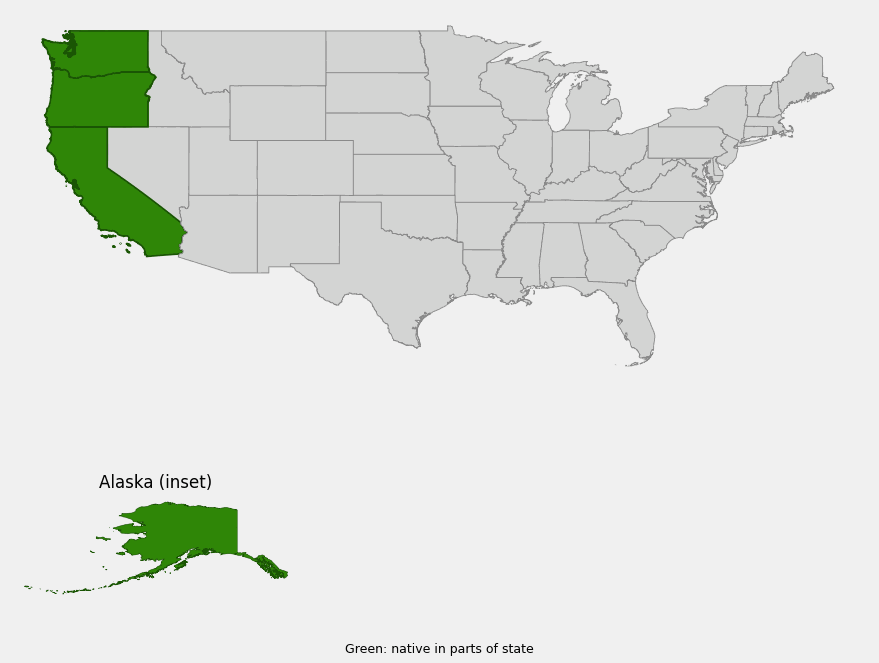
📋 Regional plant lists featuring Hooker Willow: Western Oregon & Western Washington, Alaska, California & Nevada
Growing & Care Guide
Hooker Willow is easy to grow near the coast but struggles anywhere it does not get regular moisture and salt-laden air — it is a specialist, not a generalist. Gardeners within reach of marine fog or ocean spray will find it one of the toughest, fastest shrubs available for difficult sandy sites.
Light
Plant in full sun. Hooker Willow is a pioneer of open dunes and does not perform well under shade from taller trees; it needs direct light to flower well and hold its dense, rounded form.
Soil & Water
It thrives in pure sand, sandy loam, or seasonally wet dune-swale soil, and tolerates salt spray and brief tidal splash better than almost any other native shrub. Give it consistent moisture during the first two growing seasons; established plants can draw on a shallow, naturally high coastal water table and need little supplemental irrigation. It does not require rich soil and can be hurt by heavy fertilization, which encourages weak, floppy growth.
Planting Tips
Plant bare-root or container stock in fall or winter while dormant. Hardwood cuttings taken in winter root readily when pushed directly into moist sand, which is how most restoration plantings are established. Space plants 6 to 10 feet apart for a continuous dune thicket, or farther apart for individual specimen shrubs. Stake young plants loosely in the most wind-exposed sites until roots anchor.
Pruning & Maintenance
Little pruning is needed. Hooker Willow can be cut back hard every few years to rejuvenate old, leggy thickets and encourage dense new growth, since it resprouts vigorously from the base. Remove storm-damaged branches as needed; the wood is brittle and can break in heavy wind.
Landscape Uses
Hooker Willow earns its keep in coastal and restoration landscapes:
- Dune stabilization — extensive roots hold shifting sand in place
- Coastal wetland and estuary restoration
- Windbreak or living screen in exposed beachfront gardens
- Wildlife hedgerow for nesting songbirds near the shore
- Erosion control on coastal bluffs and stream mouths
- Early-season pollinator planting for native bees
Wildlife & Ecological Value
Hooker Willow is a keystone early-season resource on an otherwise sparse winter and early-spring coastline, and its dense structure provides shelter few other dune plants can match.
For Pollinators
Blooming in February and March, before almost anything else along the coast, Hooker Willow’s pollen- and nectar-rich catkins are a critical early food source for native mining bees, mason bees, and bumblebee queens emerging from winter dormancy, as well as the first honeybee foraging trips of the year.
For Birds
The dense, low, wind-sheltered canopy provides nesting and roosting cover for coastal songbirds such as song sparrows, common yellowthroats, and wrentits, species that have few other shrubby options on open dunes. Willow leaves also host the caterpillars of several native moth and butterfly species, which in turn feed nesting songbirds.
For Mammals
Black-tailed deer and Roosevelt elk browse the foliage and young stems, especially in winter. Beaver use willow stems and bark where thickets extend along slough and estuary margins.
Ecosystem Role
As one of the few woody pioneers able to establish directly in mobile sand, Hooker Willow stabilizes foredunes and creates the first structural habitat layer that allows other dune and marsh-edge species to establish behind it. Its root system slows wind and water erosion, and its leaf litter adds organic matter to otherwise nutrient-poor sandy soils.
Cultural & Historical Uses
Coastal Indigenous peoples of the Pacific Northwest, including Chinookan, Tillamook, and Coast Salish communities, used the flexible young stems of coastal willows like Salix hookeriana for basketry, fish traps, and binding material, taking advantage of the long, pliable shoots that resprout after cutting.
In more recent history, Hooker Willow has become a workhorse of Pacific coast restoration ecology. The USDA Natural Resources Conservation Service released the ‘Clatsop’ cultivar from Oregon dune populations specifically for use in large-scale coastal stabilization and wetland mitigation projects, and it remains a standard component of dune restoration plantings from Washington to Northern California.
Like other willows, its bark contains salicin, the compound from which aspirin was originally derived, though coastal willows were historically used more for cordage and construction material than for medicine. The species carries no significant toxicity concerns and is not used in modern herbal medicine to any notable degree.
Frequently Asked Questions
Can I grow Hooker Willow away from the coast?
It is possible in consistently moist, cool inland sites, but Hooker Willow performs best within a few miles of the ocean where it gets marine fog and salt-tolerant conditions. Farther inland, Pacific Willow or Scouler’s Willow are usually better choices.
How is Hooker Willow different from Sitka Willow?
Hooker Willow has noticeably broader, more rounded, densely hairy leaves and thick, woolly twigs, while Sitka Willow has narrower leaves with silky (not woolly) undersides and thinner stems. The two often grow side by side on the coast.
Does Hooker Willow tolerate salt spray?
Yes — it is one of the most salt-tolerant native trees on the Pacific coast and is frequently the first woody plant to establish on fresh, wind-blown foredunes.
Is Hooker Willow good for a small garden?
It grows fast and wide, so it suits larger coastal lots, hedgerows, or restoration plantings better than small, formal gardens. It can be kept more compact with periodic hard pruning.
What wildlife benefits most from planting Hooker Willow?
Early-emerging native bees benefit the most, since the catkins open before almost any other coastal plant blooms; ground- and shrub-nesting songbirds are the next biggest beneficiaries thanks to the dense cover.
For background on timing coastal shrub plantings with the insects they feed, see our guide to pollinator garden design basics. Willow thickets like this one are also a mainstay of native hedgerows for birds, and gardeners managing a wetter, low-lying site may find useful overlap with our rain garden plant selection guide. For willow-specific pruning and care basics that apply across the genus, see how to care for pussy willow.

Looking for a nursery that carries Hooker Willow?
Browse our native plant nursery directory: Oregon · Washington · California · Alaska