
Netted Pawpaw (Asimina reticulata)
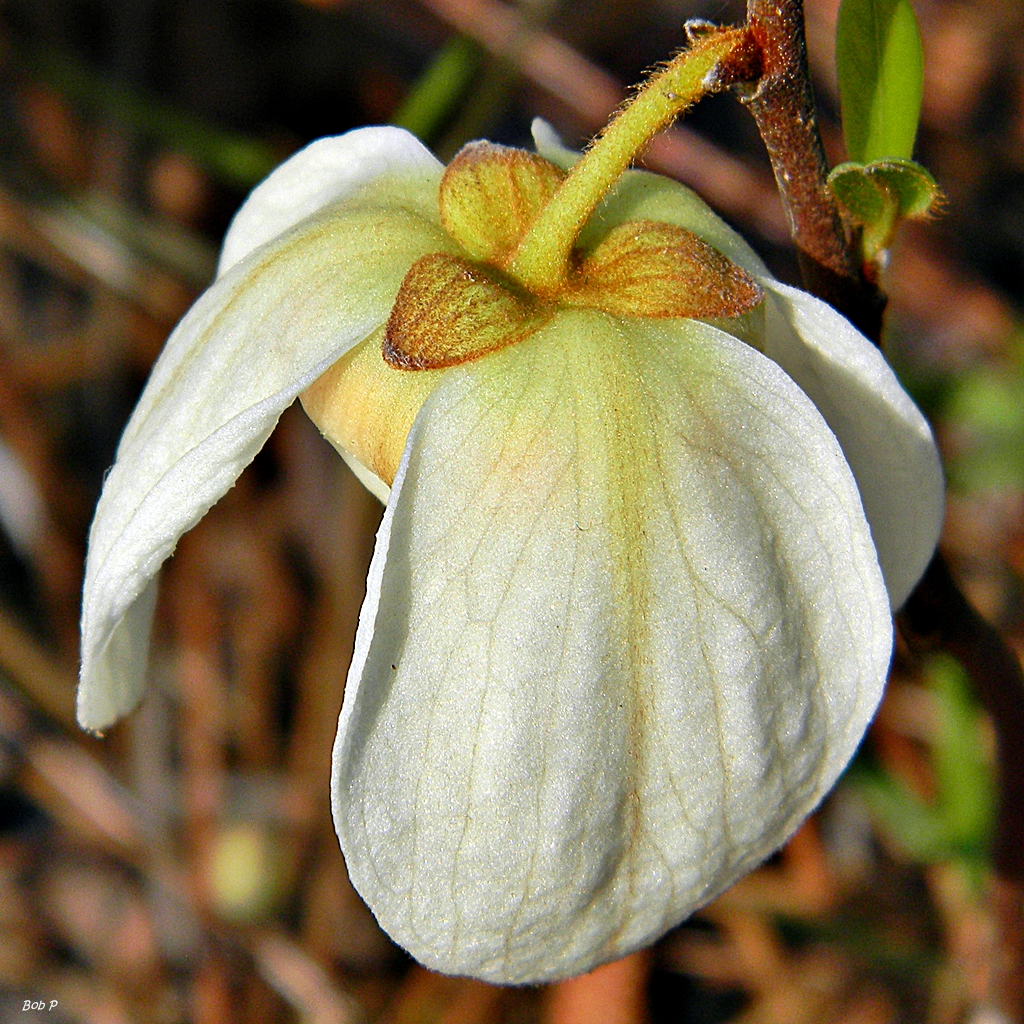
Asimina reticulata, the Netted Pawpaw, is a low shrub of Florida’s pine flatwoods and dry prairies and one of the most common of the state’s small wild pawpaws. In late winter and spring it opens fragrant, nodding, creamy white flowers up to 3 inches long, often before its new leaves have fully expanded. It belongs to the custard apple family (Annonaceae), a mainly tropical family represented in the U.S. almost entirely by the pawpaws.
Netted pawpaw is a smaller cousin of the familiar common pawpaw (A. triloba), the tree of eastern river bottoms. Instead of a tree, it forms a knee- to waist-high shrub from a deep taproot, with stiff, leathery, oblong leaves whose undersides show a raised network of veins. That network is the source of the name reticulata, meaning “netted”. It also produces an edible, if modest, fruit, which many animals eat.
For Florida gardeners it is a plant with real character: early, showy flowers, evergreen-looking leaves and an important role as a host plant for the zebra swallowtail butterfly. It is rarely sold, though, and difficult to move, so it is best kept where it already grows or raised patiently from seed. This guide covers how to identify it, where it grows, and how to care for it in a native landscape.
Identification
Florida has about a dozen kinds of small, shrubby pawpaws, several of them rare. Netted pawpaw is one of the most widespread. It is recognized by its stiff, thick leaves with rolled edges and netted veins, and by large white flowers with maroon-marked inner petals.
Stems & Root
Netted pawpaw grows from a deep, spindle-shaped taproot that sends up one to several stems. Plants are usually 1 to 3 feet tall and can reach about 5 feet where fire has been absent for many years. Young twigs are covered with rusty hairs. Bark is tan to reddish at first, becoming brown and finally gray with age. After fire, the plant resprouts quickly from the root crown.
Leaves
Leaves are alternate, oblong to elliptic, about 2 to 3 inches long, thick and leathery, with blunt to slightly notched tips and edges that roll under. Young leaves are covered with orange-rusty hairs, especially beneath. Mature leaves are pale green and hairless above and paler below, where the raised net of small veins is easy to see. The plant drops much of its foliage in winter and leafs out again in spring.
Flowers
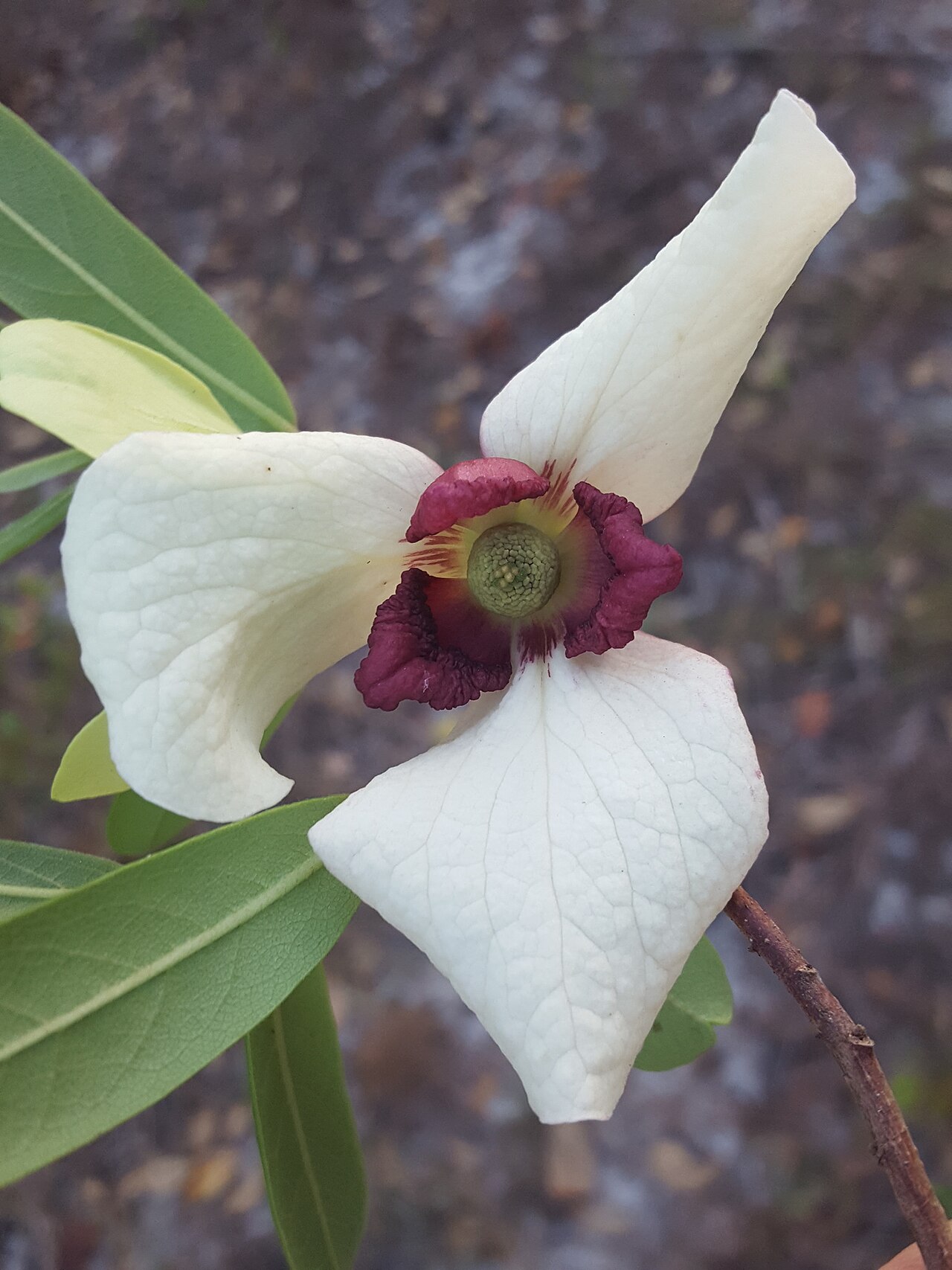
Flowers appear from late winter to spring, mostly January through May, from the leaf axils of the previous year’s growth, singly or in groups of up to three on hairy stalks. They nod, so the best view is from below. There are three small, hairy sepals, three large outer petals that are cream to white, oblong, about 1¼ to nearly 3 inches long with wavy edges, and three much smaller inner petals with deep maroon to purple, wrinkled bases. The center is a green knob of stamens and pistils. The flowers are sweetly fragrant.
Fruit
The fruit is an oblong, yellow-green berry, roughly 2 to 3 inches long, sometimes in small clusters. It ripens in summer and contains soft, yellowish, aromatic pulp and several large, flattened brown seeds. The pulp is edible, with a flavor similar to that of common pawpaw, though fruits are small and often eaten by wildlife before people find them.
Quick Facts
| Scientific Name | Asimina reticulata |
| Family | Annonaceae (custard apple family) |
| Plant Type | Low deciduous to semi-evergreen shrub from a deep taproot |
| Mature Height | 1–3 ft (to about 5 ft) |
| Mature Spread | 1–3 ft |
| Growth Rate | Slow |
| Sun Exposure | Full sun to light shade |
| Water Needs | Low to moderate; drought tolerant once established |
| Soil Type | Acidic sand; moist to dry flatwoods sand and sandy peat |
| Soil pH | About 4.5–6.0 |
| Bloom Time | January–May |
| Flower Color | Cream to white; inner petals marked deep maroon |
| Fall Color | Leaves yellow and partly drop in winter |
| Fruit | Yellow-green, edible oblong berry, summer |
| Deer Resistant | Moderately; foliage is not a preferred browse |
| USDA Hardiness Zones | 8b–10 |
Native Range
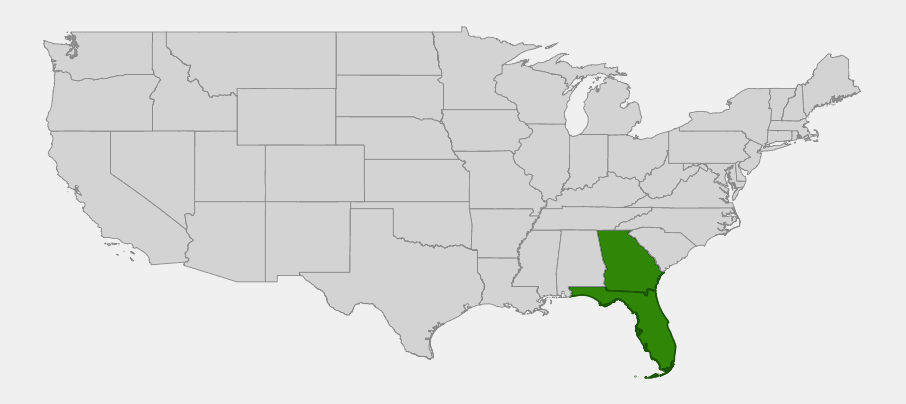
Netted pawpaw is a Southeastern Coastal Plain shrub with a range centered on Florida. USDA PLANTS records it from Florida and Georgia. In Florida it grows through most of the peninsula, from the northern counties south to the Everglades region. In Georgia it is known only from a few sites in the far south, near the Florida line. The Lady Bird Johnson Wildflower Center describes the range as peninsular Florida and a few areas of far south Georgia.
Its typical habitats are pine flatwoods, especially the palmetto flatwoods of central and south Florida, along with dry prairies, scrubby flatwoods, sandhills and the edges of savannas and low, sandy fields. It is most common in moist to dry, acidic sand under an open pine canopy or in treeless prairie, with saw palmetto, wiregrass and fetterbush.
Like many plants of these habitats, netted pawpaw depends on frequent fire. Fire burns back its stems, but the deep taproot survives and resprouts, often flowering heavily afterward. Where fire is excluded, it grows taller and shadier and flowers less. Loss of flatwoods and dry prairie to development and agriculture has reduced its habitat, though it remains common in protected natural areas.
📋 Regional plant lists featuring Netted Pawpaw: North & South Florida · Alabama, Georgia & Mississippi
Growing & Care Guide
Netted pawpaw is easy to keep but hard to establish. Mature plants need almost no care, but its deep taproot means wild plants should never be dug: they almost never survive. Start with nursery-grown plants or seed, and be patient.
Light
Give it full sun to light shade. It flowers best in sun, which matches its natural habitat in open flatwoods and prairies. Under a dense canopy it becomes leggy and flowers sparsely.
Soil & Water
It grows in acidic, sandy soil that is moist in the wet season and dry the rest of the year. Do not plant it in alkaline fill or heavy, rich soil. Established plants need no irrigation in Florida. Water container plants regularly for the first season, but avoid keeping the soil soggy.
Planting Tips
Plant in fall, winter or early spring from deep containers, keeping the root ball intact. Choose the final spot carefully, because the taproot makes later moves almost impossible. Pawpaws generally need cross-pollination between different plants to set fruit, so plant several together if you hope for fruit and zebra swallowtails. Mulch lightly with pine straw.
Pruning & Maintenance
Little pruning is needed. Remove dead stems in late winter. In natural areas, prescribed fire every few years renews the plants, and in a garden an occasional hard cutback in late winter has a similar effect. Do not use insecticides: the caterpillars on the leaves are probably zebra swallowtails.
Propagation
Grow it from fresh seed. Collect ripe fruit in summer, clean the seeds and sow them right away, or store them cool and moist. Pawpaw seeds lose viability if they dry out. Germination is slow, often taking several months, and seedlings first grow a long root before much top growth appears. Use deep pots and transplant them young. Cuttings are rarely successful.
Landscape Uses
- Pine flatwoods and dry prairie restoration: a characteristic low shrub of these Florida plant communities
- Butterfly gardens: a native host plant for the zebra swallowtail
- Naturalistic Florida landscapes: low, open shrub with early spring flowers among saw palmetto and wiregrass
- Wildlife gardens: fruit is eaten by many mammals and reptiles
- Preserving existing plants: keep established plants when building on flatwoods land; they cannot be moved
Wildlife & Ecological Value
Netted pawpaw supports a surprising number of animals for such a small shrub, from caterpillars to gopher tortoises.
For Pollinators
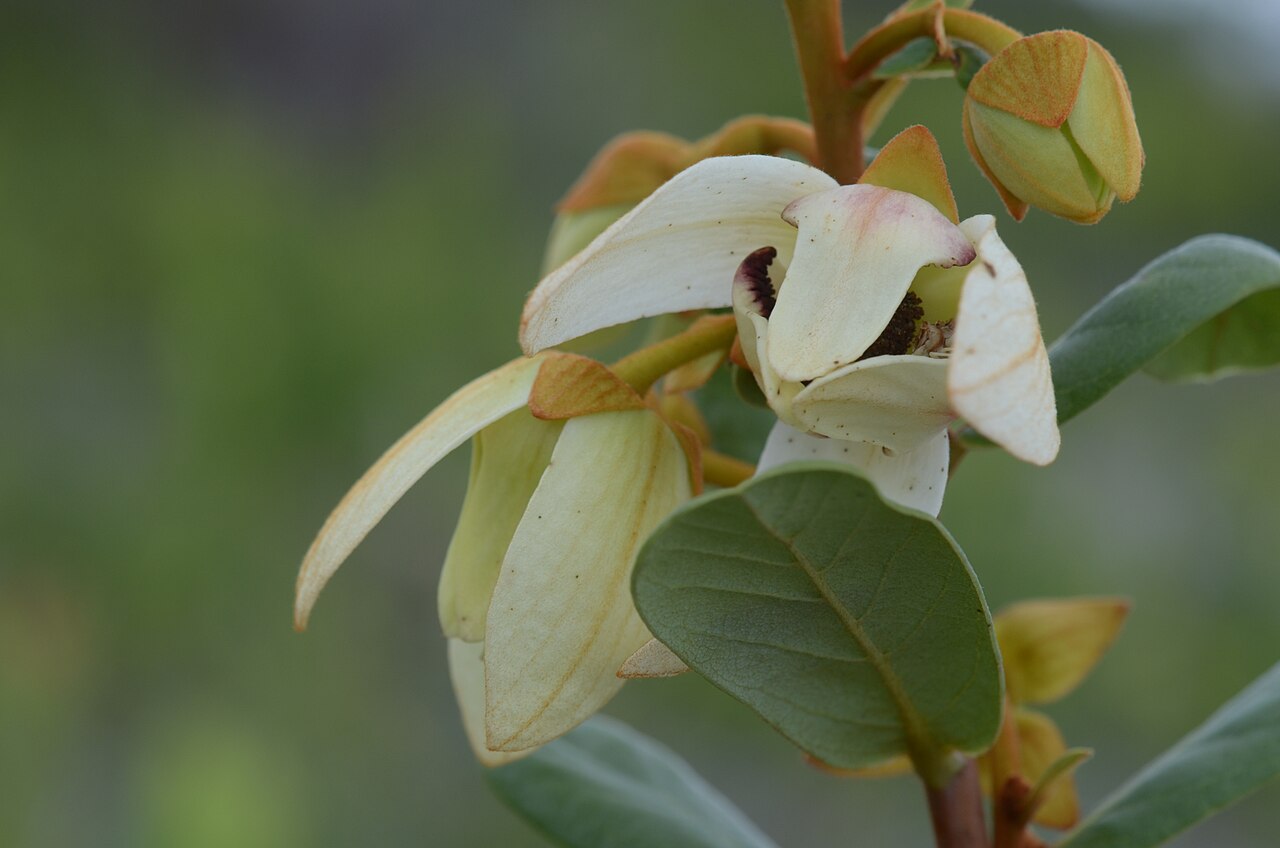
The fragrant, nodding flowers are pollinated mainly by beetles, which crawl inside to feed on pollen and the fleshy inner petals. Flies and small bees also visit. Like other pawpaws, the flowers are protogynous, with the pistils maturing before the pollen, which favors cross-pollination between plants.
For Birds
Birds do not rely heavily on the fruit, but they forage for insects on the plant, and low thickets of pawpaw and palmetto provide cover for ground-dwelling birds such as northern bobwhite.
For Mammals
The ripe fruits are eaten by raccoons, opossums, foxes and other mammals, which help disperse the large seeds. Gopher tortoises and box turtles also eat fallen fruit.
Ecosystem Role
Netted pawpaw is a larval host for the zebra swallowtail butterfly, whose caterpillars feed only on pawpaws. It is also used by the pawpaw sphinx moth. Leaves of pawpaws contain natural insecticidal compounds (acetogenins), which the caterpillars tolerate and may use for protection. As a fire-adapted resprouter, it helps keep flatwoods ground cover intact after burns.
Cultural & Historical Uses
The genus name Asimina comes from assimin, a name used by Native Americans for the common pawpaw and recorded by early French colonists. Netted pawpaw was described in the 19th century by Robert James Shuttleworth and Alvan Wentworth Chapman, as reflected in its author citation, “Shuttlw. ex Chapm.” Chapman was a physician in Apalachicola and the author of the first comprehensive flora of the southern United States.
Like other pawpaws, netted pawpaw fruit was eaten by Native Americans and settlers, though its fruits are smaller and less abundant than those of common pawpaw. Pawpaw seeds, leaves and bark contain compounds that can cause stomach upset, so only the ripe pulp is eaten.
Today netted pawpaw is valued mainly for its role in natural communities and by butterfly gardeners. Florida’s small pawpaws include several rare and federally listed species, such as four-petal pawpaw (A. tetramera) and the tiny-flowered pawpaws of the genus Deeringothamnus. Learning to recognize the common netted pawpaw is a good first step toward appreciating that remarkable group.
Frequently Asked Questions
Is netted pawpaw fruit edible?
Yes. The ripe pulp is edible and tastes similar to common pawpaw, though the fruits are small and often eaten by wildlife first. Do not eat the seeds or skin, which contain compounds that can cause stomach upset.
Does netted pawpaw attract butterflies?
It is a host plant for the zebra swallowtail, whose caterpillars feed only on pawpaws. If you see striped green caterpillars on the leaves in spring and summer, leave them alone.
Can I move a netted pawpaw from a construction site?
It is very difficult because of the deep taproot, and most moved plants die. If possible, save the area around existing plants instead. Otherwise, collect seed in summer and grow new plants.
How is netted pawpaw different from common pawpaw?
Common pawpaw (A. triloba) is a small tree of moist woods with large, thin leaves and purple-red flowers. Netted pawpaw is a low shrub of sandy flatwoods with small, thick, net-veined leaves and large white flowers.
When does netted pawpaw bloom?
Mainly from late winter through spring, roughly January to May in Florida. Flowering is often heaviest in the season after a fire.

Looking for a nursery that carries Netted Pawpaw?
Browse our native plant nursery directory: Florida & Georgia