
Northern Willow (Salix arctophila)
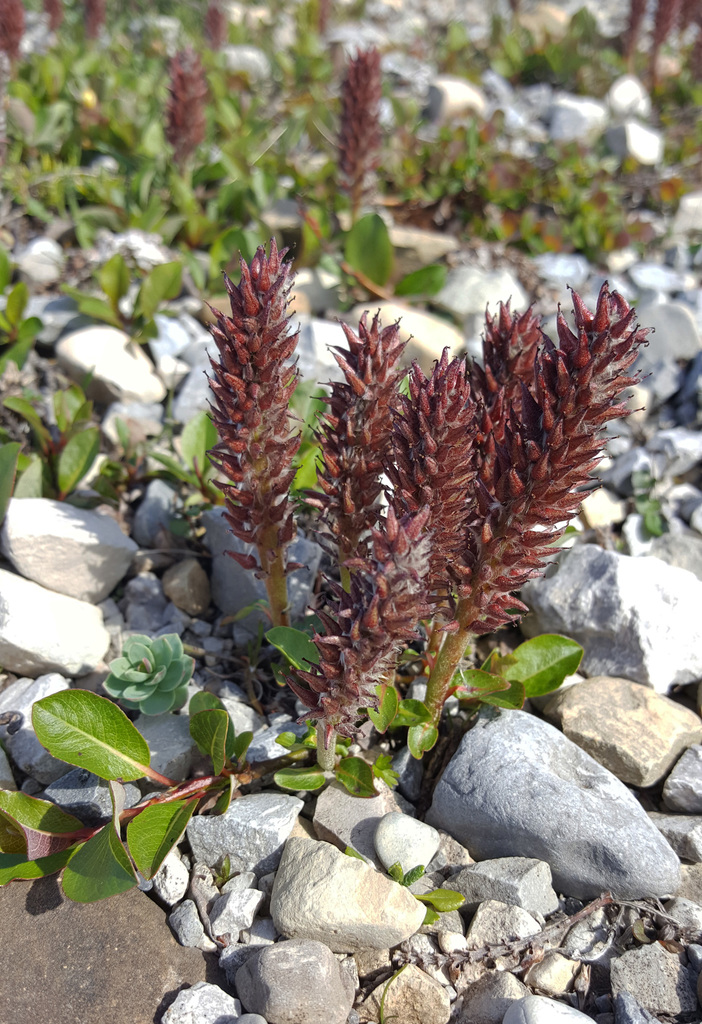
Salix arctophila, the Northern Willow, is a dwarf, trailing willow of the Arctic. It rarely stands more than a few inches tall: its woody stems creep along the ground and root as they go, forming mats of glossy, oval leaves, and in early summer it sends up upright catkins that turn from red or purple to fluffy white as the seeds ripen. It is a member of the willow family (Salicaceae).
The name causes some confusion. Northern willow is often called arctic willow, and the epithet arctophila means “arctic-loving,” but USDA PLANTS uses the common name arctic willow for a different species, Salix arctica, a more widespread circumpolar dwarf willow. Northern willow has also been treated under the names Salix groenlandica and Salix arctica Liebm. in older works. The garden shrub sold as “arctic willow” or “blue arctic willow” is yet another plant, a dwarf form of the Eurasian purple osier (Salix purpurea).
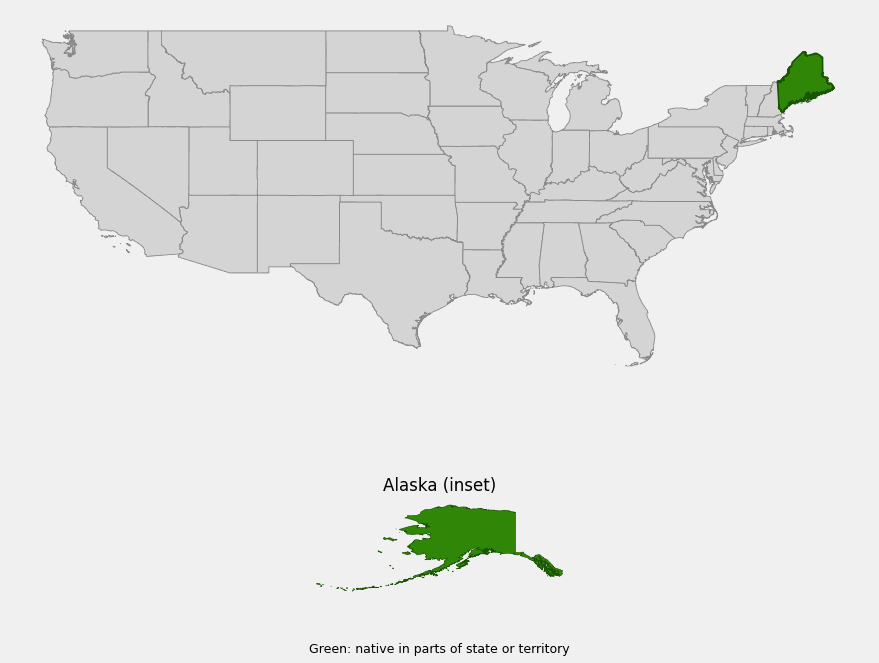
In the United States, northern willow grows in Alaska and at a single remote site on Katahdin in Maine, where it is listed as endangered. Most of its range lies in Arctic and subarctic Canada and Greenland, in wet tundra, snowbeds and along streams. It is a plant to recognize and admire in the wild rather than one for most gardens.
Identification
Look for a mat-forming dwarf willow only a few inches high, with trailing, rooting stems, glossy, oval leaves that are pale and whitish beneath, and upright catkins in early summer, in wet Arctic or alpine places.
Growth Habit
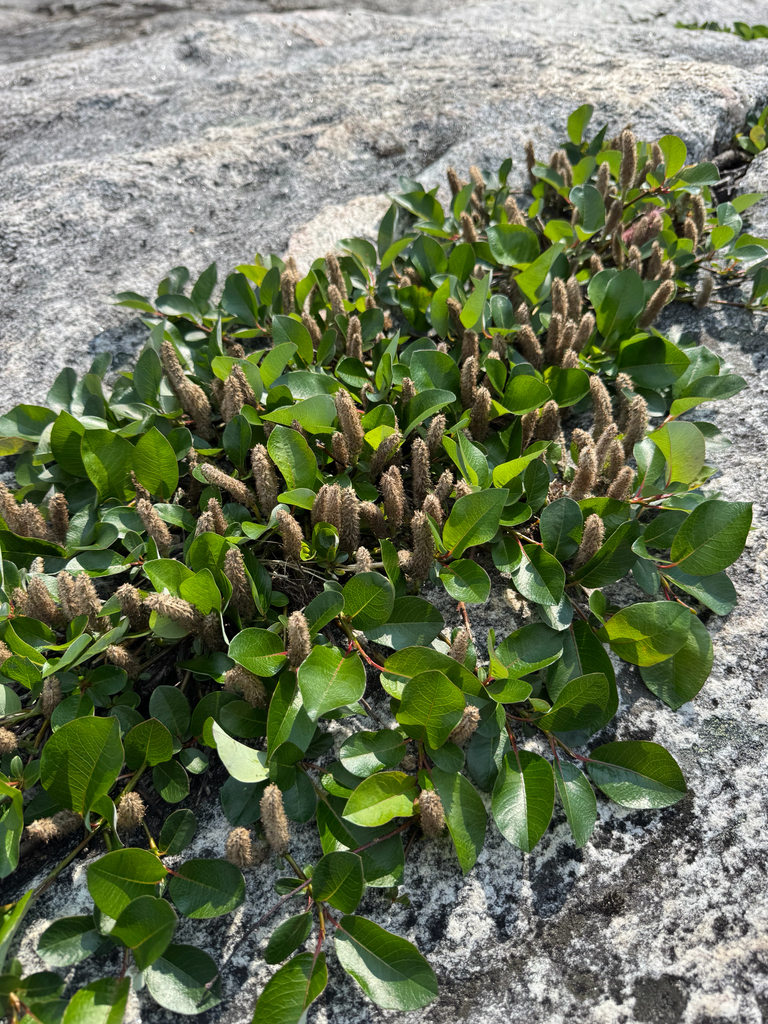
Northern willow is a prostrate shrub. Its stems trail along the ground or just below the moss and root along their length, so one plant can form a mat several feet across while its leafy shoots stand only 1 to 6 inches high. Older stems are dark brown and gnarled.
Leaves
The leaves are alternate, elliptic to oval or obovate, mostly 1/2 to 2 inches long, with smooth or finely glandular edges. They are glossy green and nearly hairless above and pale, whitish (glaucous) beneath, with a network of veins. Old dead leaves often persist on the stems.
Flowers
Like all willows, northern willow has male and female flowers on separate plants. The catkins appear as the leaves expand, usually in June and July, on short leafy branchlets. They stand upright and are often reddish or purplish, with dark scales. Male catkins carry pollen-bearing stamens with reddish anthers; female catkins are longer and grow as the fruits develop.
Fruit & Seeds
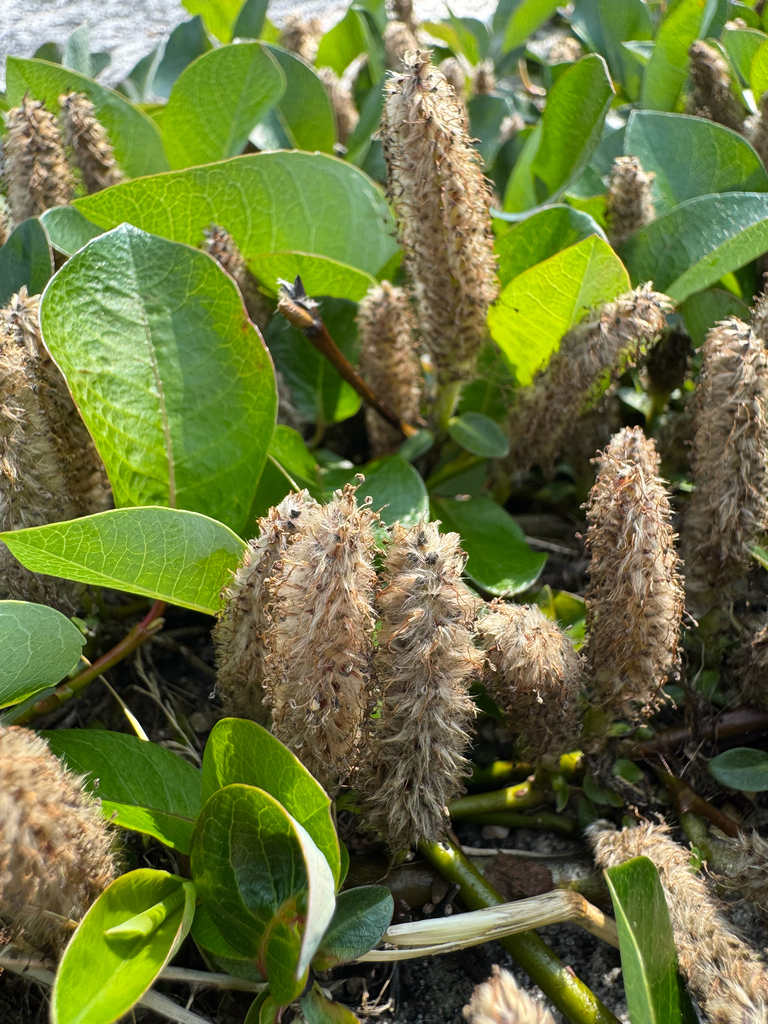
Each female flower becomes a small capsule. In mid to late summer the capsules split and release tiny seeds attached to tufts of silky white hairs, so the catkins look fluffy before the seeds blow away. As with other willows, the seeds are short-lived and must land on wet ground soon after release to germinate.
Look-alikes
Arctic willow (Salix arctica) is very similar and grows in many of the same places. It usually has leaves with long silky hairs, at least when young, while northern willow’s leaves are glossy and nearly hairless; the two also hybridize, and experts often check catkin and capsule details to separate them. Other Arctic dwarf willows, such as net-leaf willow (Salix reticulata), have rounder, deeply veined leaves, and snowbed willow (Salix herbacea) has tiny round leaves less than an inch long.
Quick Facts
| Scientific Name | Salix arctophila |
| Family | Salicaceae (willow family) |
| Plant Type | Dwarf, trailing deciduous shrub |
| Mature Height | 1–6 in |
| Mature Spread | 1–4 ft (mat-forming) |
| Growth Rate | Slow |
| Sun Exposure | Full sun |
| Water Needs | High; constantly moist to wet |
| Soil Type | Wet peaty, gravelly or rocky soils; tundra and snowbed soils |
| Soil pH | Acidic to neutral (about 5.0–7.0) |
| Bloom Time | June–July (catkins) |
| Flower Color | Reddish to purplish catkins; female catkins turn fluffy white |
| Fall Color | Yellow |
| Fruit | Small capsules releasing silky-haired seeds |
| Deer Resistant | No; browsed by caribou, muskoxen and hares |
| USDA Hardiness Zones | 1–4 |
Native Range
Northern willow is an Arctic and subarctic plant of North America and Greenland. It ranges across northern Canada from Yukon and the Northwest Territories through Nunavut, northern Manitoba, Saskatchewan and Ontario, to Quebec, Labrador and Newfoundland. USDA PLANTS lists it as native in Alaska, where it grows on tundra and in mountains, and in Maine.
The Maine population is an outlying record and one of the most remarkable in New England. According to Go Botany (Native Plant Trust), it is known only from a single remote glacial basin on Katahdin, and only male plants are known there. Maine ranks it as extremely rare (S1) and lists it as endangered. It is a relict from the end of the last ice age, when Arctic plants grew much farther south.
Across its range it grows in wet places: sedge and moss tundra, the edges of ponds and streams, seepage slopes, late-melting snowbeds, wet gravel and rocky alpine or subalpine slopes and talus, from sea level in the far north into the mountains.
📋 Regional plant lists featuring Northern Willow: Alaska · New Hampshire, Maine & Vermont
Growing & Care Guide
Northern willow is not sold by nurseries and is suited only to very cold climates. It is best appreciated in the wild. In Maine it is an endangered plant: never dig it or take cuttings there. Elsewhere, never dig wild plants; a mat is many years old and rarely survives being moved.
Light
Full sun. In the wild it grows in open tundra and alpine sites with no tree cover.
Soil & Water
Constantly cool, moist to wet, gritty or peaty soil. It needs cold winters with snow cover and cool summers, and fails in hot, humid climates and dry soils.
Planting Tips
In Alaska and other far-northern gardens, a dwarf willow like this suits a wet rock garden, the edge of a pond or a cool, moist trough planting. Where it will not grow, native dwarf shrubs such as black crowberry or lingonberry give a similar low, mat-forming look in a cold garden.
Pruning & Maintenance
No pruning is needed. Keep it moist through summer and weed out taller plants that would shade the mat.
Propagation
Like most willows, it can be rooted from short stem cuttings taken in spring or early summer, or by lifting rooted pieces of a mat that is already in cultivation. Only take cuttings with permission, and never from the Maine population. Seed is short-lived and must be sown fresh on wet soil.
Landscape Uses
- Arctic and alpine rock gardens: a trailing mat for wet, gritty soils in very cold climates
- Revegetation in the North: willows are used to stabilize disturbed tundra and gravel
- Wildlife plantings: browse for caribou, hares and ptarmigan where it grows naturally
- Nature study: an Arctic relict to look for on tundra hikes in Alaska
Wildlife & Ecological Value
On the tundra, low willows like northern willow are some of the most important plants for wildlife, providing early pollen, browse and shelter in a landscape with few woody plants.
For Pollinators
Willow catkins are among the first sources of pollen and nectar in the Arctic summer. Bumblebees and flies visit them, and willows are also partly wind-pollinated. Many moths and butterflies of the North feed on willow leaves as caterpillars.
For Birds
Ptarmigan eat willow buds and twigs, which are a key winter food for them in the Arctic. Mats of dwarf willow also give cover to nesting shorebirds and songbirds on the tundra.
For Mammals
Caribou, muskoxen, Arctic hares and lemmings browse dwarf willows. The leaves and shoots are nutritious and are eaten heavily in early summer.
Ecosystem Role
Trailing willows bind soil on wet slopes and gravel, slow erosion and trap snow. Their roots form partnerships with mycorrhizal fungi that help them take up nutrients in cold, poor soils. Along with arctic willow, it is one of the woody plants that defines wet tundra plant communities.
Cultural & Historical Uses
The species name arctophila combines the Greek arktos (bear, and by extension the far north under the Great Bear constellation) with philos (loving): “lover of the Arctic.” It was named by T. D. A. Cockerell and published by A. A. Heller in the early 20th century.
Arctic peoples have long used dwarf willows. In general, willow leaves and shoots were eaten fresh in spring in parts of the North, and willows contain salicin, the compound related to aspirin, which is why willow bark was widely used to ease pain. Specific uses of northern willow, as opposed to Arctic willows in general, are not well documented.
The Katahdin colony, made up only of male plants, cannot set seed and survives by slowly spreading its stems. It is a living reminder that Maine’s highest mountain was once surrounded by tundra when the glaciers retreated.
Frequently Asked Questions
Is northern willow the same as arctic willow?
Not quite. Northern willow (Salix arctophila) is often called arctic willow, but USDA reserves that name for Salix arctica, a closely related, more widespread species. The two look alike and can hybridize.
How tall does northern willow grow?
Usually only 1 to 6 inches. Its stems trail along the ground and root, forming mats rather than an upright shrub.
Where does northern willow grow in the United States?
Mainly in Alaska. A single endangered, male-only colony grows in a glacial basin on Katahdin in Maine.
Is the ‘arctic willow’ sold at garden centers this plant?
No. The shrub sold as arctic willow or blue arctic willow is usually a dwarf form of the Eurasian purple osier (Salix purpurea), a much larger, upright plant.
Can I grow northern willow?
Only in very cold climates with cool, wet summers, and it is not sold by nurseries. Never dig wild plants, and never collect from the protected Maine population.


