
Ozark Chinquapin (Castanea ozarkensis)
Castanea ozarkensis, commonly known as Ozark Chinquapin, is a small native chestnut tree of the Ozark and Ouachita Highlands, once a dominant forest tree across its range before chestnut blight swept through in the 20th century and reduced nearly every mature individual to a stump-sprouting shrub. Along with American chestnut (Castanea dentata) and Allegheny chinquapin (Castanea pumila), it belongs to the small group of native North American chestnuts, all members of the beech family, that once anchored vast stretches of eastern hardwood forest before the blight arrived from imported Asian chestnut stock in the early 1900s.
Taxonomically, Ozark chinquapin has had an unsettled history. USDA PLANTS currently files it as Castanea pumila var. ozarkensis, treating it as a variety of Allegheny chinquapin rather than a full species. However, Flora of North America and most current botanical treatments, along with conservation organizations working to restore the tree, recognize it as the distinct species Castanea ozarkensis, based on differences in leaf shape, nut size, growth form, and its separate, largely non-overlapping range centered on the Ozark-Ouachita Highlands rather than the Atlantic and Gulf coastal plain favored by Allegheny chinquapin. This page follows that species-level treatment and treats Ozark chinquapin as taxonomically and ecologically distinct from the Allegheny chinquapin profiled elsewhere on this site, even though the two share a genus, general form, and much of their natural history.
Before blight, Ozark chinquapin grew as a true forest tree, sometimes reaching 60 feet, an important mast producer feeding wildlife across its highland range. Today almost all surviving individuals persist as root-sprouting shrubs 10 to 20 feet tall, repeatedly top-killed by blight before reaching reproductive maturity, though scattered blight-surviving or resistant trees are the focus of active restoration breeding, mirroring the better-known effort to restore American chestnut.
Identification
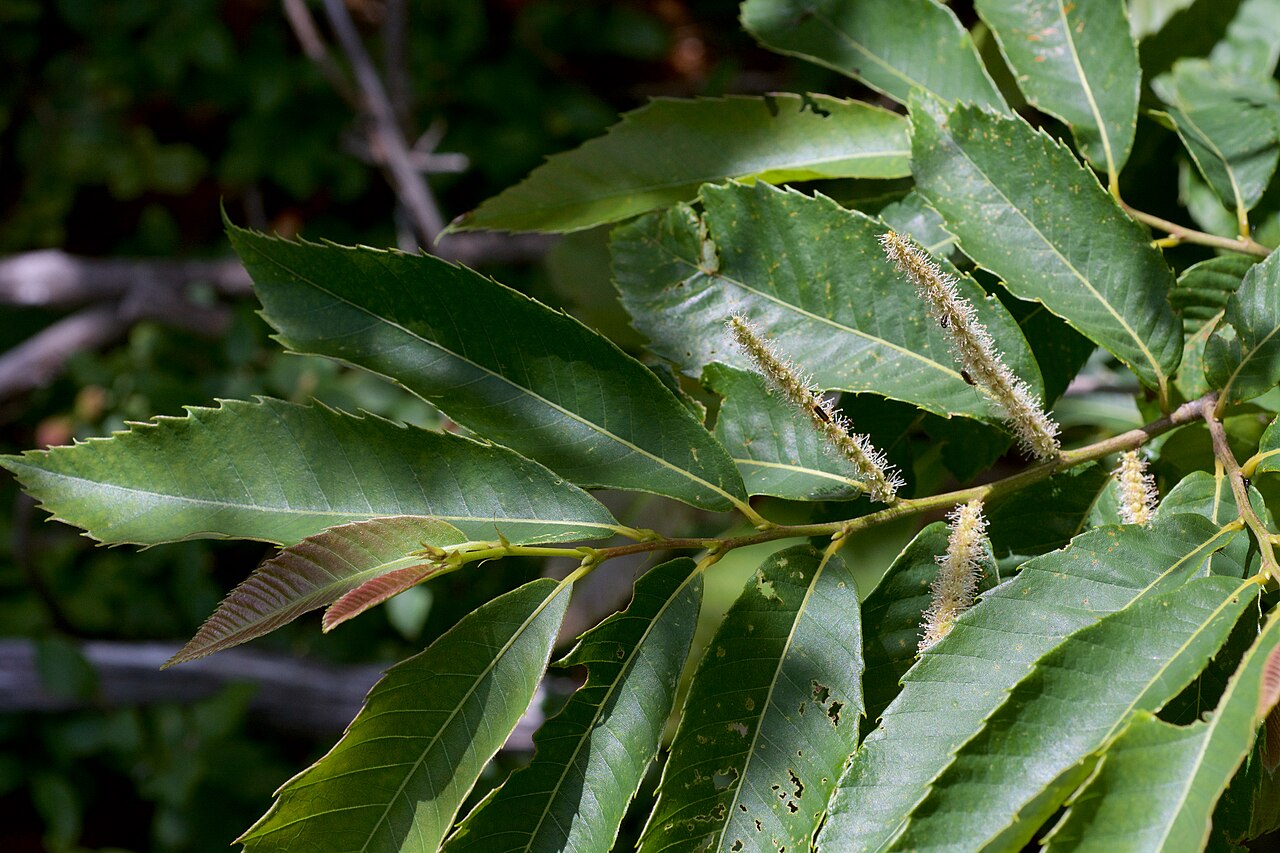
Ozark chinquapin is identified by its glossy, sharply and evenly toothed chestnut-type leaves, spiny chestnut burs enclosing one to three nuts, and, where blight has reduced it to shrub form, a multi-stemmed, root-sprouting growth habit distinct from the single-trunked tree it was historically.
Bark & Stems
On older, blight-free stems bark is gray-brown and shallowly furrowed, similar in texture to American chestnut but on a smaller scale. Because blight repeatedly kills stems back to the root crown across most of the species’ current range, most wild individuals show multiple young, smooth-barked sprouts emerging from an older root system rather than a single mature trunk.
Leaves
Leaves are simple, alternate, oblong-lanceolate, 4 to 7 inches long, with sharply pointed, evenly spaced teeth along the margin and a glossy, often yellowish-green upper surface. The underside is paler, sometimes with fine, scattered hairs. Leaves are generally narrower and somewhat smaller than American chestnut’s, a useful field comparison where the two might otherwise be confused.
Flowers
Ozark chinquapin blooms in early to mid-summer, later than most native trees, producing long, pale, upright to slightly drooping male catkins with a distinctive, strong scent that draws numerous pollinating insects. Female flowers are smaller and inconspicuous, clustered at the base of some catkins, and develop into the spiny bur after pollination.
Fruit & Seeds
The fruit is a spiny, chestnut-type bur about 1 to 1½ inches across, smaller than American chestnut’s bur, typically containing a single sweet, edible nut (occasionally two or three), compared to the multiple nuts typical of American chestnut burs. Nuts ripen in fall and are an important wildlife food where surviving trees reach nut-bearing size before blight kills the stem back again.
Quick Facts
| Scientific Name | Castanea ozarkensis (USDA: C. pumila var. ozarkensis) |
| Family | Fagaceae (Beech) |
| Plant Type | Deciduous tree, now mostly multi-stemmed shrub due to blight |
| Mature Height | Historically to 60 ft; current shrub form 10–20 ft |
| Mature Spread | 10–15 ft (shrub form) |
| Growth Rate | Moderate |
| Sun Exposure | Full sun to part shade |
| Water Needs | Low to moderate |
| Soil Type | Dry, rocky, well-drained ridges and slopes |
| Soil pH | Acidic |
| Bloom Time | Early to mid-summer |
| Flower Color | Cream to pale yellow |
| Fall Color | Yellow |
| Fruit | Spiny bur, 1–1½ in., usually 1 sweet edible nut |
| Deer Resistant | No; browsed readily |
| USDA Hardiness Zones | 5–8 |
Native Range
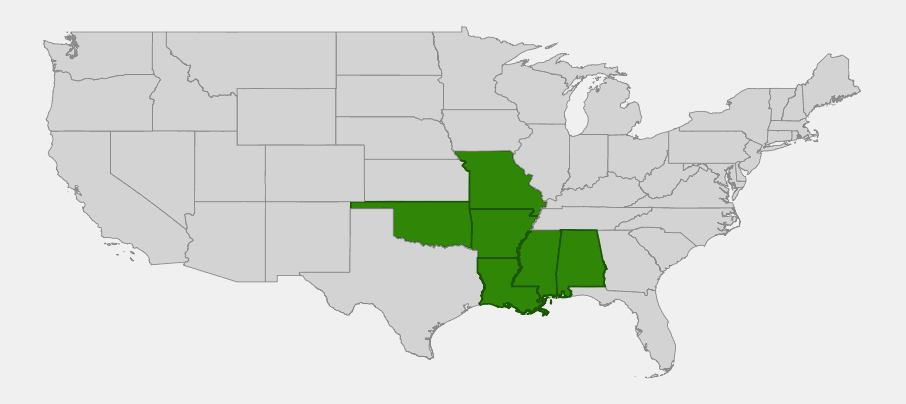
Ozark chinquapin’s core range is the Ozark Plateau and Ouachita Mountains of Arkansas, Missouri, and eastern Oklahoma, where it historically grew on dry, rocky ridges and upland forest throughout the highland region. Scattered, often widely disjunct populations also occur farther south and east into Louisiana, Mississippi, and Alabama, representing outlying remnants well separated from the Ozark-Ouachita core and now mostly reduced to the shrubby, blight-suppressed form found throughout the species’ range.
Across this range, Ozark chinquapin favors dry, acidic, rocky soils on ridgetops and south-facing slopes, often among oak-hickory forest, a niche quite different from the moist, sandy coastal-plain habitats favored by its relative Allegheny chinquapin farther east. Because most surviving individuals are blight-suppressed root sprouts rather than seed-bearing trees, the species’ functional range today is considerably more fragmented than its historical distribution, and active restoration work by groups such as the Ozark Chinquapin Foundation focuses on finding and breeding rare blight-tolerant survivors across this range.
Ozark chinquapin is not native outside the Ozark-Ouachita Highlands and its disjunct Gulf-state outliers; it should not be confused with the more easterly and coastal-plain-adapted Allegheny chinquapin, nor planted as a substitute for American chestnut outside its own native range.
Native Range
| U.S. States | Arkansas, Missouri, Oklahoma (east); disjunct in Louisiana, Mississippi, Alabama |
| Mexico or Canadian Provinces | None |
| Ecoregion | Ozark-Ouachita Highlands; disjunct Gulf coastal plain uplands |
| Elevation Range | 500–2,500 ft |
| Habitat | Dry, rocky ridges and slopes in oak-hickory forest |
| Common Associates | Post oak, blackjack oak, shortleaf pine, mockernut hickory |
📋 Ozark chinquapin is native to parts of the areas covered by Arkansas, Louisiana, Eastern Oklahoma, and Eastern Texas, Illinois, Iowa & Missouri, and Georgia, Alabama and Mississippi.
Growing & Care Guide
Light
Ozark chinquapin flowers and fruits most heavily in full sun but tolerates part shade as an understory shrub, which is how most surviving blight-suppressed individuals persist in closed-canopy oak-hickory forest today.
Soil & Water
This chestnut relative wants dry, acidic, rocky, well-drained soil typical of Ozark and Ouachita ridgetops. It does not tolerate wet, poorly drained, or alkaline soils, and established plants are notably drought-tolerant, reflecting their native dry-ridge habitat.
Planting Tips
Source planting stock only from reputable restoration programs working with blight-screened or resistant lines, since ordinary wild-collected seed will likely produce a plant doomed to repeated blight dieback. Plant on a dry, well-drained, acidic site similar to its native rocky ridge habitat, and expect a long-term restoration project rather than a quick-maturing landscape tree.
Pruning & Maintenance
Remove blight-killed stems at ground level to encourage vigorous new sprouts from the root crown, the same management many surviving wild populations undergo naturally and repeatedly. Watch for chestnut blight cankers (sunken, discolored bark with orange fungal fruiting bodies) and report unusual blight-tolerant individuals to regional chestnut restoration organizations, since such survivors are valuable for breeding programs.
Propagation
Propagate from nuts collected in fall, which require a period of cold, moist stratification before spring germination; nuts lose viability quickly if allowed to dry out. Root sprouts can also be transplanted from known wild populations with landowner permission, though breeding-program stock with documented blight tolerance is far more valuable for long-term restoration plantings than untested wild material.
Landscape Uses
- Restoration and conservation planting on dry Ozark-Ouachita ridges
- Wildlife shrub border for mast production in acidic, rocky soils
- Breeding-program plantings supporting blight-resistance research
- Native hedgerow or thicket planting on poor, dry upland sites
Wildlife & Ecological Value
For Pollinators
The strongly scented summer catkins attract a wide range of pollinating insects, including native bees, beetles, and flies, at a time of year when relatively few other native trees are still flowering, making the species a useful mid-summer nectar and pollen source where it persists.
Birds
Wild turkey, blue jays, and woodpeckers feed on the nuts where surviving shrubs manage to produce a crop, and the dense, multi-stemmed thicket form provides good nesting and escape cover for understory birds.
Mammals
Historically, Ozark chinquapin nuts were a significant mast food for black bear, deer, squirrels, and other wildlife across the Ozark-Ouachita region; the species’ blight-driven decline has measurably reduced this food source in forests where it was once abundant. Deer also readily browse young shoots, which can further suppress regrowth after blight dieback.
Ecosystem Role
As a former canopy-dominant mast tree now reduced mostly to an understory shrub, Ozark chinquapin’s decline illustrates the broader ecological disruption chestnut blight caused across eastern North American forests. Restoration efforts aim not just to save the species but to restore a historically important food source and structural component of Ozark-Ouachita oak-hickory woodlands.
Cultural & Historical Uses
Indigenous peoples and later rural communities throughout the Ozark and Ouachita Highlands historically gathered Ozark chinquapin nuts as a reliable, sweet-tasting food source, much as Allegheny chinquapin and American chestnut nuts were gathered farther east. Before the blight’s arrival, mature trees were valued both for mast production and for rot-resistant wood used in fence posts and small construction.
Chestnut blight, a fungal disease introduced to North America around 1900 on imported Asian chestnut nursery stock, spread through eastern forests over the following decades and devastated American chestnut, Allegheny chinquapin, and Ozark chinquapin alike, reducing once-dominant canopy trees to root-sprouting shrubs across their ranges. Ozark chinquapin’s relative isolation in the Ozark-Ouachita Highlands did not spare it; by the mid-20th century, virtually no mature, nut-bearing trees remained anywhere in its range.
Today, the Ozark Chinquapin Foundation and allied researchers work to locate rare blight-tolerant survivors across Arkansas, Missouri, and Oklahoma and breed them toward a restored, nut-bearing population, a regional parallel to the better-known American Chestnut Foundation’s efforts with American chestnut.
Frequently Asked Questions
Is Ozark chinquapin the same plant as Allegheny chinquapin?
No. Although USDA PLANTS files Ozark chinquapin as a variety of Allegheny chinquapin (Castanea pumila), Flora of North America and most current treatments recognize it as the separate species Castanea ozarkensis, with a distinct Ozark-Ouachita range, smaller nuts, and narrower leaves compared with the more easterly, coastal-plain Allegheny chinquapin.
Why are most Ozark chinquapins shrubs instead of trees?
Chestnut blight, an introduced fungal disease, repeatedly kills stems back to the root crown before they can reach the tree size the species historically achieved. Most wild individuals today are root-sprouting, multi-stemmed shrubs rather than mature trees.
Are Ozark chinquapin nuts edible?
Yes, the nuts are sweet and edible, similar to other native chestnuts, though few wild shrubs today survive long enough after resprouting to produce a nut crop before blight strikes the new stems again.
Is Ozark chinquapin related to American chestnut?
Yes, both are native North American members of genus Castanea and both were devastated by the same introduced chestnut blight fungus in the early 20th century. See our American chestnut profile for more on that related restoration effort.
Can I plant Ozark chinquapin in my yard?
Only within or very near its native Ozark-Ouachita range, and ideally with blight-screened stock from a restoration program rather than untested wild seed, since ordinary seedlings are very likely to succumb to blight before reaching maturity.
Looking for a nursery that carries native plants for your area? Visit our regional nursery directories: Alabama to Arkansas, Kentucky to Montana (includes Missouri), and Nebraska to Oklahoma for growers near Ozark chinquapin’s native range.

