
Parrot Pitcherplant (Sarracenia psittacina)
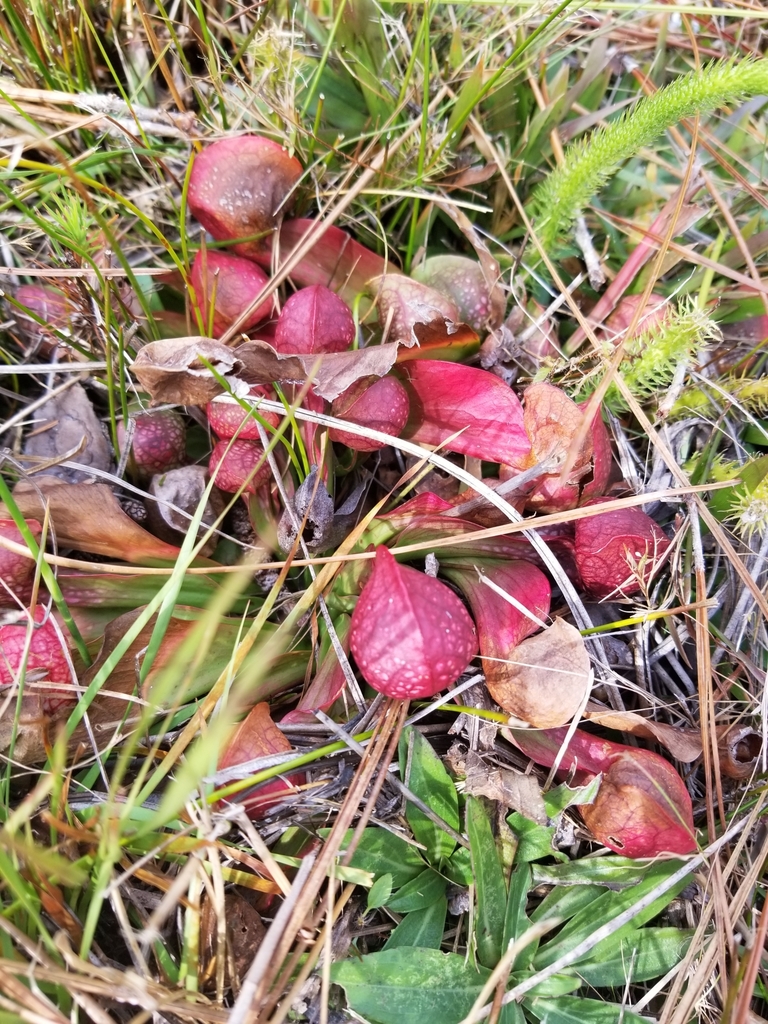
Sarracenia psittacina, the Parrot Pitcherplant, is the smallest and most unusual of the American pitcher plants. Instead of standing upright like trumpets, its pitchers lie flat on the ground in a rosette, and each one ends in a rounded, beak-like hood that gives the plant its name (psittacus is Latin for parrot). The pitchers are green, heavily veined with red, and spotted with translucent white windows. It is a carnivorous perennial in the pitcher plant family (Sarraceniaceae).
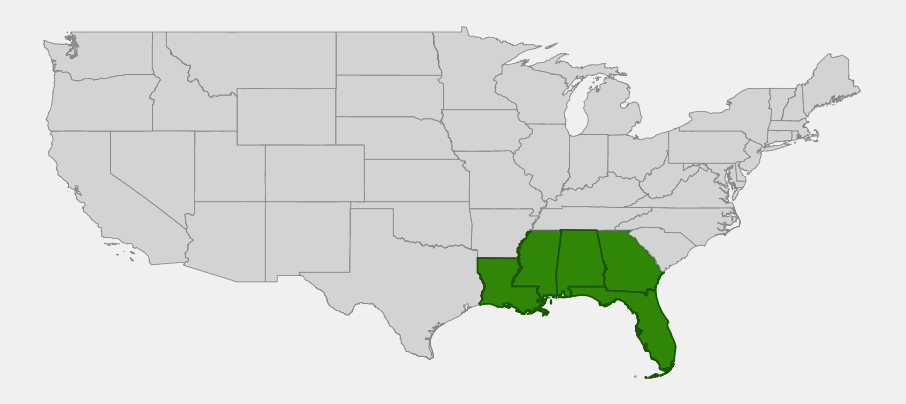
Parrot pitcherplant grows only on the Gulf Coastal Plain, from southeastern Louisiana east through southern Mississippi and Alabama to the Florida Panhandle, northern Florida and southern Georgia. It lives in the wettest parts of open, fire-maintained pine savannas, seepage bogs and pond margins, where its rosettes are often submerged for weeks during winter and spring flooding.
In Florida, parrot pitcherplant is listed as Threatened by the State of Florida (FDACS Regulated Plant Index), and its habitat has declined throughout its range. Gardeners can grow it successfully in a bog garden, but only from nursery-propagated plants: buy from reputable carnivorous plant nurseries and never collect from the wild.
Identification
No other North American pitcher plant has pitchers that lie flat and end in a closed, bulbous hood. The main difficulty is hybrids: in cultivation and in mixed bogs it crosses with other Sarracenia, and those hybrids have semi-upright pitchers with partly open hoods.
Rhizome & Habit
Each plant grows from a short, branching underground stem (rhizome) in wet peat or sand. Over years a plant forms a cluster of rosettes several inches to about a foot across, with pitchers radiating outward like the spokes of a wheel.
Pitchers
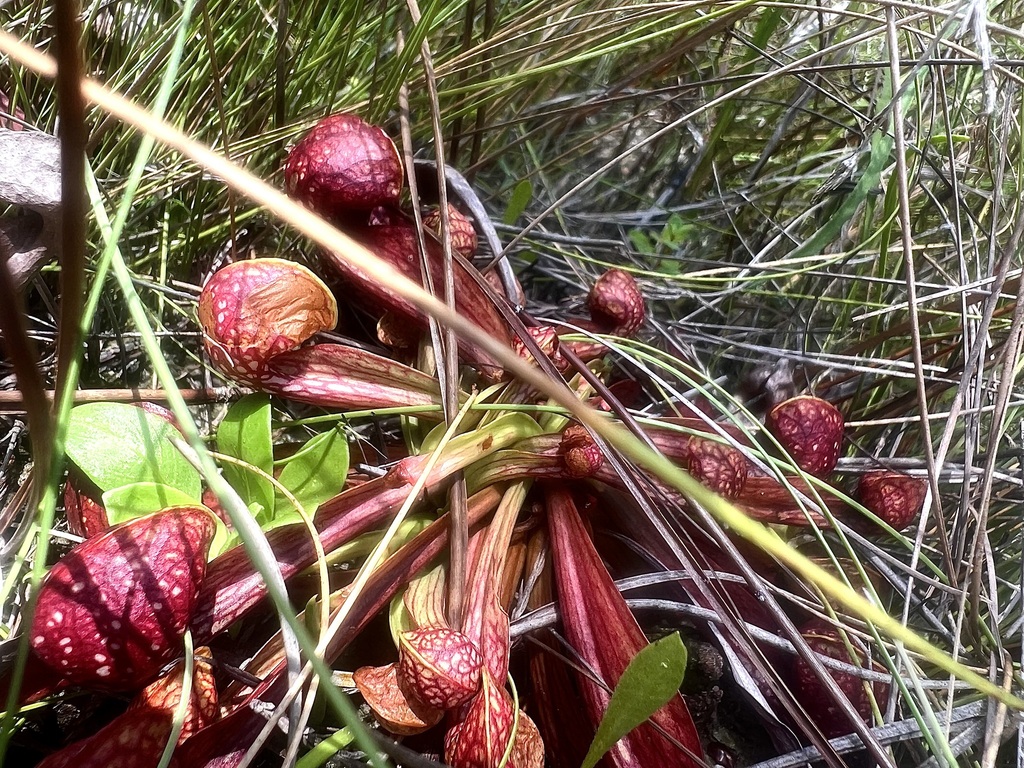
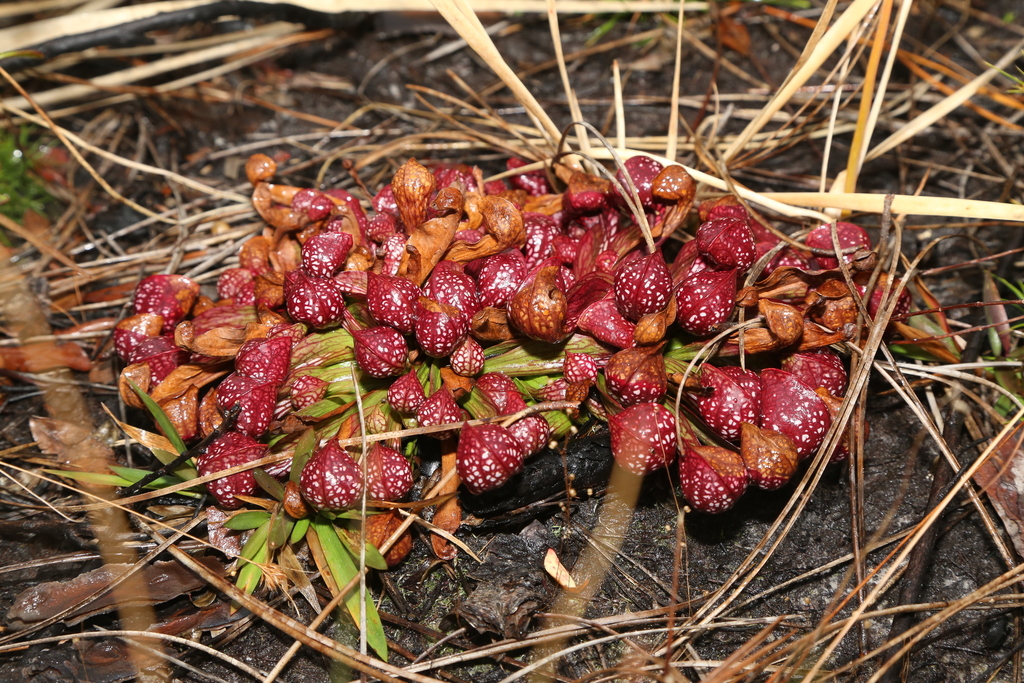
The leaves are modified into hollow tubes about 4 to 12 inches long that lie on the ground or angle slightly upward. Each has a broad wing along its upper side and ends in a globe-shaped hood that curves over the opening. The hood is mottled with white, translucent patches (areoles) between red veins, and the small entrance faces inward, toward the center of the rosette. Color ranges from green with red veins in shade to deep wine-red in full sun. Inside, the tube is lined with downward-pointing hairs.
The pitchers stay green through mild winters and persist for much of the year. New pitchers appear from spring through fall.
Flowers
Flowers appear in early to mid-spring, often before or with the first new pitchers. Each nodding flower stands alone on a leafless stalk about 6 to 12 inches tall, above the rosette. It is about 1½ to 2 inches wide, with five dark red to maroon petals that hang down around an umbrella-shaped green style disc. The structure is typical of Sarracenia and makes bees enter from below and pick up pollen on the way out.
Fruit & Seeds
After pollination the flower ripens into a rounded, warty capsule. It splits in late summer or fall and releases many small seeds, which fall near the parent or are washed across the bog by flowing water.
Quick Facts
| Scientific Name | Sarracenia psittacina Michx. |
| Family | Sarraceniaceae (pitcher plant family) |
| Plant Type | Carnivorous herbaceous perennial from a rhizome |
| Mature Height | 2–6 in (pitchers lie flat); flower stalks 6–12 in |
| Mature Spread | 6–12 in per rosette; slowly forms clumps |
| Growth Rate | Slow |
| Sun Exposure | Full sun |
| Water Needs | High; soil must stay wet, tolerates temporary submersion |
| Soil Type | Sphagnum peat, wet peaty sand |
| Soil pH | Acidic (about 4.0–5.5) |
| Bloom Time | March–April |
| Flower Color | Dark red to maroon |
| Fall Color | Pitchers deepen to wine-red in cool weather |
| Fruit | Rounded capsule with many small seeds |
| Deer Resistant | Yes |
| USDA Hardiness Zones | 7–9 |
Native Range
Parrot pitcherplant has one of the smallest ranges of any Sarracenia. USDA PLANTS and the Lady Bird Johnson Wildflower Center record it from five states: Louisiana, Mississippi, Alabama, Georgia and Florida. Within those states it is confined to the outer Gulf Coastal Plain, from the Florida parishes of southeastern Louisiana east to the Florida Panhandle and northern Florida, with outlying populations in southern Georgia.
In Florida it grows mainly in the Panhandle and the northern part of the peninsula, in wet pine flatwoods and savannas, seepage slopes and the shallow margins of ponds and streams. It often grows in the wettest, lowest spots in a bog, where its rosettes may be underwater for weeks during winter and spring. The State of Florida lists it as Threatened (FDACS Regulated Plant Index), meaning it may not be collected from the wild without permission.
Its biggest threats are habitat loss and the absence of fire. Many Gulf Coast pitcher plant bogs have been drained, converted to pine plantations or developed, and bogs that are not burned are soon shaded by shrubs and trees. Collecting is an added pressure. Plants for gardens should always come from nurseries that propagate their own stock.
📋 Regional plant lists featuring Parrot Pitcherplant: North & South Florida · Alabama, Georgia & Mississippi · Arkansas, Louisiana, Eastern Oklahoma & Eastern Texas
Growing & Care Guide
Parrot pitcherplant is one of the easier Sarracenia to grow and is widely available from carnivorous plant nurseries as propagated plants. Because it is state-listed as Threatened in Florida and declining in the wild, always buy nursery-propagated plants and never collect them from the wild. It suits a bog garden, a container bog or a tray of sphagnum kept wet with rainwater.
Light
Full sun gives the best color and the strongest plants. In shade the pitchers stay pale green and weak. Six or more hours of direct sun is ideal.
Soil & Water
Grow it in a nutrient-free mix of sphagnum peat and lime-free sand or perlite, kept constantly wet. It tolerates waterlogging better than other pitcher plants and can even be submerged for periods in winter, as in the wild. Use rainwater, distilled water or reverse-osmosis water. Tap water and well water often carry minerals that build up and kill Sarracenia. Never fertilize the soil.
Planting Tips
Plant in spring with the rhizome just below the surface and the rosette at soil level. Because the pitchers lie flat, place it at the front of a bog garden where taller pitcher plants will not shade it. In containers, use a pot without drainage holes or set a pot in a saucer kept full of water. It is hardy outdoors through most of the Southeast. In colder regions, give it winter protection or grow it in a cool, unheated space.
Pruning & Maintenance
Trim pitchers once they turn brown, usually in late winter or spring. Pull out grasses, shrubs and tree seedlings that would shade the rosettes. Plants need a cool, semi-dormant winter to stay healthy for years. Do not feed them insects or fertilizer; they catch enough food on their own outdoors.
Propagation
Divide large clumps in late winter or early spring by cutting the rhizome into sections that each have a growing point. Seed needs about four to eight weeks of cold, moist stratification and is sown on the surface of wet peat. Seedlings take several years to reach blooming size. Nurseries also propagate it by tissue culture, which is why legally grown plants are easy to find.
Landscape Uses
- Bog gardens: front-of-bog accent with low rosettes of hooded pitchers
- Container bogs: one of the best pitcher plants for a tub, bowl or tray kept wet with rainwater
- Carnivorous plant collections: a beginner-friendly Sarracenia with an unusual trap design
- Pond margins: in shallow, sunny, acidic water at the edge of a lined bog or wildlife pond
- Educational displays: shows the “lobster pot” trap and the use of light windows to confuse prey
Wildlife & Ecological Value
Parrot pitcherplant is an insect predator, but it also interacts with pollinators and other wildlife in its fire-maintained bogs.
For Pollinators
Bumble bees and other large bees pollinate the nodding red flowers in spring. They push past the hanging petals, brush against the stigmas under the umbrella-shaped style, and pick up pollen inside the flower before leaving through a gap between the petals. Because the flowers open early, before most pitchers are fully active, pollinators are less likely to be caught.
For Birds
Parrot pitcherplant has little direct value to birds. Its habitat, the open, wet longleaf pine savanna, supports birds such as Bachman’s sparrow, Henslow’s sparrow in winter and the red-cockaded woodpecker in the surrounding pines.
For Mammals
Mammals rarely eat it. Feral hogs damage many Gulf Coast bogs by rooting through the soil.
Ecosystem Role
The pitcher works like a lobster pot. Ants, beetles and other crawling insects enter the small opening, attracted by nectar secreted near it. Once inside, they move toward the light coming through the white windows in the hood, cannot find the way out, and are pushed farther into the tube by the downward-pointing hairs. When the rosettes are submerged in flooded bogs, the pitchers may also trap small aquatic animals. Like other pitcher plants, it depends on fire to keep its habitat open and sunny.
Cultural & Historical Uses
The French botanist André Michaux described parrot pitcherplant in his Flora Boreali-Americana (1803), after traveling in the southeastern United States in the 1780s and 1790s. The species name comes from the Latin psittacus, parrot, a reference to the curved hood. The genus Sarracenia honors Michel Sarrazin, a physician and naturalist in New France who sent plants to European botanists in the early 1700s.
Pitcher plants of the Gulf Coast attracted botanists for centuries, but their bogs remained little known to the public until conservation groups began protecting them in the late twentieth century. Several Gulf Coast preserves and national forests now manage pitcher plant bogs with prescribed fire, and parrot pitcherplant is often among the species they highlight.
In horticulture, parrot pitcherplant is a common parent of hybrid pitcher plants, passing on its hooded pitchers and compact size. Growing propagated plants of the true species keeps collecting pressure off the threatened wild populations.
Frequently Asked Questions
Is parrot pitcherplant endangered?
It is not federally listed, but the State of Florida lists it as Threatened (FDACS Regulated Plant Index), and it has declined across its small Gulf Coast range because of drainage, development and fire suppression. Buy only nursery-propagated plants and never collect it from the wild.
How does parrot pitcherplant catch insects?
Insects enter the small opening under the hood, attracted by nectar, then move toward light coming through the translucent windows in the hood. Downward-pointing hairs guide them deeper into the tube, where they are digested.
Can parrot pitcherplant grow underwater?
It tolerates temporary submersion well, and wild plants are often underwater for weeks in winter and spring. It should not be kept permanently submerged in a garden.
What water should I use for parrot pitcherplant?
Use rainwater, distilled water or reverse-osmosis water. Mineral-rich tap water and well water can slowly kill pitcher plants.
Does parrot pitcherplant need a dormant period?
Yes. It needs a cool winter rest, with shorter days and cooler temperatures, to stay healthy. Outdoors in the Southeast this happens naturally.

Looking for a nursery that carries Parrot Pitcherplant?
Browse our native plant nursery directory: Alabama · Florida & Georgia · Louisiana & Mississippi