
Texas Tickseed (Coreopsis linifolia)
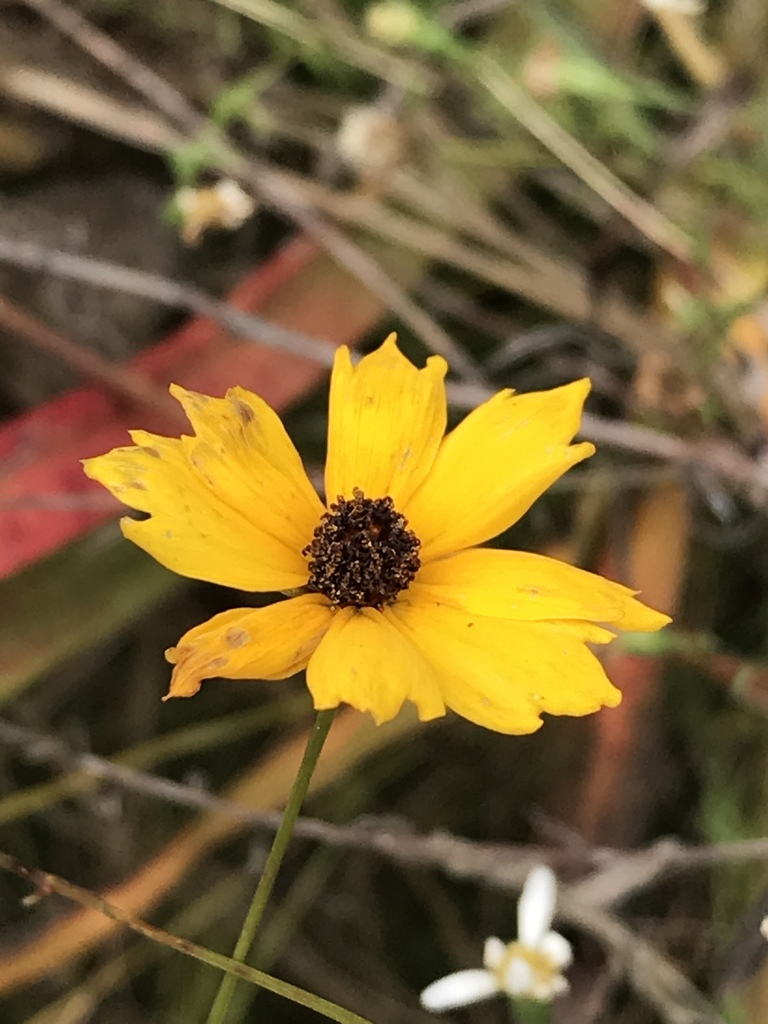
Coreopsis linifolia, known as Texas Tickseed, is a slender, late-blooming perennial tickseed of wet pine savannas, flatwoods and seepage bogs on the Southeastern Coastal Plain. From late summer into fall it lifts golden, daisy-like flower heads with dark reddish-brown centers on wiry stems 1 to 2½ feet tall, often in loose drifts among wiregrass, pitcher plants and other savanna wildflowers. It is a member of the aster family (Asteraceae) and one of roughly a dozen Coreopsis species native to the Southeast.
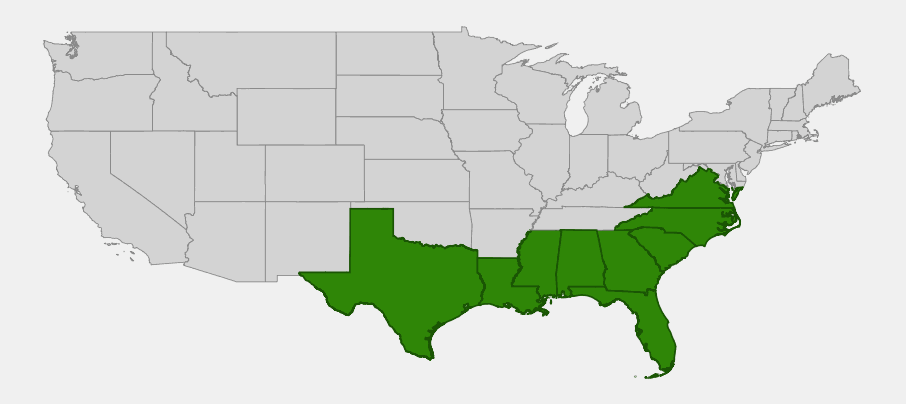
The common name is misleading. Texas tickseed is the name used by USDA PLANTS and the Atlas of Florida Plants, but the plant is not a Texas specialty at all. Its range runs along the Atlantic and Gulf Coastal Plain from southeastern Virginia through the Carolinas, Georgia and the Florida Panhandle to Louisiana and the pine savannas of east Texas. Some gardeners and field guides prefer the more descriptive names “savanna tickseed” or “flax-leaved tickseed”, the second being a direct translation of linifolia.
Texas tickseed is closely related to coastal plain tickseed (Coreopsis gladiata), and some older manuals treated it as a variety of that species. Both share wet pinelands and late-season flowers. This guide covers how to tell Texas tickseed apart, where it grows, how to grow it in a sunny, moist garden or rain garden, and why it is worth planting for fall pollinators.
Identification
Texas tickseed is easiest to identify in bloom, when its yellow heads with dark centers rise well above a low cluster of basal leaves. Look closely at the leaves too: their shape and the fine glandular dots on them separate it from similar tickseeds.
Stems & Growth Habit
Each plant forms a small clump from a short rootstock, sending up one to several upright, smooth, slender stems usually 1 to 2½ feet tall. The stems branch in the upper part, each branch ending in a single flower head on a long, nearly leafless stalk. Before flowering, the plant is inconspicuous among grasses and sedges.
Leaves
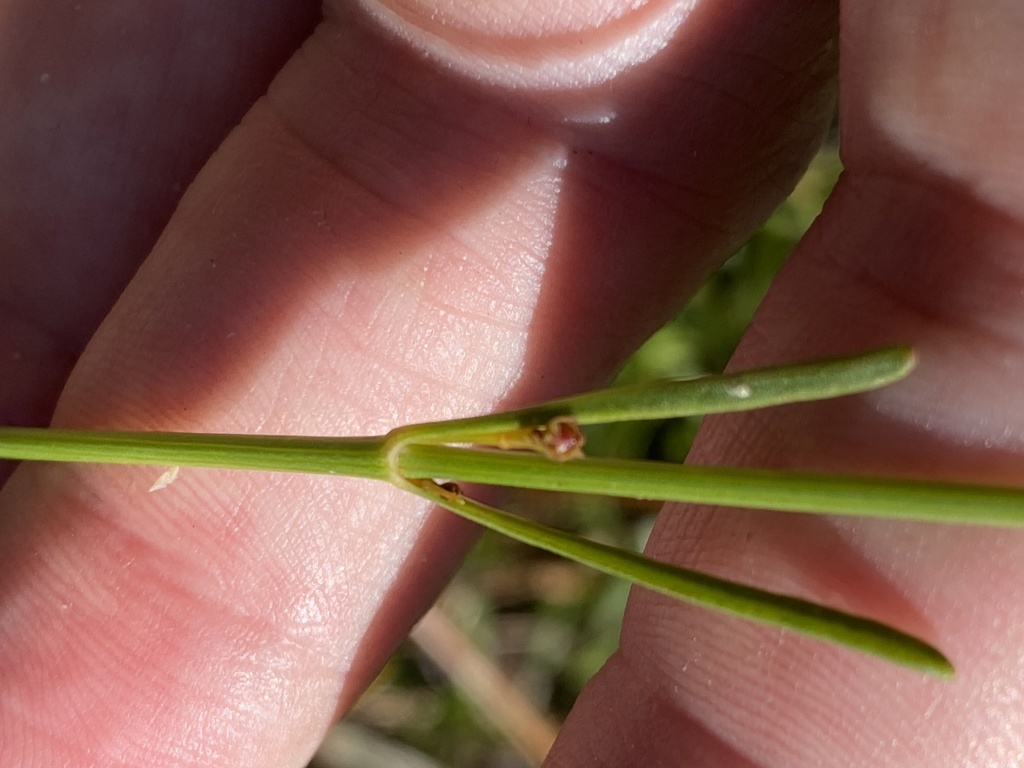
The leaves are smooth and somewhat fleshy. Basal leaves are the largest, narrowly elliptic to oblanceolate with long stalks, up to about 4 or 5 inches long. Leaves on the stem are few and become progressively narrower upward until they are almost thread-like, which is the source of the species name (Latin linum, flax, and folium, leaf). Under a hand lens the leaf surfaces are usually sprinkled with tiny dark glandular dots, a feature botanists use to separate this species from coastal plain tickseed, whose leaves are typically broader and lack obvious dots.
Flowers
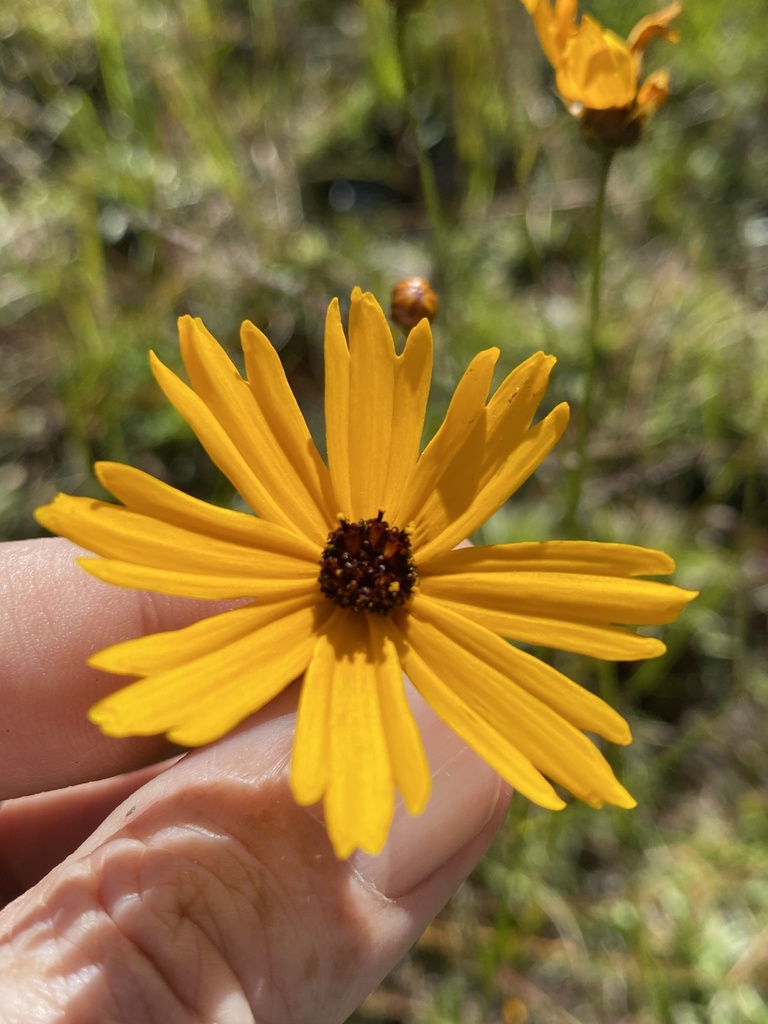
The flower heads are about 1 to 1½ inches across. Each has about eight bright yellow ray florets that are broad and shallowly toothed at the tip, around a central disk of small, dark reddish-purple to brown disk florets. Heads open over several weeks, so a clump stays in flower for a long time.
Texas tickseed blooms from late summer into fall, mostly from August through October, and some plants keep flowering into November in the Gulf states. That timing sets it apart from spring-blooming tickseeds such as Lanceleaf Coreopsis.
Fruit & Seeds
After flowering, each head produces a cluster of small, flat, dark achenes (technically cypselae). Like other tickseeds they are shaped vaguely like a tick, which explains the common name of the whole group. They drop near the parent plant or are eaten by small seed-eating birds.
Similar Species
Coastal plain tickseed (C. gladiata) grows in the same habitats and blooms at the same time. It usually has broader stem leaves without conspicuous dots. Florida Tickseed (C. floridana) of peninsular Florida has larger heads and thicker, broader leaves. In doubtful cases, a regional flora or a local botanist is the best guide.
Quick Facts
| Scientific Name | Coreopsis linifolia (sometimes treated as C. gladiata var. linifolia); USDA PLANTS and the Atlas of Florida Plants both accept C. linifolia |
| Family | Asteraceae (aster family) |
| Plant Type | Herbaceous perennial wildflower |
| Mature Height | 1–2½ ft in flower |
| Mature Spread | 6–12 in per clump |
| Growth Rate | Moderate |
| Sun Exposure | Full sun |
| Water Needs | Moderate to high; moist to seasonally wet soil |
| Soil Type | Acidic sand, peaty sand or sandy loam |
| Soil pH | About 4.5–6.5 (acidic) |
| Bloom Time | August–October, sometimes into November |
| Flower Color | Golden yellow rays with a dark reddish-brown disk |
| Fall Color | None notable; basal leaves often stay green through mild winters |
| Fruit | Small flat dark achenes (cypselae) |
| Deer Resistant | Moderate; deer occasionally browse the flower stalks |
| USDA Hardiness Zones | 7–9 |
Native Range
Texas tickseed is a Coastal Plain endemic of the southeastern United States. USDA PLANTS and the Lady Bird Johnson Wildflower Center record it from nine states: Virginia, North Carolina, South Carolina, Georgia, Florida, Alabama, Mississippi, Louisiana and Texas. Across that range it stays on the low, flat, sandy terrain of the Coastal Plain and does not reach the Piedmont or the mountains.
In Florida, the Atlas of Florida Plants lists it as native, and records cluster in the Panhandle, in Escambia, Santa Rosa and Okaloosa counties and east to Liberty and Franklin counties near the Apalachicola River. In Florida it is essentially a Panhandle plant, where Florida tickseed and coastal plain tickseed take its place in similar habitats. Farther west, it is a characteristic fall wildflower of the longleaf pine savannas and pitcher plant bogs of southern Mississippi, Louisiana and the Big Thicket region of east Texas.
Its habitat is almost always open, sunny and wet for part of the year: wet pine savannas and flatwoods, seepage slopes, herb bogs, the edges of cypress domes and depressions, and moist roadside ditches that mimic those conditions. These are fire-maintained ecosystems. Where pinelands are burned regularly, Texas tickseed can be common; where fire is excluded and shrubs close in, it declines.
📋 Regional plant lists featuring Texas Tickseed: North & South Florida · Alabama, Georgia & Mississippi · North & South Carolina · Maryland, Virginia & West Virginia · Arkansas, Louisiana, Eastern Oklahoma & Eastern Texas
Growing & Care Guide
Texas tickseed is not difficult to grow, but it is rarely sold. Most native nurseries carry coastal plain tickseed, lanceleaf coreopsis or the annual plains coreopsis instead. Look for it at native plant society sales or regional native nurseries in the Gulf states and the Carolinas, or grow it from seed collected responsibly with permission. It rewards gardeners who have a sunny, moist spot that other perennials find too wet.
Light
Give Texas tickseed full sun. It flowers best with at least six hours of direct sun, and in shade it becomes leggy and sparse. In the wild it disappears from savannas when shrubs and trees close in.
Soil & Water
Plant it in acidic, sandy or peaty soil that stays moist through most of the year and may be wet in winter and spring. It handles seasonally soggy soil and brief flooding well, which makes it a good choice for rain gardens, swales and the margins of bog gardens. Average garden beds work if they are watered during long dry spells. Avoid rich, heavily fertilized soil, which produces floppy stems and fewer flowers.
Planting Tips
Plant container-grown plants in spring or fall, 12 to 18 inches apart in groups of at least five so the late flowers make a show. Seed can be sown on the soil surface in fall or winter; it needs light and a period of cool, moist conditions to germinate well. Combine it with grasses and wildflowers of similar size, such as muhly grass, blazing stars and meadow beauties, so the slender stems have support.
Pruning & Maintenance
Leave the seed heads standing into winter for birds, then cut the old stems to the ground in late winter. Mowing or cutting back a savanna-style planting once a year in late winter imitates the effect of fire and keeps woody seedlings out. Plants are relatively short-lived, so let a few seeds fall each year to keep the planting going.
Propagation
Grow it from fresh seed sown outdoors in fall or from seed cold-stratified for several weeks in the refrigerator before spring sowing. Established clumps can also be divided carefully in late winter. Seedlings usually flower in their second year.
Landscape Uses
- Rain gardens and swales: tolerates the cycle of wet and dry soil in the lower parts of a rain garden
- Wet savanna and pine flatwoods restoration: a characteristic fall wildflower of fire-maintained Coastal Plain pinelands
- Bog garden margins: pairs well with pitcher plants and other sun-loving wetland species
- Fall pollinator gardens: adds late-season nectar and pollen when many other wildflowers are finished
- Naturalistic meadows: blends with grasses and asters in moist, sunny meadows within its range
Wildlife & Ecological Value
Like most tickseeds, Texas tickseed is a dependable source of food for pollinators, and its late bloom period makes it more valuable than its modest size suggests.
For Pollinators
The open flower heads offer easy access to nectar and pollen for native bees, including small sweat bees, mining bees and leafcutter bees, as well as butterflies, skippers, hover flies and beetles. Because it flowers in late summer and fall, it overlaps with the migration of monarchs and other butterflies and with the late flights of native bees preparing for winter.
For Birds
The small achenes are eaten by seed-eating birds such as goldfinches and sparrows, especially when stems are left standing into fall and winter. The open savannas where it grows also support Bachman’s sparrows, brown-headed nuthatches and other pineland birds.
For Mammals
Texas tickseed has little direct value for mammals. Deer and rabbits occasionally nibble flower stalks but rarely damage established clumps.
Ecosystem Role
Texas tickseed is part of the diverse ground-layer flora of longleaf pine savannas, one of the most species-rich plant communities in North America. Like many savanna wildflowers, it depends on frequent low-intensity fire to keep the habitat open and sunny. Its presence along roadsides and in power-line corridors often signals that remnant savanna plants survive nearby.
Cultural & Historical Uses
The English-born naturalist Thomas Nuttall named Coreopsis linifolia in the nineteenth century, during his years of collecting across the southern United States. The genus name comes from the Greek koris, bug, and opsis, appearance, a reference to the tick-like shape of the seeds that also gave the plants their English name, tickseed.
There is little recorded use of this particular species. Several other Coreopsis species were traditionally used to make yellow and orange dyes and herbal teas, but Texas tickseed is valued mainly as a wildflower of the savannas and as a source of food for insects and birds.
Coreopsis was designated the state wildflower of Florida in 1991, a designation that covers all the native species in the genus, including this one. Florida’s Department of Transportation and many county programs encourage tickseeds along roadsides, where several native species, including Texas tickseed in the Panhandle, add color in season.
Frequently Asked Questions
Why is it called Texas tickseed if it grows in Florida and the Carolinas?
The name is a historical label rather than a description of its range. Texas tickseed grows along the whole Southeastern Coastal Plain from Virginia to east Texas. USDA PLANTS and the Atlas of Florida Plants use the name Texas tickseed, and some field guides call it savanna tickseed instead.
Is Texas tickseed easy to find at nurseries?
Not usually. It is rarely sold compared with lanceleaf coreopsis or coastal plain tickseed. Check native plant society sales and regional native nurseries in the Southeast, or start it from seed.
Can Texas tickseed grow in wet soil?
Yes. It is a facultative wetland plant that grows naturally in seasonally wet pine savannas and bogs. It is a good choice for rain gardens and moist, sunny spots, as long as the soil is acidic and not overly rich.
How is it different from coastal plain tickseed?
The two are very similar and grow together. Texas tickseed usually has narrower, almost thread-like upper leaves that are dotted with tiny dark glands. Coastal plain tickseed (C. gladiata) tends to have broader leaves without conspicuous dots.
When does Texas tickseed bloom?
Mostly from August through October, with some flowers into November along the Gulf Coast. It is one of the later-blooming tickseeds, so it is useful for extending the season in a native garden.

Looking for a nursery that carries Texas Tickseed?
Browse our native plant nursery directory: Alabama · Florida & Georgia · Louisiana & Mississippi · North Carolina · South Carolina, Texas & Virginia