
Bartram’s Rose Gentian (Sabatia bartramii)
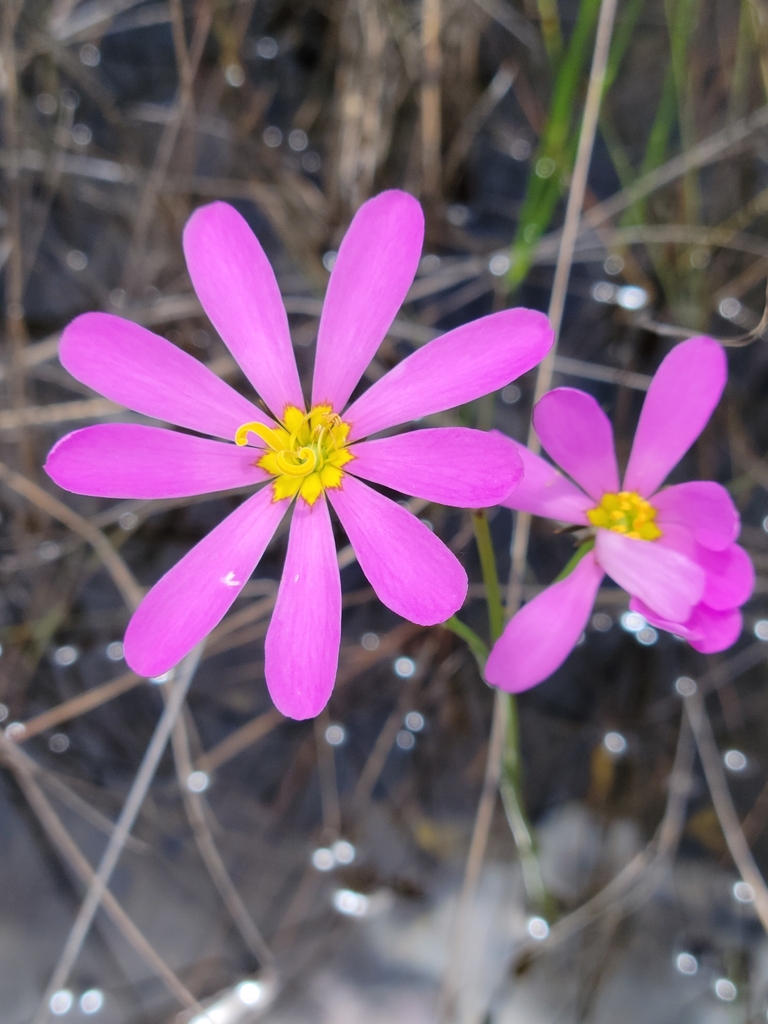
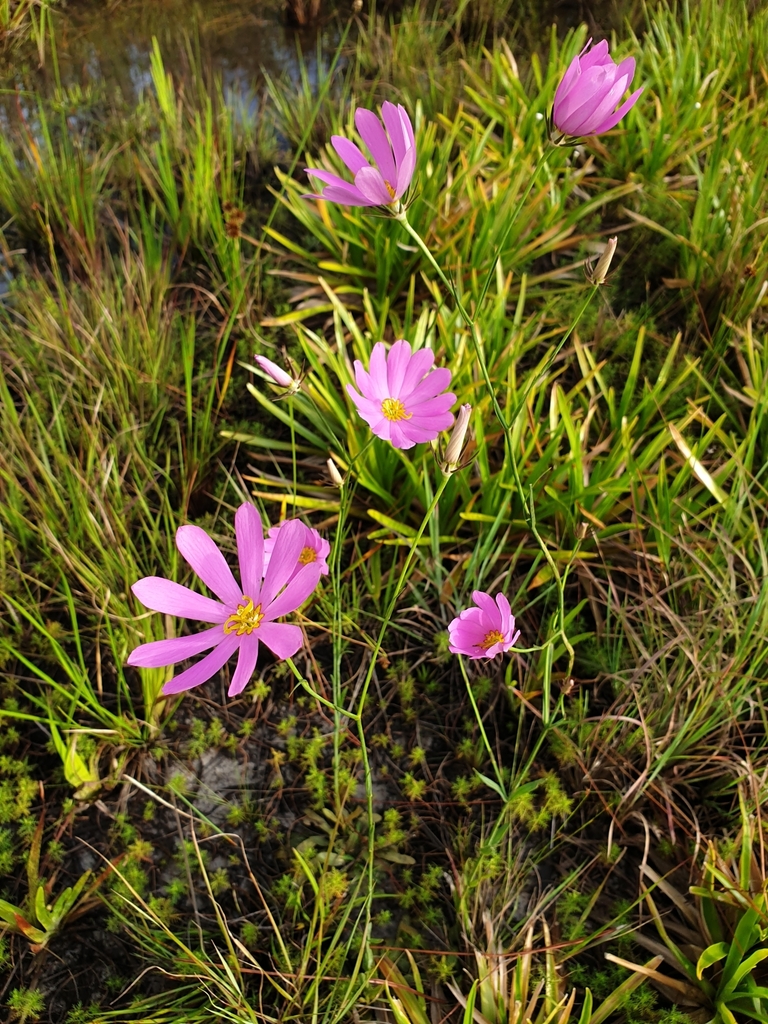
Sabatia bartramii, Bartram’s Rose Gentian (also written Bartram’s rosegentian or Bartram’s marsh pink), is one of the showiest wildflowers of Southeastern wetlands. In summer its slender stems carry hot-pink flowers up to about 2½ inches across, each with 8 to 14 narrow petals around a bright yellow star outlined in red. It belongs to the gentian family (Gentianaceae) and grows in wet pine savannas and flatwoods, pond and cypress-dome margins, freshwater marshes and wet roadside ditches, sometimes standing in shallow water.
The plant has two scientific names in current use. USDA PLANTS and the Lady Bird Johnson Wildflower Center use Sabatia bartramii, the name Robert Wilbur published in 1955. The Atlas of Florida Plants and the Flora of North America use the older name Sabatia decandra, based on Thomas Walter’s 1788 Chironia decandra. Both names refer to the same plant. Older Carolina floras also treated it as Sabatia dodecandra var. coriacea.
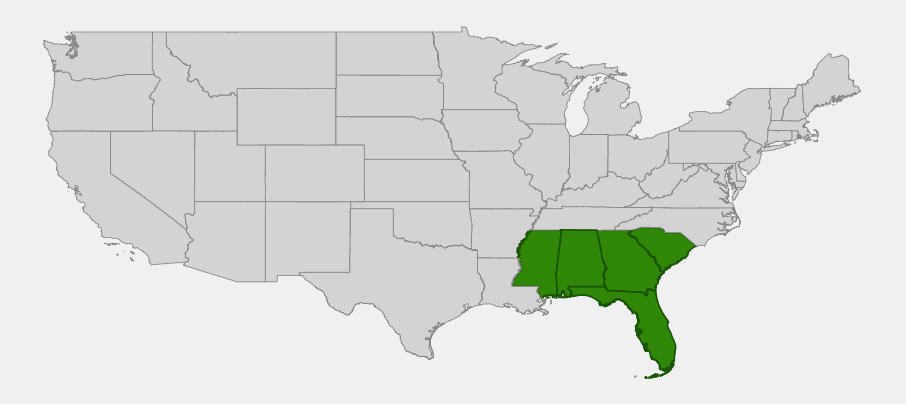
Bartram’s rose gentian is a Coastal Plain plant, native from northeastern South Carolina south through Florida and west to southern Alabama and southeastern Mississippi. In Florida it occurs nearly throughout the state. This guide explains how to tell it apart from similar rose gentians, where it grows, how to grow it in a wet garden, and its place in fire-maintained wetlands.
Identification
Several pink, many-petaled Sabatia species grow in the Southeast, and they can be hard to separate. Bartram’s rose gentian is the largest-flowered of the wetland group. Look for its narrow stem leaves, the thick calyx lobes, and its preference for the wettest sites.
Stems & Leaves
Bartram’s rose gentian is a perennial with a single, round stem 1 to about 3 feet tall that branches above, usually alternately. In spring it forms a rosette of somewhat fleshy, oblanceolate to spoon-shaped basal leaves, 1½ to 4 inches long. The leaves on the flowering stem are quite different: few, narrow, linear to lance-shaped, opposite, and usually 1 to 2 inches long. The Flora of North America notes that they are usually no wider than the stem, which helps separate this species from its relatives. The basal leaves often wither by the time the plant blooms.
Flowers
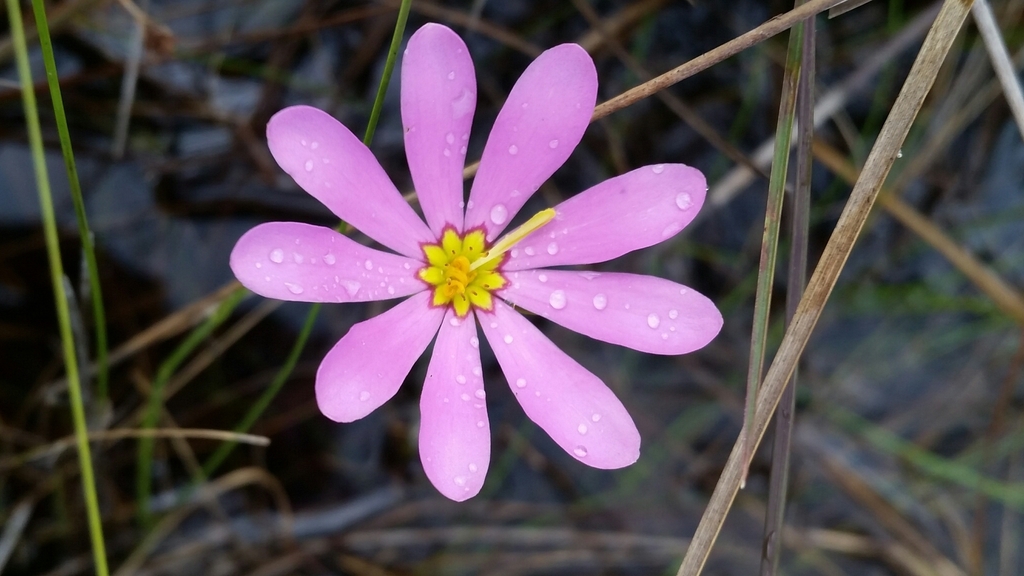
Flowers are borne singly or in pairs at the ends of long, slender branches, often 3 to 5 inches long, so each blossom seems to float above the surrounding grasses. Each flower has 8 to 12 (rarely up to 14) petal lobes, most often about 10. They are bright rose-pink, rarely white, and up to about 1½ inches long. At the center is a yellow eye whose points extend into the base of each petal, usually edged in red, forming a starburst. The yellow, twisted stigma stands in the middle, and the anthers coil into little spirals as they shed pollen.
The calyx lobes below the petals are long and narrow, and in this species they are thickened, semicircular in cross section rather than thin and flat. Flowering runs from late spring through summer and into early fall, peaking from June to August.
Fruit & Seeds
After flowering, the ovary ripens into a small, rounded capsule that splits open to release many tiny seeds. The dry stems and capsules often stand into fall.
Similar Species
Large marsh pink (Sabatia dodecandra) is very similar but has wider stem leaves and thin, flat calyx lobes, and it extends farther north along the Atlantic coast. Plymouth gentian (S. kennedyana) is a rare plant of New England and Nova Scotia pond shores. Five-petaled pinks, such as rosepink (S. angularis) and the Florida native S. grandiflora, have only five petals, which separates them at once.
Quick Facts
| Scientific Name | Sabatia bartramii Wilbur (syn. Sabatia decandra, Chironia decandra, S. dodecandra var. coriacea) |
| Family | Gentianaceae (gentian family) |
| Plant Type | Herbaceous perennial wildflower |
| Mature Height | 1–3 ft |
| Mature Spread | 6–12 in |
| Growth Rate | Moderate |
| Sun Exposure | Full sun |
| Water Needs | High; wet to saturated soil, tolerates shallow standing water |
| Soil Type | Wet sand, peaty sand or muck |
| Soil pH | Acidic (about 4.5–6.5) |
| Bloom Time | Late spring to early fall; mainly June–August |
| Flower Color | Bright rose-pink with a yellow, red-edged center; rarely white |
| Fall Color | None notable |
| Fruit | Small capsule with many tiny seeds |
| Deer Resistant | Moderate; gentians are bitter and seldom browsed |
| USDA Hardiness Zones | 8–10 |
Native Range
Bartram’s rose gentian is a plant of the southeastern Coastal Plain. USDA PLANTS and the Lady Bird Johnson Wildflower Center record it from five states: South Carolina, Georgia, Florida, Alabama and Mississippi. The Flora of the Southeastern United States describes the range as northeastern South Carolina south to southern Florida and west to southern Alabama and southeastern Mississippi. It is not native outside the United States.
Within that range it is a lowland plant, found from near sea level to about 330 feet (100 m). Florida holds the heart of its range, and the Florida Wildflower Foundation describes it as occurring nearly throughout the state, from the Panhandle savannas to the wet prairies and marl flats of Big Cypress and the Everglades region. In Georgia and the Carolinas it is mostly restricted to the outer Coastal Plain.
Its habitats are wet and open: the margins of pond-cypress and swamp tupelo depressions, wet pine savannas and flatwoods, freshwater marshes, pond and lake edges, and boggy roadside ditches. Many of these places flood in summer, and the plant often blooms with its base in shallow water. Frequent fire keeps these sites open, and rose gentians often flower most heavily in the years after a burn.
📋 Regional plant lists featuring Bartram’s Rose Gentian: North & South Florida · Alabama, Georgia & Mississippi · North & South Carolina
Growing & Care Guide
Bartram’s rose gentian is not a common nursery plant, but native plant nurseries in Florida and the Southeast sometimes offer it, and it is worth seeking out for a wet, sunny spot. Buy plants or seed from nurseries that propagate their own stock rather than collecting from the wild. Like most gentians it can be finicky, and it does best where conditions closely match its native wetlands.
Light
Full sun. In shade it grows weak and flowers poorly, and in the wild it disappears when shrubs close over a savanna or pond edge.
Soil & Water
Plant it in acidic, sandy or peaty soil that stays wet through the growing season. The edge of a pond, a rain garden that holds water, a bog garden or a large container sitting in a saucer of water all work. It tolerates a few inches of standing water in summer and short dry spells in winter, but it will not survive in an ordinary, well-drained bed. Do not fertilize; nutrient-rich soil favors weeds that crowd it out.
Planting Tips
Set plants out in spring or early summer, spacing them 8 to 12 inches apart, among low grasses, sedges and other wetland wildflowers rather than in bare soil. Mark their position, since the plants are inconspicuous when not in bloom.
Pruning & Maintenance
Leave the stems standing after flowering so the capsules can ripen and drop seed. Pull taller, aggressive plants that would shade it. In naturalistic wet meadows, a late-winter mowing or prescribed burn every few years mimics the fires that keep its habitat open.
Propagation
Grow it from seed. The seed is dust-fine and needs light to germinate: sprinkle it on the surface of moist, sandy peat and keep it constantly damp. Seedlings form a small rosette first and usually bloom in their second year. Established plants may also self-sow on bare, wet soil nearby.
Landscape Uses
- Pond and lake edges: a vivid summer accent along sunny, wet shorelines
- Rain and bog gardens: with pitcher plants, meadow beauties and yellow-eyed grasses
- Wet meadow and savanna restoration: within its Coastal Plain range, using propagated seed
- Pollinator gardens: a summer nectar and pollen source for bees in wet sites
- Containers: in a large tub or pot kept standing in water
Wildlife & Ecological Value
Bartram’s rose gentian is a conspicuous member of Southeastern wetland communities, and its bright flowers draw insects from across the savanna.
For Pollinators
The open, bowl-shaped flowers offer pollen and nectar that are easy for many insects to reach. Bees, including bumblebees and smaller native bees, are the main visitors, and butterflies and flies visit as well. Like other rose gentians, the flowers shed pollen before the stigma becomes receptive, which encourages cross-pollination between plants.
For Birds
The plant has little direct food value for birds. Its wet savanna and marsh-edge habitats support wading birds, sparrows and other wetland birds.
For Mammals
Gentians contain bitter compounds, and this species is seldom eaten by deer or rabbits.
Ecosystem Role
Bartram’s rose gentian is part of the diverse, fire-maintained ground layer of Coastal Plain savannas and pond margins. Its abundance tends to reflect healthy natural water levels and regular fire. Drainage, development and fire suppression have reduced these wetlands across much of its range.
Cultural & Historical Uses
The common name honors William Bartram (1739–1823), the Philadelphia naturalist who traveled through the Carolinas, Georgia and Florida in the 1770s and described their landscapes in his Travels (1791). The genus name Sabatia honors the eighteenth-century Italian botanist Liberato Sabbati.
The plant’s naming history is tangled. Thomas Walter described Chironia decandra in his Flora Caroliniana of 1788, but no specimen survived. Robert Wilbur concluded in 1955 that Walter’s description was too uncertain to apply, and he gave the species the new name Sabatia bartramii. Later, in 2007, Daniel Ward designated a modern type specimen for Walter’s name, and some floras returned to Sabatia decandra. Both names are still widely used.
Rose gentians in general have long been valued as bitter tonic plants in American folk medicine, and the genus is sometimes called marsh pinks. Today Bartram’s rose gentian is mainly appreciated as one of the most striking summer wildflowers in Florida’s wet prairies and savannas.
Frequently Asked Questions
Is Sabatia bartramii the same as Sabatia decandra?
Yes. USDA PLANTS and the Lady Bird Johnson Wildflower Center use Sabatia bartramii, while the Atlas of Florida Plants and the Flora of North America use Sabatia decandra. They are two names for the same plant.
How many petals does Bartram’s rose gentian have?
Usually about 10, but anywhere from 8 to 12, and occasionally up to 14. Five-petaled pink Sabatia species are different plants.
Can I grow Bartram’s rose gentian in a regular garden bed?
Not easily. It needs full sun and soil that stays wet all summer. A pond edge, bog garden, rain garden or a container kept in a saucer of water is a much better choice.
When does it bloom?
From late spring into early fall, mainly June through August, with the latest flowers in September and October.
Where can I get plants?
Look for native plant nurseries in Florida and the Southeast that grow it from seed. Never dig plants from the wild; they rarely survive transplanting.

Looking for a nursery that carries Bartram’s Rose Gentian?
Browse our native plant nursery directory: Alabama · Florida & Georgia · Mississippi · South Carolina