
Bigflower Pawpaw (Asimina obovata)
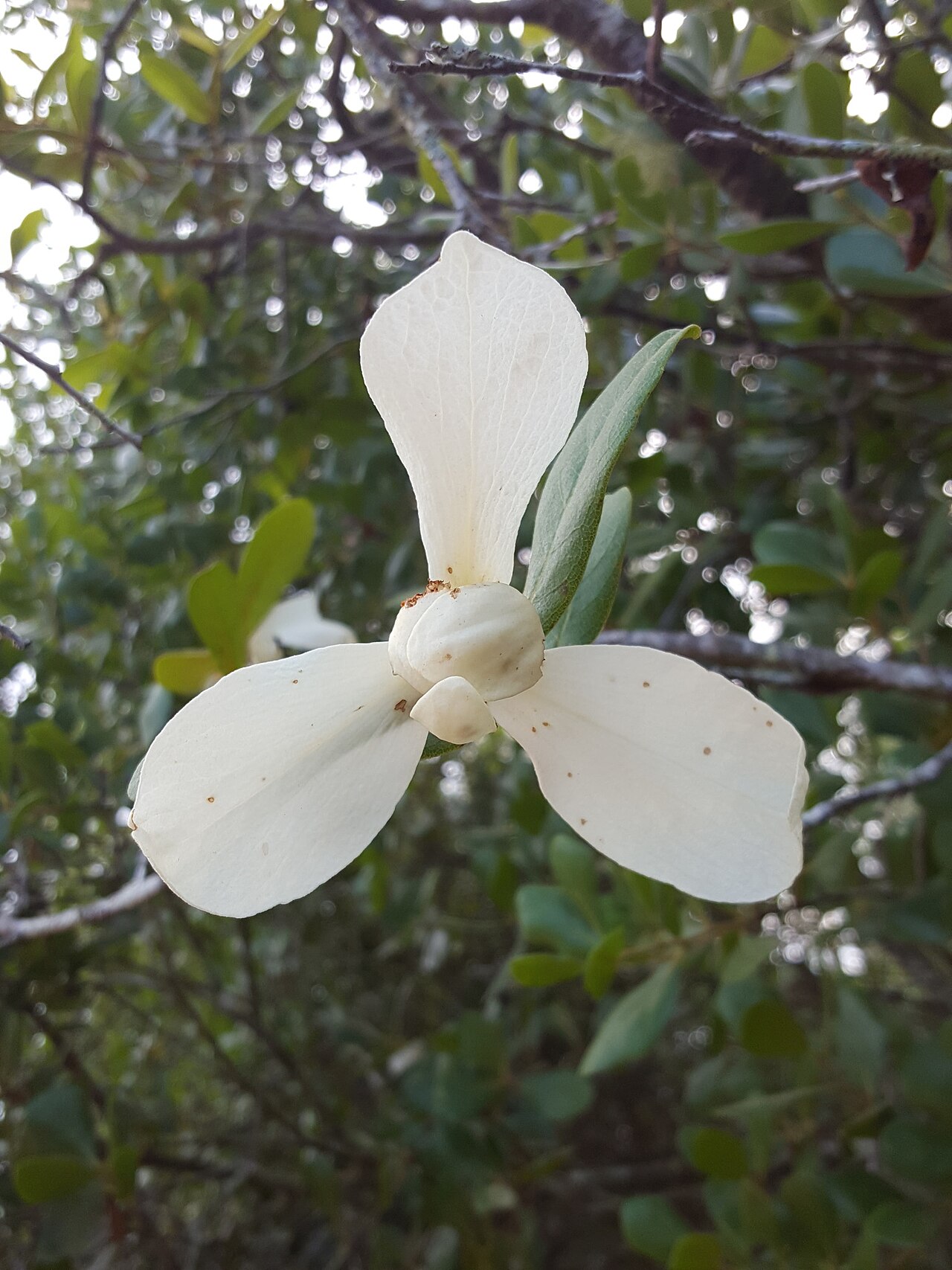
Asimina obovata, known as Bigflower Pawpaw or flag pawpaw, is a shrub or small tree of the dry sand ridges of peninsular Florida. In spring it produces some of the largest flowers of any native Florida shrub: creamy white, fragrant blossoms up to about 4 inches across, held among thick, blunt, leathery leaves. Later in the season it bears green, oblong fruits that are relatives of the familiar pawpaw of eastern forests.
Bigflower pawpaw belongs to the custard apple family (Annonaceae), a mostly tropical family that also includes the cherimoya and soursop. The genus Asimina is the only part of that family that reaches far into temperate North America, and Florida is the center of its diversity, with several species found nowhere else. Bigflower pawpaw is one of these: it is endemic to Florida per the Atlas of Florida Plants, growing wild in no other state or country. Older books sometimes call it Pityothamnus obovatus.
It grows in scrub, sandhills and dry, sandy oak woods from northeast Florida south through the central ridges. Because its range is small and much of its scrub habitat has been cleared for housing and citrus, gardeners should buy only nursery-propagated plants or seed-grown stock and never collect from the wild. This guide covers how to identify it, where it grows, and how to use it in a dry, sunny Florida landscape.
Identification
Florida has about ten native pawpaw species, and several share the same scrub and sandhill habitats. Bigflower pawpaw stands out for its large, pure white to cream flowers that open with or after the new leaves, and for its thick, rounded leaves.
Growth Form & Bark
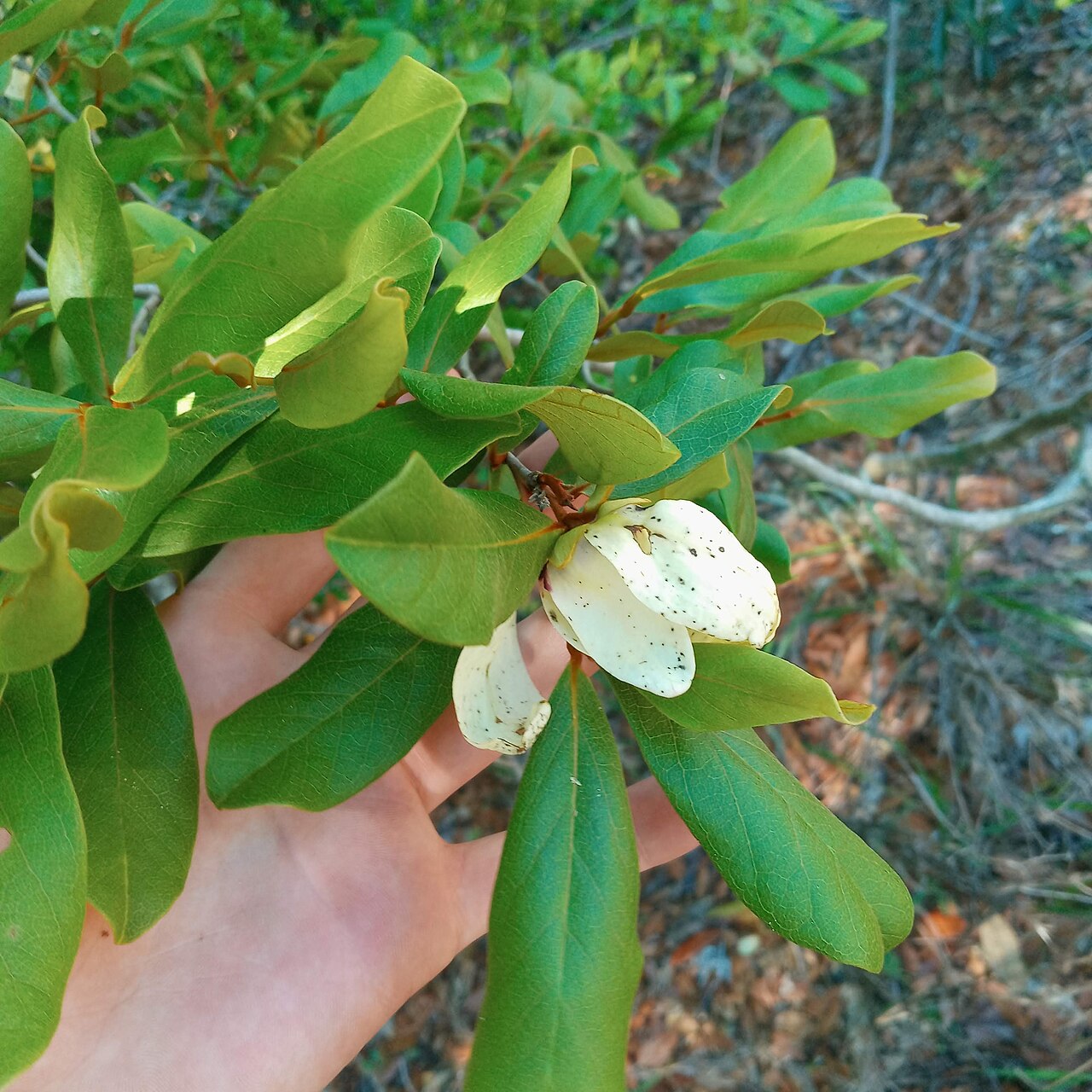
It is usually a multi-stemmed shrub 3 to 8 feet tall, sometimes a small tree up to about 12 feet. The stems are upright and somewhat sparsely branched, with smooth gray bark. Young twigs and new leaves are covered with fine rusty-red hairs, which wear off as they mature. Plants spread slowly by underground roots and can form small colonies.
Leaves
The leaves are alternate, simple and leathery, 2 to 4 inches long, broadest near the rounded tip and narrowing to the base (obovate, the source of the species name). They are dull to bright green on top and paler below, with smooth edges. They are deciduous, dropping in late fall or winter, and the new leaves appear in spring with or just before the flowers.
Flowers
The flowers are solitary on short stalks near the ends of new shoots. Each has three broad, spreading outer petals, 1½ to 2 inches long, white to creamy white, and three much smaller inner petals that form a cup over the reproductive parts in the center. The flowers are pleasantly fragrant. Flowering is mostly from March to May, sometimes beginning in February or continuing into June.
Fruit & Seeds
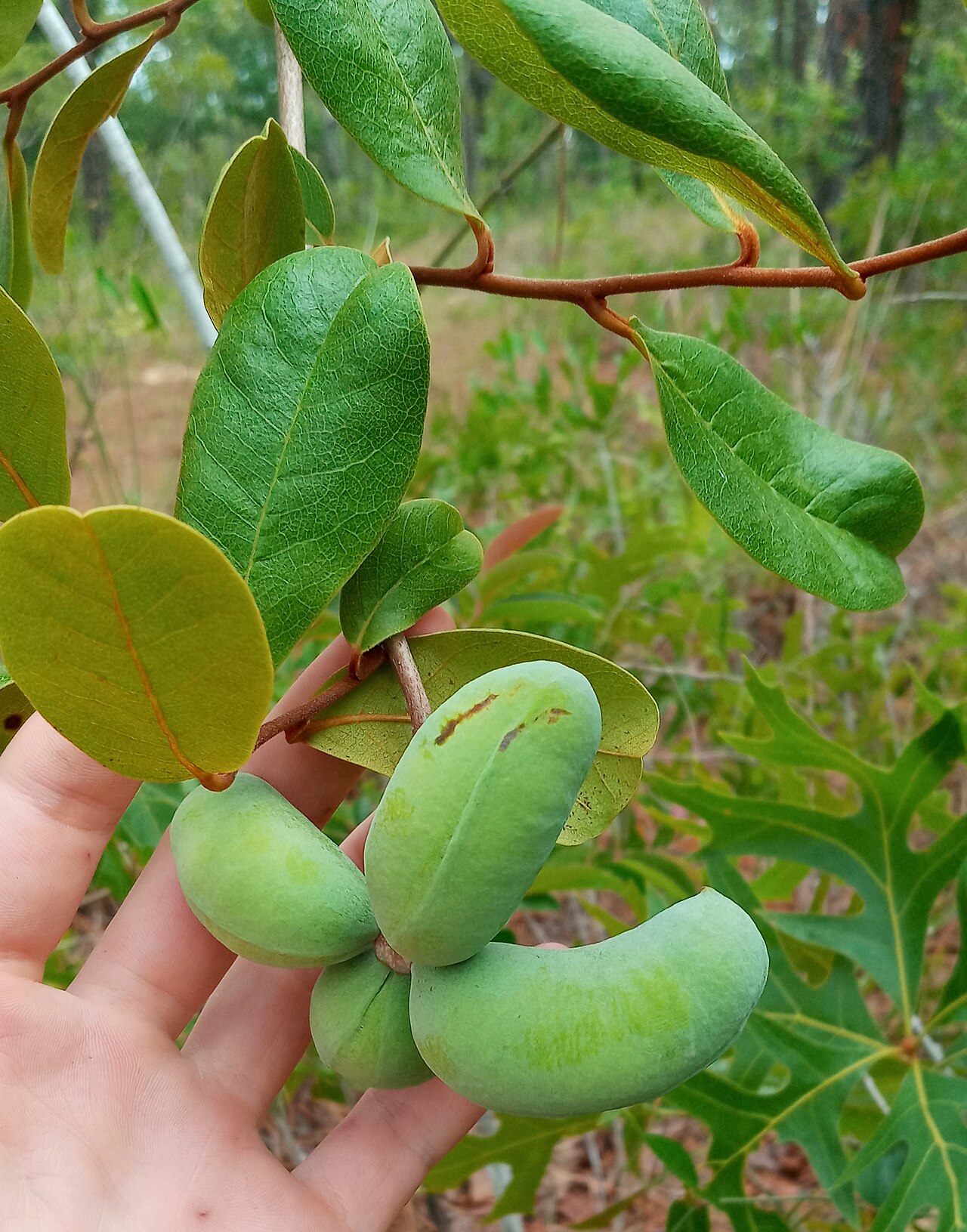
The fruit is an oblong, slightly curved berry, 2 to 4 inches long, green ripening to yellowish green, sometimes borne in clusters of two to four. The soft yellow pulp surrounds several large, flat, brown seeds. Fruits ripen in summer and are quickly taken by wildlife.
Similar Species
Asimina reticulata (netted pawpaw) has narrower, stiffer leaves with a strong network of veins and grows mainly in flatwoods. Asimina incana (woolly pawpaw) flowers before its leaves appear and has densely woolly young growth. Asimina pygmaea (dwarf pawpaw) is under 1 foot tall with maroon flowers. The common Pawpaw (Asimina triloba) of eastern forests has much larger, thinner leaves and dark maroon flowers.
Quick Facts
| Scientific Name | Asimina obovata (syn. Pityothamnus obovatus) |
| Family | Annonaceae (custard apple family) |
| Plant Type | Deciduous shrub or small tree |
| Mature Height | 3–8 ft (rarely to about 12 ft) |
| Mature Spread | 3–6 ft; slowly forms colonies |
| Growth Rate | Slow |
| Sun Exposure | Full sun to partial shade |
| Water Needs | Low; drought tolerant once established |
| Soil Type | Deep, dry, well-drained sand |
| Soil pH | About 4.5–6.5 (acidic) |
| Bloom Time | March–May (February–June) |
| Flower Color | White to creamy white |
| Fall Color | Leaves turn yellow before dropping |
| Fruit | Oblong green to yellowish berry, 2–4 in, with large flat seeds |
| Deer Resistant | Mostly; the foliage contains bitter compounds and is seldom browsed |
| USDA Hardiness Zones | 8b–10a |
Native Range
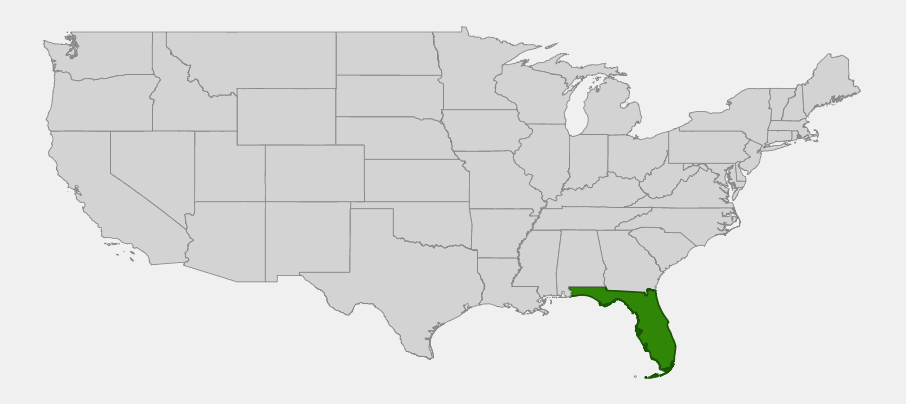
Bigflower pawpaw is found only in Florida. USDA PLANTS records it from Florida alone, and it is endemic to Florida per the Atlas of Florida Plants. It grows in the peninsula, from northeast Florida south along the central sand ridges, including the Lake Wales Ridge, to the southern end of the Lake Wales Ridge.
Its habitats are among the driest in eastern North America: Florida scrub, with its sand pine, scrub oaks and Florida rosemary; longleaf pine and turkey oak sandhills; and dry, sandy oak hammocks. It grows on deep, sterile, quickly draining white or yellow sand, often in openings or at the edges of scrub thickets where it gets sun for at least part of the day.
Much of Florida’s scrub and sandhill habitat has been converted to housing, citrus groves and pasture, and the remaining patches depend on fire to stay open. Bigflower pawpaw resprouts after fire from its roots, and it remains reasonably common in protected scrub. Even so, because it grows wild nowhere else, gardeners should buy nursery-propagated plants and never dig plants or collect from the wild.
📋 Regional plant lists featuring Bigflower Pawpaw: North & South Florida
Growing & Care Guide
Bigflower pawpaw is an excellent shrub for dry, sandy Florida yards where irrigation is limited. It is occasionally available from native plant nurseries in Florida. Because it is a Florida endemic, buy only nursery-propagated plants; never dig it from the wild, where it rarely survives transplanting anyway because of its deep taproot.
Light
Plant it in full sun to partial shade. It flowers most heavily in sun, but it also grows well under the light shade of scattered pines and oaks.
Soil & Water
Use deep, well-drained sand with no added compost or fertilizer. Water a new planting regularly through its first growing season, then only during long droughts. Established plants are very drought tolerant. Poor drainage and wet soil are the main causes of failure.
Planting Tips
Plant small container-grown specimens; pawpaws develop long taproots early and resent root disturbance, so larger plants often struggle after planting. Plant in fall through early spring, set the plant at the same depth as in the pot, and mulch lightly with pine straw or leaf litter. It works well in groups at the edge of a scrub-style planting or along a sunny path where the flowers can be seen up close.
Pruning & Maintenance
Very little pruning is needed. Remove dead stems in winter. It is slow-growing and may sit still for a year or two while the root system develops. Do not spray it: its leaves feed zebra swallowtail caterpillars, which do little lasting harm.
Propagation
Grow it from fresh seed collected from ripe fruit in summer. Clean off the pulp and sow immediately, or keep the seed moist; pawpaw seeds lose viability if they dry out. Germination is slow and irregular, often taking several months, and seedlings should be grown in deep pots. Root suckers can sometimes be separated, but they transplant poorly.
Landscape Uses
- Scrub and sandhill gardens: a showy flowering shrub for dry, sunny, sandy sites
- Butterfly gardens: a larval host for the zebra swallowtail
- Wildlife plantings: fruits are eaten by gopher tortoises, raccoons, opossums and other animals
- Habitat restoration: in Florida scrub and sandhill restoration using nursery-grown stock
- Low-water landscapes: needs no irrigation once established
Wildlife & Ecological Value
Bigflower pawpaw is a small but important part of the Florida scrub community, supplying nectar, foliage and fruit to several specialized animals.
For Pollinators
Like other pawpaws, its fragrant flowers are pollinated mainly by beetles, including flower scarabs, which crawl into the cup of inner petals to feed. Its pollination and breeding system were described in a 1986 study of two Florida pawpaws by Norman and Clayton. Like most pawpaws, a plant sets only a small number of fruits relative to its many flowers.
For Birds
Birds sometimes peck at ripe fruit, and the shrubs offer cover in open scrub. Its main value to birds is as part of scrub habitat, home to the Florida scrub-jay and other scrub birds.
For Mammals
The ripe fruits are eaten by raccoons, opossums, foxes and other mammals, and gopher tortoises eat fruits that fall to the ground. These animals disperse the large seeds.
Ecosystem Role
Bigflower pawpaw is a larval host for the zebra swallowtail butterfly and for the pawpaw sphinx moth. Chemical compounds in pawpaw leaves (acetogenins) make the caterpillars distasteful to predators. The plant is adapted to the periodic fires of scrub and sandhill, resprouting from its roots after a burn.
Cultural & Historical Uses
Carl Ludwig Willdenow first described this species in 1799 as a member of the genus Annona, and George Valentine Nash later moved it to Asimina. John Kunkel Small later placed it in his genus Pityothamnus, which is no longer recognized. The name obovata refers to the leaf shape, broadest near the tip.
The fruit pulp is edible, like that of other pawpaws, but it is small and seedy, and few people eat it. Pawpaw seeds, leaves and bark contain toxic compounds and should not be eaten. Some people develop a skin rash from handling the fruit.
For Florida gardeners, bigflower pawpaw is one of the most rewarding native shrubs for dry sand. It offers large spring flowers, supports butterflies, and needs no irrigation once established. Using propagated plants in home landscapes is also a small way to keep a Florida endemic in cultivation while its wild habitat continues to shrink.
Frequently Asked Questions
Is bigflower pawpaw only found in Florida?
Yes. It is endemic to Florida per the Atlas of Florida Plants and grows wild nowhere else. Buy nursery-propagated plants and never collect plants or seed from wild populations.
Can you eat bigflower pawpaw fruit?
The ripe pulp is edible, but the fruits are small and seedy. Do not eat the seeds, leaves or bark, which contain toxic compounds, and wash your hands after handling the fruit if you have sensitive skin.
Does bigflower pawpaw attract butterflies?
Yes. It is a larval host plant for the zebra swallowtail, whose caterpillars feed only on pawpaws. Expect some chewed leaves in spring and summer.
Why is my pawpaw not growing?
Pawpaws spend their first year or two building a deep taproot and may show little top growth. Make sure the soil drains well, avoid fertilizer, and be patient. Large transplanted plants often decline, so start with small ones.
How is it different from the common pawpaw?
The common pawpaw (Asimina triloba) is a tree of moist eastern forests with large, thin leaves and maroon flowers. Bigflower pawpaw is a Florida scrub shrub with small, thick leaves, white flowers and much smaller fruit.

Looking for a nursery that carries Bigflower Pawpaw?
Browse our native plant nursery directory: Florida