Rock Penstemon (Penstemon baccharifolius)
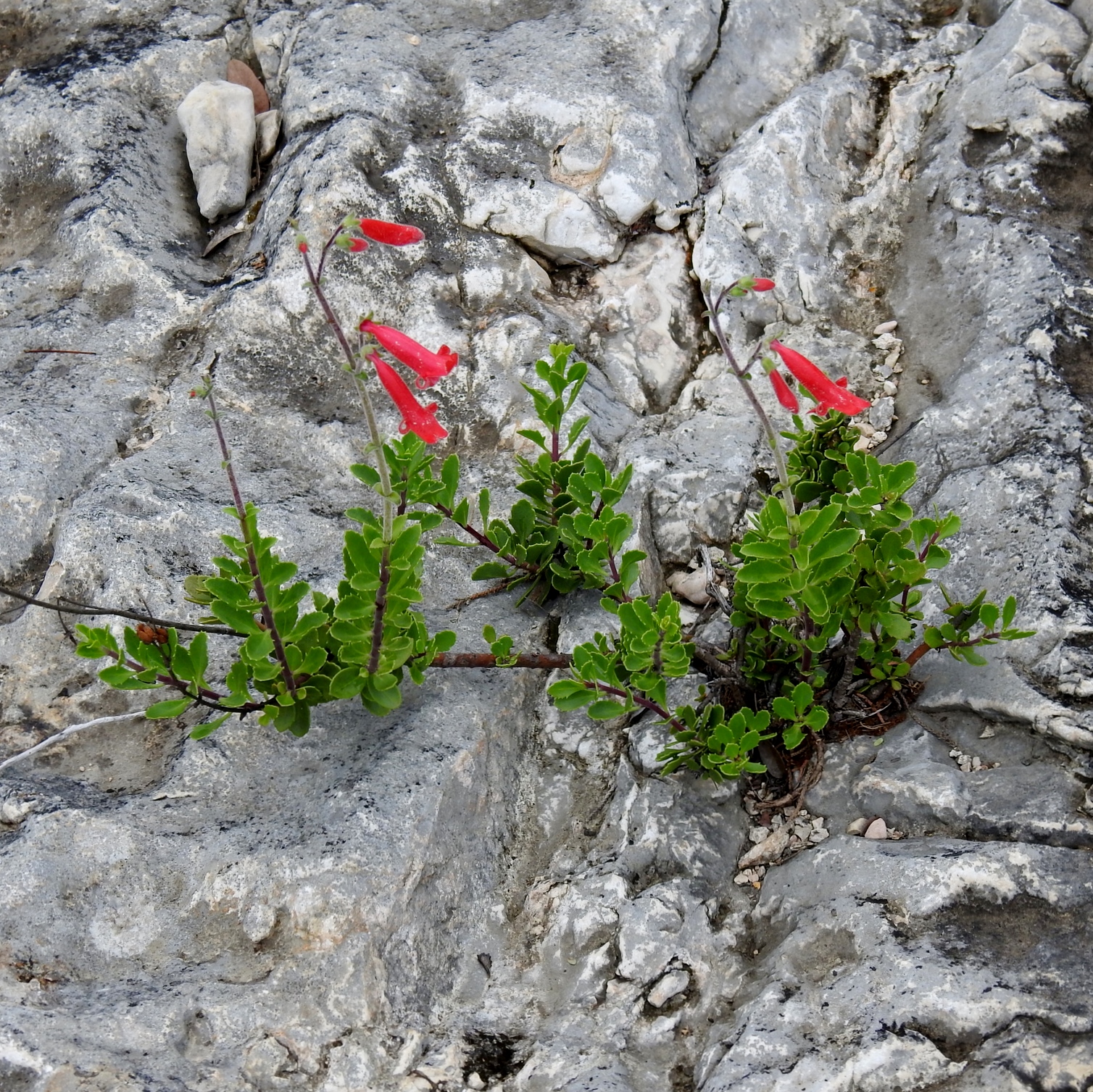
Penstemon baccharifolius, commonly known as Rock Penstemon or Baccharis-leaf Beardtongue, is a wiry, woody-based perennial of the limestone canyons and rocky slopes of south-central and west Texas. A member of the Plantaginaceae (plantain family, where penstemons are now classified), it is unusual among the beardtongues for its small, glossy, evergreen leaves and its habit of growing directly out of bare rock, often with almost no visible soil around its roots.
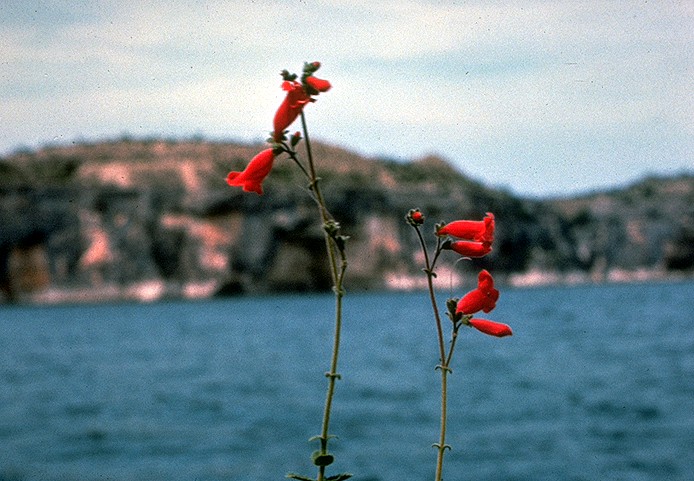
From spring through fall, Rock Penstemon sends up slender flowering stems tipped with brilliant red to coral-red, tubular flowers that are a magnet for hummingbirds. Between bloom flushes, the low mound of small, rounded, dark green leaves remains attractive and tidy, making this one of the most garden-worthy penstemons for hot, dry limestone country — exactly the conditions that make many other perennials struggle.
Rock Penstemon’s native range is tightly confined to the limestone country of the Edwards Plateau, the Trans-Pecos, and adjacent northern Mexico, but within that range it is a dependable, long-lived rock garden and xeriscape plant, prized for its resilience and its long hummingbird-friendly bloom season.
Identification
Rock Penstemon forms a low, woody-based subshrub or herbaceous perennial 8 to 18 inches tall and about as wide, with a semi-sprawling to mounding habit that often drapes attractively over rock edges.
Leaves
Leaves are opposite, small — roughly half an inch to an inch and a half long — oval to rounded, thick and leathery, with shallowly toothed margins, and a glossy dark green color that persists through most winters in its native range. The leaf shape and texture resemble those of baccharis shrubs, which is the source of the species name baccharifolius.
Flowers
Flowers are tubular and two-lipped, about an inch long, in shades of bright red to coral-red (occasionally orange-red), carried in loose, open clusters on slender stems that rise 6 to 12 inches above the foliage mound. The narrow floral tube and vivid red color are classic hummingbird-pollinated traits, and the plant blooms in flushes from spring through fall, especially after rain, rather than in one single flush like many penstemons.
Fruit & Seeds
After bloom, flowers are followed by small, dry, two-chambered seed capsules typical of the genus, splitting open at maturity to release numerous tiny seeds.
Quick Facts
| Scientific Name | Penstemon baccharifolius |
| Family | Plantaginaceae (Plantain, formerly Scrophulariaceae) |
| Plant Type | Evergreen Perennial / Subshrub |
| Mature Height | 8–18 in |
| Mature Spread | 10–18 in |
| Growth Rate | Slow to moderate |
| Sun Exposure | Full Sun to Part Shade |
| Water Needs | Low |
| Soil Type | Rocky, limestone, thin or crevice soils; sharply drained |
| Soil pH | 7.0–8.5 (neutral to alkaline) |
| Bloom Time | April – October, in flushes after rain |
| Flower Color | Red to coral-red |
| Fall Color | Evergreen dark green foliage |
| Fruit | Small dry seed capsules |
| Deer Resistant | Yes |
| USDA Hardiness Zones | 7–10 |
Native Range
Rock Penstemon has a notably narrow native range centered on the limestone country of south-central and west Texas, from the canyons of the Edwards Plateau — including Kickapoo Cavern State Park and similar Hill Country limestone systems — west into the Trans-Pecos region, continuing south into adjacent northern Mexico.
Within this range it is strongly tied to exposed limestone: canyon walls, rocky bluffs, cliff crevices, and thin rocky slopes where it roots into cracks with little or no accumulated soil. It is rarely found away from limestone outcrops and is a signature wildflower of the dry canyon country of the western Hill Country and the Stockton and Edwards plateaus.
Rock Penstemon is occasionally grown as a rock-garden plant outside Texas, including in parts of the Southwest and California; in those settings it is a garden introduction rather than a native plant, valued for the same limestone and drought tolerance that defines it in the wild.
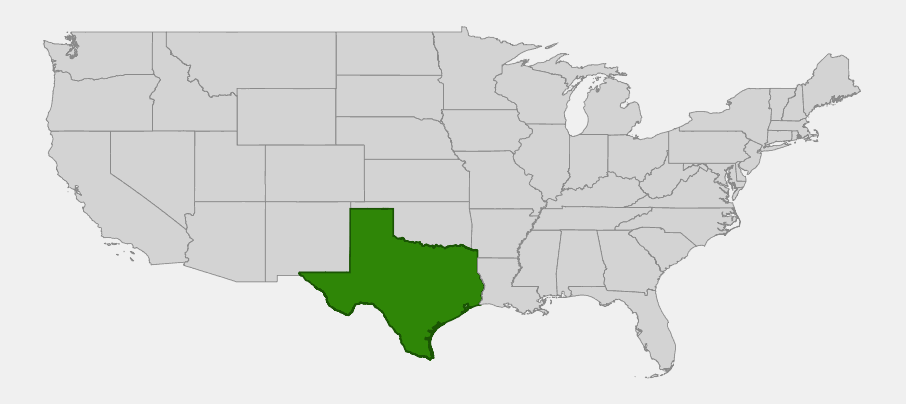
📋 Regional plant lists featuring Rock Penstemon: South & West Texas
Growing & Care Guide
Rock Penstemon is built for conditions that kill most perennials: baking heat, reflected sun off stone, and soil so thin it barely qualifies as soil. Give it those conditions and it rewards you with months of hummingbird-attracting bloom.
Light
Full sun produces the most compact growth and heaviest bloom, though in the hottest parts of its range — the Trans-Pecos and west Texas canyon country — a bit of afternoon shade helps the foliage stay fresh through summer. It is not a plant for damp, shady sites.
Soil & Water
Drainage is everything. Rock Penstemon is adapted to growing with its roots wedged into limestone cracks and crevices, often with almost no accumulated soil, so in cultivation it needs rocky, gravelly, or heavily amended alkaline soil that never stays wet. Established plants need very little supplemental water; overwatering, especially in heavy clay, is the most common way to lose this plant.
Planting Tips
Plant in a rock garden, dry stone wall, raised bed, or crevice planting where drainage is guaranteed. Set plants slightly proud of grade or on a gentle slope so water sheds away from the crown. It is an excellent choice for tucking into gaps between limestone pavers or boulders, mimicking its natural rock-crevice habitat.
Pruning & Maintenance
Shear back lightly after the first flush of bloom to encourage denser growth and a second flowering later in the season. Remove dead or winter-damaged stems in early spring. Established plants are long-lived and largely trouble-free, needing minimal fertilizer or care once sited correctly.
Landscape Uses
Rock Penstemon shines in several specialized but increasingly popular garden settings:
- Rock gardens and crevice gardens, its most natural home
- Dry stone walls, where it can cascade from gaps between stones
- Xeriscape plantings needing season-long hummingbird appeal with minimal water
- Limestone and caliche beds where many perennials struggle
- Containers with sharply drained, gritty potting mix
- Hummingbird gardens paired with other red tubular bloomers
Wildlife & Ecological Value
Rock Penstemon’s long, nectar-rich red flowers make it a consistently valuable resource for pollinators across its bloom season, which runs far longer than that of most other penstemons.
For Pollinators
Hummingbirds are the primary pollinators, strongly drawn to the narrow red tubular flowers, and the plant provides a dependable nectar source through much of spring, summer, and fall whenever rain triggers a new flush of bloom. Large carpenter bees and other native bees also visit, sometimes nectar-robbing through the base of the tube.
For Birds
Beyond hummingbirds, the dense evergreen foliage mounds provide minor cover for small birds foraging among rocky outcrops, and the tiny seeds in mature capsules are taken opportunistically by seed-eating birds.
For Mammals
The thick, leathery foliage is not a preferred browse for deer, making Rock Penstemon a reliably deer-resistant choice for Hill Country and Trans-Pecos gardens where browsing pressure is often heavy.
Ecosystem Role
As one of the few flowering perennials able to establish directly in bare limestone crevices, Rock Penstemon adds color and pollinator resources to otherwise sparsely vegetated cliff and canyon habitat, and its root systems help stabilize small amounts of soil and organic matter that accumulate in rock cracks over time.
Cultural & Historical Uses
Rock Penstemon has no significant documented history of medicinal, ceremonial, or practical use among Indigenous peoples or early settlers of the region, unlike some more widespread and visually dominant Texas wildflowers. Its narrow range, confined largely to remote limestone canyon country, likely limited regular human contact with the plant compared to species growing in more accessible grassland or woodland settings.
Its modern significance is primarily horticultural: botanists and native-plant gardeners in Texas identified Rock Penstemon early as an outstanding candidate for rock gardens because of its combination of showy, long-lasting red bloom and extreme tolerance for the thin limestone soils common across the Hill Country and Trans-Pecos, and it has since become a staple offering among Texas native-plant nurseries specializing in xeriscape and rock-garden plants.
Today the species is valued chiefly for its role in sustainable, low-water Texas landscaping, offering a reliable source of hummingbird-attracting color in gardens built around limestone and rock features that mimic its wild canyon habitat.
Frequently Asked Questions
Where does Rock Penstemon grow best in a garden?
In a rock garden, dry stone wall, or raised bed with gravelly, alkaline, sharply drained soil and full sun. It is specifically adapted to growing in limestone crevices with very little soil, so good drainage matters more than soil fertility.
How long does Rock Penstemon bloom?
It blooms in flushes from spring through fall, especially after rainfall, rather than in one single bloom period — making it one of the longer-flowering native penstemons for Texas gardens.
Do hummingbirds like Rock Penstemon?
Yes, strongly. The narrow, tubular, bright red flowers are a classic hummingbird-pollinated form, and this species is a reliable nectar source through much of the growing season.
Is Rock Penstemon easy to kill with overwatering?
Yes — overwatering, particularly in heavy or poorly drained soil, is the most common cause of failure. This plant is adapted to growing in bare rock crevices and needs soil that drains essentially as fast as it is watered.
Is Rock Penstemon deer resistant?
Yes. Its tough, leathery evergreen foliage is not a preferred browse, making it a dependable choice in areas with significant deer pressure, such as the Texas Hill Country.

Looking for a nursery that carries Rock Penstemon?
Browse our native plant nursery directory: Texas