
Scrub Wild Olive (Osmanthus megacarpus)
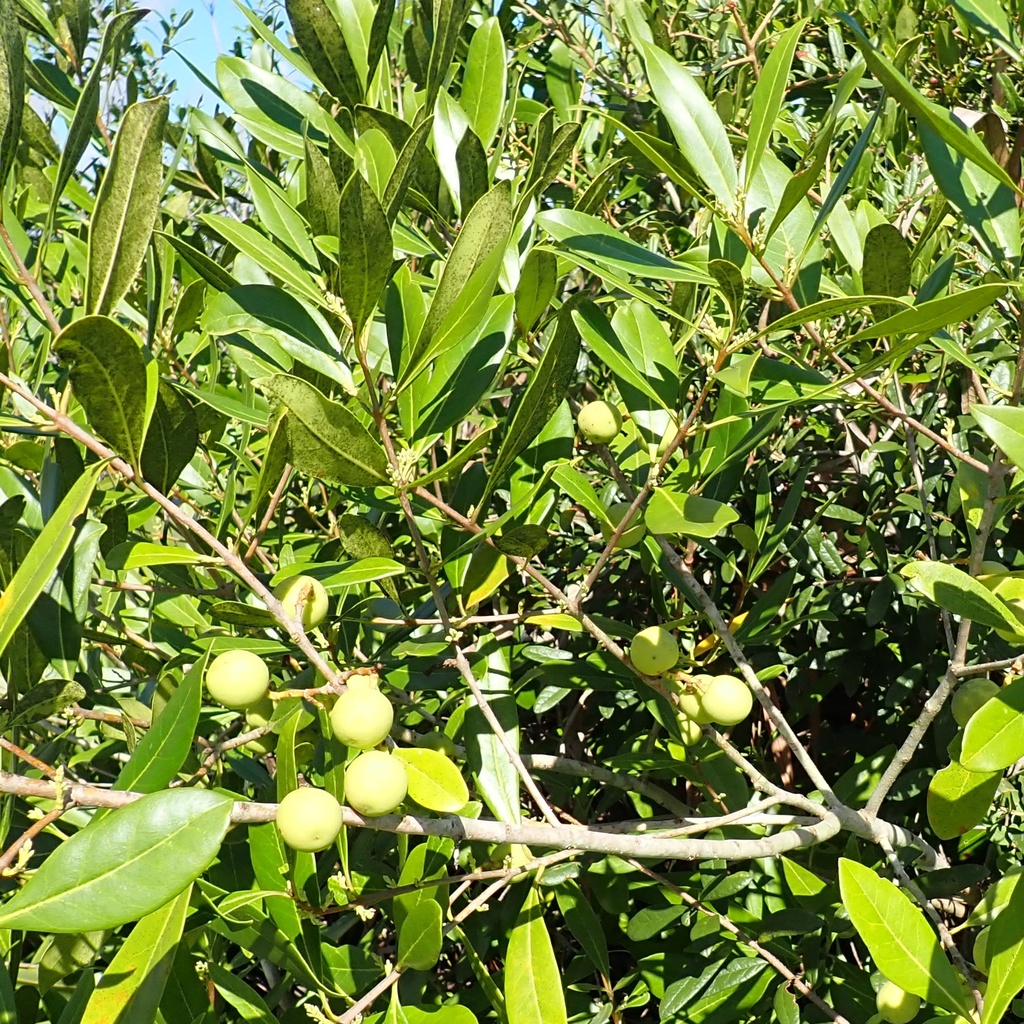
Scrub Wild Olive (Osmanthus megacarpus) is an evergreen shrub or small tree of the olive family (Oleaceae) that grows only in Florida. It is endemic to Florida per the Atlas of Florida Plants, where it is listed as Cartrema floridanum, the name most current Florida botanists use. USDA PLANTS treats it as a variety of American sweet olive, Osmanthus americanus var. megacarpus, and older books and nursery lists call it Osmanthus megacarpus or Osmanthus floridanus. All of these names refer to the same plant.
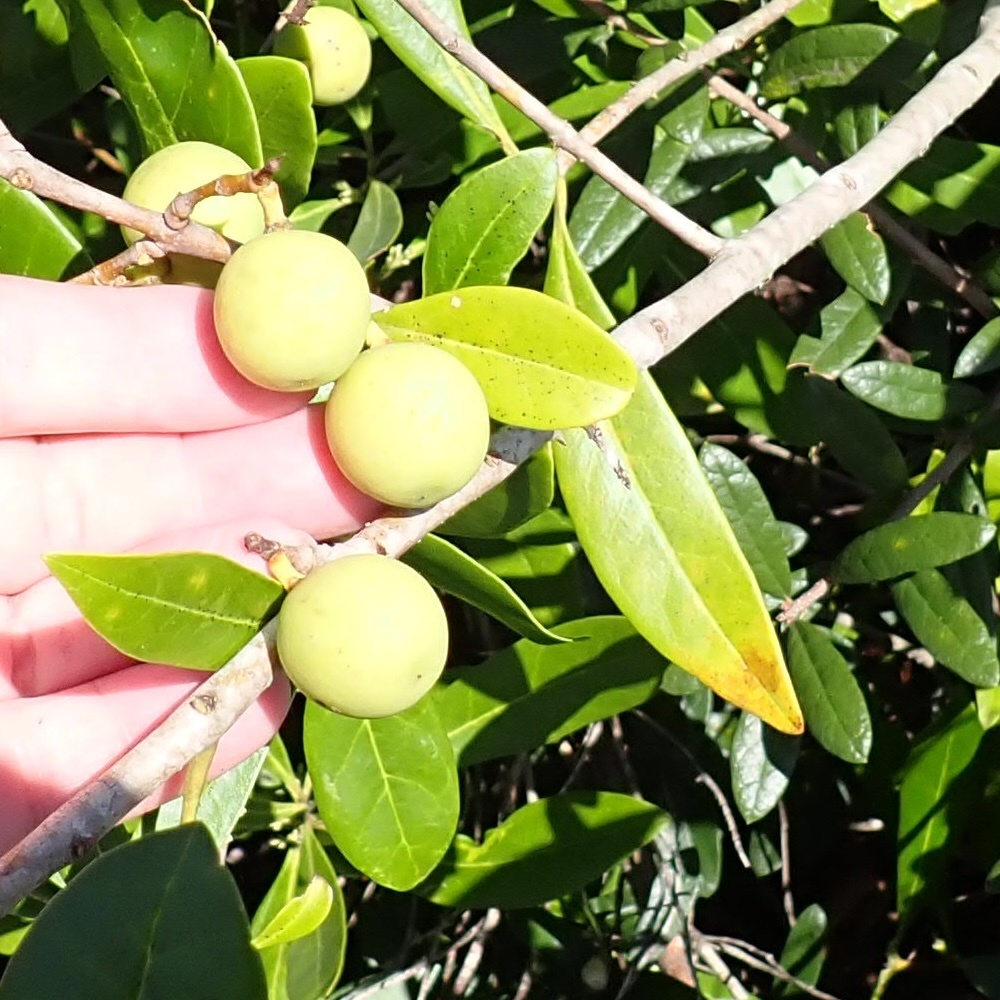
It looks much like its widespread relative, American Sweet Olive (devilwood), with opposite, leathery, olive-green leaves and small, fragrant, creamy white flowers tucked into the leaf axils in late winter and spring. Two things separate them. Scrub wild olive has much larger fruits, round drupes about 3/4 to 1 inch across when mature, against roughly 1/4 to 3/8 inch in American sweet olive. And it grows in dry places: sand pine scrub, oak scrub, rosemary balds and xeric hammocks, while American sweet olive is a plant of moist woods and hammock edges.
Because it is found only in the dwindling scrub of central peninsular Florida, scrub wild olive is a plant to grow from nursery stock, never to collect. Buy only nursery-propagated plants, and never dig plants or take cuttings from the wild. This guide covers how to identify it, where it grows, and how to use it in a dry, sandy Florida landscape.
Identification
Out of fruit, scrub wild olive and American sweet olive are almost impossible to tell apart, and botanists have long identified flowering or sterile specimens mainly by habitat. Guy Nesom, who moved both species into the genus Cartrema in 2012, found that fruit size is the only reliable physical difference, but the difference is striking once the fruits mature in late summer and fall.
Growth Form & Bark
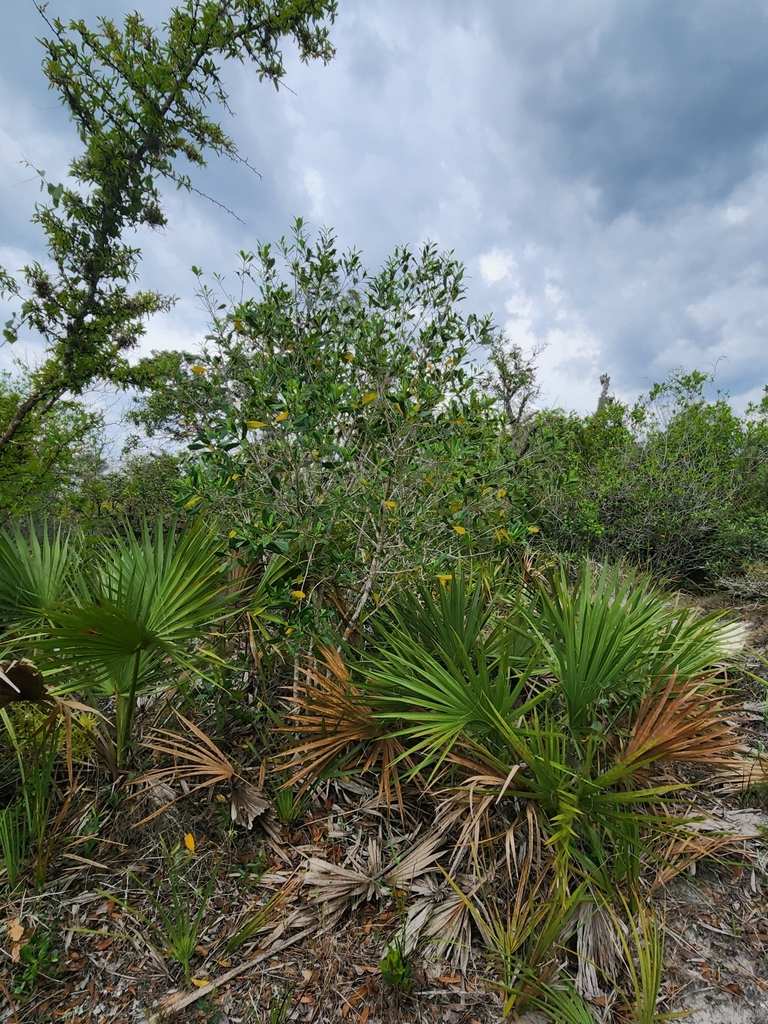
Scrub wild olive is usually a multi-stemmed shrub about 6 to 12 feet tall, branching near the ground. Older plants in protected spots can become small trees of 15 to 20 feet or more. The bark is gray-brown to light gray or silvery, smooth at first and becoming finely scaly with age.
Leaves
The leaves are evergreen, opposite, thick and leathery, about 2 to 5 inches long and 3/4 to 1½ inches wide. They are elliptic to oblanceolate with smooth edges that roll slightly under (revolute), a pointed to blunt tip, and a tapering base. Both surfaces are hairless; the upper side is a glossy olive green and the underside paler.
Flowers
Small clusters of 12 to 20 tiny flowers form in the leaf axils from February to May. Each flower is about 1/4 inch long, with a short tube and four creamy white to pale yellow lobes. They are sweetly fragrant, which is what the old genus name Osmanthus (Greek for “fragrant flower”) refers to. Most plants bear flowers of only one sex, so not every shrub sets fruit.
Fruit
The fruit is an olive-like drupe that ripens from green to dark bluish purple or nearly black, mainly from mid-August into November. Nesom measured mature, dried fruits at 18 to 25 millimeters (about 3/4 to 1 inch), compared with 7 to 10 millimeters in American sweet olive, and the epithet megacarpus simply means “large-fruited.” Each fruit holds a single hard stone. If a Florida plant has fruit clearly larger than a blueberry and grows in dry sand, it is scrub wild olive.
Quick Facts
| Scientific Name | Osmanthus megacarpus (syn. Cartrema floridanum, Osmanthus americanus var. megacarpus, O. floridanus) |
| Family | Oleaceae (olive family) |
| Plant Type | Evergreen shrub or small tree |
| Mature Height | 6–12 ft typical; occasionally a small tree to 20 ft or more |
| Mature Spread | 6–10 ft |
| Growth Rate | Slow |
| Sun Exposure | Full sun to part shade |
| Water Needs | Low; very drought tolerant once established |
| Soil Type | Deep, well-drained, nutrient-poor sand |
| Soil pH | Acidic (about 4.5–6.5) |
| Bloom Time | February–May |
| Flower Color | Creamy white to pale yellow; fragrant |
| Fall Color | None; evergreen |
| Fruit | Large round drupe, about 3/4–1 in, ripening dark bluish purple to nearly black in late summer and fall |
| Deer Resistant | Moderately; leathery leaves are seldom browsed heavily |
| USDA Hardiness Zones | 9–10 |
Native Range
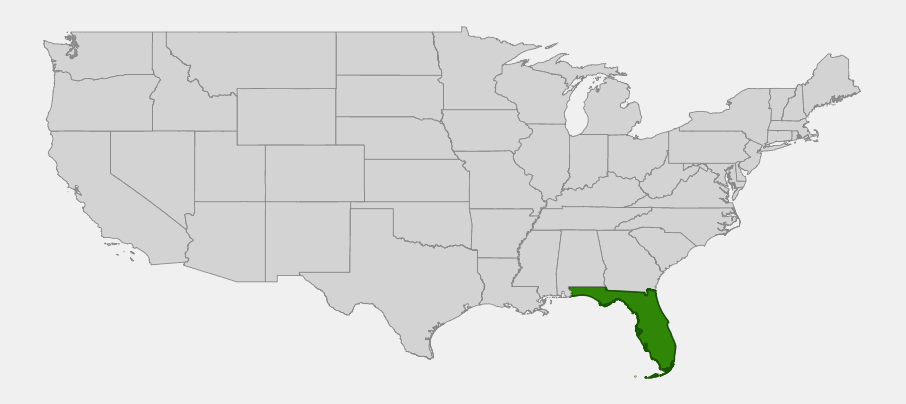
Scrub wild olive is endemic to Florida per the Atlas of Florida Plants. It grows in the central part of the peninsula, from Marion, Citrus and Volusia counties south to Highlands, DeSoto and Sarasota counties. Herbarium records with mature fruit document it in Brevard, Citrus, DeSoto, Hernando, Highlands, Hillsborough, Indian River, Lake, Manatee, Marion, Orange, Osceola, Pasco, Pinellas, Polk, Sarasota, Seminole, Sumter and Volusia counties. It is most frequent on the Lake Wales Ridge in Polk and Highlands counties and on the other old sand ridges of the interior.
Its habitats are among the driest in Florida: sand pine scrub, oak scrub, rosemary balds, turkey oak barrens and dry oak hammocks, on deep white or yellow sand from about 30 to 330 feet above sea level. It shares this ground with Florida rosemary, sand live oak, Chapman oak, scrub palmetto and saw palmetto, along with several other scrub endemics. American sweet olive, by contrast, reaches south only to about the middle of the peninsula and grows in moister woods, so where the two meet, habitat alone usually tells them apart.
Florida scrub has been reduced to a small fraction of its original extent by citrus groves, housing and roads, and much of what remains has grown overgrown and unhealthy without fire. Scrub wild olive is not on the state endangered or threatened list, but like everything that depends on scrub, it now survives mainly on preserves, state parks and conservation lands. Plant only nursery-propagated stock and never collect plants or seed from the wild.
📋 Regional plant lists featuring Scrub Wild Olive: North & South Florida
Growing & Care Guide
Scrub wild olive is a tough, slow-growing evergreen for the hottest, driest, sandiest parts of a central or south Florida yard. It needs almost no water or fertilizer once established, and its dense, glossy foliage makes it a good native alternative to exotic hedging shrubs on sand. It is grown less often than American sweet olive, so ask Florida native nurseries for it by name, and buy only nursery-propagated plants.
Light
Full sun gives the densest growth and the best flowering and fruiting. It also tolerates part shade under high pines or at the edge of an oak canopy, where it becomes looser and more open.
Soil & Water
Plant it in deep, sharply drained, acidic sand, the kind of soil that makes most landscape shrubs struggle. It does not need amended or enriched soil, and it does poorly in heavy, wet or poorly drained ground, where roots can rot. Water regularly for the first growing season while roots establish; after that, rainfall is enough in most years. Do not fertilize.
Planting Tips
Set container plants at the same depth they grew in the pot, in fall or winter when rainfall and temperatures are lower, and mulch lightly with leaf litter or pine needles rather than heavy wood chips. Space plants 5 to 8 feet apart for an informal hedge or screen. Pair it with other scrub plants such as Florida rosemary, scrub palmetto and sand live oak. Because it is a Florida endemic, buy only nursery-propagated plants, and never dig wild plants or collect cuttings or seed from preserves or roadsides.
Pruning & Maintenance
Little pruning is needed. It responds well to light shaping and can be kept as a dense hedge, but heavy shearing removes the flower buds that form in the leaf axils, and with them the fruit. Prune lightly right after flowering if needed. Pests are few. In natural areas, scrub is maintained by periodic fire, and scrub wild olive resprouts from its base after burning.
Propagation
Seed is the usual method. Clean the flesh from ripe fruits in fall and sow the stones promptly; germination is slow and can take many months, as with other olive-family stones. Semi-hardwood cuttings taken in summer can also root with rooting hormone and patience. Most plants have flowers of only one sex, so several plants are needed if you want reliable fruit.
Landscape Uses
- Native hedges and screens: dense evergreen foliage on dry sand where most hedging shrubs struggle
- Scrub and sandhill gardens: with Florida rosemary, scrub palmetto, sand live oak and other scrub plants
- Wildlife plantings: spring flowers for insects and fall fruit for birds and mammals
- Fragrance gardens: small but sweetly scented flowers in late winter and spring
- Scrub restoration: on conservation lands within its native range, using local nursery-propagated stock
Wildlife & Ecological Value
Scrub wild olive is one of the larger evergreen shrubs in Florida scrub, and its flowers and fruit add food to a habitat where resources are scarce.
For Pollinators
The small, fragrant flowers open in late winter and spring, when few other scrub plants bloom, and are visited by bees, flies and other small insects.
For Birds
Birds eat the ripe fruit of wild olives in fall and winter. Fruits as large as those of scrub wild olive are more than most small songbirds can swallow whole, so larger birds and mammals are probably the main dispersers of its seeds. The dense evergreen branches also give cover and nest sites to scrub birds.
For Mammals
The oily fruits are eaten by mammals that forage in scrub, and the evergreen thickets provide shelter. Deer browse it only lightly.
Ecosystem Role
Scrub wild olive is part of the Florida scrub community, a fire-adapted ecosystem found on ancient sand ridges and home to many endemic plants and animals, including the Florida scrub-jay, the gopher tortoise and the sand skink. Like other scrub shrubs, it resprouts after fire. Protecting and burning remnant scrub is the main thing keeping its populations healthy.
Cultural & Historical Uses
Alvan Chapman, the pioneering botanist of the Florida panhandle, first described this plant in 1892 as Osmanthus floridanus, from a flowering specimen collected near Manatee by J. H. Simpson. John Kunkel Small, unaware that the name applied to the large-fruited plant, described it again in 1933 as Amarolea megacarpa from the sandhills near Lake Annie in Highlands County, and it became widely known as Osmanthus megacarpus.
Later botanists disagreed about whether it was a separate species or a variety of American sweet olive, which is why USDA PLANTS still lists it as Osmanthus americanus var. megacarpus. In 2012, Guy Nesom showed that the true Osmanthus species are Asian, moved the two American wild olives to the genus Cartrema, and restored Chapman’s older name as Cartrema floridana (now usually written Cartrema floridanum), the name used by the Atlas of Florida Plants.
The common names “wild olive” and “devilwood” are shared with American sweet olive, and “wild olive” is also used for Florida privet (Forestiera segregata) and the Texas wild olive (Cordia boissieri). The fruits look like olives, but they are not edible in the same way. Using the scientific name, or the full name “scrub wild olive,” avoids confusion when looking for this plant at nurseries.
Frequently Asked Questions
How is scrub wild olive different from American sweet olive?
The fruit is the reliable difference. Scrub wild olive has round drupes about 3/4 to 1 inch across, while American sweet olive fruits are only about 1/4 to 3/8 inch. Scrub wild olive also grows in dry scrub and sandhills of central Florida, while American sweet olive grows in moister woods across the Southeast. Leaves and flowers are nearly identical.
Is scrub wild olive endangered?
It is not on Florida’s endangered or threatened plant lists, but it is endemic to Florida per the Atlas of Florida Plants and depends on scrub, one of the state’s most reduced habitats. Buy only nursery-propagated plants and never collect plants, cuttings or seed from the wild.
Can I eat the fruit?
It is not a cultivated olive and is not grown or recommended as food. Leave the fruit for wildlife.
Will it grow in north Florida?
It is native only to central peninsular Florida and is best suited to zones 9 and 10. In north Florida, American sweet olive is the better choice and grows naturally there.
Why does my plant not produce fruit?
Most plants carry flowers of only one sex, so a single shrub may never fruit, or it may need a plant of the other sex nearby. Heavy shearing also removes the flower buds. Plant several nursery-grown plants and prune lightly, if at all, for the best fruit.

Looking for a nursery that carries Scrub Wild Olive?
Browse our native plant nursery directory: Florida