
Soaptree Yucca (Yucca elata)
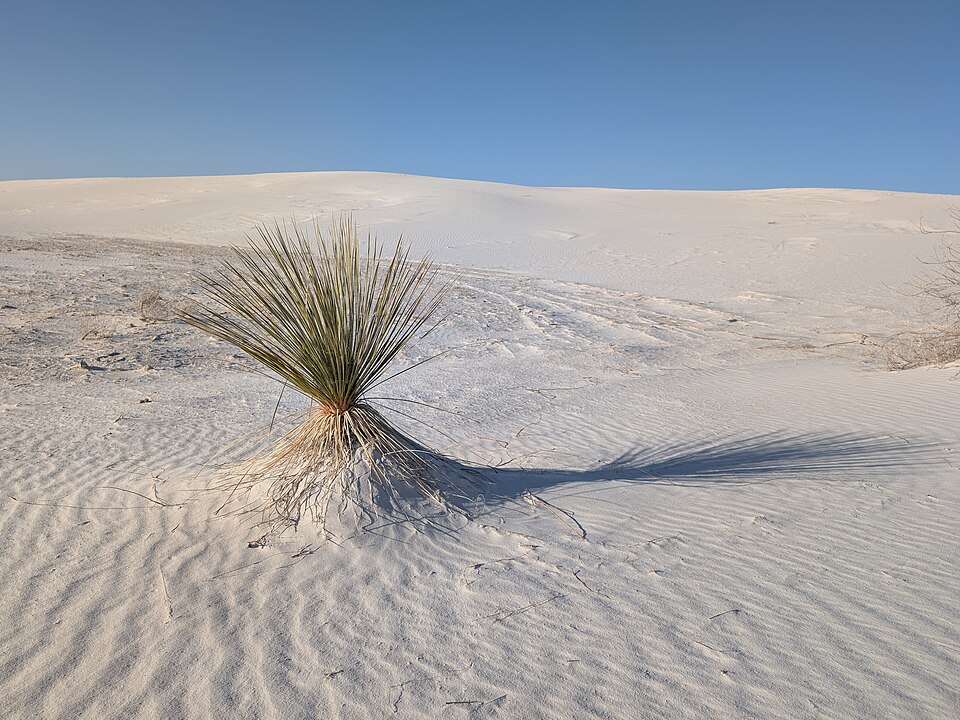
Yucca elata, commonly known as Soaptree Yucca, Soapweed Yucca, or Palmella, holds the distinction of being the state flower of New Mexico — its creamy white flower spikes rising magnificently from the desert landscape represent both the beauty and the resilience of the American Southwest. One of the tallest yuccas in North America, Soaptree Yucca can grow to 15 feet or more in height, with long, slender leaves armed with a sharp terminal spine crowning a thick trunk that develops over many decades. In the wild, these extraordinary plants dot the Chihuahuan Desert grasslands of southern New Mexico, Arizona, Texas, and neighboring Mexico like living sentinels, each one potentially a century or more old.
The common name “Soaptree” refers to the remarkable saponin content of the roots, which can be crushed and mixed with water to create a natural soap with real lathering ability. Indigenous peoples of the Southwest — including the Apache, Navajo, Zuni, and various Pueblo peoples — used Soaptree Yucca roots as shampoo and body wash for thousands of years, a tradition that continues among traditional communities today. The fibers from the leaves were woven into baskets, sandals, mats, and rope; the flowers and fruit were eaten as food; and the plant figured prominently in ceremonial contexts across multiple cultures.
In the landscape, Soaptree Yucca is one of the most dramatic and architecturally striking native plants available for desert gardens. Its towering flower spike, which appears in late spring or early summer and can reach the height of a one-story building, creates a garden focal point unlike anything else in the native plant palette. The extraordinary mutualistic relationship between Soaptree Yucca and the Yucca Moth — neither species can reproduce without the other — is one of the most elegant examples of coevolution in nature, and one of the most important ecological stories of the American Southwest.
Identification
Soaptree Yucca is one of the taller tree-like yuccas, developing a distinct trunk (sometimes branched) with age. Young plants consist of a ground-level rosette of long, narrow leaves; as they age, the persistent dead leaf bases form a characteristic thatch skirt around an elongating trunk. Old specimens with multiple trunks and heights of 12–15+ feet are genuinely impressive landscape plants that look like something from a prehistoric landscape.
Trunk & Leaves
The trunk is cylindrical, covered with persistent dead leaf bases that form a rough, fibrous skirt around the growing stem. The living leaves are produced at the top of the trunk in a dense rosette. Individual leaves are 20–40 inches long and just 0.3–0.5 inches wide — much narrower than most other yuccas — giving the plant a distinctly fine-textured, almost grasslike appearance at a distance. The leaf color is yellow-green to grayish-green. The leaf margins bear fine white fibers (threads) that peel away over time, and the leaf tip ends in a sharp, rigid terminal spine. The narrowness of the leaves compared to other yuccas is the most reliable visual identification feature.
Flowers
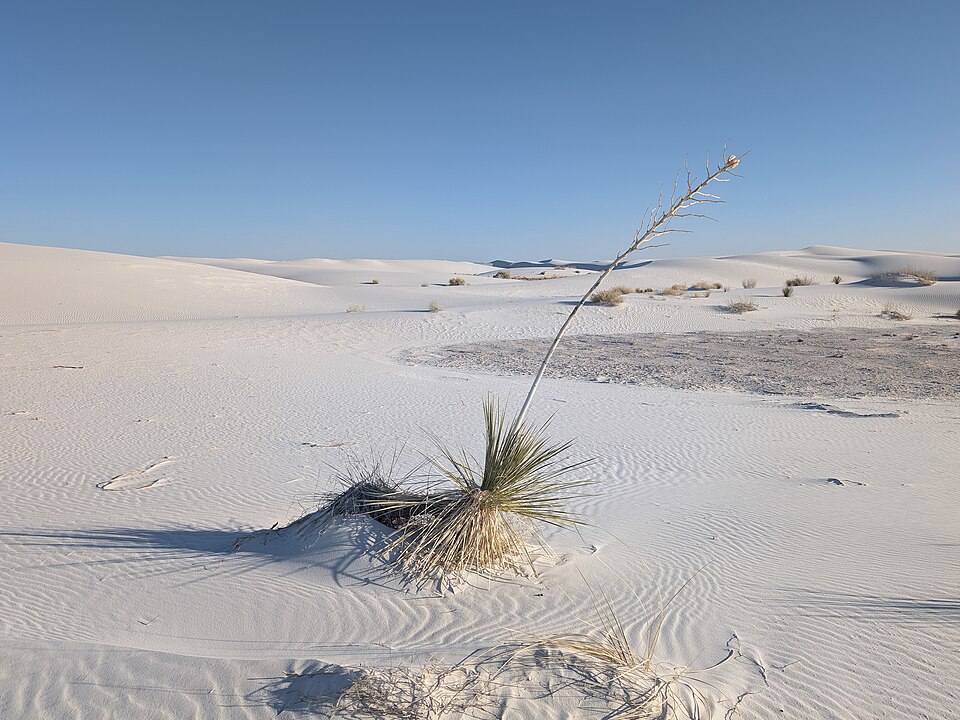
The flower spike (panicle) emerges from the center of the leaf rosette in late spring to early summer — typically May through July. It rises to an impressive 3–12 feet above the leaf rosette, making the total height of a blooming plant up to 15 feet or more. The flowers are creamy white to greenish-white, waxy, and bell-shaped, about 1.5–2 inches long, arranged in large, branched clusters along the upper portion of the spike. They open at night and emit a pleasant, sweet fragrance that attracts their exclusive pollinator — the Pronuba Yucca Moth (Tegeticula yuccasella) and related species. This mutualistic relationship is so tight that neither species can reproduce without the other.
Fruit & Seeds
The fruits are large, fleshy, oblong capsules 2–5 inches long, green when fresh and becoming brown and dry at maturity. Each fruit contains hundreds of flat, black seeds. The fruits are edible and were an important food source for Indigenous peoples — they can be eaten raw when young, roasted when mature, or dried for later use. The dry, open capsules persist on the stem for months after seed release, adding winter interest to the landscape.
Quick Facts
| Scientific Name | Yucca elata |
| Family | Asparagaceae (Agave/Asparagus) |
| Plant Type | Evergreen Tree / Shrub |
| Mature Height | 15 ft |
| Sun Exposure | Full Sun |
| Water Needs | Low (Drought Tolerant) |
| Bloom Time | May – July |
| Flower Color | Creamy white |
| USDA Hardiness Zones | 5–10 |
Native Range
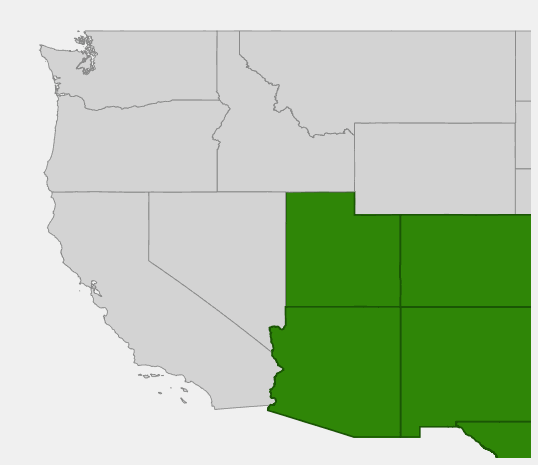
Soaptree Yucca is native to the Chihuahuan and Sonoran deserts of the southwestern United States and northern Mexico. In the United States, it occurs in New Mexico, Arizona, Texas, Utah, and Colorado — with New Mexico hosting the largest and most abundant populations. The plant is particularly characteristic of the Chihuahuan Desert grassland zone — the semi-arid grasslands at elevations of 3,500–6,000 feet that stretch across southern New Mexico and southwestern Texas. White Sands National Park in New Mexico contains spectacular populations where Soaptree Yucca grows on and around gypsum sand dunes in spectacular association with white sand landscapes.
In Utah, Soaptree Yucca is found primarily in the extreme southwestern corner of the state — in Washington County near St. George and in adjacent Kane County — where the Mojave Desert climate creates conditions warm enough for this species at the northern edge of its range. Utah populations are generally at lower elevations (below 4,500 feet) and in the hottest, most sheltered desert locations. The Virgin River Gorge area hosts some of the northernmost Soaptree Yucca populations in existence. Gardeners in southern Utah can grow it with minimal difficulty; those in the Salt Lake City area and northward face more challenging conditions but can succeed with sheltered, south-facing exposures.
In Mexico, Soaptree Yucca is abundant through Chihuahua, Sonora, Coahuila, and adjacent states. The species shows considerable variation across its range in leaf width, trunk height, and flower timing. It is one of the most prominent landscape elements in the Chihuahuan Desert — the millions of individual plants scattered across the grasslands of southern New Mexico and northern Chihuahua create a landscape unlike anywhere else on Earth. White Sands National Park, Organ Mountains–Desert Peaks National Monument, and Jornada del Muerto desert in New Mexico contain some of the most accessible and spectacular Soaptree Yucca landscapes in North America.
📋 Regional plant lists featuring Soaptree Yucca: Utah
Growing & Care Guide
Soaptree Yucca is one of the most dramatic and low-maintenance native plants you can add to a desert or xeric garden. Given the right conditions — full sun and excellent drainage — it virtually takes care of itself, growing slowly but steadily into a magnificent specimen that will outlive its planter by decades or centuries.
Light
Soaptree Yucca demands full sun. It evolved on open desert grassland slopes where it receives direct sunlight from sunrise to sunset. In any shade, it grows poorly, becomes susceptible to rot, and rarely flowers. Plant in the most exposed, sun-drenched location available. South and west-facing slopes with reflected heat from rocks or walls are ideal. The more sun, the better.
Soil & Water
Excellent, fast drainage is critical. Soaptree Yucca rots quickly in poorly draining soil or with excessive irrigation. It is one of the most drought-tolerant plants available — in its native desert grassland, it survives extended droughts that kill less-adapted plants. In the garden, water during the first summer to establish, then reduce to occasional deep watering (monthly or less) once established. Do not leave dead leaves on the plant — the note “Don’t cut dead leaves” in the plant list refers to leaving the dead leaf thatch (the brown skirt of old dead leaves along the trunk) in place, as these protect the trunk. However, dead leaves that have accumulated on the base should be monitored for pest habitation. In clay or compacted soil, plant on a raised mound with added gravel for drainage.
Planting Tips
Plant in spring after the last frost, or in fall in mild-winter areas. Handle carefully — the leaf tips are genuinely sharp and can cause painful puncture wounds. Wear leather gloves and use caution when working around established plants. Plant at the same depth as the container — do not bury the crown. Young plants from 1-gallon or 5-gallon containers establish well; larger specimens can be transplanted but require careful root preservation. Space Soaptree Yucca at least 6–8 feet from structures, paths, and areas where people will pass — the sharp leaf tips are a real hazard at eye level.
Pruning & Maintenance
As mentioned in the plant list: do NOT cut the dead leaves that form the characteristic thatch skirt along the trunk — this is a natural feature of the plant and removing it damages the trunk. Soaptree Yucca requires essentially no pruning. Remove the spent flower spike after it finishes blooming if you want a tidier appearance, though it can also be left for wildlife value. The plant is completely self-sufficient once established.
Landscape Uses
- Desert xeriscape specimen — dramatic architectural form
- Wildlife garden anchor — essential yucca moth host plant
- Erosion control on slopes — deep root system stabilizes soil
- Naturalistic desert plantings — authentic Southwest character
- Container plant (when young) — juvenile rosettes are striking container specimens
- Night garden — white flowers and fragrance peak at night
Wildlife & Ecological Value
Soaptree Yucca supports one of the most famous and fascinating examples of mutualistic coevolution in all of nature — the yucca-yucca moth relationship — as well as providing significant food and habitat for desert wildlife.
The Yucca Moth Mutualism
Soaptree Yucca cannot reproduce without the Yucca Moth (Tegeticula spp.), and the moth cannot reproduce without the yucca — a tight, obligate mutualism. The female yucca moth collects pollen from one flower, then visits another flower, deliberately deposits the pollen on the stigma (thus pollinating the flower), and simultaneously lays her eggs in the flower’s ovary. The developing moth larvae eat some of the seeds, while the remaining seeds mature normally. Both species benefit: the plant is pollinated, the moth’s larvae have food. This elegant relationship evolved over millions of years and is among the most celebrated examples of coevolution in the biological literature.
For Birds
The large fleshy fruits are eaten by various birds and mammals. The dense leaf rosettes provide nesting sites for small desert birds — Curve-billed Thrashers, Cactus Wrens, and various warblers build nests hidden within the leaf bases. The tall flower spikes provide prominent singing perches for Loggerhead Shrikes and other birds. Dead Soaptree Yucca trunks are excavated by woodpeckers for nest cavities.
For Mammals
Javelinas (Collared Peccary) eat the fruits and roots of yuccas, and can cause significant damage to landscape plants in areas where they occur. Mule Deer browse the flowers and young fruits. Coyotes eat the fallen fruits. Pack rats (woodrats) build their middens in the protective clumps of dead yucca leaves and use yucca as construction material for their dens. Various rodents cache yucca seeds.
Ecosystem Role
Soaptree Yucca is a keystone species in Chihuahuan Desert grassland communities. Beyond its direct ecological relationships with the yucca moth and wildlife, it modifies its immediate environment in several ways. The dead leaf thatch that accumulates around the trunk creates a distinctive microhabitat that supports a specific community of insects, spiders, scorpions, and lizards. The slow-growing trunk accumulates carbon over many decades, making old Soaptree Yuccas significant carbon stores. In areas where cattle grazing has reduced grass cover, Soaptree Yucca tends to increase in abundance — it is a reliable indicator of land-use history and ecological health in the desert grassland.
Cultural & Historical Uses
Few plants in the American Southwest have been more thoroughly integrated into Indigenous cultures than Soaptree Yucca. The Mescalero and Chiricahua Apache built their material culture substantially on this plant — using the leaf fibers for weaving, the roots for soap, the flowers and fruit for food, and the plant in ceremonial contexts. The Apache are believed to have used Soaptree Yucca leaf fibers to weave the sandals, baskets, mats, and burden baskets that formed the foundation of their material goods. The term “Mescalero” itself is sometimes said to derive from the mescal (agave), but the Apache’s comprehensive use of yucca was equally fundamental to their survival in the harsh desert environment.
The saponin-rich roots of Soaptree Yucca produce a natural soap when pounded and mixed with water — a soap that lathers effectively and was used for washing hair, skin, and clothing throughout the Southwest by Indigenous peoples and, later, by Spanish settlers. This use gave rise to the plant’s common name “Soaptree.” Hopi and Navajo peoples used the roots ceremonially for washing hair during ritual preparations, a practice that continues in some communities today. Modern chemical analysis confirms that yucca root saponins are genuine surfactants — molecules that reduce surface tension and enable cleaning — validating the traditional use.
As the state flower of New Mexico (adopted in 1927), Soaptree Yucca holds a special place in the culture of that state. It appears in state emblems, folk art, and is recognized as one of the defining visual symbols of New Mexico’s landscape. The Spanish name “palmilla” (small palm) reflects the tree-like appearance of mature specimens, which do resemble small palms at a distance. In modern native plant landscaping, Soaptree Yucca has found a new cultural role as a symbol of authentic Southwestern garden design — its distinctive form is instantly recognizable as part of the visual vocabulary of the American Southwest.
Frequently Asked Questions
Why is Soaptree Yucca the New Mexico state flower?
New Mexico adopted the yucca as its state flower in 1927, with Soaptree Yucca (Yucca elata) being the most abundant and visible yucca across the state’s landscapes. The creamy white flower spike rising dramatically from the desert grassland perfectly symbolizes both the beauty and the resilience of New Mexico — a plant of extraordinary endurance that blooms magnificently in the harshest conditions. It is found throughout the state from the Chihuahuan Desert grasslands to desert mountain foothills.
How long does it take for Soaptree Yucca to bloom?
From seed, Soaptree Yucca typically takes 5–10 years to produce its first flower spike. Established container-grown plants may bloom sooner, particularly if they were already several years old when purchased. Once a plant begins blooming, it produces flower spikes annually (sometimes biannually) for the rest of its life. Blooming is triggered by a combination of temperature, day length, and accumulated growing degree days — warm springs with adequate winter rainfall tend to produce the best bloom years.
Why shouldn’t I cut the dead leaves off my Soaptree Yucca?
The persistent dead leaves that form the characteristic fibrous “skirt” along the trunk are part of the plant’s natural structure and serve protective functions — they insulate the trunk from temperature extremes, provide habitat for beneficial insects, and reflect the plant’s natural growth pattern. Removing them by cutting can damage the trunk and is not necessary for plant health. Additionally, many desert birds and small mammals use this fibrous skirt as nesting material and shelter. Leave the dead leaf thatch in place for ecological and aesthetic authenticity.
Can Soaptree Yucca grow in containers?
Young plants can be grown in large containers — they make dramatic patio and courtyard specimens. Use a very fast-draining cactus mix with added perlite or coarse gravel, choose an unglazed container with multiple large drainage holes, and place in full sun. Water sparingly — deeply once every 2–3 weeks in summer, almost not at all in winter. Repot every 2–3 years. Eventually, the plant will outgrow any container, at which point it should be planted in the ground.
Is Soaptree Yucca deer-resistant?
Reasonably so in most situations — the sharp leaf tips deter casual browsing. However, Mule Deer and Javelinas will eat the flowers and young fruit when present, and Javelinas can dig and eat the roots, potentially killing plants. In areas with high deer or Javelina pressure, protect young plants with fencing until they are large enough to deter browsing.

Looking for a nursery that carries Soaptree Yucca?
Browse our native plant nursery directory: Utah