
Utah Serviceberry (Amelanchier utahensis)
Amelanchier utahensis, commonly known as Utah Serviceberry or Utah Shadbush, is one of the most ecologically important and ornamentally rewarding native shrubs in the mountain West. When this multi-stemmed deciduous shrub bursts into bloom in early to mid-spring, often before its leaves have fully expanded, it covers itself so densely in brilliant white, five-petaled flowers that it appears to be a cloud of white against the rocky mountain slopes. The blooms may last only one to two weeks, but they represent one of the most spectacular wildflower displays available in the native plant palette — and they are followed, in summer, by clusters of small purple berries that are as eagerly consumed by wildlife as any fruit in the western mountains.
Utah Serviceberry is a plant of extraordinary ecological breadth. It grows from near sea level in the Pacific Northwest to above 10,000 feet in the Rocky Mountains, on everything from dry, rocky canyon walls to moist, north-facing mountain slopes. It is one of the most widespread and abundant native shrubs in the western United States — a reliable, adaptable component of dozens of different plant communities ranging from Pinyon-Juniper woodland and chaparral to Ponderosa Pine forest and alpine shrubland. For birds and mammals, it is a critically important food plant: the berries are consumed by hundreds of wildlife species, making Utah Serviceberry one of the most valuable wildlife shrubs in the entire West.
In the garden, Utah Serviceberry combines seasonal interest (spring flowers → summer berries → fall color) with modest size, drought tolerance once established, and genuine wildlife value. It is one of those rare plants that is simultaneously beautiful enough for the most ornamental garden and ecologically significant enough to be a cornerstone of habitat restoration plantings. For native plant enthusiasts in Utah, Colorado, Arizona, and the surrounding states, it belongs on the must-plant list for virtually every landscape.
Identification
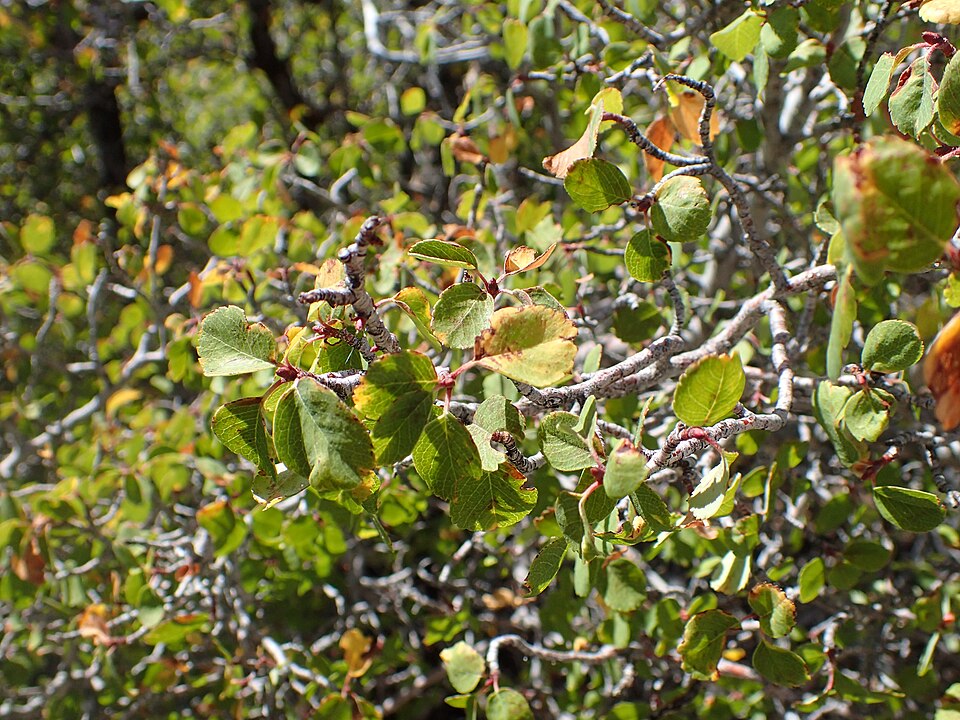
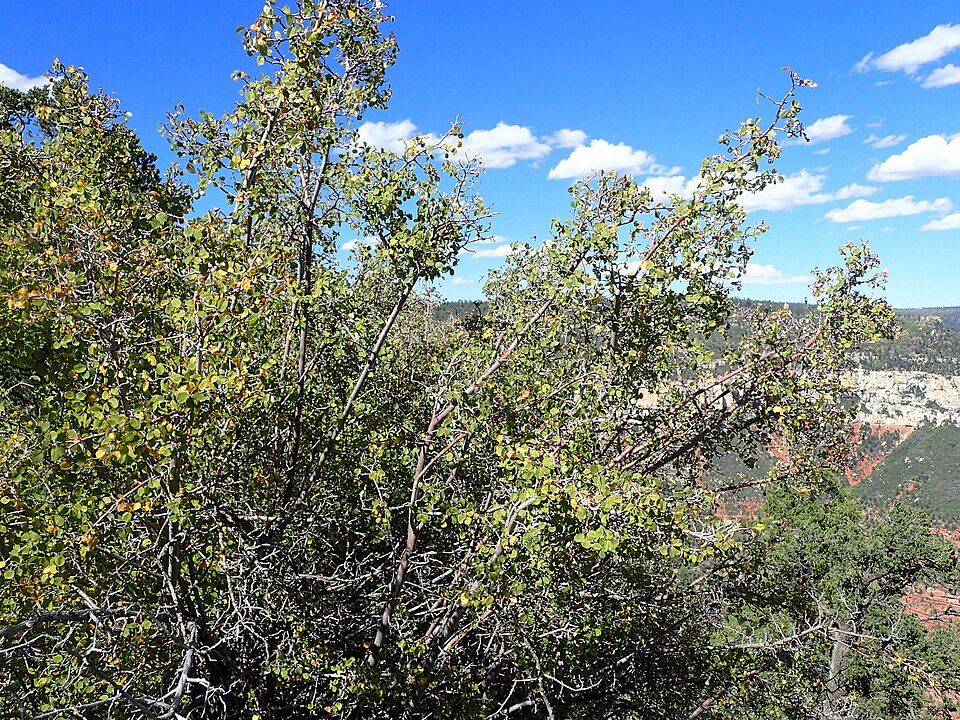
Utah Serviceberry is a deciduous shrub ranging from 3 to 18 feet tall — the batch data lists 6–15 ft — with an irregular to rounded crown. It may grow as a compact, multi-stemmed shrub at high elevations or dry exposures, or as a taller, more tree-like form in favorable, moist, lower-elevation sites. The bark is smooth and grayish on young stems, becoming slightly furrowed and grayish-brown on older trunks. One of the diagnostic features is the dark green, slightly oval leaves with toothed margins and a distinctive pattern of parallel veins.
Bark & Stems
Young twigs are reddish-brown to purplish, smooth, and flexible. As the plant ages, the bark becomes smooth and light gray to grayish-brown — somewhat similar to the smooth gray bark of other Rosaceae family members. Old trunks on mature specimens can be 3–5 inches in diameter and develop attractive silvery-gray bark that is attractive year-round. The plant spreads by root sprouting to form dense clumps in favorable conditions.
Leaves
The leaves are simple and alternate, broadly oval to nearly circular, 1–2 inches long and nearly as wide, with a somewhat rounded tip and a slightly heart-shaped base. The margins are sharply toothed in the upper half to two-thirds of the leaf — often the lower third near the base is untoothed. The upper surface is dark green and hairless at maturity; the underside is paler and may be slightly hairy when young. Fall color ranges from muted yellow to orange to deep red-orange — not the most spectacular fall display, but reliably colorful and adding to the multi-season interest of the plant. The batch note says “muted fall colors,” which accurately characterizes the typical performance — variable, sometimes striking, often subdued.
Flowers & Fruit
The flowers appear in early spring (April–May depending on elevation and location), often before the leaves are fully out, in loose, elongated clusters (racemes) of 3–10 flowers. Each flower has 5 narrow, strap-shaped white petals about 0.5–0.75 inches long and numerous yellow-tipped stamens, creating an open, airy, snow-white floral display. The flowers have a faint sweet fragrance and attract early-season native bees, butterflies, and other insects when few other blooming plants are available.
The fruits — pomes (technically, like tiny apples) — ripen from red to dark purple or purplish-black in June and July, typically 0.25–0.5 inches in diameter. They are sweet, nutritious, and palatable — long used by Indigenous peoples as food, and eagerly consumed today by bears, birds, coyotes, and other wildlife. The word “serviceberry” relates to historical tradition of holding burial services when the plant bloomed in spring (signaling that frozen ground had thawed enough for digging), though this etymology is debated.
Quick Facts
| Scientific Name | Amelanchier utahensis |
| Family | Rosaceae (Rose) |
| Plant Type | Deciduous Shrub / Small Tree |
| Mature Height | 6–15 ft |
| Sun Exposure | Full Sun |
| Water Needs | Moderate |
| Bloom Time | April – May |
| Flower Color | White |
| USDA Hardiness Zones | 4–9 |
Native Range
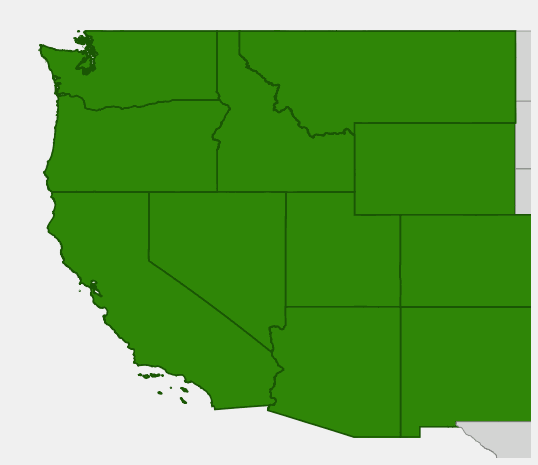
Utah Serviceberry has one of the broadest distributions of any native serviceberry in North America, ranging from British Columbia and Alberta south through the western mountains to Arizona, New Mexico, and northern Mexico. In the United States, it occurs in eleven western states: Arizona, California, Colorado, Idaho, Montana, Nevada, New Mexico, Oregon, Utah, Washington, and Wyoming. It is most abundant in the Intermountain West — the vast region between the Sierra Nevada and the Rocky Mountains — where it is one of the most common native shrubs.
In Utah, Amelanchier utahensis is one of the most widespread native shrubs in the state, occurring in virtually every county at appropriate elevations. It is a common component of Pinyon-Juniper woodlands, Gambel Oak scrub, Mountain Shrub communities, and lower montane forests across the Colorado Plateau, the Uinta Mountains foothills, and the Wasatch Range. In Utah, it grows most abundantly at elevations between 5,000 and 9,000 feet on rocky slopes and canyon walls, often in the transition zone between desert scrub below and coniferous forest above. The dry, rocky canyon walls of Utah’s canyon country — Capitol Reef, Canyonlands, Zion — support abundant Utah Serviceberry populations visible during spring bloom as white splotches on the cliff faces.
The species shows considerable morphological variation across its range, and the boundaries between Utah Serviceberry and closely related species (particularly Amelanchier alnifolia, Saskatoon Serviceberry) are not always clear — some botanists treat these as varieties of a single species, while others maintain them as distinct. In Utah, the species is relatively consistent in its appearance: a compact to medium shrub of dry, rocky mountain slopes with the typical serviceberry combination of white spring flowers, purple summer berries, and reliable fall color.
📋 Regional plant lists featuring Utah Serviceberry: Utah
Growing & Care Guide
Utah Serviceberry is an excellent landscape shrub for native gardens in the Intermountain West — adaptable, ornamental across multiple seasons, and genuinely valuable to wildlife. It is not demanding in its requirements and, once established, thrives with minimal intervention.
Light
Full sun to light shade. While the plant list notes full sun, Utah Serviceberry is quite adaptable to partial shade — it naturally grows on both sunny south-facing slopes and on shadier north-facing canyon walls. In full sun, it tends to be more compact and blooms more heavily. In partial shade, growth is taller and more open. Both forms have landscape value. Avoid deep shade, where blooming decreases significantly.
Soil & Water
Utah Serviceberry tolerates a very wide range of soil types — from rocky, shallow, dry soils on canyon walls to deeper, moderately moist mountain soils. It is not as drought-tolerant as pure desert species, but it is considerably more drought-tolerant than most ornamental shrubs once established. In the garden, water regularly during the first 1–2 growing seasons to establish the root system. After establishment, deep watering every 2–3 weeks during summer drought is adequate in most of Utah. The plant performs best with some summer moisture but will survive considerable drought once its deep root system is established. Amending clay soils with organic matter and grit improves performance significantly.
Planting Tips
Plant in fall or early spring. Container-grown plants establish readily. Bareroot plants can also be planted in early spring if kept moist until planted. Utah Serviceberry transplants reasonably well. It will sucker from the roots to form multi-stemmed clumps — this is its natural growth pattern and should be embraced. If a single-trunk tree form is desired, remove suckers as they appear. Space plants 8–12 feet apart for hedgerow or naturalistic planting, or plant singly as a specimen for ornamental use.
Pruning & Maintenance
Utah Serviceberry requires minimal pruning. In late winter, remove any dead or crossing branches. If the plant becomes too dense, selectively thin by removing a few of the oldest, most congested stems at the base — this rejuvenates the plant and improves air circulation. After the berry crop, birds will usually clean up any remaining fruit. No fertilization is needed in naturalistic plantings; a light application of compost mulch in spring is beneficial in garden settings.
Landscape Uses
- Wildlife habitat planting — essential berry plant for mountain birds and mammals
- Native hedgerow — creates wildlife-rich multi-season interest
- Mountain slope revegetation — drought-tolerant, deep-rooted soil anchor
- Spring flowering specimen — spectacular white bloom in April–May
- Fall color accent — muted orange to red fall foliage
- Transition zone planting — bridges desert scrub and mountain forest communities
- Edible landscape — berries are edible and nutritious for humans as well as wildlife
Wildlife & Ecological Value
Utah Serviceberry is one of the most wildlife-valuable native shrubs in the western United States, providing critical food resources at a time — early summer — when many other berry-producing plants haven’t yet fruited.
For Birds
The berries are consumed by dozens of bird species as they ripen in June–July. American Robins, Western Tanagers, Cedar Waxwings, Swainson’s Thrushes, and Hermit Thrushes are voracious consumers during migration and breeding. Mountain Bluebirds, Black-headed Grosbeaks, Steller’s Jays, Clark’s Nutcrackers, and many other resident mountain birds depend on serviceberry fruit as a critical early-summer food source. In favorable years, a single Utah Serviceberry shrub may be visited by dozens of individual birds over the course of a few days during peak berry ripening — one of the most satisfying wildlife-watching experiences in the mountain West.
For Mammals
Black Bears consume serviceberry berries extensively and actively seek out productive shrubs during their pre-denning hyperphagy (excessive eating before hibernation). Mule Deer browse the foliage and twigs, particularly in late summer and fall. Coyotes, foxes, and raccoons eat the berries. Chipmunks and ground squirrels consume fallen berries. In areas with Black Bear activity, serviceberry shrubs are well-known as important feeding sites — observing a bear gorging on serviceberry is a memorable wildlife encounter in Utah and Colorado.
For Pollinators
The early spring bloom of Utah Serviceberry is critically important for native bees, which emerge from winter dormancy at the same time the flowers open. The flowers provide nectar and pollen when few other sources are available. Mason bees (Osmia spp.), Mining bees (Andrena spp.), and early-emerging bumblebee queens are major visitors. The serviceberry bloom also supports early-season butterflies including Mourning Cloak, California Tortoiseshell, and various anglewings that overwinter as adults and need early nectar sources.
Ecosystem Role
Utah Serviceberry occupies an important ecological niche as a mid-elevation, drought-tolerant shrub that connects the desert scrub and mountain forest zones. It grows on rocky slopes that transition between these communities, creating wildlife corridors and movement pathways for animals that use both habitats. Its role as an early fruit producer is especially significant — by ripening in June–July, before most other berry crops are available, it fills a critical gap in the food supply for frugivorous birds and mammals. The serviceberry berries are also critical fuel for migratory songbirds passing through the Intermountain West during fall migration.
Cultural & Historical Uses
Serviceberries rank among the most important wild food plants in western North America. The Ute, Shoshone, Paiute, and numerous other Indigenous peoples of the Intermountain West relied heavily on serviceberry berries as a summer food source. The berries were eaten fresh, dried in the sun for winter storage, or mixed with pemmican — dried meat pounded with berries and fat — which was a critical high-calorie, shelf-stable food for winter survival and long travel. The nutritional value of serviceberries is significant: they are high in protein, iron, calcium, and vitamins C and E, comparing favorably with cultivated blueberries and outperforming them in some nutrients.
The Navajo and various Pueblo peoples used serviceberry in medicinal preparations — teas were made from the bark and leaves for various ailments, and the berries were considered beneficial for digestion and overall health. The wood, while relatively small in diameter, is very hard and was used for tool handles, arrow shafts, and small implements where extreme hardness was required. The flexible young stems were used in some basket-weaving traditions. The bark was used to produce a reddish-brown dye.
Lewis and Clark noted serviceberries extensively during their Corps of Discovery expedition through the West (1804–1806), recording the importance of the berries to Indigenous peoples they encountered and partaking themselves. The journals describe finding serviceberry plants (likely Amelanchier alnifolia and related species) throughout the mountain West and noting their importance as a food source. The common name “serviceberry” has several proposed etymologies: some say it comes from “sarvis” (a corruption of the European wild service tree Sorbus torminalis); others say it refers to the timing of bloom coinciding with when church services resumed in spring after frozen-ground winters, or with funerary services held when the ground thawed enough for grave-digging. Today, Utah Serviceberry is increasingly cultivated both as a landscape ornamental and for its edible berries — it is a promising candidate for development as a commercial fruit crop given its hardiness, drought tolerance, and nutritional value.
Frequently Asked Questions
Are Utah Serviceberry berries edible?
Yes — the berries are edible and quite good. They taste sweet to mildly tart, somewhat like a blend of blueberry and mild cherry. They can be eaten fresh off the bush, used in jams, jellies, pies, and syrups, or dried like raisins. Historically, they were one of the most important wild foods for Indigenous peoples of the western United States. The main limitation for human use is competition — birds find the berries just as attractive as humans do, and often strip the plant before gardeners have a chance to harvest.
How do I tell Utah Serviceberry from Saskatoon Serviceberry?
The distinction between Amelanchier utahensis and Amelanchier alnifolia (Saskatoon) can be difficult. Utah Serviceberry generally has smaller, narrower petals, a more compact shrubby form, and occurs primarily in the drier, more rocky conditions of the Colorado Plateau and Intermountain West. Saskatoon tends to be larger, with broader petals, and prefers moister conditions in the Pacific Northwest and northern Rockies. The two species hybridize where their ranges overlap, and many plants in transitional areas are difficult to assign to one species or the other.
When do Utah Serviceberries produce fruit?
In Utah, serviceberry berries typically ripen in late June through July, varying with elevation and year-to-year temperature variations. Higher-elevation plants ripen later than lower-elevation plants. The berry ripening window is only 2–4 weeks per plant — you need to be watching closely to catch them at peak ripeness before the birds take them all. Watching for increasing bird activity in the shrub is often the best indicator that berries are approaching peak ripeness.
How quickly does Utah Serviceberry grow?
Utah Serviceberry is a moderate grower — typically adding 12–24 inches per year under favorable garden conditions. Growth is faster in moist, well-amended soils; slower in the rocky, dry conditions of its natural habitat. An established plant in a garden setting might reach 8–10 feet in 5–7 years. It is not a fast grower compared to non-native ornamental shrubs, but its growth rate is appropriate for its longevity — well-established plants can persist for 50 years or more.
Does Utah Serviceberry need a pollinator?
Utah Serviceberry is generally self-fertile — a single plant can produce berries without cross-pollination. However, planting two or more plants in proximity typically improves berry production through cross-pollination, just as with most fruit-bearing shrubs. For best berry crops, plant at least two plants within 30 feet of each other and ensure adequate native bee activity in the area for pollination.

Looking for a nursery that carries Utah Serviceberry?
Browse our native plant nursery directory: Utah