
Spanish Needles (Bidens alba)
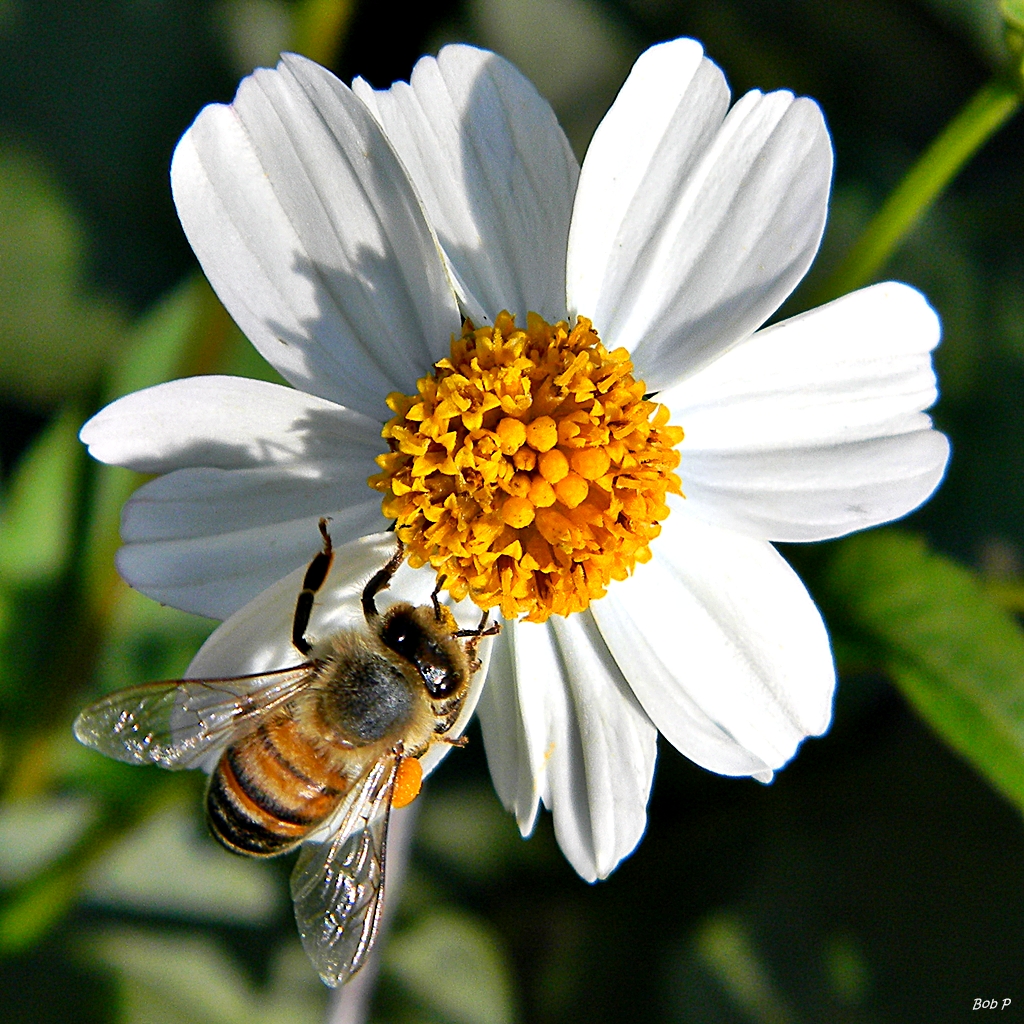
Bidens alba, known as Spanish Needles, white beggarticks, beggarticks, shepherd’s needles and, in USDA PLANTS, romerillo, is a fast-growing member of the aster family (Asteraceae) and one of the most familiar wildflowers in Florida. It grows on almost any sunny patch of disturbed ground: road shoulders, vacant lots, yard edges, pasture margins and the back corners of gardens. Its small daisy-like heads, with five to eight broad white rays around a golden-yellow disk, can be found in flower in every month of the year in central and south Florida.
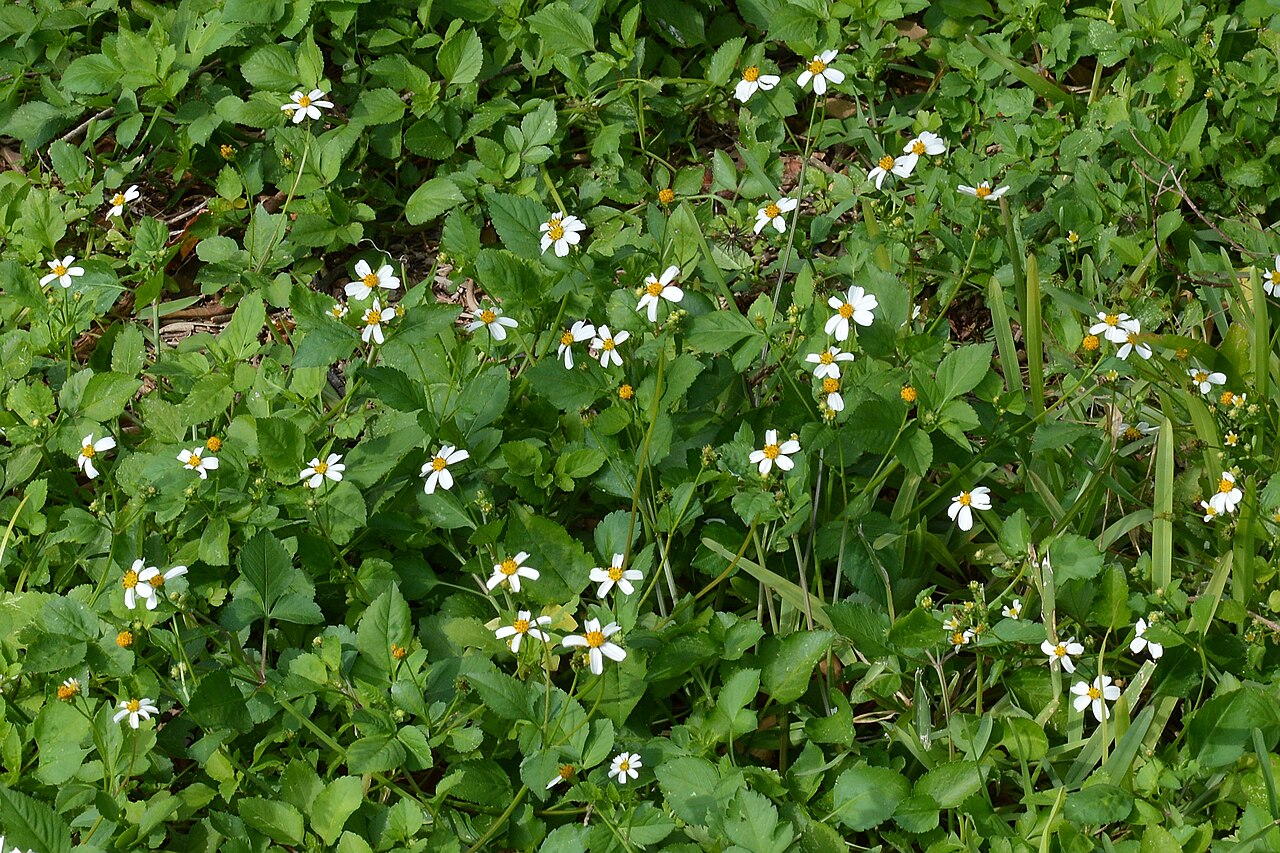
Its reputation is split down the middle. Many homeowners pull it as a weed, because it seeds heavily and its barbed black seeds cling to socks, pant legs and dog fur. Butterfly gardeners, on the other hand, rank it among the most productive nectar plants in the state: on a sunny day a single clump can carry skippers, sulphurs, hairstreaks, honey bees and native bees all at once. It is also a recorded larval host for the dainty sulphur butterfly.
Its native status is also split, and we want to state that plainly. USDA PLANTS lists Bidens alba as native to the lower 48 states and Puerto Rico, which is why it is included on this site. The Atlas of Florida Plants lists it as Not Native in Florida, and the Flora of North America treatment regards its native status in the United States as doubtful, suggesting it may have arrived from the American tropics. The sources agree that it is now established across all of Florida; they disagree about whether it was here before people. We follow the site rule that a species counts as native when either USDA PLANTS or the Atlas of Florida Plants lists it as native, and we note the disagreement wherever this plant appears.
Identification
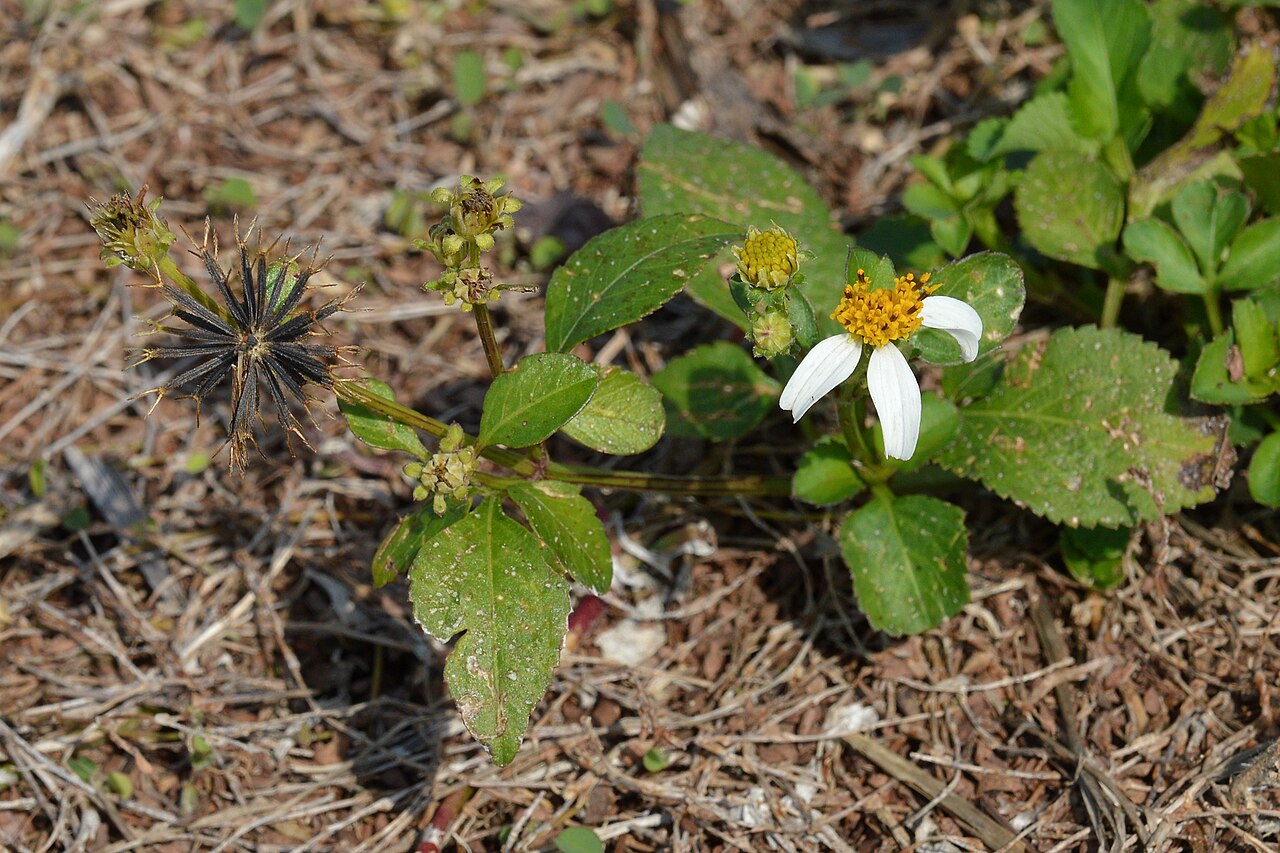
Spanish needles belongs to a group of closely related beggarticks that are easy to confuse. The combination to look for is a branching, leafy annual or short-lived perennial with mostly three- to five-part leaves, conspicuous white rays about half an inch long, and black, needle-like seeds with two or three barbed prongs at the tip.
Habit & Stems
An erect to sprawling herb, usually 1 to 4 feet tall and about as wide, branching freely from the base. Stems are green to purplish, four-angled and mostly smooth. It is an annual or short-lived perennial: in frost-free south Florida individual plants persist and flower for a year or more, while in north Florida and along the Gulf coast frost kills the top growth and the colony returns from seed. Stems that touch moist ground can root, so clumps regrow quickly after cutting.
Leaves
Leaves are opposite, with toothed margins. Most are divided into three to five lance-shaped to oval leaflets, the end leaflet the largest; leaves near the top of the plant are often simple. Individual leaves are roughly 1 to 4 inches long, with sparse hairs on the underside. The crushed foliage has a mild, slightly resinous smell.
Flowers
Flower heads are about 1 to 1.5 inches across, borne singly or in loose clusters at the ends of long stalks. Each head has five to eight broad white ray florets, sometimes faintly flushed pink, around a dense button of yellow disk florets. A ring of narrow green bracts cups the head. Bloom is year-round in south and central Florida and from spring to the first frost farther north.
Fruit & Seeds
The fruit is a slender, dark brown to black, four-angled achene about a third to a half inch long, crowned by two or three stiff awns covered in backward-pointing barbs. Ripe achenes stand out from the head like a small starburst of needles, which is the source of the names Spanish needles and beggarticks. The barbs are the dispersal system: seeds travel on animals, clothing and equipment, and a single plant can produce well over a thousand of them.
Similar Species
Bidens pilosa, often called hairy beggarticks or black-jack, is the closest look-alike and is widely regarded as introduced. In most treatments its rays are absent or tiny (under about a quarter inch), while those of Bidens alba are clearly showy. Some older books, and some current ones, treat Spanish needles as Bidens pilosa var. radiata or Bidens alba var. radiata, so check the description rather than the name alone. Florida also has several yellow-rayed native beggarticks, such as bur marigold (Bidens laevis) of marshes and pond edges, which are easily separated by their golden rays and wetter habitats.
Quick Facts
| Scientific Name | Bidens alba (syn. Bidens alba var. radiata; often treated as Bidens pilosa var. radiata) |
| Family | Asteraceae (aster or daisy family) |
| Plant Type | Herbaceous annual or short-lived perennial wildflower |
| Mature Height | 1–4 ft; occasionally taller in rich soil |
| Mature Spread | 1–3 ft per plant; colonies spread by seed |
| Growth Rate | Fast; flowers within weeks of germination |
| Sun Exposure | Full sun to part shade |
| Water Needs | Low to moderate; drought tolerant once established |
| Soil Type | Almost any well-drained soil: sand, shell, limestone, loam or disturbed fill |
| Soil pH | About 5.5–8.0 |
| Bloom Time | Year-round in central and south Florida; spring to frost farther north |
| Flower Color | White rays (rarely pinkish) around a yellow disk |
| Fall Color | None |
| Fruit | Black, needle-like achenes with 2–3 barbed awns |
| Deer Resistant | Not documented; treat it as unprotected where deer browse |
| USDA Hardiness Zones | 8–11 (perennial in 10–11; acts as a reseeding annual in cooler zones) |
Native Range
Native status in brief: USDA PLANTS lists Bidens alba as native to the lower 48 states, Puerto Rico and the U.S. Virgin Islands, and as introduced in Hawaii and the Pacific Basin. The Atlas of Florida Plants classifies it as Not Native in Florida, and the Flora of North America considers its native status doubtful. Because USDA lists it as native, it meets this site’s rule for inclusion; because the Atlas does not, our Florida list carries a note saying so.
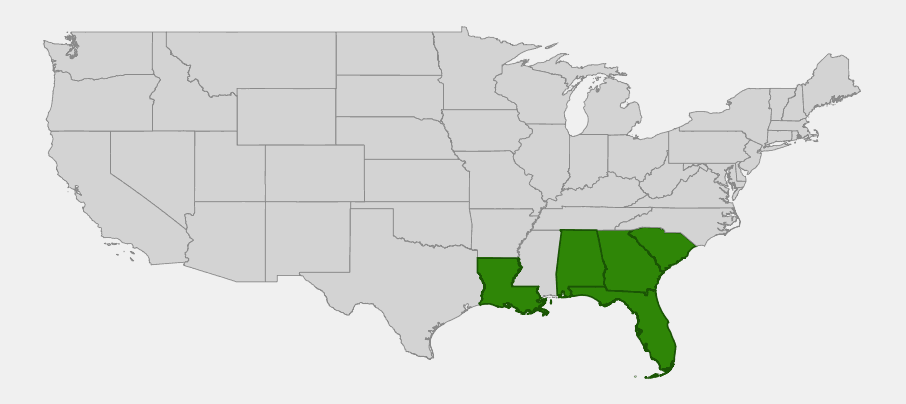
Whatever its origin, Spanish needles is now one of the most widespread wildflowers in Florida. The Atlas of Florida Plants has vouchered records from every county in the state, from the western Panhandle to the Keys. Outside Florida it occurs mainly on the coastal plain of Georgia, South Carolina, Alabama and Louisiana, where it is most common near the coast and in towns, and there are scattered records farther north that are generally regarded as waifs. Beyond the United States it ranges through the West Indies, Mexico, Central America and South America, and it has been carried to tropical Asia, Africa and the Pacific islands, where it is often a weed.
Its habitat is disturbed, sunny ground. It is far more common in yards, roadsides, fallow fields, firebreaks and canal banks than in intact natural communities, which is one reason botanists question whether it is truly native. In natural areas it appears most often after disturbance, at the edges of hammocks and in openings that have been cleared, and it gives way as taller vegetation closes in.
📋 Regional plant lists featuring Spanish Needles: North & South Florida · Alabama, Georgia & Mississippi
Growing & Care Guide
Nobody needs instructions to get Spanish needles to grow; the useful skill is keeping it where you want it. Treat it as a tough, long-blooming nectar plant for a defined butterfly bed, a meadow corner or a wild edge, and manage its seed so it does not take over neighboring beds and lawn.
Light
Full sun gives the most compact plants and the heaviest bloom. It tolerates part shade, especially in south Florida, but stretches and flops when it gets less than about half a day of sun.
Soil & Water
It grows in nearly anything: deep sand, shell, limestone rock, clay fill or rich garden loam. Rich, irrigated soil produces taller, lankier plants; lean, dry soil keeps it lower and denser. Water seedlings or transplants until they root in. After that it needs no supplemental irrigation except in a prolonged drought, and it does not need fertilizer.
Planting Tips
If it is not already on your property, it will often arrive on its own. To start a planting deliberately, scatter seed on bare, sunny soil and rake it in lightly, or set out nursery plants or rooted cuttings about 2 to 3 feet apart. Give it room in the back of a butterfly bed or meadow rather than at the front of a formal border, and keep it away from walkways and pet runs where the seeds will cling to everyone who passes.
Pruning & Maintenance
Shear plants back by a third to a half whenever they get leggy; they branch and rebloom within a few weeks. The main maintenance task is seed control. Deadhead or cut back stems as the first seed heads darken if you want to limit spread, and pull unwanted seedlings while they are small, since older plants develop a tough taproot. In a mowed area it will persist as a low, flowering groundcover.
Propagation
Seed germinates readily on bare soil with no pretreatment; collect ripe black achenes and sow them fresh. Stem cuttings root easily in moist sand, and stems that lie on damp ground often root on their own. Because it hybridizes and intergrades with related beggarticks, collect seed from plants that clearly show large white rays.
Landscape Uses
- Butterfly and pollinator gardens: a nearly year-round nectar source in central and south Florida that draws a wide variety of butterflies, bees and wasps
- Meadow and wild edges: fills sunny, unirrigated corners and field margins quickly
- Low-maintenance groundcover: in mowed areas it persists as a low, flowering layer
- Pollinator support in winter: in frost-free areas it flowers through the cool months when few other nectar plants are open
- Edible and foraging gardens: young leaves and shoots are used as a cooked green in many tropical countries
Wildlife & Ecological Value
Whatever its history, Spanish needles has become one of the most heavily used nectar plants in Florida, largely because it flowers so continuously and grows almost everywhere.
For Pollinators
The open heads give easy access to nectar and pollen, so the visitor list is long: skippers, sulphurs, hairstreaks, whites, swallowtails and the Florida duskywing among butterflies, plus honey bees, many native bees, wasps and flies. Florida beekeepers value it as a nectar source. It is recorded as a larval host for the dainty sulphur (Nathalis iole), one of the smallest sulphur butterflies in North America.
For Birds
Small seed-eating birds pick at ripe seed heads, and the insects the plant attracts feed warblers and other insectivorous birds, especially during spring and fall migration when the plant is still in flower.
For Mammals
Mammals use it mainly as a passenger service: the barbed achenes attach to fur and are carried away from the parent plant. The foliage is not a notable food source.
Ecosystem Role
Spanish needles is a pioneer of disturbed soil. It covers bare ground quickly after clearing, fire or storms, holds the soil and feeds pollinators while longer-lived plants become established, then fades as shade and competition increase. Its status as a weed of farms and gardens in many tropical countries is a reminder to manage its seed in a home landscape, and to avoid introducing it to natural areas where it is not already present.
Cultural & Historical Uses
The genus name Bidens means “two teeth” in Latin, after the paired barbed awns on the seeds of many species, and alba means white, for the rays. Common names in English almost all describe the seeds: Spanish needles, shepherd’s needles, beggarticks and pitchfork weed. USDA PLANTS uses the Spanish name romerillo, which is common in the Caribbean.
Across the American tropics, Asia and Africa, the young leaves of Bidens alba and its relatives are cooked as greens or dried for tea, and the plants are used in folk medicine. Florida foragers also gather the young shoots and leaves, which are typically cooked rather than eaten raw because the raw greens are resinous and can upset the stomach. As with any wild green, identify it confidently, harvest only from clean sites away from roadsides and sprayed areas, and eat it in moderation.
In Florida it has become something of a symbol of the debate between tidy landscapes and pollinator gardening. Extension weed guides describe it among the common broadleaf weeds of citrus groves and lawns, while butterfly gardeners and naturalists promote it as one of the best nectar plants in the state. Both are right: it is a valuable wildflower in the right spot and a nuisance in the wrong one.
Frequently Asked Questions
Is Spanish needles native to Florida?
The sources disagree. USDA PLANTS lists Bidens alba as native to the lower 48 states and Puerto Rico. The Atlas of Florida Plants lists it as not native in Florida, and the Flora of North America considers its native status doubtful. This site includes it because USDA lists it as native, and we note the disagreement.
Is it the same as Bidens pilosa?
They are closely related and sometimes combined. Spanish needles has showy white rays about half an inch long; Bidens pilosa in the strict sense has tiny rays or none and is widely regarded as introduced. Older references may call Spanish needles Bidens pilosa var. radiata.
How do I keep it from spreading everywhere?
Cut plants back when the first seed heads turn dark, before the barbed seeds ripen and drop. Pull unwanted seedlings while they are young, and keep it in a defined bed or meadow area rather than next to paths and lawn.
Which butterflies use it?
Many species nectar on it, including skippers, sulphurs, hairstreaks, swallowtails and the Florida duskywing. It is also a recorded larval host for the dainty sulphur.
Is it edible?
Young leaves and shoots are eaten as a cooked green in many tropical countries and by Florida foragers. Cook them rather than eating them raw, harvest only from clean sites, and be certain of your identification.

Looking for a nursery that carries Spanish Needles?
Browse our native plant nursery directory: Florida & Georgia · Alabama · South Carolina · Louisiana