
Kentucky Bluegrass (Poa pratensis)
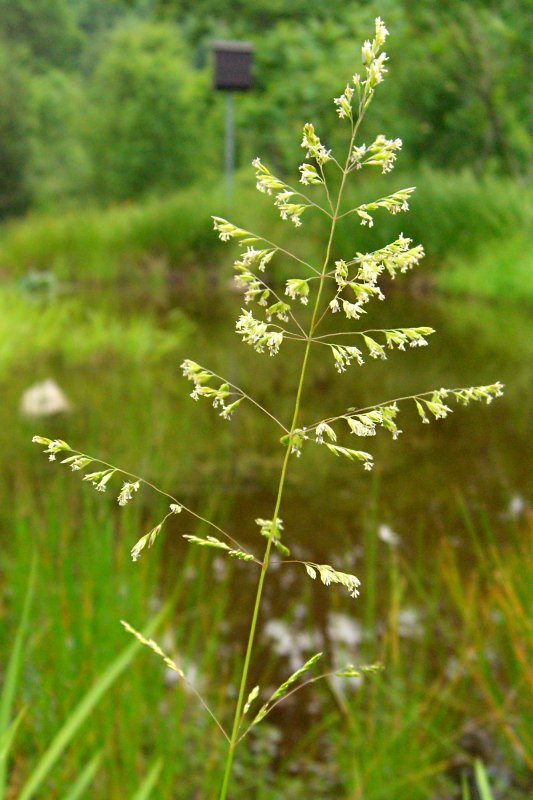
Poa pratensis, known as Kentucky Bluegrass, is the most familiar lawn grass in the northern United States, and that makes it an unusual subject for a native plant site. The species is really a complex of closely related races. Some of them are genuinely native to North America: small, hardy, slowly spreading bluegrasses of arctic tundra, alpine meadows and boreal openings from Alaska across northern Canada to Greenland, with a few rare outposts in the mountains of New England. Others, including the races bred into nearly every lawn, sod farm and pasture seed mix, were brought from Europe.
USDA PLANTS reflects this by listing Poa pratensis as both native and introduced in Alaska, Canada and the lower 48 states. At the subspecies level the split is clearer. USDA lists subsp. alpigena as native in Alaska, Canada and the lower 48, and subsp. colpodea as native in Alaska, Canada and Greenland, while subsp. pratensis, the common turf and pasture grass, is listed as introduced throughout the United States. In New England, the Native Plant Trust’s Go Botany flora treats subsp. alpigena on Mount Washington and subsp. agassizensis in northern Maine as rare natives, and the two widespread lowland races as non-native.
This page is about the species as a whole, with the native races at its center. If you are buying seed or sod labeled Kentucky bluegrass, you are almost certainly buying European-derived cultivars, not the native plant. The practical guidance below explains how to tell the races apart where it matters, why the introduced forms are a problem in native prairie, and when the native forms are worth seeking out for restoration in the far north.
Identification
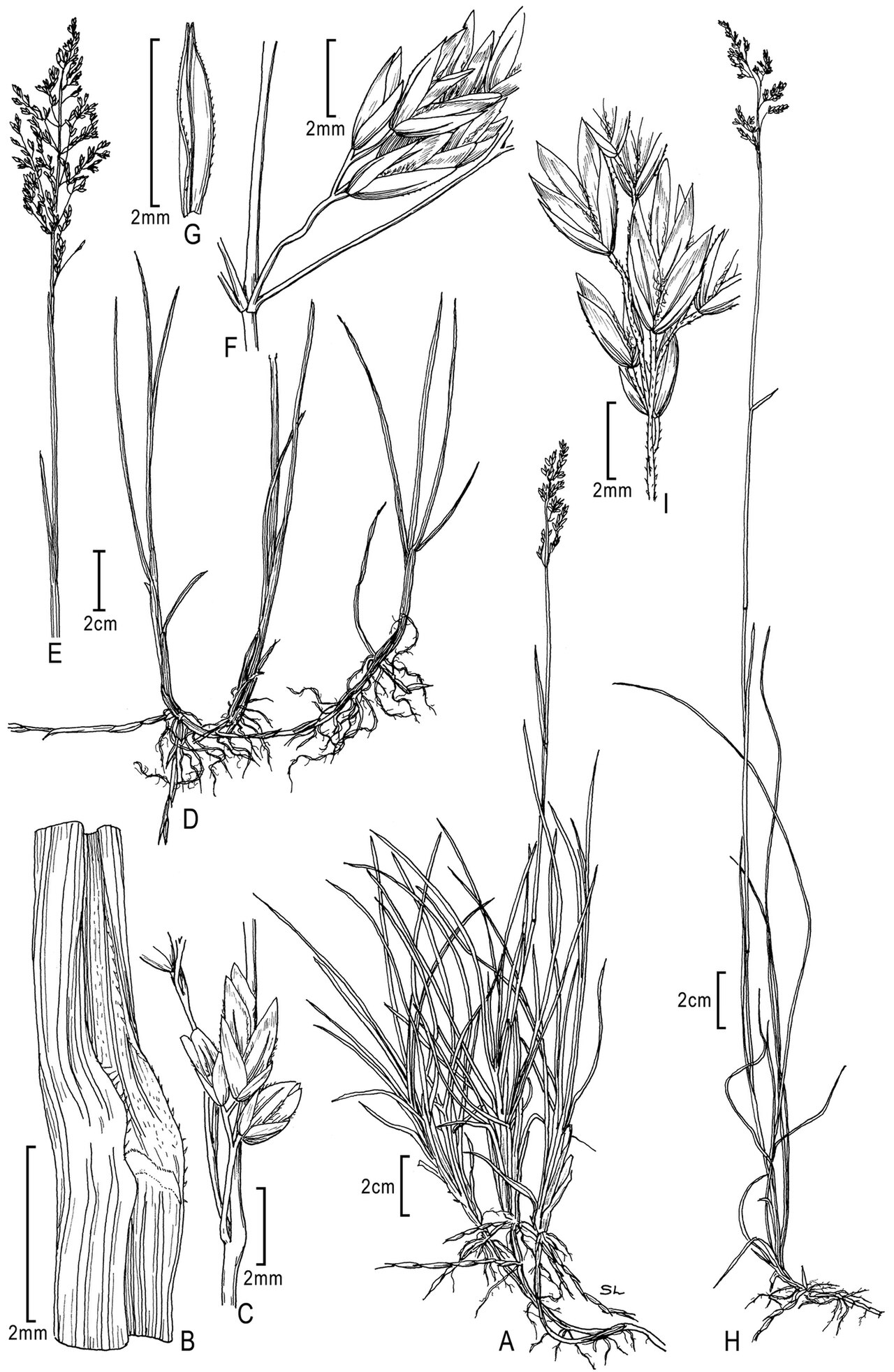
All races of Poa pratensis share a few features that separate them from most other grasses: creeping rhizomes, leaf tips shaped like the bow of a boat, a very short, blunt ligule, and an open, pyramid-shaped panicle with branches in whorls of three to five. The races differ in size, leaf width and fine spikelet details, and telling them apart reliably usually requires a hand lens and a technical key.
Habit & Rhizomes
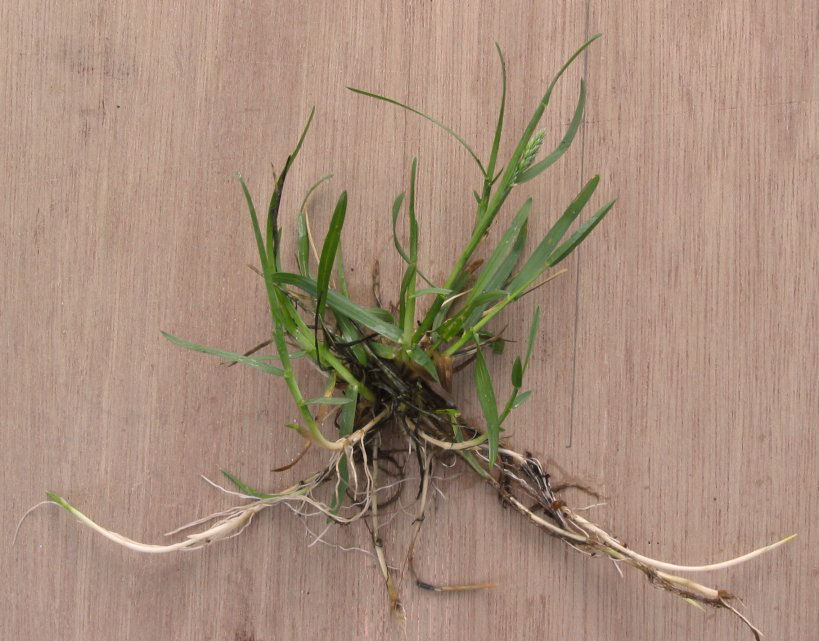
A cool-season perennial that spreads by slender underground rhizomes, forming a continuous sod rather than separate bunches. Flowering stems are usually 1 to 2 feet tall, occasionally up to about 3 feet in the lowland races. The native boreal and alpine races are generally smaller and less aggressive, often under a foot tall in exposed tundra and alpine sites, with shorter rhizomes and fewer, more open shoots.
Leaves
Leaf blades are flat or folded, up to about 8 inches long and roughly an eighth of an inch wide, soft, dark green to blue-green, with a prominent midrib flanked by two pale lines (the “tram tracks” common to bluegrasses) and a distinctly boat-shaped tip. The ligule, the small flap where blade meets sheath, is very short and squared off. The introduced subsp. angustifolia has narrow, inrolled leaves on its non-flowering shoots; the native subsp. alpigena has short, relatively broad leaves on compact shoots.
Flowers & Spikelets
The panicle is open and pyramid-shaped, roughly 2 to 8 inches long, with the lowest branches in whorls of three to five. Spikelets are small, a quarter inch or less, with two to five florets, green to purplish, and the lemmas carry a tuft of cobwebby hairs at the base, a feature shared with many other bluegrasses. Flowering is in late spring and early summer in the lowlands and in mid summer in the Arctic and alpine zone. The panicles of the alpine race tend to be shorter, denser and more strongly purple-tinged.
Seeds
The fruit is a tiny grain (caryopsis) that falls with the floret. Many plants of Poa pratensis set seed without fertilization (apomixis), so a single plant can produce offspring that are near-copies of itself. That is one reason the complex contains so many slightly different forms, and why lawn cultivars stay true to type.
Similar Species
Alpine Bluegrass (Poa alpina) of northern and alpine sites is a bunchgrass without rhizomes and with broad, short leaves. Sandberg Bluegrass (Poa secunda) of western steppe is a small bunchgrass with a narrow, contracted panicle. Rough bluegrass (Poa trivialis), another European introduction, has a long, pointed ligule and creeping stolons rather than rhizomes. Canada bluegrass (Poa compressa), also introduced, has flattened, two-edged stems.
Quick Facts
| Scientific Name | Poa pratensis (native races include subsp. alpigena and subsp. colpodea) |
| Family | Poaceae (grass family) |
| Plant Type | Cool-season perennial grass, rhizomatous |
| Mature Height | 1–2 ft in flower (to about 3 ft in lowland races); native alpine forms often under 1 ft |
| Mature Spread | Indefinite; spreads by rhizomes to form sod |
| Growth Rate | Moderate; slow to establish from seed, then spreads steadily |
| Sun Exposure | Full sun to light shade |
| Water Needs | Moderate to high; goes dormant in summer drought |
| Soil Type | Moist, well-drained loam; tolerates limestone soils |
| Soil pH | About 6.0–7.5 |
| Bloom Time | May–August (later in Arctic and alpine sites) |
| Flower Color | Green to purplish spikelets |
| Fall Color | Stays green into late fall; native alpine forms tan in winter |
| Fruit | Tiny grain (caryopsis); often set without fertilization |
| Deer Resistant | No; grazed by deer, elk, caribou and livestock |
| USDA Hardiness Zones | 2–7 (native races to zone 1 and colder in the Arctic) |
Native Range
Where it is native: The native races of Poa pratensis are circumboreal plants of the far north and high mountains. USDA PLANTS lists subsp. alpigena as native in Alaska, Canada and the lower 48 states, and subsp. colpodea as native in Alaska, Canada and Greenland. In the lower 48 the native forms are rare and confined to cold, high-elevation habitats; in New England, Go Botany records subsp. alpigena only from the alpine zone around Mount Washington in New Hampshire, where it is state-listed as endangered, and subsp. agassizensis only from Aroostook County in northern Maine. Our map shades Alaska, Maine and New Hampshire, the states where native races are documented in the sources we checked; the native forms also range across northern Canada.
Where it is introduced: The lowland races, subsp. pratensis and the narrow-leaved subsp. angustifolia, came from Europe with early settlers and pasture seed. They are now naturalized in every state except the hottest parts of the South, and in all Canadian provinces. The Atlas of Florida Plants, for example, records Poa pratensis as not native in Florida, where it is known only from a handful of northern counties. In the northern Great Plains and the Canadian prairies, introduced Kentucky bluegrass has invaded large areas of native mixed-grass and tallgrass prairie, where it is treated as an unwelcome exotic that displaces native grasses and wildflowers.
Which race you are looking at is usually a question of setting. A bluegrass in a lawn, pasture, roadside, old field or city park in the lower 48 is almost always one of the introduced races. A small, compact Poa pratensis on arctic tundra, an alpine meadow above treeline or a remote boreal gravel bar in Alaska or northern Canada is much more likely to be native. Between those extremes, especially in Alaska where introduced races have spread along roads and settlements, separating them takes a technical key.
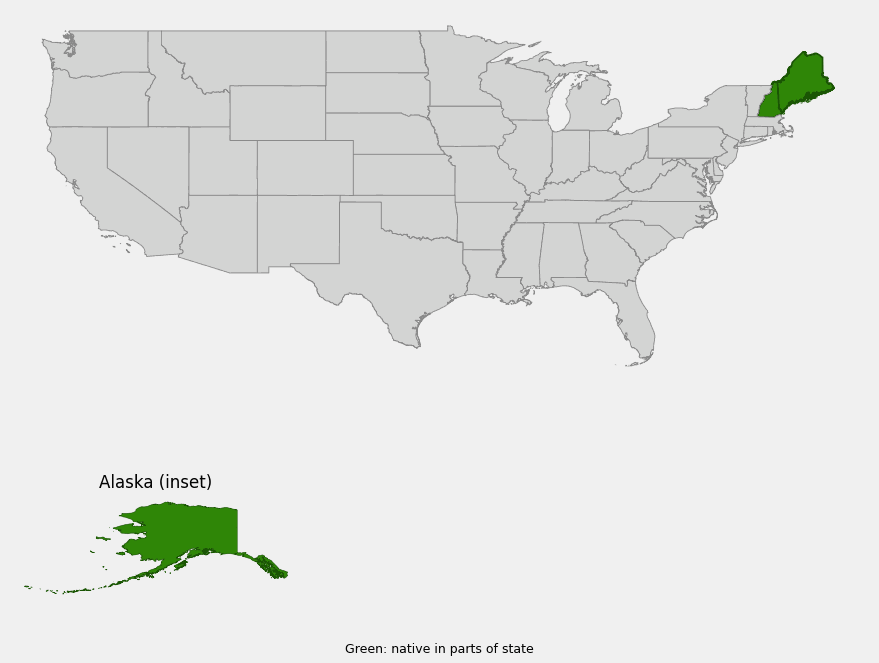
📋 Regional plant lists featuring Kentucky Bluegrass: Alaska · New Hampshire, Maine & Vermont
Growing & Care Guide
How you treat Poa pratensis depends on which race and which place. In most of the lower 48, the plant you can buy is the introduced lawn grass, and the native-plant advice is to use less of it, not more. In Alaska and the far north, locally sourced native forms have a place in revegetation and restoration.
Light
Full sun to light shade. Lawn forms thin out in deep shade, and the native alpine forms grow in fully exposed tundra and ridgetop sites.
Soil & Water
The lowland races want moist, fertile, well-drained loam, ideally near neutral, and they need regular water to stay green through summer; in drought they go dormant and turn tan. The native northern races grow in thin, cold, often gravelly soils with short growing seasons and need no irrigation once established in their own climate.
Planting Tips
For revegetation in Alaska and northern Canada, use seed or plants from local native sources where they are available, rather than turf cultivars bred from European stock. In the lower 48, if you are replacing lawn, consider regional native alternatives instead: Buffalograss and Blue Grama on the plains and in the dry West, Pennsylvania Sedge for shaded eastern lawns, or Red Fescue in cool, moist regions.
Pruning & Maintenance
As a lawn it is mowed at about 2.5 to 3.5 inches; taller mowing shades out weeds and deepens roots. Native stands need no maintenance. Where introduced Kentucky bluegrass is invading native prairie, land managers use well-timed spring burning and grazing to set it back while the native warm-season grasses are still dormant; consult your local conservation agency before attempting this.
Propagation
Seed germinates slowly, often taking two to three weeks, and is sown in late summer or early fall in the lowlands. Sod and rhizome divisions establish quickly. Native northern forms can be grown from locally collected seed or by dividing rhizomatous clumps.
Landscape Uses
- Arctic and alpine revegetation: locally sourced native forms help stabilize disturbed ground in Alaska and northern Canada
- Lawns and sports turf: the introduced races are the most widely planted cool-season turfgrass in the northern U.S.
- Pasture and hay: a palatable, high-quality forage grass for livestock
- Erosion control: its rhizomes bind soil on slopes and banks
- Not for native prairie plantings: introduced races invade and degrade prairie; choose native bunchgrasses instead
Wildlife & Ecological Value
The ecological value of Poa pratensis depends on context. The native races are part of the forage base of the far north, while introduced turf and pasture races are a mixed blessing at best in native ecosystems.
For Pollinators
Like all grasses, it is wind-pollinated and offers no nectar. It is, however, a larval host for several skipper butterflies; the Lady Bird Johnson Wildflower Center lists the common roadside-skipper, sandhill skipper, garita skipperling and pepper and salt skipper among species whose caterpillars feed on it.
For Birds
Ground-feeding birds and small mammals eat the seed, and the insects living in the sod feed ground-foraging birds. In prairie regions, dense mats of introduced bluegrass provide poorer nesting cover for grassland birds than the native mixed-grass sod they replace.
For Mammals
It is a highly palatable grass, grazed by deer, elk, bison, caribou, rabbits and livestock. In the Arctic, native forms contribute to summer forage for caribou and other grazers.
Ecosystem Role
The native races are one of many grasses that knit tundra and alpine turf together and stabilize thin, cold soils. The introduced races play a very different role: in the northern Great Plains they spread into native prairie, form a dense thatch, green up early and crowd out native grasses and wildflowers, and their expansion is one of the major management concerns on remaining prairie in the region.
Cultural & Historical Uses
Carl Linnaeus described Poa pratensis in 1753. Poa is Greek for fodder or grass, and pratensis means “of meadows.” The species is the type of the genus Poa. In Britain it is called smooth meadow-grass, a better reflection of its role as a pasture plant in Europe.
The name Kentucky bluegrass comes from the limestone-rich Bluegrass Region around Lexington, Kentucky, famous for horse farms, where the grass grew so well on the fertile soils that the region and the grass became linked. The “blue” refers to the bluish cast of the flowering heads when the grass is left to grow to full height. The European races were spreading through the eastern colonies by the 1700s, and some historians suggest the seed arrived with early Spanish and English settlers in hay and pasture mixes.
Because of that history, botanists long debated whether any Poa pratensis was native to North America at all. Detailed study of the complex, much of it by grass specialists working on the Flora of North America, separated the native boreal and alpine races from the introduced lowland ones. That is why USDA PLANTS lists the species as both native and introduced, and why the answer to “is Kentucky bluegrass native?” is: the lawn grass is not, but some of its wild relatives in the far north are.
Frequently Asked Questions
Is Kentucky bluegrass native to North America?
Partly. Native races of Poa pratensis, such as subsp. alpigena and subsp. colpodea, grow in Alaska, northern Canada, Greenland and a few high mountain sites in the lower 48. The lawn and pasture forms, mostly subsp. pratensis, were introduced from Europe. USDA PLANTS lists the species as both native and introduced.
Is the Kentucky bluegrass in my lawn native?
Almost certainly not. Lawn seed and sod are cultivars bred from European races. If you want a native lawn alternative, look at buffalograss or blue grama on the plains, Pennsylvania sedge in shade, or other grasses native to your region.
Why is it a problem in prairies?
Introduced Kentucky bluegrass spreads by rhizomes, forms dense thatch and greens up early in spring. In the northern Great Plains and Canadian prairies it has invaded large areas of native grassland, displacing native grasses and wildflowers.
Where can I see the native form in New England?
According to the Native Plant Trust’s Go Botany flora, subsp. alpigena grows only in the alpine zone around Mount Washington in New Hampshire, where it is state-listed as endangered, and subsp. agassizensis is known only from northern Maine. Stay on trails in alpine areas; the vegetation is fragile.
Is Kentucky bluegrass native to Kentucky?
No. Despite the name, the bluegrass of the Kentucky horse country is the introduced European form, which thrived on the region’s fertile limestone soils after settlement.

Looking for a nursery that carries Kentucky Bluegrass?
Browse our native plant nursery directory: Alaska · Maine · New Hampshire