Sugarberry (Celtis laevigata)
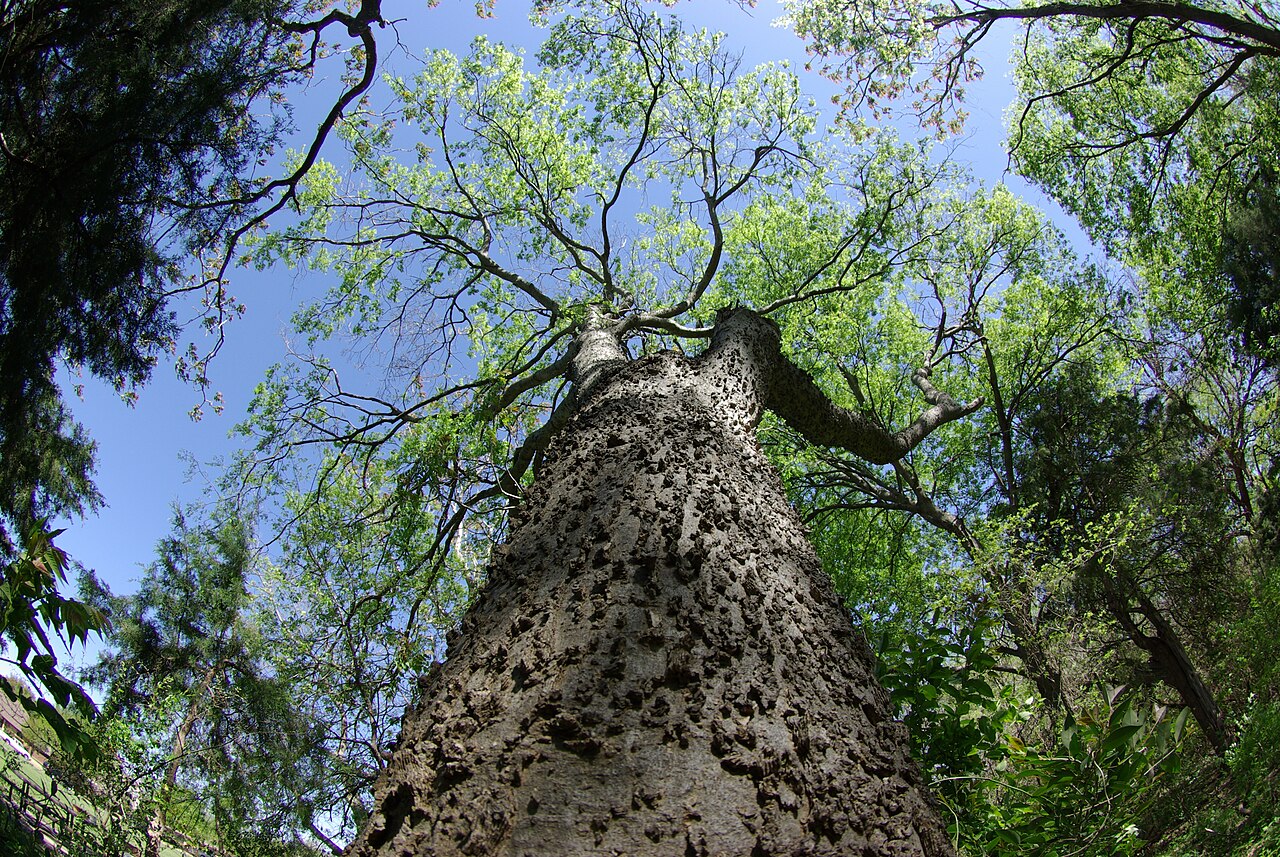
Sugarberry is a large native shade tree with an irregular rounded crown, pale bark marked by corky warts, and small fruits used by wildlife. It is often called hackberry, but the scientific name Celtis laevigata is important: several related trees share that common name.
In Arkansas and Louisiana it belongs naturally to the vocabulary of bottomland and moist-soil landscapes. A well-placed tree can provide substantial shade, but its mature size rules out a cramped planting pocket. Think in decades and canopy width rather than judging it by the dimensions of a young nursery sapling.
This guide treats sugarberry as Celtis laevigata in the current accepted sense and does not merge it with netleaf hackberry, Celtis reticulata, or common hackberry, Celtis occidentalis. Older publications sometimes include varieties under a broader concept. That is why both photographs and range records need checking rather than being borrowed solely from a familiar common name.
Identification
Leaves
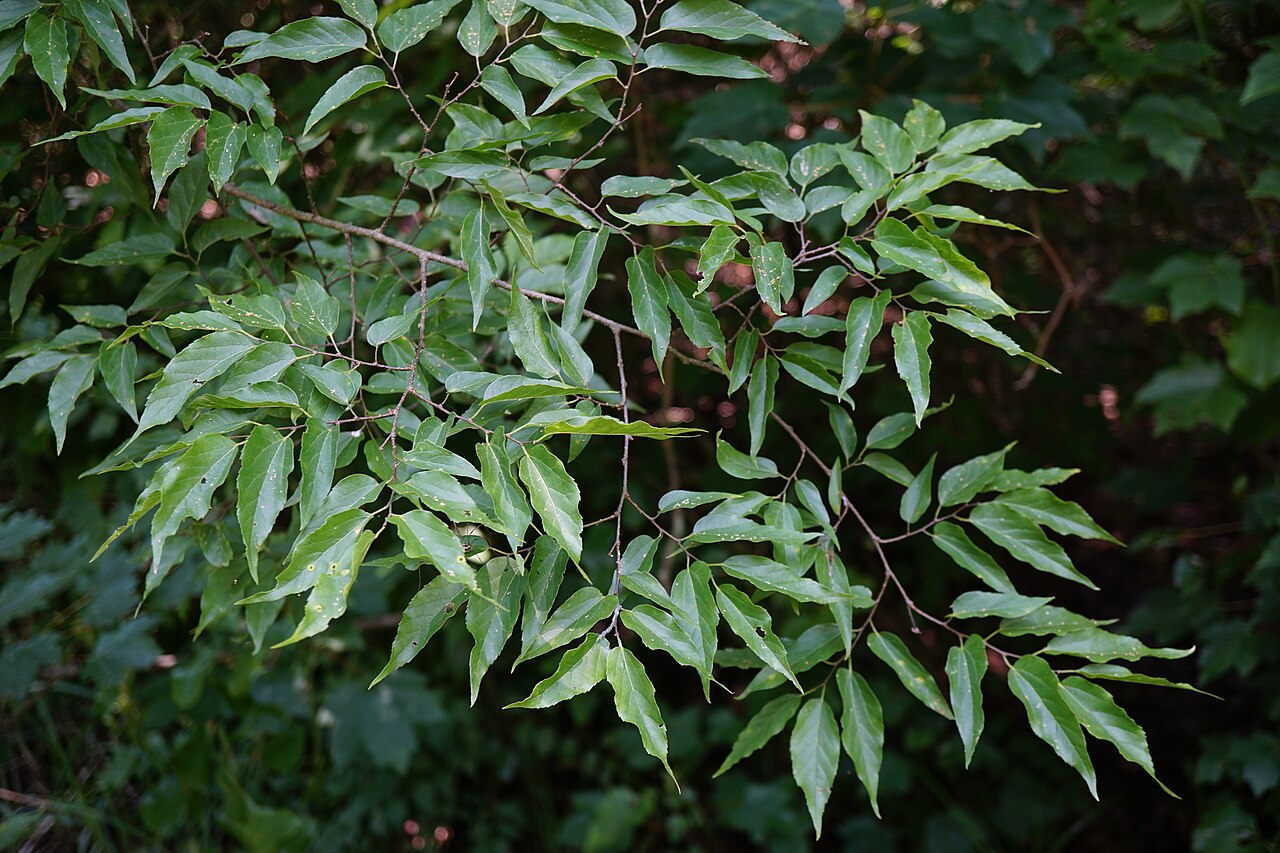
Look for alternate simple leaves with an uneven base and a tapering tip. Sugarberry leaves often have largely smooth margins, unlike the more strongly toothed leaves commonly associated with common hackberry. Variation and overlap occur, so one damaged leaf is not enough for a difficult identification. Examine several mature leaves and the fruit if available.
Bark
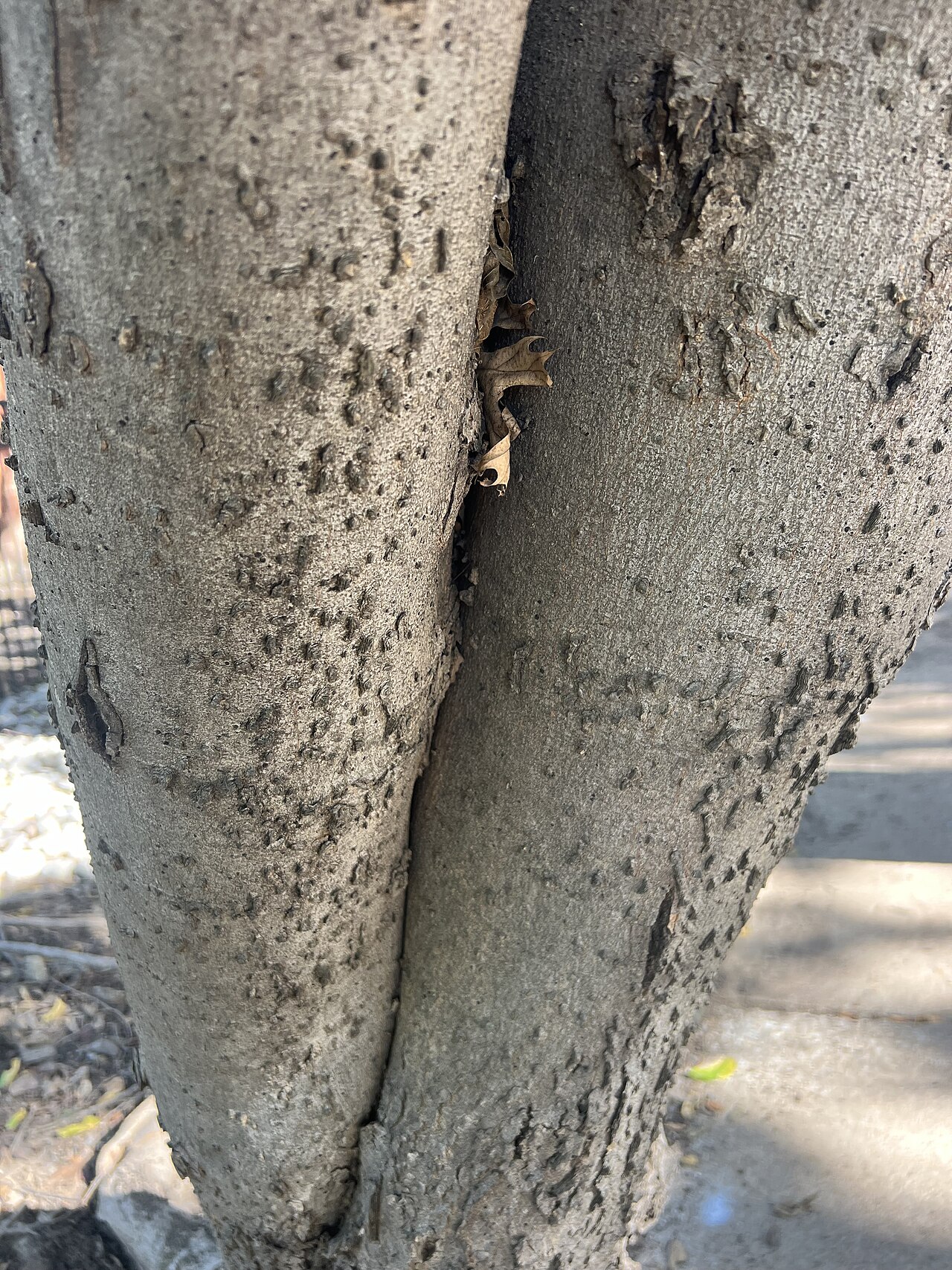
The gray bark often carries distinctive corky projections or warts. Young and old parts of a tree can look different, and the amount of corkiness varies. The bark is a useful field clue, but other Celtis species can also be corky; combine it with leaves, habitat and a regional key.
Flowers and fruits
The spring flowers are small and greenish rather than a conspicuous ornamental display. Later, small drupes mature through reddish or darker tones. Each contains a hard seed. Do not confuse a drupe with a cluster of tiny berries from a vine growing through the crown.
Related hackberries
Common hackberry and sugarberry overlap geographically, and netleaf hackberry has often appeared under a sugarberry variety name in older records. A photograph explicitly labeled Celtis laevigata var. reticulata was not used for this page. If the identification affects a restoration or plant inventory, use a current regional treatment rather than forcing a match from bark alone.
Quick Facts
| Scientific Name | Celtis laevigata |
| Family | Cannabaceae |
| Plant Type | Large deciduous shade tree |
| Mature Height | Commonly 50–80 feet; larger forest trees occur |
| Mature Spread | Often 30–60 feet, depending on growing space |
| Growth Rate | Moderate to fast in favorable conditions |
| Sun Exposure | Full sun to partial shade |
| Water Needs | Moist to average; established trees tolerate some drought and seasonal flooding |
| Soil Type | Adaptable, including moist loams and bottomland clay; not a deep-swamp tree |
| Soil pH | Adaptable across a range of soil reactions; test before amending |
| Bloom Time | Spring; flowers are small and inconspicuous |
| Flower Color | Greenish flowers; red to purple drupes later in the season |
| Fall Color | Often yellowish, variable rather than reliably spectacular |
| Fruit | Small single-seeded drupes eaten by birds and other wildlife |
| Deer Resistant | Young trees may require browse and rubbing protection |
| USDA Hardiness Zones | Commonly cultivated in USDA zones 5–10; provenance and local climate matter |
Native Range
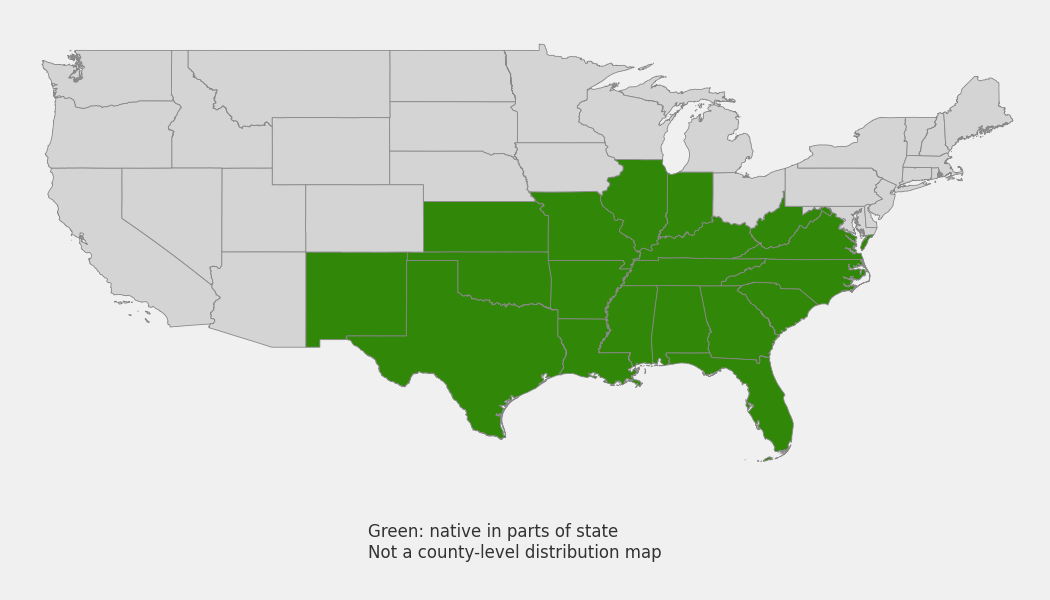
Sugarberry is native to central and southeastern parts of the United States, continuing into Mexico and Bermuda. The map follows the current Kew accepted-species distribution and includes Arkansas and Louisiana. It is not a map of every tree that has ever been planted or recorded under a broad hackberry name.
The species is especially associated with southern floodplains, flats and moist bottomlands, but it can grow in other settings. Seasonal flooding tolerance does not make it a deep-swamp tree, and drought tolerance after establishment does not remove the need to water a new transplant. Site history and soil depth are important when translating a natural occurrence into garden care.
Range sources differ at the margins. An older Forest Service account mentions Maryland, while the current Kew account treats that record as erroneous; Maryland is therefore not shaded here. Kew includes New Mexico in its accepted range. For a county-level restoration decision, confirm the local flora and separate netleaf hackberry records before using a broad state map.
📋 Regional plant list: Arkansas and Louisiana
Growing & Care Guide
Allow for the mature crown
Before planting, consider the eventual height and width, nearby overhead lines, foundations, pavement and neighboring trees. A large shade tree should not depend on repeated topping to remain in place. Use the site to accommodate the tree’s form rather than choosing a tree that will continually conflict with the site.
Select sound nursery stock
Look for a healthy root system, a visible root flare and a sensible branching structure. A very large container specimen is not automatically the best choice if its roots circle tightly. Ask whether the plant is the straight species and what provenance information is available, especially for a local-native project.
Planting depth and soil
Plant with the root flare at an appropriate level and avoid burying the trunk. Backfill so roots can grow into the surrounding soil. Do not create a small bowl of unusually rich material inside heavy ground. Water thoroughly to settle the planting, then check for sinking or exposed roots rather than piling soil against the stem.
Water through establishment
Monitor the original root ball during the first growing seasons. A tree can stand beside damp ground while its container-grown roots remain dry. Water deeply enough to reach the roots and adjust the wetted area as they expand. Avoid using a fixed calendar without considering rainfall, heat and soil texture.
Drainage and flooding
A bottomland association supports tolerance of some wet periods, not permanent deep water around a newly planted trunk. If the site is a basin that never drains, seek a tree suited specifically to that hydroperiod. Conversely, if the site dries severely, establishment watering remains essential even though mature sugarberries can tolerate drought.
Mulch and trunk protection
Maintain a broad, modest mulch layer without heaping it against the trunk. Keep mowers and string trimmers away from the bark. Where deer browse or rub young trees, use an appropriate guard that does not constrict growth and inspect it regularly. Remove or adjust ties before they become embedded.
Structural pruning
Develop a sound structure gradually, using small purposeful cuts rather than waiting until a major branch must be removed. Do not top the crown. A qualified arborist can assess competing stems, weak attachments or clearance needs in a mature tree. Large-tree work is not the place for speculative pruning from the ground.
Pests and leaf symptoms
Aphids, scales and leaf galls can occur, but their presence is not automatically a reason to spray the entire tree. Assess the severity and the tree’s overall condition. Honeydew beneath a canopy can be inconvenient, so placement over a frequently used seating area deserves thought. Seek a diagnosis for progressive dieback rather than treating every leaf blemish alike.
Seedlings and propagation
Birds can move fruits, and seedlings may appear away from the parent tree. Remove unwanted seedlings while small, after confirming they are not desired plants. For propagation, obtain a species-specific seed treatment from a nursery or extension source and keep collection records. Do not assume a seedling beneath a tree is the same species without checking it.
Long-term care
Protect the root zone from repeated compaction, trenching and grade changes. Mature trees can respond poorly to construction even when the trunk is not directly struck. Record major changes around the tree and consult an arborist when planning work near it. Routine observation is more useful than an annual fertilizer application made without evidence of need.
Landscape Uses
- A large shade tree where there is adequate root and crown space.
- A wildlife-oriented planting in an appropriate central or southern native landscape.
- A component of suitable bottomland restoration using verified local stock.
- Not a small patio tree or a substitute for every species sold as hackberry.
Wildlife & Ecological Value
Fruits and dispersal
The small drupes are used by birds and other animals, which can disperse the seeds. Leaving a tree’s seasonal fruit crop available is one way a garden tree contributes beyond shade. Avoid presenting fruit production as a guarantee that a particular bird will visit; the wider habitat and season also matter.
Leaves as habitat
Extension accounts recognize hackberries as larval resources for several butterflies, including hackberry emperors and American snouts. This is a reason to tolerate some leaf feeding rather than treating every chewed leaf as failure. Do not apply broad-spectrum insecticides routinely to a wildlife tree.
Canopy and ground layer
A mature crown creates shade and structure that can support a layered planting. Choose understory plants for the actual light and soil conditions rather than installing sun-loving flowers beneath dense shade. Retain some leaf litter where appropriate, while keeping it clear of places where it would create a practical problem.
Cultural & Historical Uses
Sugarberry has long been recognized as both a useful shade tree and a source of wood. The Forest Service silvics account discusses its role in southern forests and wood products. These uses are part of the species’ history, but they do not reduce a living garden tree to timber value.
Older books often place Celtis in the elm family, Ulmaceae; modern classifications place it in Cannabaceae. The change can confuse readers comparing sources, but it does not change the identity of a correctly documented tree. Likewise, old variety names need interpretation rather than automatic acceptance as the same modern species concept.
The sweet flesh of the fruit explains the common name, but this page is an identification and gardening guide rather than a foraging instruction. Accurate identification, local contamination and individual circumstances all matter before any wild plant is used as food. The simplest garden value is to leave the fruit available to wildlife.
Frequently Asked Questions
Is sugarberry the same as common hackberry?
No. Celtis laevigata and Celtis occidentalis are related but distinct species, although their ranges and some features overlap.
Why are the leaves not strongly toothed?
Sugarberry commonly has largely smooth leaf margins. Use several features and a regional key rather than one leaf alone.
Will it fit beneath power lines?
A tree commonly reaching 50–80 feet is generally not an appropriate choice beneath overhead lines. Select a smaller species instead of planning to top it.
Does a bottomland tree need constant standing water?
No. Seasonal wetness and permanent deep water are different conditions. Match the tree to the actual drainage and flooding regime.
Why does this map differ from an older hackberry map?
Taxonomic treatments and marginal records differ. This map follows current Kew sugarberry distribution and does not combine netleaf hackberry records.
Sources & Further Reading
- Kew POWO — accepted Celtis laevigata and native range
- NC State Extension — sugarberry identification and care
- USDA Forest Service Silvics — sugarberry ecology and management
- USDA PLANTS — sugarberry
Find Native Plants
Ask growers about nursery propagation and regional provenance. Browse our AR native plant nurseries, LA native plant nurseries directory for suppliers. Explore the native nursery finder.