Sundrops (Oenothera fruticosa)
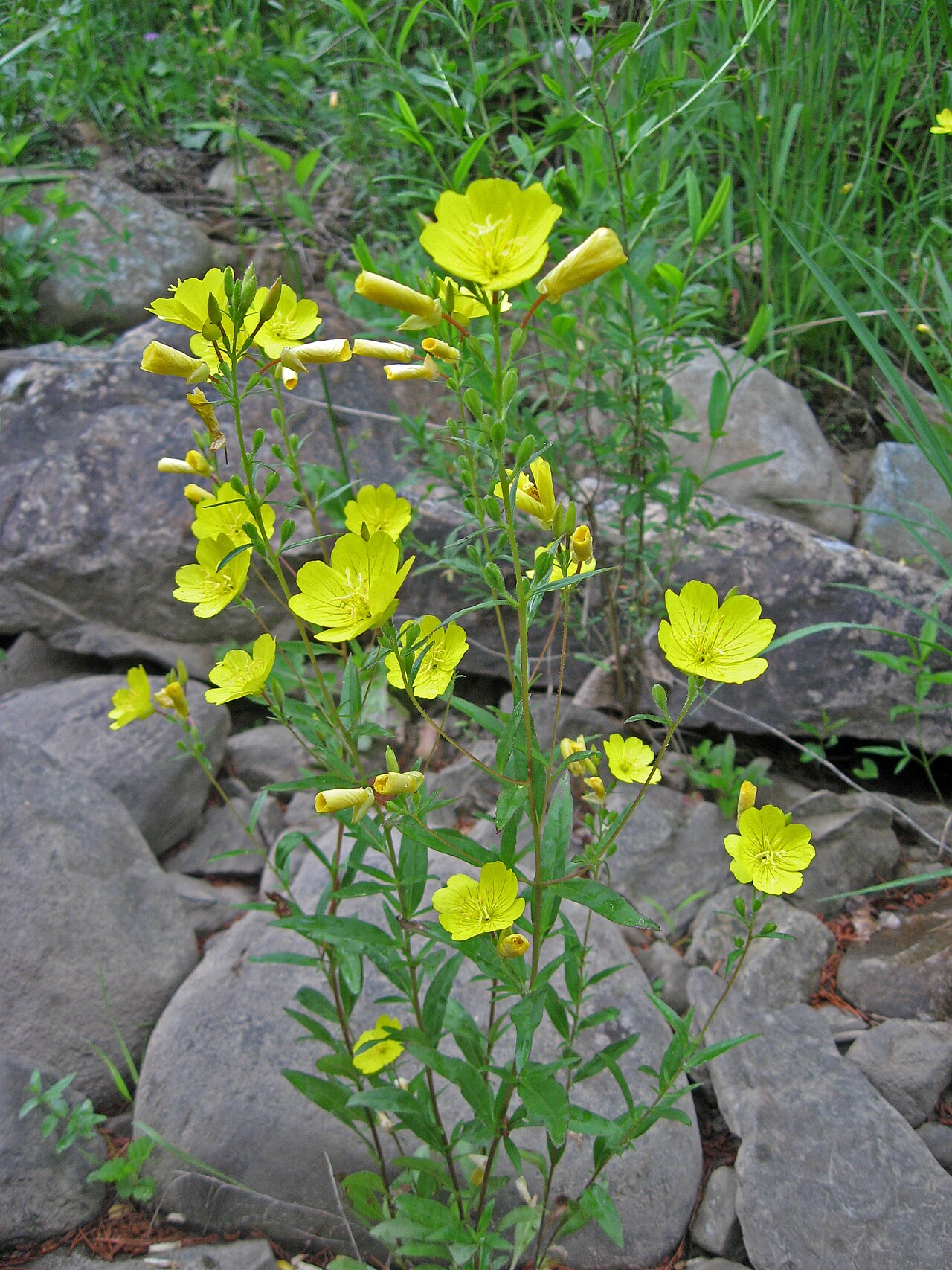
Sundrops is an apt name for the clear yellow flowers of Oenothera fruticosa. Rather than waiting until dusk, this member of the evening-primrose family opens its showy flowers by day. A group in a sunny border can look bright even when individual flowers are already fading, because new buds continue to open. Its upright leafy stems give it a different presence from the sprawling pink evening primroses often sold for groundcover.
This is a herbaceous perennial, not the tall biennial common evening primrose and not an ornamental shrub despite the Latin epithet. It is also a variable species. Botanists have recognized different varieties and segregates, and nursery labels sometimes carry names from older treatments. For a native planting, purchase a documented Oenothera fruticosa accession rather than assuming every pot labeled sundrops represents the same taxon or local provenance.
The best starting place is a sunny, well-drained bed where the plant can form a patch without crowding delicate neighbors. Its familiar appearance in roadsides and openings should not lead to the assumption that any neglected soil will do. Light, drainage, competing vegetation and the origin of the planting material all influence performance. This guide also distinguishes its confirmed regional range from the broader Arkansas–Louisiana–Oklahoma–Texas list in which the site’s original row appears.
Identification
Stems and habit
Sundrops produces upright herbaceous stems from a perennial base. Garden plants commonly fall in the roughly 1–3-foot height range, with shorter or taller forms depending on the population and growing conditions. Stems may show reddish coloring, especially around buds and upper growth. Do not identify the species solely from a red stem: several related evening primroses share that feature. A mature flowering stem, leaves and fruit together provide a much better identification.
Leaves
Leaves are alternate along the stem rather than arranged as a whorl of narrow needles. They are simple, often narrow or lance-shaped, with entire to somewhat toothed edges. Basal growth may persist as rosettes in mild winters, sometimes taking on a purplish cast. Leaf proportions and hairiness vary within the broad species treatment. Preserve labels when moving divisions; a plant that is easy to name in flower can be much less obvious during winter cleanup.
Flowers
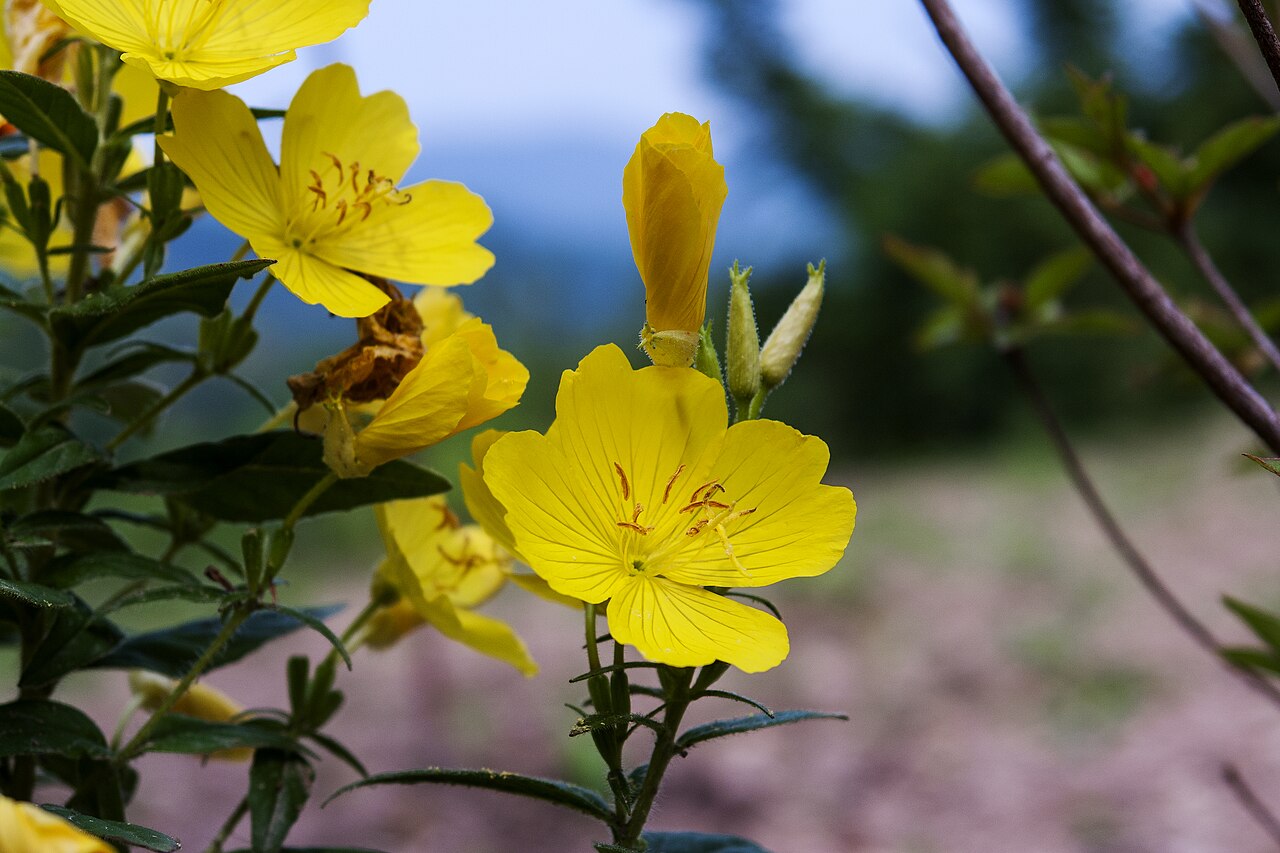
The yellow flowers have four conspicuous petals and a central cluster of reproductive structures. They open in daylight, which is the useful distinction behind the name sundrops. Each individual flower is short-lived, but a stem carries more than one bud and a patch can sustain a longer sequence of bloom. Flowering commonly begins in late spring and continues into summer, with timing influenced by latitude, exposure and the particular form being grown.
Fruit and similar plants
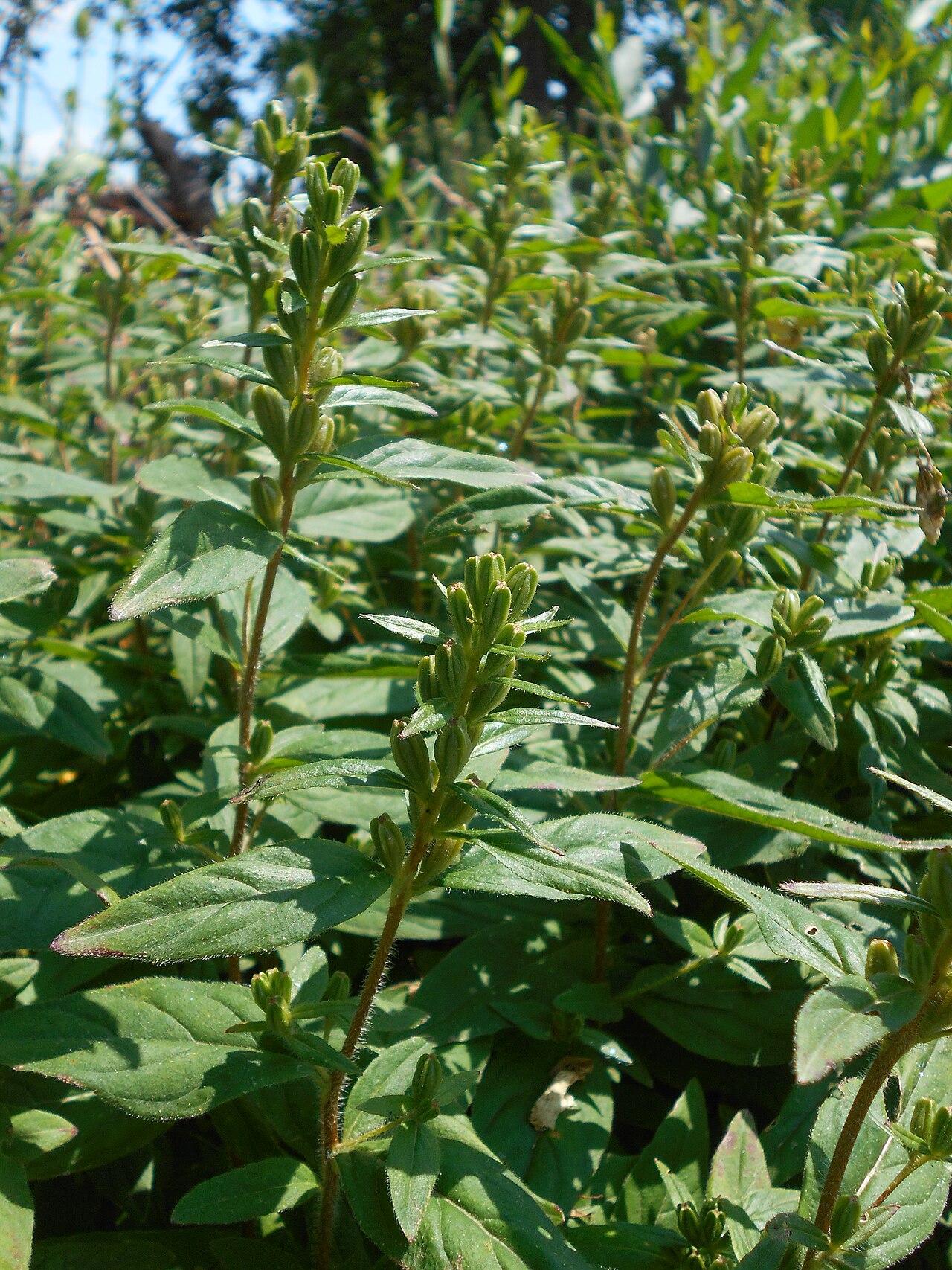
After pollination, the developing fruit becomes a dry capsule. Its shape and attachment are useful to botanists separating members of the sundrops complex. Oenothera tetragona and plants historically sold under glauca names can complicate nursery identification; this page does not silently treat every such label as interchangeable. The photographs selected here are identified as O. fruticosa, including a wild Tennessee plant, rather than using an unidentified yellow-flowered garden hybrid.
Quick Facts
| Scientific Name | Oenothera fruticosa; variable species with several historical names |
| Family | Onagraceae (evening-primrose family) |
| Plant Type | Herbaceous perennial |
| Mature Height | Usually about 1–3 feet; population and cultivar dependent |
| Mature Spread | Patch-forming; allow roughly 1–2 feet initially |
| Growth Rate | Moderate to vigorous where well suited |
| Sun Exposure | Full sun; tolerates some light shade |
| Water Needs | Dry to average with good drainage; avoid winter saturation |
| Soil Type | Well-drained garden loam, sandy or rocky sites |
| Soil pH | Broadly adaptable; match local soil and source population |
| Bloom Time | Late spring into summer |
| Flower Color | Yellow |
| Fall Color | Basal foliage can become purplish in cool weather |
| Fruit | Dry capsules |
| Deer Resistant | Not guaranteed; protect young plants where browsing is severe |
| USDA Hardiness Zones | Zones 4–8 in NC State guidance; check the particular selection |
Native Range
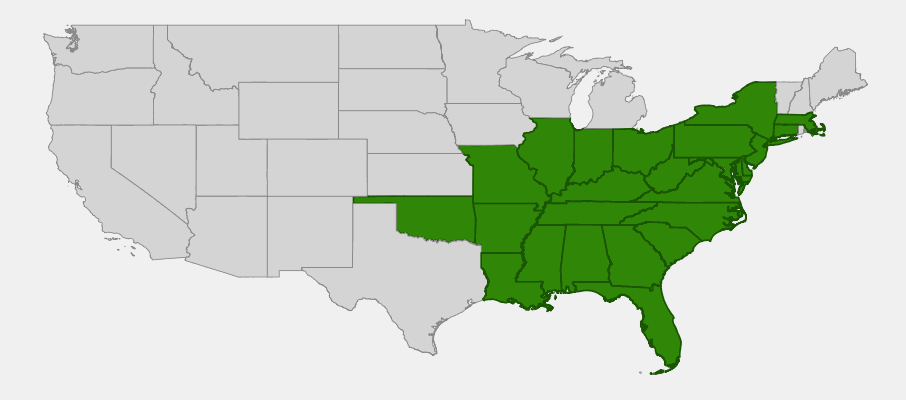
Kew’s current broad treatment places Oenothera fruticosa in eastern and east-central parts of the United States. The shaded map follows its listed native states rather than simply copying every state with a horticultural or naturalized record. The species is especially associated with open habitats: clearings, meadows, open woods, glades, rocky outcrops and some savanna settings. Those habitats differ in detail, which helps explain the variation gardeners encounter.
For the regional list linked below, Arkansas, Louisiana and Oklahoma are included in Kew’s native distribution; Texas is not. Therefore this row is not a blanket recommendation of local nativity across all four states. A Texas gardener should verify a county-level flora and the identity of the offered plant before treating it as a restoration species. The fact that a nursery can grow sundrops successfully is not evidence that it originated naturally in that locality.
Infraspecific names and different species concepts account for some disagreement among range summaries. This page uses O. fruticosa in the sense of the cited Kew account and NC State’s broad description, while keeping uncertain cultivated glauca material out of the photographs. Austria and Germany are listed as introductions, not native range. The map is a state-level orientation tool and cannot replace a local flora when deciding whether a particular population belongs in a conservation planting.
📋 Regional plant list: Arkansas, Louisiana, Eastern Oklahoma and Eastern Texas
Growing & Care Guide
Light
Place sundrops where it receives ample direct sun. Some light shade is possible, but crowding it beneath a dense shrub canopy is unlikely to produce the same flower display as an open border. Watch how nearby grasses and perennials develop through the season: a spot that is sunny when planted in March may be shaded by June. Give the stems room to receive light from the sides as well as from above.
Soil and water
Well-drained soil is the practical priority, particularly during winter. Average garden soil is often sufficient without heavy enrichment. After planting, water deeply enough to moisten the root ball and surrounding soil, then let the site determine the interval before the next watering. Established plants suit relatively dry to average beds, but a small new division should not be expected to tolerate the same drying as a rooted patch. Standing water calls for a different site, not simply less fertilizer.
Planting
Use nursery-propagated plants of known identity, ideally from a source that can distinguish straight species from named garden selections. Set the crown at the level at which it grew in its container and avoid burying living basal rosettes under a thick mulch layer. Leave space for expansion rather than filling every gap with a second plant. On a slope, plant into stable soil and water carefully so that the first storm does not wash the root ball loose.
Pruning and maintenance
Remove spent flowering stems if a tidier appearance is desired, but keep healthy basal foliage. In a naturalistic planting, some fruiting stems can remain while seed develops. Monitor the patch boundary rather than waiting until sundrops has mingled completely with a small neighboring perennial. If the clump is becoming crowded, divide it during a suitable cool, moist period and replant only what the site can comfortably support. There is no need to prune it as if it were a woody hedge.
Propagation
Division is useful for retaining the characteristics of an established garden plant. Take a sound portion with roots and growing points, keep it from drying during the move, and give it establishment care. Seed offers genetic variation but may not reproduce a named cultivar exactly. Follow a reputable seed supplier’s instructions for the particular taxon and provenance rather than applying one recipe to every evening primrose. Label divisions and seedlings because closely related sundrops can be difficult to separate when not flowering.
Managing a patch
A successful sundrops planting is usually managed as a small colony rather than as a single immutable stem. Check the edge in spring, identify desirable basal shoots, and remove competing weeds while they are still small. If flowering declines, assess shade and crowding before adding fertilizer. If crowns disappear after a wet winter, assess drainage. These observations separate a normal spreading habit from a site mismatch and reduce unnecessary chemical intervention.
Landscape Uses
- A bright yellow early-summer patch in a sunny native border.
- Rock-garden or open-bank planting where roots have well-drained soil.
- A cottage-garden group with enough room for colony expansion.
- A daytime pollinator stop combined with later-flowering native species.
Wildlife & Ecological Value
Pollinators
The open daytime flowers are accessible to visiting insects. A research study of O. fruticosa describes insect-mediated outcrossing, reinforcing the value of keeping flowers available to visitors rather than treating them only as decoration. Avoid spraying open flowers and provide other bloom times nearby. A single species, even one with a striking display, cannot supply an entire season of resources.
Birds
This plant produces dry capsules rather than bird-attracting berries. The garden’s bird value is better understood as part of a diverse planting that supports insects and offers seasonal structure. It should not replace woody plants that provide shelter or fruit. Leaving a modest portion of stems until later cleanup also allows observation of the plant’s natural seed stage.
Mammals
Do not assume a native perennial is automatically resistant to every herbivore. Monitor browsing in the actual garden and protect new plants if needed. This page does not promote sundrops as livestock forage or as a human food plant. In a small border, a temporary physical barrier around a trial group is more informative than buying a large quantity on the strength of a resistance label.
Ecological fit
Its open-habitat character makes it more suitable for sunny edges and meadow-style beds than for a shaded woodland floor. In a restoration context, verify both the taxonomic treatment and local provenance before sowing. In a garden, manage spread so that other native species retain space. A planting can be vigorous and useful without being allowed to dominate every available opening.
Cultural & Historical Uses
Sundrops illustrates why common names are helpful starting points but incomplete botanical labels. Evening primrose can suggest a night-opening flower, yet O. fruticosa is conspicuously day flowering. Older names and varieties reflect the effort to describe regional variation within this group. Keeping a scientific label with the plant makes future identification and exchange much easier.
NC State records sundrops as the 1989 North Carolina Wildflower of the Year. Its long-standing ornamental appeal is easy to understand from the combination of bright flowers and manageable herbaceous growth. Garden selections can emphasize compactness, stem color or flowering performance, but a selection’s horticultural merits do not establish that it is the best genetic source for a local restoration.
The useful cultural story here is one of native wildflowers entering gardens and of gardeners learning to distinguish species, varieties and cultivars. This article does not turn historical medicinal references into treatment advice. For practical conservation, ask where plants were propagated, maintain labels, and avoid collecting wild colonies just because a familiar garden name makes them seem common.
Frequently Asked Questions
Does sundrops open only at night?
No. Oenothera fruticosa is a day-flowering evening primrose. The family or common-name association with evening does not describe every species.
Is it the same as common evening primrose?
No. Oenothera biennis is a different species with a different habit and life cycle. Use the scientific name when buying or comparing plants.
Is it native throughout Texas?
The Kew treatment used for this map does not list Texas as native. Its inclusion in a multi-state regional table does not establish Texas nativity; consult a local flora and verify the taxon.
Will it spread?
It can form a widening patch in favorable conditions. Allow space, monitor the edges, and divide or thin where it begins to crowd smaller neighbors.
Why did it disappear over winter?
Poor winter drainage is a likely site concern, although individual cases need inspection. Check whether crowns remained saturated and whether mulch buried the basal growth before replacing plants.
Sources & Further Reading
- NC State Extension: sundrops
- Kew: accepted name, synonyms and native distribution
- USDA PLANTS: narrowleaf evening primrose
- NC State native-plant handbook
- Research on Oenothera fruticosa pollination
Find Native Plants
Ask growers about nursery propagation and regional provenance. Browse our AR native plant nurseries, LA native plant nurseries, OK native plant nurseries, TX native plant nurseries directory for suppliers. Explore the native nursery finder.