Swamp Bay (Persea palustris)
Persea palustris, commonly known as Swamp Bay, is an aromatic evergreen tree or large shrub native to the pocosins, bay swamps, and wetland margins of the southeastern Atlantic and Gulf Coastal Plains. A member of the Laurel family — the same family as Bay Laurel (Laurus nobilis), Camphor Tree, Cinnamon, and Avocado — Swamp Bay carries the characteristic aromatic quality of the family in its leaves, stems, and bark, with a pleasant spicy-sweet fragrance reminiscent of culinary bay leaf. The leaves have traditionally been used as a seasoning in southern cooking, substituting for or blending with the Mediterranean Bay Laurel familiar in commerce.
In its natural habitat, Swamp Bay is one of the dominant trees of the pocosins and bay forests of the Carolinas — the dense, shrubby, evergreen wetland communities that give this distinctive southeastern ecosystem its name. Along with Sweetbay Magnolia (Magnolia virginiana), Loblolly Bay (Gordonia lasianthus), and Atlantic White Cedar (Chamaecyparis thyoides), Swamp Bay is one of the characteristic trees of these dark, mysterious, biologically rich ecosystems. Growing to 40 feet tall, it produces small, inconspicuous cream-white flowers in spring and early summer that develop into dark blue-black drupes consumed by numerous birds and mammals.
Unfortunately, Swamp Bay is currently under severe threat from Laurel Wilt Disease, a lethal vascular disease introduced to the United States from Asia via the Redbay Ambrosia Beetle (Xyleborus glabratus). This disease, first detected in the coastal plain of Georgia in 2002, has killed billions of bay trees (Persea spp.) across the southeastern Coastal Plain and continues to spread. Despite this threat, Swamp Bay remains an ecologically irreplaceable component of southeastern bay forest ecosystems and is critically important to the lifecycle of the Palamedes Swallowtail butterfly (Papilio palamedes), whose caterpillars feed almost exclusively on the leaves of Swamp Bay and its close relatives.
Identification
Swamp Bay is an evergreen tree or large shrub typically growing 20 to 40 feet tall, with a rounded to broadly oval crown and multiple ascending trunks or branches from near the base. In pocosins and bay forests, it often forms dense thickets of multi-stemmed individuals. The overall form is irregular and branchy, with the lower branches sometimes sweeping downward before ascending. Healthy trees have a rich, full canopy of dark green, glossy leaves; trees infected with Laurel Wilt Disease show sudden, rapid wilting and browning of foliage, followed by death of the entire tree within a few weeks.
Bark & Stems
The bark is dark gray to gray-brown, thin and smooth on young stems, developing shallow furrows and slight scaling on older trunks. All parts of the plant — bark, leaves, and stems — are aromatic when crushed or broken, with a spicy, bay-like scent characteristic of the Lauraceae family. Young stems are often reddish-brown and covered in fine, silky hairs (pubescent). The inner bark is greenish-cream when freshly cut and quickly turns brown with exposure to air. The wood is moderately hard, with an attractive fine grain.
Leaves
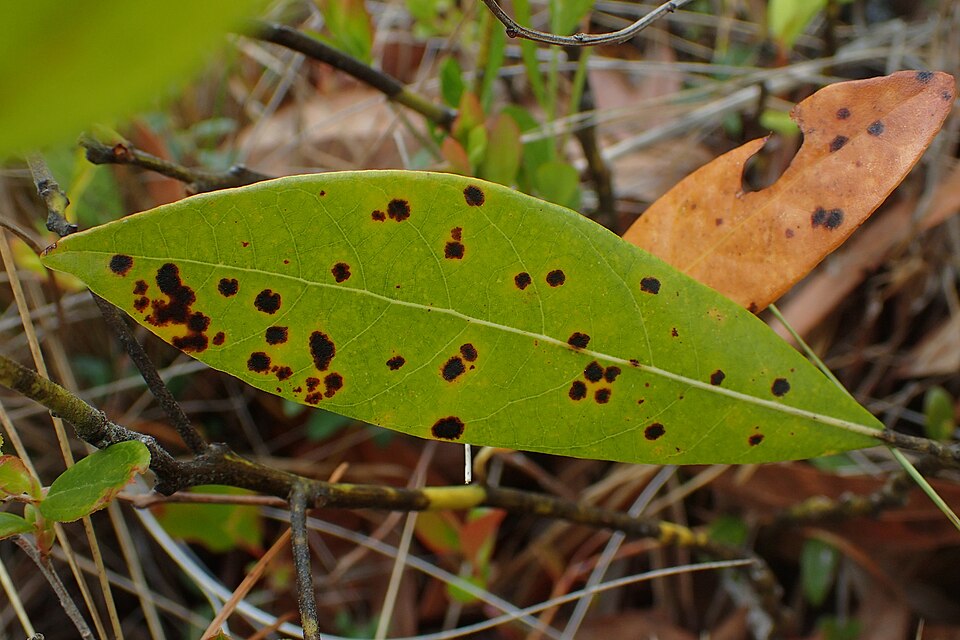
The leaves are simple, alternate, and persistently evergreen — though in the northern part of its range the tree may lose some leaves in particularly cold winters, making it semi-evergreen. Each leaf is 3 to 5 inches long and 1 to 2 inches wide, elliptic to oblong-elliptic in shape, with a pointed tip and a smooth, entire margin. The upper surface is dark, glossy green; the lower surface is paler, with fine silky hairs when young that may persist along the midrib at maturity. When crushed, the leaves release a strong, pleasant spicy-aromatic fragrance — one of the most distinctive sensory features of the plant.
Flowers & Fruit
The flowers are small, cream-white to pale yellow, about ¼ inch across, with 6 tepals in two whorls and numerous stamens. They are borne in small axillary clusters (panicles) emerging from the leaf axils from March through June. Though individually inconspicuous, the flowers are produced in sufficient quantity to be visible in the canopy and are visited by native bees, small wasps, and flies for nectar and pollen. Following pollination, the fruit develops as a small, ovoid to nearly spherical drupe, about ½ inch long, ripening from green to dark blue-black (sometimes with a glaucous bloom) by late summer and fall. Each drupe is borne on a thickened, reddish-orange pedicel (fruit stalk) that provides a striking color contrast to the dark fruit.
Quick Facts
| Scientific Name | Persea palustris |
| Family | Lauraceae (Laurel) |
| Plant Type | Evergreen Tree / Large Shrub |
| Mature Height | 40 ft |
| Sun Exposure | Full Sun to Part Shade |
| Water Needs | Moderate to High |
| Bloom Time | March – June |
| Flower Color | Cream-white |
| USDA Hardiness Zones | 7–10 |
Native Range
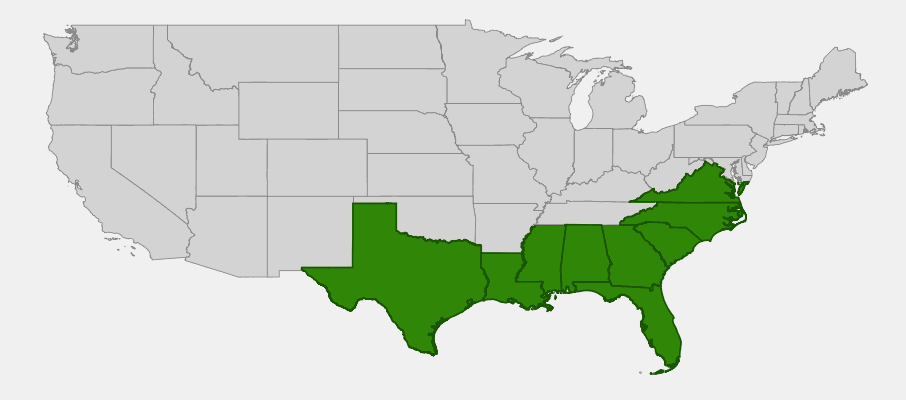
Swamp Bay is native to the Atlantic and Gulf Coastal Plains of the southeastern United States, ranging from southern Delaware south through Maryland, Virginia, North Carolina, South Carolina, Georgia, and Florida, then west along the Gulf Coast through Alabama, Mississippi, Louisiana, and into eastern Texas. Its distribution is closely tied to the pocosins, bay forests, and wetland communities of the outer Coastal Plain, where the poorly drained, acidic, peaty or sandy soils and mild, humid climate create conditions the species has occupied for millions of years.
Within its range, Swamp Bay is most abundant and ecologically dominant in the pocosins and bay forests of North and South Carolina — the dense, impenetrable shrub-dominated wetlands that are among the most distinctive ecosystems in the eastern United States. Here, Swamp Bay forms dense multi-stemmed thickets alongside Titi (Cyrilla racemiflora), Atlantic White Cedar, and Sweetbay Magnolia, creating dark, aromatic bogs that are extraordinarily rich in endemic plant and animal species. In Florida, Swamp Bay grows in bay swamps, wet hammocks, and bottomland forest margins. In Georgia and the Gulf states, it occurs along the margins of blackwater rivers and swamps.
The current distribution of Swamp Bay is being dramatically altered by the ongoing spread of Laurel Wilt Disease, which has killed an estimated 1–2 billion Redbay (Persea borbonia) and Swamp Bay trees across the southeastern Coastal Plain since 2002. The disease is spread by the introduced Redbay Ambrosia Beetle, which carries the fungal pathogen (Raffaelea lauricola) in specialized structures on its body and inoculates trees as it bores into the wood. Once infected, trees typically die within 2–8 weeks. The ecological consequences of this mass mortality for Palamedes Swallowtail butterflies, bird populations, and pocosin ecosystems are still being assessed and are expected to be severe.
📋 Regional plant lists featuring Swamp Bay: Alabama, Georgia & Mississippi
Growing & Care Guide
Swamp Bay is an elegant, aromatic evergreen for wet native garden settings. Despite the ongoing threat of Laurel Wilt Disease, it remains a valuable and beautiful plant for appropriate landscape uses, and planting it helps support the recovery and resilience of Persea populations in the landscape.
Light
Swamp Bay grows well in full sun to part shade. In its natural habitat, it occurs both in the open canopy positions of pocosin margins, where it receives substantial direct sunlight, and in the denser shade of bay forest understories. Best growth and fullest form are achieved in full sun with consistent moisture. In part shade, the plant grows adequately but tends to be more open in form and produces less fruit. Deep shade significantly reduces fruiting and causes sparse, leggy growth.
Soil & Water
Swamp Bay is adapted to wet, poorly drained, acidic soils and is one of the best native trees for persistently wet planting sites. It thrives in peaty, sandy, or loamy soils with pH 4.0–6.5 and is tolerant of seasonal flooding. The ideal planting conditions replicate the naturally waterlogged pocosin and bay swamp soils where it occurs: consistently moist to wet, highly acidic, organic-rich substrate. Swamp Bay does not perform well in alkaline, compacted, or excessively dry soils. In garden settings with average soil moisture, mulching with pine bark or peat helps maintain the necessary soil acidity and moisture retention.
Planting Tips
Plant Swamp Bay in fall or early spring in wet to moist, acidic conditions. Avoid planting in areas where Laurel Wilt has been confirmed in the immediate vicinity, as the beetle spreads the disease through the landscape. If planting in areas where the disease is present, monitor for symptoms (sudden wilting, browning of foliage) and remove infected trees promptly to slow local spread. Plant multiple individuals to support Palamedes Swallowtail populations — this butterfly is nearly dependent on Persea species and benefits greatly from larger plantings. Space plants 15–20 feet apart for screening or thicket plantings.
Pruning & Maintenance
Swamp Bay requires minimal pruning. Remove dead or damaged branches as needed. For a more tree-like form, gradually remove lower branches over several seasons. The plant is naturally pest-resistant, though scale insects can occasionally be a minor issue. The primary threat is Laurel Wilt Disease — monitor regularly for signs of sudden wilting or browning of foliage and consult with a professional arborist if symptoms appear. No chemical treatment is currently available that can save infected trees, though some proactive systemic treatments (propiconazole trunk injection) are being studied as a preventive measure.
Landscape Uses
Swamp Bay is well suited for several native landscape applications:
- Wet native garden plantings — excels in poorly drained, acidic pocosin and bay swamp soils
- Pocosin restoration — a keystone species of these endangered Carolina bay ecosystems
- Aromatic native garden — fragrant foliage used as bay leaf seasoning in traditional southern cooking
- Wildlife habitat — essential for Palamedes Swallowtail butterfly; fruit feeds birds and mammals
- Streamside planting — stabilizes wet banks and enriches riparian corridors with evergreen cover
- Screening hedge — dense, aromatic evergreen foliage provides year-round privacy
Wildlife & Ecological Value
Swamp Bay is ecologically indispensable in southeastern bay forests and pocosins. It supports a web of wildlife interactions — from its spring flowers to its late-summer fruit — and is the obligate larval host plant of one of the most spectacular butterflies in North America.
For Birds
The dark blue-black drupes of Swamp Bay are consumed by a wide range of birds in fall and early winter, including Northern Mockingbird, American Robin, Hermit Thrush, Cedar Waxwing, Brown Thrasher, Eastern Bluebird, and various thrushes and vireos. The persistent, aromatic foliage provides year-round cover and nesting substrate for Carolina Wren, Yellow Warbler, and Common Yellowthroat. In coastal plain pocosins, Swamp Bay thickets are among the most important dense-cover habitats available for ground-nesting and low-nesting birds. Prothonotary Warblers and several other wetland warblers use the dense stems and foliage of Swamp Bay thickets during breeding season.
For Mammals
White-tailed Deer browse the aromatic foliage of Swamp Bay and consume the fruit in fall. Raccoons and opossums eat the drupes. Black Bears in the Southeast forage extensively in pocosin habitats and consume Swamp Bay fruit as part of their fall hyperphagia. The dense thickets created by multi-stemmed Swamp Bay provide critical thermal cover and hiding habitat for White-tailed Deer and a range of smaller mammals in the open, shrubby pocosins of the Carolinas.
For Pollinators
The small cream-white flowers of Swamp Bay attract native bees, small wasps, and flies during their March–June bloom period. More critically, Swamp Bay (along with Redbay and other Persea species) is the obligate larval host plant for the Palamedes Swallowtail butterfly (Papilio palamedes) — a spectacular, large butterfly of southeastern coastal plain forests. Female Palamedes Swallowtails lay their eggs almost exclusively on the leaves of Persea species; without these plants the butterfly cannot complete its life cycle. The ongoing devastation of Persea populations by Laurel Wilt Disease represents a grave threat to Palamedes Swallowtail populations across the Southeast, making every planted Swamp Bay an important contribution to butterfly conservation.
Ecosystem Role
Swamp Bay is a structural dominant of the pocosin and bay forest ecosystems of the southeastern Coastal Plain — dense, dark, evergreen wetland communities that harbor extraordinary levels of endemic plant and animal diversity. Its aromatic, persistent leaves create a characteristic leaf litter that influences soil chemistry and invertebrate communities. The plant’s dense, multi-stemmed growth form creates exceptional vertical structure in otherwise open wetland systems, providing nesting, cover, and foraging habitat at multiple height levels. The current mass mortality of Swamp Bay and Redbay from Laurel Wilt Disease is one of the most significant ecological catastrophes currently unfolding in the southeastern United States, with cascading effects on the entire bay forest ecosystem.
Cultural & Historical Uses
The Lauraceae family to which Swamp Bay belongs has a long and intimate relationship with human culture around the world. Bay laurel (Laurus nobilis) of the Mediterranean has been used as a culinary and ceremonial herb since ancient Greece and Rome; camphor from Cinnamomum camphora has been used medicinally for millennia in Asia; and cinnamon, avocado, and sassafras are all members of this same remarkable family. Swamp Bay carries this aromatic heritage in its own foliage — the leaves emit a strong, spicy bay-like scent when crushed and have been used as a bay leaf substitute and blend in traditional southern Cajun and Creole cooking for generations.
Indigenous peoples of the southeastern coastal plain, including the Seminole, Choctaw, and various coastal Algonquian nations, used Swamp Bay and its close relative Redbay (Persea borbonia) medicinally and practically. The aromatic leaves were used in decoctions for fever and headache treatment, and the plant was used as an insect repellent in some traditions — the volatile aromatic compounds that give the leaves their distinctive scent are indeed effective insect deterrents. The wood, though generally small in diameter, is moderately hard and was used for small woodworking projects and fuel wood. Bark preparations were used by some groups for wound treatment and as a general tonic.
In Cajun and Creole culinary traditions, the leaves of Persea borbonia and P. palustris — collectively known as “red bay” or “sweet bay” in Louisiana — were used interchangeably with commercial bay laurel as a seasoning in gumbo, etouffee, jambalaya, and other classic dishes of the Gulf Coast. The practice of gathering bay leaves from wild coastal plain forests for use in cooking is a living cultural tradition in parts of Louisiana, Mississippi, and the Gulf Coast of Florida. The loss of bay tree populations to Laurel Wilt Disease threatens to eliminate this connection between the native landscape and the culinary heritage of the region — an ecological and cultural loss with deep roots in the history of the southeastern United States.
Frequently Asked Questions
What is Laurel Wilt Disease and should I worry about it?
Laurel Wilt Disease is a lethal fungal infection spread by the Redbay Ambrosia Beetle (Xyleborus glabratus), an invasive species introduced from Asia. Once a Swamp Bay tree is infected, it typically dies within 2–8 weeks. The disease has killed an estimated 1–2 billion bay trees across the southeastern Coastal Plain since 2002 and continues to spread. In areas where Laurel Wilt is already established, newly planted Swamp Bay trees are at high risk; however, planting still has value for Palamedes Swallowtail habitat and for maintaining genetic diversity in the landscape. Research into resistant genotypes and preventive trunk injection treatments is ongoing.
Can I use Swamp Bay leaves for cooking like bay laurel?
Yes — the aromatic leaves of Swamp Bay and its close relative Redbay (Persea borbonia) have been used as a bay leaf substitute in southern cooking for generations, particularly in Cajun and Creole traditions. The flavor is similar to bay laurel but with a slightly different aromatic profile. Use fresh or dried leaves in the same quantities as commercial bay leaves. The leaves are much more intensely aromatic than most commercial bay laurel, so use sparingly at first.
What is the Palamedes Swallowtail and why does it need Swamp Bay?
The Palamedes Swallowtail (Papilio palamedes) is a large, spectacular butterfly of the southeastern coastal plain forests — one of the largest butterflies in North America. Its caterpillars feed almost exclusively on the leaves of Persea species (Swamp Bay, Redbay). Without these plants, the butterfly cannot complete its life cycle. The mass mortality of bay trees from Laurel Wilt Disease is severely impacting Palamedes Swallowtail populations across the Southeast. Planting Swamp Bay is one of the most direct ways to support this charismatic species.
Is Swamp Bay related to avocado?
Yes! Both Swamp Bay and avocado (Persea americana) are members of the same genus, Persea, in the Lauraceae family. They share the family’s characteristic aromatic foliage and small flowers. Swamp Bay fruit, though much smaller than an avocado, is also a drupe with a single seed — the same basic fruit structure as the avocado. The close relationship between these species is also what makes Swamp Bay susceptible to Laurel Wilt, the same disease that threatens commercial avocado production.
Can Swamp Bay grow in dry soil?
Swamp Bay prefers consistently moist to wet, acidic soils and performs best in conditions that replicate its native pocosin and bay swamp habitat. It will grow in moderately moist garden soils but does not tolerate prolonged drought or dry, alkaline conditions. For best performance, choose a naturally wet or consistently moist planting site, or mulch heavily to maintain soil moisture. Avoid planting in high, dry, well-drained sites.

Looking for a nursery that carries Swamp Bay?
Browse our native plant nursery directory: Alabama · Georgia · Mississippi