Mayhaw (Crataegus opaca)
Crataegus opaca, commonly known as Mayhaw, Western Mayhaw, or Western Haw, is a native small tree of the wet lowlands, swamps, and bottomland forests of the Deep South — and one of the most beloved native fruit trees of southern culture. Its name reflects deep cultural significance: “May” for the month its brilliant red fruit was traditionally celebrated (though it actually ripens in April in much of the range), and “haw” from the Old English word for hawthorn. In Louisiana, Mississippi, Alabama, Georgia, and east Texas, Mayhaw jelly and Mayhaw syrup are considered regional delicacies of the highest order — eagerly sought at roadside stands, farmers’ markets, and Southern food festivals.
A member of the rose family (Rosaceae) and the hawthorn genus (Crataegus), Mayhaw is a small, thorny, deciduous tree growing 15 to 35 feet tall, typically found in swampy bottomlands, pond margins, river swamps, and flooded bottomland hardwood forests. It is one of the earliest flowering trees of the Deep South, producing beautiful clusters of white flowers in February and early March — before most deciduous trees have leafed out — when the forest understory still has a late-winter feel. These early flowers are a critical nectar source for honeybees and native bees emerging from dormancy in late winter, and Mayhaw honey is considered a distinctive Southern specialty product.
In the landscape, Mayhaw is an excellent small ornamental tree with multiple seasons of interest: spectacular winter-to-early-spring flower display, attractive dark green summer foliage, small red fruit that is both ornamental and highly valued for jelly-making, and thorny branching structure that creates impenetrable wildlife cover year-round. For rain gardens, wet meadow edges, and pond margins in the Deep South, Mayhaw is without peer among native fruit trees — combining ornamental beauty with deep cultural significance and outstanding ecological value.
Identification
Mayhaw is a small, deciduous tree that may develop multiple trunks or a single central leader, growing 15 to 35 feet tall with a rounded to irregular crown. The plant is notably thorny, bearing stout, sharp thorns 1 to 2 inches long on older branches. The overall form is picturesque and somewhat gnarled in mature specimens, adding winter interest.
Bark & Thorns
The bark is grayish-brown to reddish-brown, rough and scaly on mature trunks, finely furrowed into irregular, interlacing ridges. Young stems are smooth and reddish-brown. The thorns are stout, sharp, and persistent — 1 to 2 inches long, unbranched, arising directly from the woody stems. In winter, the thorny branching creates dense, impenetrable thickets that are ideal nesting habitat for birds and wildlife shelter. Heavy gloves are essential when pruning or working near Mayhaw!
Leaves
The leaves emerge after or alongside the flowers in late February to March. They are simple, alternate, roughly oval to obovate (widest above the middle), 1 to 3 inches long, with shallowly lobed to toothed margins. The upper surface is dark, somewhat glossy green; the underside is paler and may be slightly hairy along the veins. The leaves create a pleasant, fine-textured canopy through summer before dropping in fall with modest yellow or bronze coloration.
Flowers & Fruit
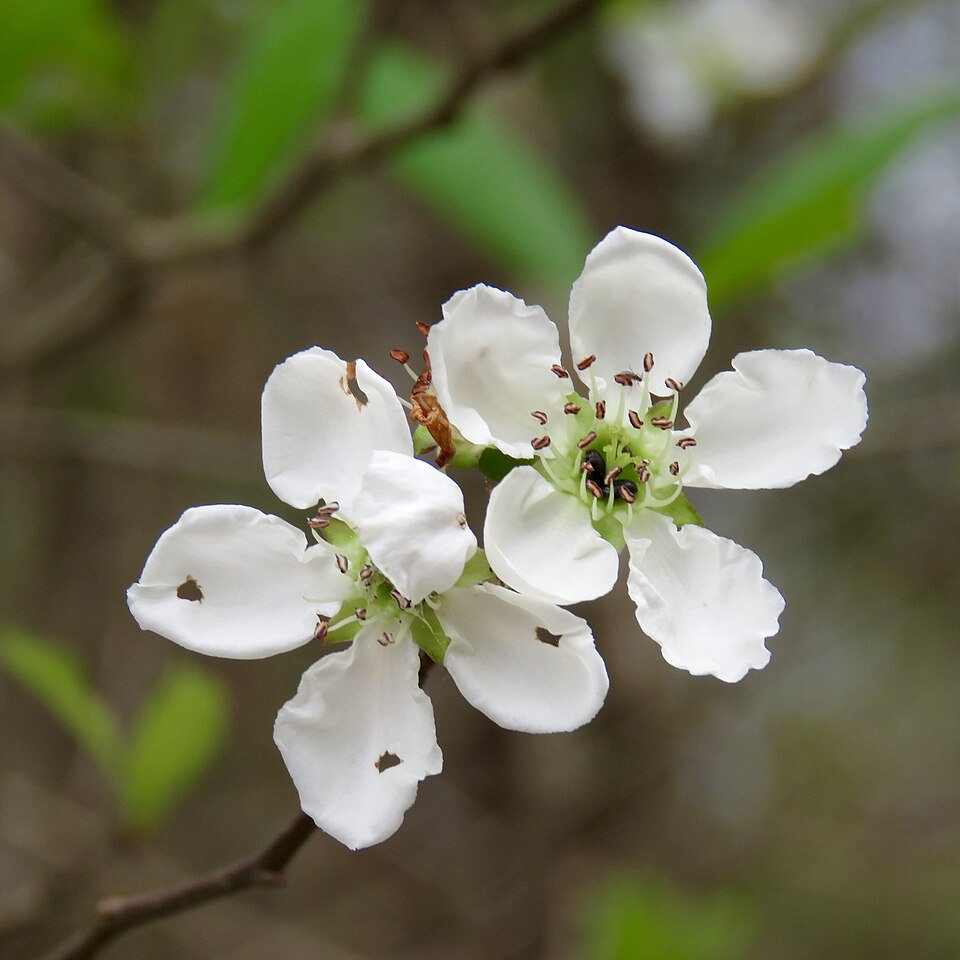
The flowers are produced in showy flat-topped clusters (corymbs) of 4–10 flowers each in February to early March — well before most competing flowers in the late-winter landscape. Each flower is ½ to ¾ inch across with 5 white petals, 20 or more stamens with pink anthers, and a mild, pleasant fragrance. The flower clusters cover the bare branches in a spectacular late-winter display that announces the beginning of spring in the Deep South.
The fruit is a small pome (like a tiny apple), ½ to ¾ inch in diameter, brilliant red to red-orange at maturity, ripening in April (hence “April haw” in some locales) to May. Each fruit contains 2–5 hard seeds. The flesh is white to pinkish, tart, and moderately sweet when fully ripe — excellent for jellies, syrups, wines, and other preserves that have deep cultural roots in Gulf South cuisine.
Quick Facts
| Scientific Name | Crataegus opaca |
| Family | Rosaceae (Rose) |
| Plant Type | Deciduous Small Tree |
| Mature Height | 35 ft |
| Sun Exposure | Full Sun |
| Water Needs | Moderate to High |
| Bloom Time | February – March |
| Flower Color | White |
| Fruit | Red pome, ½–¾ inch (ripens Apr–May; edible) |
| Special Features | Edible fruit prized for jelly; thorny wildlife thicket; flood tolerant |
| USDA Hardiness Zones | 6–9 |
Native Range
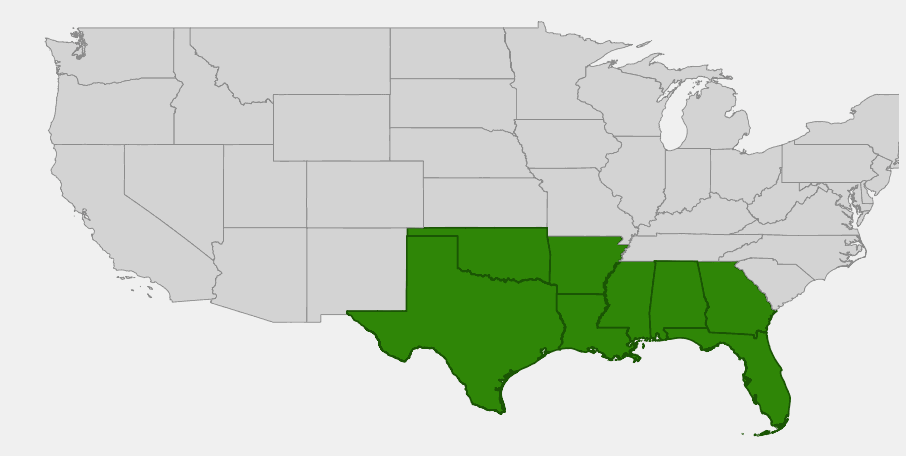
Mayhaw (Crataegus opaca) is native to the wet lowlands of the Deep South — a range tightly correlated with the bottomland hardwood forest and swamp systems of the Gulf Coastal Plain and adjacent interior lowlands. Its core range includes southeastern Texas, Louisiana, Mississippi, Alabama, Georgia, and the Florida Panhandle, extending north into Arkansas and Oklahoma along major river corridors. It is most abundant in the river swamps, backwater sloughs, and seasonally flooded bottomland forests of Louisiana, east Texas, and southern Mississippi, where it can form dense, thorny thickets along pond edges and bayou margins.
Within its natural range, Mayhaw grows along pond and lake margins, in river swamps and floodplains, at the edges of cypress-gum swamps, and in seasonally flooded bottomland hardwood forests. It tolerates and even thrives in seasonal flooding — growing in areas that may stand in water 6 to 12 inches deep for weeks each year. This tolerance for wet conditions combined with its requirement for full sun makes it a specialist of open swamp margins and forest clearings rather than the deep forest interior or dry uplands.
Mayhaw is considered a species of conservation interest in some Gulf states, as its preferred wet lowland habitat has been extensively drained, cleared, and converted to agriculture and development throughout the Gulf Coastal Plain. Commercial Mayhaw orchards established in several Gulf states now support the traditional jelly-making industry and reduce harvest pressure on remaining wild populations, but the wild trees remain an irreplaceable ecological resource in the swamps and bottomland forests of the Deep South.
📋 Regional plant lists featuring Mayhaw: Alabama, Georgia & Mississippi
Growing & Care Guide
Mayhaw is a relatively easy native tree to grow when sited in appropriate conditions — it needs adequate moisture and full sun above all else. Given these two requirements, it is vigorous, productive, and long-lived with minimal care. It is an excellent choice for wet, sunny areas of the garden that challenge most other trees.
Light
Full sun is essential for good flowering and fruit production. Mayhaw grown in shade produces minimal fruit and becomes leggy and structurally weak over time. Choose a site that receives at least 6–8 hours of direct sun daily. Open yard settings, pond edges, rain garden margins, and wet meadow borders are ideal locations.
Soil & Water
Mayhaw is best adapted to moist to wet, acidic soils — the kind found naturally in bottomland forest margins and swamp edges. It tolerates seasonal flooding exceptionally well and actually thrives in consistently moist or even periodically wet conditions. In home gardens, plant it in consistently moist areas: rain garden edges, low spots in the yard, pond margins, or areas with regular irrigation. It performs poorly in dry, well-drained upland soils without supplemental watering. Neutral to slightly acidic soil pH (5.5–7.0) is suitable.
Planting Tips
Plant container or bareroot stock in fall or early spring. Space trees 15–20 feet apart for a naturalistic grove or small orchard setting. Mulch generously with wood chips or leaf mulch to retain soil moisture. For maximum fruit production, plant at least 2 trees for cross-pollination — different cultivars or seedling-grown trees from different sources are ideal. Several named commercial cultivars including ‘Big Red’, ‘Super Spur’, and ‘Texas Super Berry’ are available from specialty native nurseries and produce superior fruit size and yield compared to wild seedlings.
Pruning & Maintenance
Minimal pruning is required for established trees. Remove dead wood and broken branches in late winter. Light thinning of the interior crown improves air circulation and reduces disease pressure. Wear thick gloves and protective clothing when pruning — the thorns are sharp and capable of causing serious puncture wounds. Fire blight can occasionally affect hawthorns during wet springs; prune out any infected branches below the visible infection point and disinfect tools between cuts.
Landscape Uses
- Edible native orchard — premier native fruit tree for traditional Mayhaw jelly and preserves
- Rain garden and wet margin planting — perfect for seasonally flooded areas
- Wildlife thicket anchor — dense thorny structure provides nesting and escape cover
- Pond and stream edge planting — attractive and ecologically functional at water margins
- Early spring ornamental — spectacular flower display in February–March
- Bottomland restoration — key species in Gulf Coastal Plain bottomland hardwood restoration
Wildlife & Ecological Value
Mayhaw is a wildlife powerhouse in the Deep South landscape. Its combination of early spring flowers, abundant nutritious fruit, and thorny defensive structure makes it one of the most ecologically valuable small trees in its native range.
For Birds
The April–May fruit crop attracts American Robins, Cedar Waxwings, Brown Thrashers, Gray Catbirds, Eastern Bluebirds, and numerous other fruit-eating songbirds during spring migration and breeding. The dense, thorny branching provides exceptional nesting habitat for Northern Cardinals, Northern Mockingbirds, Brown Thrashers, White-eyed Vireos, and other species that prefer well-protected nest sites. Mayhaw thorns deter nest predators effectively, making these thickets among the most productive nesting habitats in southeastern lowland landscapes. During winter, the structure provides important thermal and escape cover for year-round resident birds.
For Mammals
Raccoons, opossums, and foxes consume the fallen fruit. White-tailed deer browse tender shoots and leaves. The thorny thickets provide prime escape cover and bedding sites for deer, rabbits, and small mammals year-round. Bears consume fruit where their ranges overlap in the Deep South, and river otters occasionally forage at Mayhaw-lined pond edges.
For Pollinators
The February–March flowers are among the most important early-season nectar sources in the entire Deep South, blooming when virtually no other native trees or shrubs are yet in flower. Mayhaw provides critical late-winter nutrition for honeybees making their first spring foraging flights, early-emerging native bumblebee queens, and solitary bees. The abundant early pollen is also a vital protein source for bee populations building up their spring colonies. Mayhaw honey is prized as a regional specialty for its distinctive, delicate floral flavor.
Ecosystem Role
In its native bottomland habitat, Mayhaw plays a keystone role at the swamp-edge transition zone. Its early spring flowers are among the first major nectar sources of the year; its fruit feeds a wide range of wildlife during the critical spring migration period; its thorny thickets provide irreplaceable nesting and escape cover; and its root system helps stabilize wet soil at pond and stream margins. As a phenological anchor of the Deep South spring, Mayhaw sets off a cascade of ecological events that benefits the entire swamp-edge community.
Cultural & Historical Uses
Mayhaw holds a unique place in the foodways and culture of the Deep South that few native plants can match. The tradition of “mayhaw picking” — going out to the swamps and river bottoms in April and May with buckets and long-handled nets to harvest the floating fruit from flooded areas, or shaking and catching fruit from overhanging branches — is a beloved seasonal ritual in Louisiana, Mississippi, east Texas, and south Georgia. Families pass down mayhaw jelly recipes and harvesting traditions from generation to generation, and Mayhaw festivals (including the famous Mayhaw Festival in Colquitt, Georgia) celebrate this unique Southern heritage each spring.
The fruit was harvested by Indigenous peoples of the region long before European settlement. Muscogee (Creek), Choctaw, and other southeastern nations used the berries for food and in traditional preparations. As European and African American communities in the region developed their distinctive culinary traditions, Mayhaw jelly emerged as one of the defining specialty foods of the Gulf South. The jelly has a beautiful translucent red-to-pink color and a distinctive tart-sweet flavor described variously as resembling cranberry, quince, or a delicate rose-apple — unlike any other native fruit preserve.
Beyond food, Indigenous peoples used hawthorn wood — which is extremely hard and dense — for tool handles, digging sticks, and implements requiring exceptional durability. The thorny branches were used as natural defensive fencing and livestock barriers. Traditional healers used hawthorn bark and fruit preparations medicinally — consistent with the well-documented cardiovascular benefits of hawthorn compounds now recognized in modern herbal medicine. Today, commercial Mayhaw orchards in Louisiana, Texas, and Georgia produce jelly and syrup for markets throughout the region, preserving this unique Southern food tradition while reducing pressure on wild tree populations.
Frequently Asked Questions
What does Mayhaw jelly taste like?
Mayhaw jelly has a beautiful translucent rose-to-deep-red color and a distinctive flavor that is tart-sweet with floral and fruity notes — often compared to quince or cranberry jelly but with its own entirely unique character. It is considered one of the finest wild fruit preserves in American food culture, deeply prized throughout the Gulf South and increasingly sought by food enthusiasts nationwide.
Can Mayhaw grow in a regular yard or does it need a swamp?
Mayhaw can grow successfully in regular yard conditions if given adequate moisture and full sun. It does not require standing water — it simply tolerates it well. In a home garden, plant in a low spot, rain garden, or area that receives regular irrigation. Consistently moist but not waterlogged soil is ideal. In drier upland soils, it will need regular supplemental watering to thrive and produce good fruit crops.
How long until a Mayhaw tree produces fruit?
Grafted or container-grown Mayhaw trees from named cultivars typically begin bearing fruit within 2–4 years of planting. Seedling-grown trees may take 5–7 years to reach first fruiting. Named cultivars grafted onto vigorous rootstock tend to fruit earliest and most reliably. Established trees in good conditions can produce 10–30 pounds or more of fruit per season.
Are Mayhaw trees deer-resistant?
Established Mayhaw trees with well-developed thorns are somewhat deer-resistant, as the sharp thorns deter browsing on the main branches. However, young transplants without mature thorns may be browsed. Deer will readily eat the fruit and can reach lower leaves and young growth. Once a Mayhaw thicket develops dense thorny structure, it provides more browsing protection than most shrubs.
Can you pick Mayhaws while they are floating in water?
Yes — the traditional Mayhaw harvest often involves wading into flooded areas with long-handled nets or wire scoops to collect ripe berries that have fallen into the floodwaters. The buoyant fruit floats and can be scooped up efficiently in large quantities. This “float harvest” technique is part of the beloved cultural tradition of mayhaw picking in the Gulf South, passed down through generations of Southern families.

Looking for a nursery that carries Mayhaw?
Browse our native plant nursery directory: Alabama · Georgia · Mississippi