Texas Persimmon (Diospyros texana)
Diospyros texana, commonly called Texas Persimmon (also Mexican Persimmon or Black Persimmon), is a small, slow-growing native tree of the Edwards Plateau, South Texas Plains, and Trans-Pecos. It is one of the most recognizable small trees of the Texas Hill Country, prized for its smooth, pale gray-to-white peeling bark that looks almost sculpted, its tidy rounded leaves, and its dark, grape-sized fruit that ripens black in late summer. Unlike its larger eastern cousin, common persimmon (Diospyros virginiana), Texas Persimmon stays compact, drought-hardy, and well suited to rocky, alkaline soils where few other small trees thrive.
Texas Persimmon is dioecious — individual plants are either male or female, and only female trees bear fruit. In the wild it grows as an understory or edge species in oak-juniper woodlands, along limestone outcrops, and in dry washes, where its dense, twiggy crown offers shade and cover. Established plants are remarkably drought tolerant, needing no supplemental water once rooted, which makes this tree a dependable choice for xeriscaping and wildlife gardens across its native range.
Identification
Texas Persimmon typically grows as a many-trunked large shrub or small tree, usually 10 to 25 feet tall, though it can reach 40 feet on the best sites in deep soil. Most landscape and wild specimens stay under 20 feet, with an irregular, rounded crown about as wide as it is tall. Growth is slow, which is part of why old specimens with thick, sculptural trunks are so valued in Hill Country gardens.
Bark
The bark is the tree’s signature feature: smooth and thin, it exfoliates in thin flakes to reveal a patchwork of gray, white, and pink-toned new bark underneath. On mature trunks this peeling creates a mottled, almost camouflage-like pattern that stays attractive through all seasons, including winter when the tree is bare.
Leaves
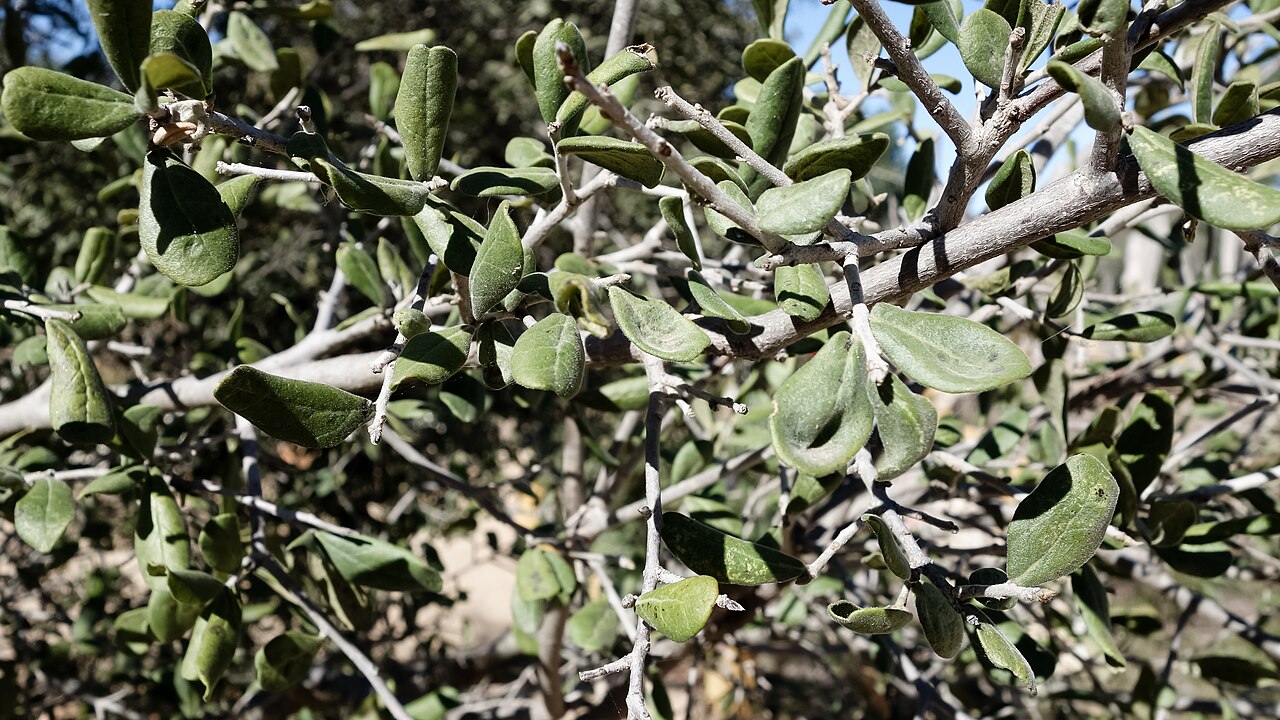
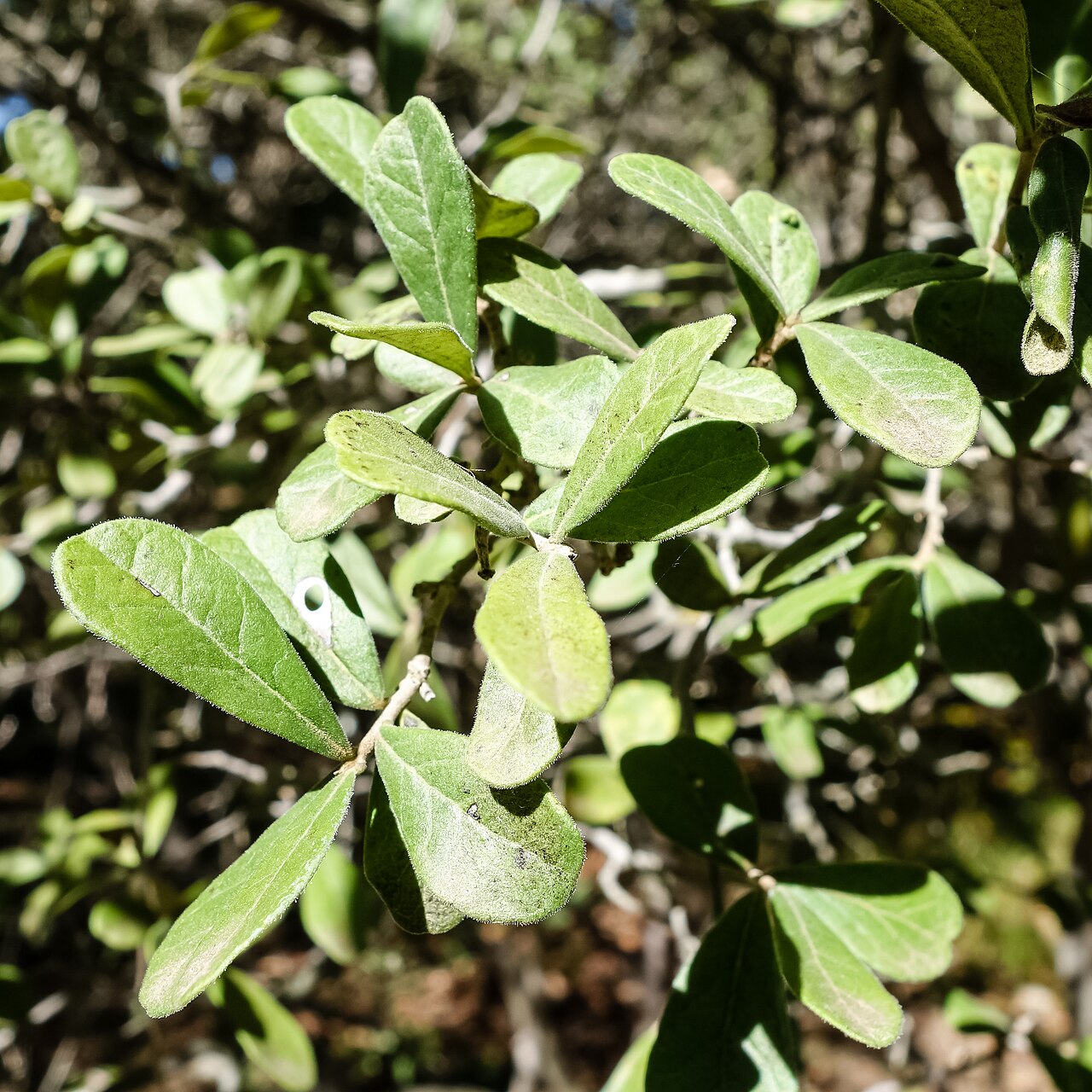
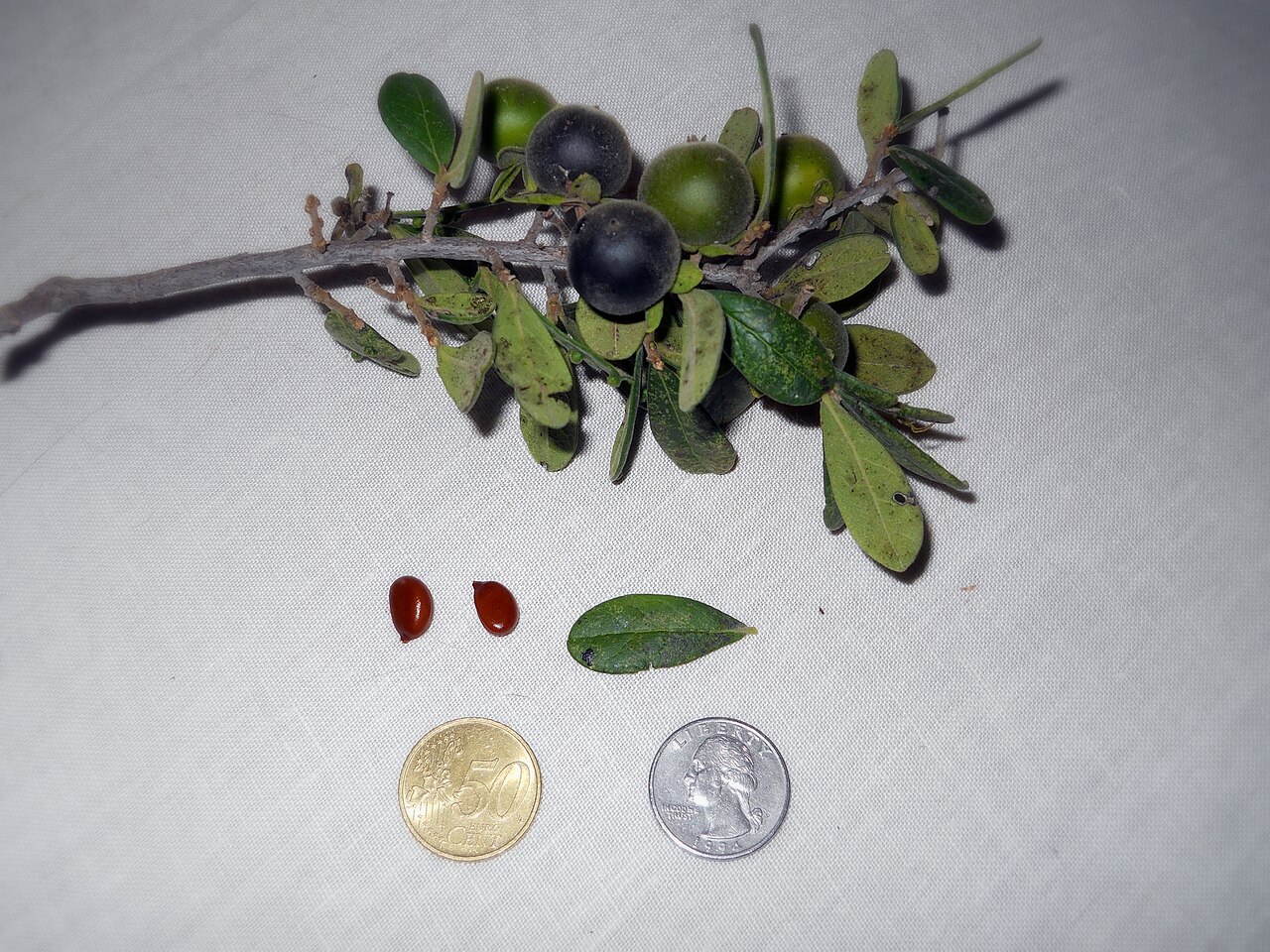
Leaves are simple, alternate, and small — typically ¾ to 2 inches long — with an oval to spoon-like shape, a blunt or slightly notched tip, and a leathery texture. New growth is often covered in fine, soft hairs that give young leaves a grayish-green, velvety look, while mature leaves are a dull dark green above and paler beneath. The species is deciduous in its northern range but may hold leaves later into winter farther south, and in some years is nearly evergreen in South Texas.
Flowers & Fruit
Small, bell-shaped, creamy white flowers appear in spring, usually March through May, before or alongside the new leaves. Male flowers cluster in small groups and are lightly fragrant; female flowers are borne singly and are slightly larger. Only female trees produce fruit, round black-skinned berries about ¾ to 1 inch across that ripen from July into September. The flesh is dark purple-black, sweet, and juicy when fully ripe, surrounding several flattened seeds.
Quick Facts
| Scientific Name | Diospyros texana |
| Family | Ebenaceae (Ebony) |
| Plant Type | Deciduous Tree / Large Shrub |
| Mature Height | 10–25 ft (occasionally to 40 ft) |
| Growth Rate | Slow |
| Sun Exposure | Full Sun to Part Shade |
| Water Needs | Low once established |
| Soil Type | Rocky, limestone, caliche, well-drained |
| Soil pH | Alkaline preferred |
| Bloom Time | March – May |
| Flower Color | Creamy white |
| Fruit | Black, rounded, ¾–1 in., ripens July–September (female trees only) |
| Deer Resistant | Moderate (leaves occasionally browsed) |
| USDA Hardiness Zones | 7–9 |
Native Range
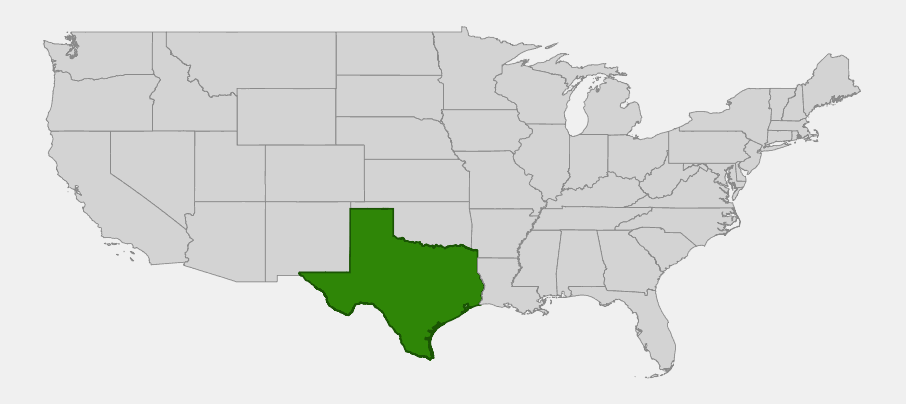
Texas Persimmon is native to central, south, and west Texas — including the Edwards Plateau (Hill Country), South Texas Plains, and the Trans-Pecos — and extends south into the Mexican states of Chihuahua, Coahuila, Nuevo León, and Tamaulipas. Within the United States it is found only in Texas; it is not native to Oklahoma or any other U.S. state, despite occasionally being described in older nursery literature as extending into neighboring states. BONAP county-level records confirm the native distribution is concentrated in the southern, central, and western thirds of Texas.
In the wild, Texas Persimmon grows on dry limestone hills, in oak-juniper woodlands, along rocky canyon slopes, and in brushland of the South Texas Plains. It tolerates thin, rocky soils that would stunt or kill many other small trees, and it is frequently found growing alongside Texas live oak, Ashe juniper, agarita, and various species of sumac.
📋 Texas Persimmon does not yet have a matching Plant Native regional list for its south/central/west Texas range.
Growing & Care Guide
Texas Persimmon is one of the toughest small native trees for Texas gardens, asking for very little once it is established. Its main requirements are good drainage and full sun to light shade — beyond that, it is remarkably forgiving.
Light
Plant Texas Persimmon in full sun for the densest, most compact form and best fruit production on female trees. It also tolerates part shade, especially as an understory tree beneath taller oaks, where it grows slightly more open and upright reaching for light.
Soil & Water
This species is naturally adapted to thin, rocky, alkaline soils, including caliche and limestone-derived ground that frustrates many other landscape trees. Good drainage is essential; it does not tolerate wet feet or heavy clay that stays saturated. Water young trees regularly during their first one to two summers to establish a deep root system, then taper off — mature trees need little or no supplemental irrigation even through extended Texas droughts.
Planting Tips
Set out container-grown trees in fall or late winter so roots can establish before summer heat arrives. Because the species is dioecious, buy a tree already identified as female if fruit production for wildlife or home use is a goal; otherwise either sex works fine as an ornamental. Give it room — mature specimens can spread 15 to 20 feet wide — and avoid working soil or mulch up against the trunk, which can damage the thin, easily bruised bark.
Pruning & Maintenance
Texas Persimmon needs very little pruning. Remove dead or crossing branches in late winter while dormant, and resist the urge to prune heavily, since the species grows slowly and recovers gradually from large cuts. Many gardeners choose to limb up a young multi-trunked specimen over several years to showcase the attractive peeling bark as a specimen tree.
Landscape Uses
Texas Persimmon’s small size, drought tolerance, and sculptural bark make it valuable in many garden settings:
- Specimen tree where its peeling bark can be seen and appreciated year-round
- Xeriscaping and low-water native plant gardens
- Wildlife gardens — fruit on female trees feeds birds and mammals
- Hill Country and rock gardens, planted directly into thin limestone soils
- Understory planting beneath live oak or other shade trees
- Screening or informal hedgerow when planted in groups
Wildlife & Ecological Value
Texas Persimmon is an important food source in the dry woodlands and brushlands where it grows, especially in late summer when little else is fruiting.
For Birds
Mockingbirds, cardinals, jays, and many other songbirds eat the ripe black fruit from female trees, helping disperse the seeds across the landscape. The dense, twiggy branching also offers good nesting cover and protection from predators.
For Mammals
Raccoons, foxes, coyotes, and deer all consume the fallen fruit, and white-tailed deer will browse the foliage of young plants, particularly where deer densities are high. Small mammals use the dense thicket-like growth of multi-trunked specimens as cover.
For Pollinators
The small, fragrant spring flowers attract native bees and other pollinating insects at a time of year when many Hill Country plants have not yet bloomed, making Texas Persimmon a useful early-season nectar source.
A Note on the Fruit
Fully ripe, soft black fruit from female Texas Persimmon trees has long been eaten fresh off the tree in its native range, though it is tannic and astringent until fully soft and dark, much like other persimmons. Unripe green or firm fruit is strongly astringent and unpleasant. In the landscape, the fruit is primarily valuable for the wildlife it supports rather than as a garden food crop, since fruiting is limited to female trees and ripening is uneven. Heavy fruit drop can also stain patios, walkways, and parked cars, which is worth considering when siting a female tree near hardscape.
Frequently Asked Questions
Do all Texas Persimmon trees produce fruit?
No. The species is dioecious, meaning individual trees are either male or female, and only female trees bear fruit. Male trees still flower and support pollinators but never produce berries.
Is Texas Persimmon fruit safe to eat?
Fully ripe, soft, black fruit is edible and has traditionally been eaten fresh in its native range, but unripe fruit is highly astringent. As with any wild fruit, be certain of identification and ripeness before eating, and be aware the fruit can stain hands, clothing, and hardscape.
How fast does Texas Persimmon grow?
It is a slow-growing tree, often adding well under a foot per year, which is part of why mature specimens with thick, sculptural trunks are so highly valued in Hill Country landscaping.
Is Texas Persimmon native to Oklahoma?
No. Despite occasional mentions in general plant guides, current BONAP and Flora of North America records place its native range within Texas and adjoining northeastern Mexico only.
Can Texas Persimmon handle clay soil?
It prefers rocky, well-drained, alkaline soils and struggles in heavy clay that stays wet. If your soil is dense clay, improve drainage or choose a raised planting area.

Looking for a nursery that carries Texas Persimmon?
Browse our native plant nursery directory: Texas