
Texas Stillingia (Stillingia texana)
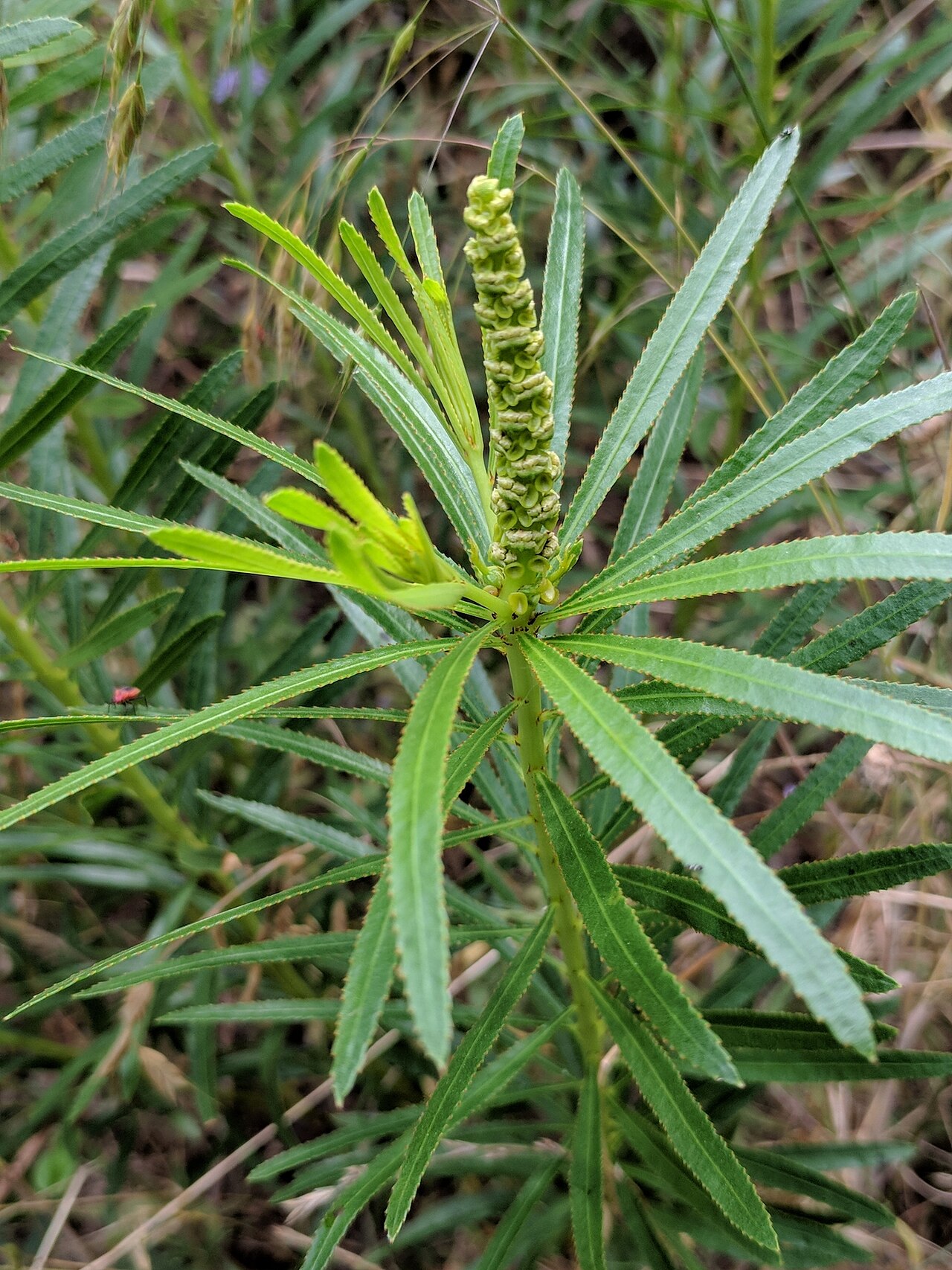
Stillingia texana, known as Texas Stillingia (USDA: Texas toothleaf; also Texas queen’s delight), is a tough, deep-rooted perennial of dry limestone prairies and hillsides, centered in central and north-central Texas. It belongs to the spurge family (Euphorbiaceae) and is a close relative of queen’s delight (Stillingia sylvatica); some botanists have treated it as a variety of that species.
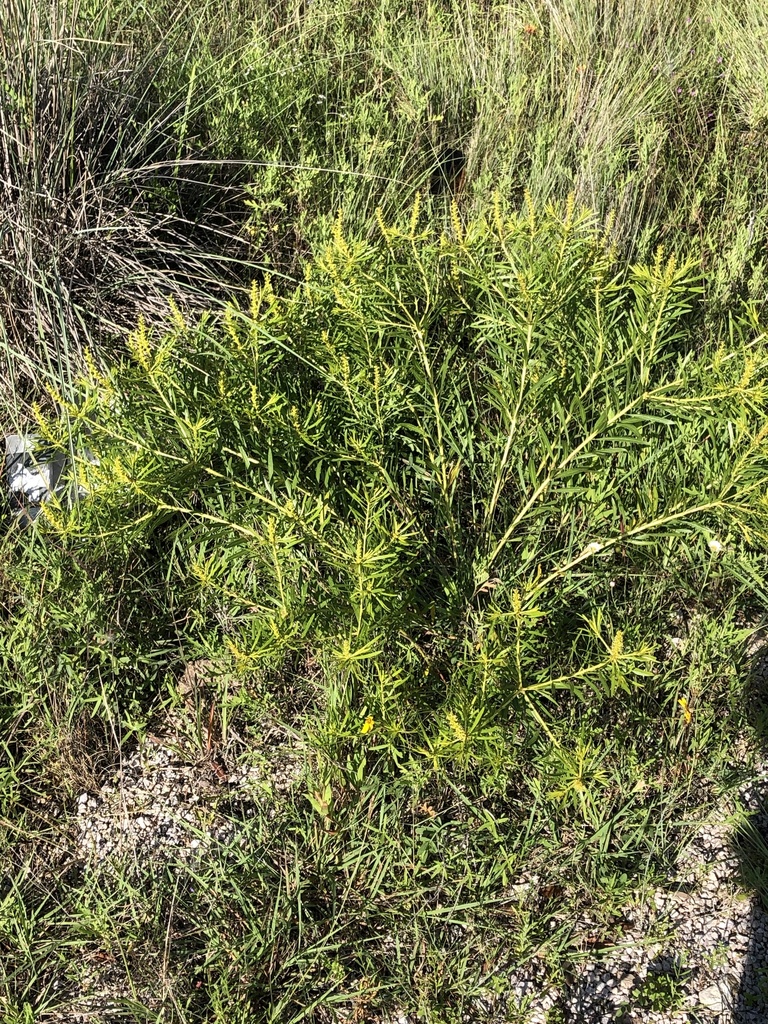
Each spring many leafy stems rise 1 to 2 feet from a thick, woody taproot, forming a rounded, bushy clump. The leaves are narrow, willow-like and finely toothed. From spring through late summer, the stems end in slender spikes of tiny yellow-green flowers, followed by small, three-lobed green capsules. In fall the leaves and stems often turn yellow, orange and red.
Like most spurges, the plant has milky sap that can irritate skin and eyes, and it should not be eaten. Texas stillingia is a durable, drought-tolerant plant for native prairie and Hill Country gardens, valued more for its fine texture, bushy form and fall color than for its small flowers.
Identification
Look for a bushy clump of many upright stems crowded with narrow, finely toothed leaves, topped by slender yellow-green flower spikes, growing on dry, rocky or limestone soils. Break a leaf and the sap is milky.
Growth Habit
Texas stillingia is a herbaceous perennial that dies back to a thick, woody taproot each winter. Mature plants produce many unbranched or few-branched stems from the crown, forming a rounded clump 1 to 2 feet tall and about as wide. The whole plant is smooth and hairless.
Leaves
Leaves are alternate and crowded on the stems, narrowly lance-shaped to linear, about 1 1/2 to 4 inches long and 1/8 to 1/2 inch wide, with finely toothed (serrulate) edges that give the plant its USDA name, toothleaf. They are bright to bluish green and contain milky latex.
Flowers
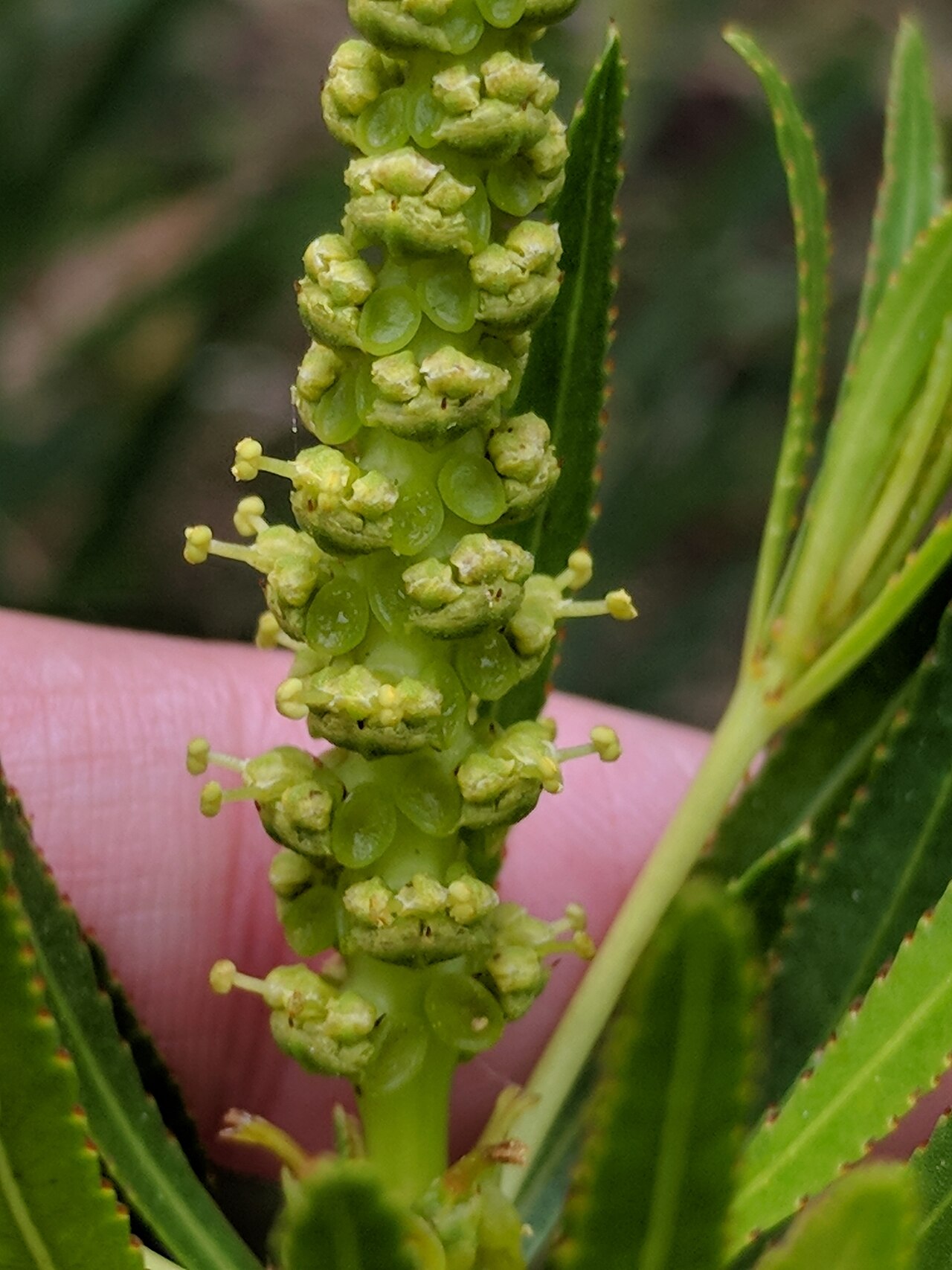
Flowers appear from about April to September in a slender spike 2 to 4 inches long at the tip of each stem. The spike is covered with clusters of tiny male flowers, each cluster set above a small bract with a pair of yellowish glands, which gives the spike its yellow-green color. One to a few female flowers sit at the base of the spike. There are no showy petals.
Fruit & Seeds
Female flowers develop into a three-lobed capsule about 1/3 inch across, which splits explosively when ripe to throw out three smooth, gray-brown seeds. After the capsule opens, a distinctive three-pointed woody base (the gynobase) remains on the stem.
Look-alikes
Queen’s delight (Stillingia sylvatica) is very similar but usually has broader, elliptic leaves and grows mostly on sandy soils farther east and south. Texas stillingia’s narrow, linear leaves and preference for limestone soils set it apart. Some narrow-leaved crotons and spurges look similar at a glance but have star-shaped hairs or different flower clusters.
Safety Notes
The milky sap contains compounds that can irritate skin and eyes, and the roots and other parts are considered toxic if eaten. Wear gloves when cutting or dividing the plant, keep the sap away from your eyes, and do not let children or pets chew it. Livestock usually avoid it.
Quick Facts
| Scientific Name | Stillingia texana |
| Family | Euphorbiaceae (spurge family) |
| Plant Type | Herbaceous perennial with a woody taproot |
| Mature Height | 1–2 ft |
| Mature Spread | 1–2 ft |
| Growth Rate | Moderate |
| Sun Exposure | Full sun to part shade |
| Water Needs | Low; very drought tolerant once established |
| Soil Type | Dry, well-drained, rocky or calcareous soils |
| Soil pH | About 7.0–8.5 (neutral to alkaline) |
| Bloom Time | April–September |
| Flower Color | Yellow-green |
| Fall Color | Yellow, orange and red |
| Fruit | Three-lobed capsule with three seeds |
| Deer Resistant | Yes; milky sap deters browsing |
| USDA Hardiness Zones | 7–9 |
Native Range
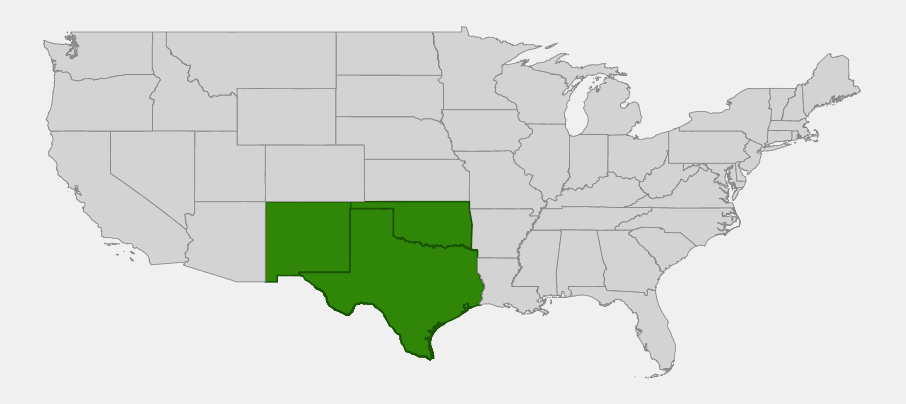
Texas stillingia is a plant of the southern Great Plains. USDA PLANTS lists it as native in Texas, Oklahoma and New Mexico. In Texas, the Lady Bird Johnson Wildflower Center describes it as growing throughout the state on dry, calcareous soils of fields and hillsides, and it is especially common on the Edwards Plateau (Hill Country), the Grand Prairie and Cross Timbers, and the Blackland Prairie around Dallas and Fort Worth, with records west into the Rolling Plains.
In Oklahoma it is known from relatively few records in the southern part of the state, and New Mexico records are few and outlying, at the western edge of its range. It is not a plant of the sandy pine and hardwood forests of far East Texas, where its relative queen’s delight is more common.
Typical habitats are limestone prairies and hillsides, rocky openings in juniper and oak woodlands, roadsides, old fields and caliche slopes, nearly always on dry, well-drained, alkaline soils.
📋 Regional plant lists featuring Texas Stillingia: South & West Texas
Growing & Care Guide
Texas stillingia is easy in hot, dry, sunny sites with lean, well-drained soil. Its deep taproot makes it extremely drought tolerant but hard to transplant once established, so start with small container plants or seed.
Light
Plant it in full sun for the densest, most colorful plants. It tolerates part shade but becomes looser and flowers less.
Soil & Water
It needs well-drained soil and does best in rocky, limestone, caliche or gravelly soils. Avoid heavy, wet clay and irrigated beds. Water during the first summer; after that it seldom needs watering except in extreme drought.
Planting Tips
Plant small container plants in fall or early spring, about 18 to 24 inches apart. Use it in prairie and meadow plantings, dry borders, rock gardens and roadside or slope plantings, with native grasses and wildflowers. Keep it away from paths where children might break stems and get sap on their hands.
Pruning & Maintenance
Little care is needed. Cut the dead stems back to the ground in late winter. Wear gloves and eye protection when cutting, because of the milky sap. It is long-lived once established and rarely needs dividing.
Propagation
Grow it from fresh seed sown outdoors in fall, or in pots after a cold, moist stratification of a month or two. Seedlings quickly form a taproot, so transplant them while small. Large established plants do not move well.
Landscape Uses
- Prairie and meadow plantings: fine texture and fall color among grasses
- Hill Country gardens: for rocky, limestone soils and full sun
- Xeriscapes: very drought-tolerant once established
- Deer-resistant borders: rarely browsed thanks to its milky sap
- Restoration: native component of limestone prairie and savanna
Wildlife & Ecological Value
Texas stillingia supports insects and birds in dry prairies and open woodlands, even though its flowers are small.
For Pollinators
The nectar glands on the flower spikes attract small bees, wasps, flies and ants over a long season, from spring through late summer.
For Birds
Seed-eating birds such as quail and doves may eat the seeds that the capsules throw onto the ground, and insects on the plant feed insect-eating birds.
For Mammals
Deer and livestock generally avoid it because of the irritating milky sap. Its deep roots help it survive grazing and fire.
Ecosystem Role
As a long-lived, deep-rooted perennial, Texas stillingia helps hold thin, rocky soils on slopes and returns quickly after fire or mowing. It is a characteristic plant of the limestone prairies and savannas of central Texas.
Cultural & Historical Uses
The genus Stillingia was named by Alexander Garden and Linnaeus for Benjamin Stillingfleet, an 18th-century English naturalist and writer. The species name texana refers to Texas, the heart of its range. The plant was described by the American botanist Ivan M. Johnston.
Its eastern relative, queen’s delight (Stillingia sylvatica), has a long history in American folk medicine, and its root was once listed in pharmacopeias as a strong purgative. Those uses are not safe: the sap and roots of stillingias are irritating and toxic, and they should not be used as home remedies.
Today Texas stillingia is appreciated by native plant gardeners and prairie restorationists in Texas for its durability, fine-textured foliage and fall color. It is offered by some Texas native plant nurseries and seed suppliers.
Frequently Asked Questions
Is Texas stillingia poisonous?
Yes, it should be treated as toxic. The milky sap can irritate skin and eyes, and the plant should not be eaten by people, pets or livestock. Wear gloves when cutting it.
What is the difference between Texas stillingia and queen’s delight?
Texas stillingia has narrow, linear leaves and grows on dry limestone soils in central and north-central Texas. Queen’s delight (Stillingia sylvatica) has wider leaves and usually grows on sandy soils farther east and south.
Does Texas stillingia need water?
Very little. Water it during its first summer; after that it survives on rainfall in most of its range.
Can I transplant an established Texas stillingia?
It is difficult because of its deep, woody taproot. Plant small container plants or seed instead.
Does it have fall color?
Yes. In autumn the leaves and stems often turn yellow, orange or red before the plant dies back for winter.

Looking for a nursery that carries Texas Stillingia?
Browse our native plant nursery directory: New Mexico & Oklahoma · Texas